Thursday, April 12, 2012

EARTH ~


Tamarack


EARTH ~


back road chalkie
photo © bob arnold


Wednesday, April 11, 2012

Tuesday, April 10, 2012

EARTH ~


Jane and Paul Bowles, New York, 1944


PAUL BOWLES, HIS LIFE
previously unpublished journal, 1986


The first sky he saw was the sky above New York.

Winters it snowed. The school was dark.

There was a song which went: "When you come back, if you do come back."

It was addressed to the American soldiers in France.

There was a day when the children paraded in the street.

They sang "Marching through Georgia", a song of victory from the Civil War.

Now it celebrated a different victory.

Kaiser Wilhelm would no longer haunt the children's dreams.

Summer meant sunshine and lakes and crickets.

The peaches dropped to the ground and were speared
by the stubble.

A day was invisible, had no hours.

The dark brought the voices of the night insects.

But school went on for many years. Discipline was strict.

The idea of escape took root and grew.

A night with thunder in the sky he packed his bag and left.

The S.S. Rijndam was old and slow. This was its last voyage.

Passengers for Boulogne went ashore in a dinghy,
rocked by the waves.

At dawn the empty streets of Paris were clean and shining.

This was fifty-seven years ago. Things are different now.

The excitements of Paris: Le Cafe du Dome, La Mosquee.

Le Theatre du Grand Guignol, el Bal Negre de la Rue Blomet.

He worked for forty francs a week, and sometimes was hungry.

Then a girl he'd known from childhood came through Paris
and saved him.

He wandered on the Cote d'Azur, in Switzerland.

And along the paths of the Schwarzwald.

He was happy, and he wrote words which he imagined made poems.

That winter in New York Aaron Copland told him: You should
become a composer.


It will be difficult, he thought, but why not try?

Soon he was in Paris again. He admired Gertrude Stein.

She told him he was not a poet, so he stopped trying to be one.

This meant that he devoted himself only to music.

Miss Stein did not like the music either.

In Hanover he stayed with Kurt Schwitters.

He went with him to the city dumping ground

And they collected material for the Merzbau.

In Berlin he wrote music, and people shouted; Fenster zu!

In Paris they cried: Fermez la fenetre!

In Tangier only Copland and the cicadas could hear him.

In the Sahara he fell in love with the sky

And knew that he would keep returning there.

In the spring he was in Agadir, where the food was not clean.

The doctors in Paris told him he had typhoid fever.

He lay for a month in the hospital. His mother came from New
York.

When he was well they went to Spain and to Monte Carlo.


Winter came. He wanted the desert.

He took a house outside the oasis of Ghardaia.

He went to Tunisia on the back of a camel.

In Tunis he learned that he had no money.

Frank D. Roosevelt had closed the banks. The dollar was not
negotiable.

Friends in France wired him francs.

He arrived in Tangier with his python skin and seventeen
jackal pelts.

He knew he must return to America, but first he sailed to
Puerto Rico.

That way he stayed outside the cage a little longer.

In New York he thought only of Morocco.

Like a convict planning a prison break he presented his escape.

And summer found him sailing toward the east. he stayed in
Fez this time.

And though his parents awaited him in New York

He went to South America to see how it looked.

The forests and the mountains delighted him, but he did not stay.

He was in California writing music. He was in New York
writing music.

Orson Welles wanted music for two plays, and he provided it.

Kristians Tonny and his wife arrived in New York.

Jane Auer appeared on the scene, and the four set out for Mexico.

The day after they arrived in Mexico City Jane disappeared.

Much later they heard she had gone to Arizona.

After a few months they went on to Guatemala. It was very fine.

He hurried to New York to orchestrate his first ballet.

He took Jane Auer to hear it played by the Philadelphia
Orchestra.

Soon Jane Auer became Jane Bowles.

With too much luggage they boarded a Japanese ship
and went southward.

Then they were in Guanacaste with the monkeys and parrots

And they carried a parrot with them from Costa Rica
to Guatemala.

They were on the Cote d'Azur when Chamberlain visited
Munich.

They were in New York when Hitler marched eastward.

He was writing music for theater and film directors

And Jane was writing a novel.

They decided to go and live in Mexico. The hacienda
was ten thousand feet up.

When he had to fly to New York to work, Jane stayed behind.

The rooming-house where they lived that winter was run by
the poet Auden.

At half past six each morning Jane met the poet in the
dining-room.

Jane was a friend of Thomas Mann's daughter Erika.

And Auden had married her. They had things to talk about.

Soon they were back in Mexico. He was composing a zarzuela.

And Jane was writing a novel.

One day she came to the end of it.

The next day the Japanese bombed Pearl Harbor.


They went to Tehuantepec and listened to the marimbas.

He was still working on the zarzuela. He was also writing a
second ballet.

They went to New York and he became a music critic.

Jane's novel was published and Leonard Bernstein conducted
the zarzuela.

He went to Mexico and admired the new volcano Paricutin.

The Belgian Government-in-Exile commissioned music for a
film on the Congo.

Collaborating with Salvador Dali, he wrote a third ballet.

Then he began to write short stories, and grew tired of writing
theater music.

He went to Cuba and El Salvador. Jane was writing a play.

He stopped being a music critic, but continued to write music
for Broadway.

One night he dreamed he was in Morocco. The dream made
him very happy.

A publisher commissioned him to write a novel.

He decided to leave New York and go back to Morocco.

In Fez he began to write The Sheltering Sky.

He continued to write it as he moved here and there in the
Sahara.


He met Jane in Tangier and took her to Fez.

A stream rushed by under their windows as they worked.
He finished his novel.

He had already written music for Tennessee Williams' first
Broadway success.

He was not surprised to learn that Tennessee wanted him for
another play.

He went to New York and wrote the score.

After the opening he took Tennessee back to Morocco with him.

The weather was bad, and Tennessee stayed less than a month.

He and Jane were living at the Farhar in Tangier.
Truman Capote arrived.

For six weeks he amused them at mealtimes.

There were many parties and picnics.

Jane worked in her cottage, but he did not know what she was writing.

He was chagrined to hear that the publishers did not want his book.

We expected a novel, they said, and this is not a novel.

So it was published first in London.


They went to England and stayed a few weeks in Wiltshire.

Jane wanted to spend the winter inParis. He decided on Sri Lanka.

On the ship he started a novel about Tangier.

He went to stay on a tea plantation in the hills.

Where leopards hid behind rocks and carried off the dogs.

He took a boat across to Dhanushkodi in India.

India was hotter than Sri Lanka. He worked on his novel.

When he arrived in Paris, Jane was not ready to leave.

He was making an opera out of Garcia Lorca's Yerma.

This was for Libby Holman. They spent a month together in Andalusia.

Autumn in Fez. Winter and spring in the Sahara.

Jane wanted to return to Morocco.

He drove to the French frontier and picked her up.

But she liked Spain so much that they spent a month there.

She finished her play and went to New York.

He finished his novel and went to Bombay.

The Indian railways had suffered in the past two years.

In South India he was put into a screening camp.

Along with twenty thousand Tamils caught while trying to
escape to Sri Lanka.

But although they were here for months and years.

He got out after two days, and went to Sri Lanka.


In midsummer he was in Venice. he was in Madrid when a
wire came from Ceylon.

It was possible now to buy a small island off the coast of
Sri Lanka.

He bought it and went to New York to write music for Jane's play.

In the summer he was in Rome, working on a film for Visconti.

He did not know what he was doing, but he did it anyway.

That winter in Tangier, while he had paratyphoid, William Burroughs
came to see him.

It was a year before they got to know one another.


In the summer he started to write a third novel, this one about Fez.

It was half finished when he and Jane sailed

To pass the winter on Taprobane, the island off the coast of Sri Lanka.

Jane was not well. She was not happy there.

After two months she returned to Tangier.

He finished his novel and took a cruise to Japan.

Then he went back to Tangier and continued his work on the
Garcia Lorca opera.

His parents came to visit him. They enjoyed Morocco.
He was surprised.

He thought about his island, and decided to go to Sri Lanka and sell it.

The Suez Canal was blocked. He had to go via Cape Town.

He passed the winter at Taprobane and set sail for Mombasa.

While he was in Kenya Jane suffered a stroke.

He took her to England to be examined.

The doctors could do nothing, and they returned to Tangier.

Soon she became worse and had to go to London again.
It was a bad time.

In Madeira her health grew worse. She was obliged to go to
New York.

Tennessee, who loved her, came from Florida to meet her at
the airport.

The Garcia Lorca opera was produced. It was not a success.

Libby Holman had worked very hard, but there was no director.

He and Jane went back to Tangier. But then a telegram came from Tennessee.

Saying he needed music for a new play.

He sent him the script for Sweet Bird of Youth.

Part of the music was written in Tangier and part on the
New York-bound ship.

The Rockefeller Foundation gave him a grant to record music
in Morocco.

He spent six months taping music in the mountains, the desert
and the city.

The following year he began to tape Moroccan story-tellers.

Jane seemed to be better, but she still could not see to work.


He took Allen Ginsberg to Marrakesh.

But they arrived the day the Medina burned.

The smoke from the bazaars and souks was heavy in the air.

Jane's health was now less good. They went twice to America,
saw their parents.

Consulted doctors who might be of use. But no doctors could
be of use.

In Tangier on the Monte Viejo he wrote his fourth novel.

He began to translate what Mohammed Mrabet recorded.

A publisher asked him to write a book about cairo.

He did not want to do it, so he playfully suggested Bangkok.

The publisher agreed. He went to Bangkok via Panama.
He was appalled.

You have arrived fifteen years too late, everyone told him.

The trees were gone. The klongs has been filled in.
The air was foul.

After four months the Thai authorities forced him to leave.

In Tangier he found that Jane needed to be hospitalized.

He took her to Spain.

Then he agreed to go to California to teach.

He told his students that he was not a teacher and could not teach.

They laughed, thinking he was eccentric.

After the first semester he returned to Morocco.

Jane begged to be taken back to Tangier. The doctors advised
against it.

Nevertheless he took her back with him because she was so unhappy.

It was a disaster. She would not eat, and grew weak and thin.

He admitted defeat and returned her to the hospital in Spain.

She remained there. She died there. Her grave is unmarked.

After that it seemed to him that nothing more happened.

He went on living in Tangier, translating from Arabic, French
and Spanish.

He wrote many short stories, but no novels.

There continued to be more and more people in the world.

And there was nothing anyone could do about anything.


from TRAVELS
Collected Writings
1950-1993
(Ecco)


Monday, April 9, 2012

EARTH ~


Richard Brautigan


FOR FEAR YOU WILL BE ALONE


For fear you will be alone
you do so many things
that aren't you at all.


"GOOD WORK," HE SAID, AND


"Good work," he said, and
went out the door. What
work? We never saw him
before. There was no door.


SEXUAL ACCIDENT


The sexual accident
that turned out to be your wife,
the mother of your children
and the end of your life, is home
cooking dinner for all your friends.


THE AMELIA EARHART PANCAKE


I have been unable to find a poem
for this title. I've spent years
looking for one and now I'm giving
--------up.

-----------------November 3, 1970


MARCH 18, RESTING IN THE MAYTAG

HOMAGE


Looking out a hotel window
it's snowing in New York with
great huge snowflakes like millions
of transparent washing machines swirling
through the dirty air of this city, washing
--------it.


WE ARE IN A KITCHEN


We are in a kitchen
in Santa Fe, New Mexico.
Some bacon is frying.
It smells like a character
that you like in a good movie.
A beautiful girl is watching
-------the bacon.


THE LAST SURPRISE


The last surprise is when you come
gradually to realize that nothing
--------surprises you any more.


1 / THE CURVE OF FORGOTTEN THINGS


Things slowly curve out of sight
until they are gone. Afterwards
-------only the curve
-------remains.


RICHARD BRAUTIGAN
from Loading Mercury With A Pitchfork
(Simon and Schuster 1976)


Richard Brautigan was born in Tacoma Washington on January 30, 1935.
He died of a self inflicted wound some time in the autumn of 1984 in Bolinas California.
The date isn't precise because the body stayed unknown for awhile.
If a 'note' was left it was cryptic but the author wasn't ~
when asked how to pronounce his name he often said,
"Richard Brought A Gun".
Zillions tried to write like him, but none as well.


http://blogs.westword.com/showandtell/2012/04/qa_richard_brautigan_william_g.php


In this monster biography of Brautigan I've reached page 100, with 800 microscopic type size pages to go. He's already killed himself, born himself, raised himself, left home and all behind as if the genuine orphan, and has landed in "Frisco". Now the tale begins. I adored all his books when I came upon them in 1968 and that lasted for about 10 years. Watermelon Sugar was sweet to the tongue in 1970. Let's not forget 1970. Sweetheart saw him read in Santa Barbara at the same time, and since Brautigan didn't drive, we're now thinking K. may have driven him down. At age 76 (in May) K. will still get up and drive at the drop of a hat, or a dare.


Sunday, April 8, 2012

Sunday, April 8, 2012

Bob Arnold: Forever

Cover of Bob Arnold's Forever


Two little beauties from Bob Arnold's new tiny little booklet, Forever. The handmade paper cover, delightful photos, illustrations and fine poems comprise a production any small press maven might envy (and collector might covet). I don't see it mounted up on the Longhouse website yet, so if you are interested, drop Bob a line at , substituting @ for at, and . for dot.


The First Step To Independence
Breaking worse
what you try
to fix


Tobacco Road
what a corny
film

and how
I can't

forget the
old fella's

sadness
Bob Arnold


my eternal youth ornament--
just three cents
of emperor's pine
Issa
translated by David G. Lanoue


best,
Don


http://lilliputreview.blogspot.com/


Buy direct from Longhouse with Paypal $20.00, signed, with free shipping


EARTH ~


PROGRESS REPORT AFTER THE STORM


It takes the utility company forever

to get the power back on


Meanwhile —

the birds are already singing


photo © bob arnold


Saturday, April 7, 2012

EARTH ~


Angelica and Tom Clark, 2009


Here is to Angelica and Tom Clark, Berkeley, California. Tom, an evening walker, was struck by an elderly woman motorist near his home while using the crosswalk earlier this week. I've copied the news report and a photograph from the scene of the accident below. After a very close call, and one operation, Tom is back home awaiting a second operation next week. Many of you will be familiar with Tom's work as poet, essayist, biographer, editor, teacher and blogger (you can link to his blog Beyond the Pale from the Birdhouse, look to the left of the screen). During this hardship time for the family, let's extend our support and care as part of the family. The poetry tree needs those birds that sing.

[BA]


Pedestrian released from hospital after Berkeley collision
Posted By Tracey Taylor On April 4, 2012 (2:15 pm) In News


The accident occurred at the intersection of Marin and Colusa at around 7:50 pm Tuesday night


Update, 6:25 pm: The pedestrian who was involved in an accident on Marin and Colusa has been released from the hospital and is doing well, according to authorities. The preliminary collision investigation by BPD revealed that a senior female resident of Albany driving her car eastbound on Marin Avenue was making a southbound turn onto Colusa Avenue. A senior Berkeley male pedestrian was walking across Colusa from the southwest to the southeast in the crosswalk (thus eastbound in the crosswalk) when he was struck by the car.

Original story: A collision between a car and a male pedestrian at the intersection of Colusa and Marin avenues in Berkeley on Tuesday night has left the pedestrian in serious condition in hospital.

The initial medical assessment of the pedestrian by BFD and BPD, after they received a call about the accident at 7:58 pm, prompted concern the injuries could be potentially life threatening and the on-duty BPD watch commander called the the
Fatal Accident Investigation team to complete the investigation.

Late last night, however, BPD received word that the pedestrian/patient was alert and talking. Physicians deemed him in serious but stable condition, according to Sgt Mary Kusmiss of the BPD. We will provide further details about the accident as they are made available.

This is the second serious accident on Marin this year. On January 30,
18-year-old Tyler De Martini died after being hit by a 54-year old man driving a Prius around 7:05 pm at the intersection of Marin and Tulare avenues. De Martini, who was not wearing a helmet, was in violation of the California Vehicle Code, which requires skateboarders to use sidewalks if they are available.

In 2005, a stretch of Marin Avenue was narrowed from four travel lanes to two. A two-way turn lane and bicycle lanes were added to make the street safer for motorists, bicyclists, and pedestrians. But, according to
a report on Albany Patch, public records from the California Highway Patrol show that the number of injury collisions on Marin Avenue increased after 2005.

There were no fatal collisions in the city of Berkeley in 2011, although a pedestrian was killed when he was struck by a vehicle on Interstate Highway 80 in Berkeley in November 2011. There were two fatal collisions in the city in 2010, and four in 2009.


Article taken from Berkeleyside - http://www.berkeleyside.com
URL to article: http://www.berkeleyside.com/2012/04/04/pedestrian-released-from-hospital-after-berkeley-collision/


photo of mom & dad by juliet clark


Friday, April 6, 2012

EARTH ~


William Maxwell
(August 16, 1908 – July 31, 2000)


His middle name was "Keepers" and if anyone wrote as well from the middle west of America since Sherwood Anderson, it was William Keepers Maxwell. As an editor at The New Yorker for forty years his stable of authors included: Larry Woiwode, J.D. Salinger, Vladamir Nabokov, John Cheever, John Updike, Eudora Welty, and Welty spoke of her very close friend this way: "For fiction writers, he was the headquarters." She meant it, too.


Matthews was untouched by the Spanish influenza that slithered through his hometown of Lincoln, Illinois in 1918 when he was 10 years old. It infected 2000 and took away 100 lives. 600,000 were killed by the epidemic in all of the U.S. by year's end. Other losses came for the boy, including the early death of his mother; a suicide attempt by blade to his adolescent wrists and throat, by gum, this passionate reader of Elinor Wylie and Walter de la Mare after being stilted by his best friend for a girl he loved — and to think he grew up to have one of the most peaceful faces of anyone in American literature. His contribution there was six acclaimed novels, wondrous short stories (best read aloud), children's tales, reviews, and a memoir titled Ancestors (1972). And he had them.


Preface to So Long, See You Tomorrow


When I was in the 7th or 8th grade the father of the boy in my class at school committed a murder. It was not a thing you could easily forget. The details floated around in my mind and were considerably altered, as is likely to happen with the memory carried over a period of many years. The first time I tried to deal with the situation in writing, it was in the form of a short story in which a boy was wakened out of a deep sleep by the sound of a gun going off inside the house. It was still dark outside. He heard his mother’s voice saying “Don’t!” and a second shot and then silence. He thought his father was away and that he was the nearest thing to a man in the house and must protect his mother. When he opened the door of his room the hall light was on and his father was standing there as if lost in thought. Indicating the room where he and the boy’s mother slept he said, “Don’t go in there.” After which he went from room to room turning on lights and opening and shutting drawers, and when finally he left, the boy summoned the strength to telephone his grandmother and say, “You have to come.” “Can’t it wait until morning?” she asked. And he said, “No.” He was waiting on the front steps when she got there, and told her about the shots and that his father had said he was not to go into the bedroom “Somebody’s got to do it,” she said. The milkman making his rounds in his wagon in the first morning light saw them, the old woman and the boy, standing on the sidewalk, and heard the old woman’s story and took them in his wagon to the police station. It was all very real to me, but when The New Yorker didn’t cotton to it, I concluded that I didn’t have the kind of literary talent that can deal at close hand with raw violence, and put the manuscript in a drawer. One day, sitting at my desk, I found myself thinking of the boy in my class, the actual boy, the murderer’s son, and how we met in the corridor of a high school in Chicago, and I saw that there was a possibility of a novel.


I remembered reading about the murder in the Lincoln Evening Courier but it turned out that their files did not go back that far. My cousin Tom Perry, who lives in Lincoln, got photocopies for me from the State Historical Society, and I was astonished to discover how far, in that short story, I had strayed from the facts. I have not departed from them in any way in So Long, See You Tomorrow. What I couldn’t find in the newspaper account or what nobody could tell me, I have permitted myself to imagine, but the reader has given fair notice that I am doing this.


Christopher Isherwood once observed that in a novel the first person narrator must be as solidly done as the other characters or there will be an area of unreality. One can think of exceptions — The Brothers Karamazov, for example — but anyway I thought he had something. If I followed his precept it meant that I had two stories on my hands, which must somehow be made into one. Since any prose narrative is open, during the writing of it, to all the winds that blow — to anything that happens to the novelist, to what he happens to read, to any new idea that comes into his head — it is likely to be affected to some degree by accident. One day, waking from a nap, I sat on the edge of the bed in a mild daze, staring at a row of books. Among them was a book about Alberto Giacometti. I opened it at random and found myself reading a letter from Giacometti to Matisse in which he described a love affair that took place while he was working on a piece of sculpture now known as “Palace at 4 A. M.” As literal autobiography I doubt if it is worth much, but it contained a perfect metaphor for what I wanted to say and a bridge between the two stories that made them hold together.


I came to have a considerable feeling for the farm boy whose character and daily life I invented. The actual boy who served as a model for him I knew only very slightly. After the novel was published I wondered if he (now, of course, an elderly man) would read it. Or if I would hear from him. I never did.


WILLIAM MAXWELL


Wednesday, April 4, 2012

NEW BOOK ~


please click on image to enlarge


Donald Hall's comment is extracted from a review he wrote of Bob Arnold's poems for The Harvard Review


Forty years of Bob Arnold's love poems

are now under one roof with his new book:


~ I'm In Love With You Who Is In Love With Me ~


It is volume 2 in the trilogy of books titled Woodlanders

which will be completed with the third book in 2013


MANY TIMES


There is the absolute way

Of doing it, and we have done it

Many times and again —

How I will come to you

How you will meet me

The early morning sun

Perfect on the bed, and

Stripes in the Mexican blanket

Like blood, the sea, yellow iris petals —

And it is a silly lovers ritual of ours,

I hug you and you hug me and step onto

My boots, and I walk you and me around the

Sunlit room, the sway of patchouli in your hair,

And your face smooth against my lips

Like the inside of your hands


___________________________________


If you want your copy it is yours for $18

plus $2 shipping & handling ~

the first edition is limited to 200 copies

150 pages, perfect bound, softcover

ISBN 978-1-929048-11-3

____________________________________

Use Paypal?

easy ordering $18 + $2 s/h (for all U.S. orders)


all orders may be made by Paypal, credit card or check ~

please link here , or order here:

Longhouse, PO Box 2454, West Brattleboro, Vermont 05303


I CUT A MASSIVE MAPLE TREE DOWN


I cut a massive maple tree down

Long long ago

I sculptured the tree stump into a chair

I sat up there

I also sat up there with my baby son

I sat up there with my love

I later saw my love sitting up there alone in the sun

She had a checkered red and black wool shirt

Thrown with the blondest hair

Then a chipmunk sat there for longer than you would think

And today I tore the carbonized tissue stump apart with my hands

All of it, very easily

And my son visited us with his wife for part of the afternoon

And in a week she was gone.


photo © bob arnold


Tuesday, April 3, 2012

BACK ROAD CHALKIE ~


EMILY DICKINSON


photo © bob arnold


EARTH ~


TIMOTHY LEARY


WHEN THE HARMONY IS LOST


When the harmony is lost


Then comes the clever discussions and


"Wise men" appear


When the unity is lost


Then come "friends"


When the session is plunged
-------into disorder


Then there are "doctors"


from Psychedelic Prayers
(Poets Press or University Books editions, 1966)


Timothy Leary wrote this book of prayers and poems while living in
India (Kumaon Hills, Almora) in 1965.
Finished the book in Millbrook, NY 1966.

Monday, April 2, 2012

PHANTOMS ~


Bureau of Investigative Journalism


http://www.thebureauinvestigates.com/2012/04/02/americas-new-data-centre-makes-uk-surveillance-plans-seem-petty/

2 April 2012

America’s New Data Center Makes UK Surveillance Plans Seem Petty
Big Love and Big Brother have become uneasy neighbors in Utah
by Alice Ross

In the small town of Bluffdale in the Utah desert, the US government is halfway to completing a gargantuan complex designed to store and trawl through billions of phone calls, emails, and other global communications. As the UK government reveals its own plans to carry out mass surveillance, a lengthy piece in May’s Wired ( http://www.wired.co.uk/magazine/archive/2012/05/features/the-black-box?page=all) reveals the full extent of the US’s ambitions to capture and spy on almost everything that is said online or on the phone.

The Utah Data Center is the new hub in the National Security Agency’s (NSA) network of surveillance centers: a sprawling $2bn (£1.25bn) complex that takes the US one step closer to ‘total information awareness’.

The center is so big it’s hard to get your head around the figures quoted in the article. Ten thousand builders are working on it. It will use an estimated $40m of electricity every year, according to one estimate. Much of this will be spent powering four 2,300 sq m halls filled with servers capable of storing a truly enormous amount of data – Wired mentions Pentagon ambitions to store yottabytes of data (septillion bytes of data).

The center will ‘intercept, decipher, analyze and store vast amounts of the world’s communications from satellites and underground and undersea cables of international, foreign and domestic networks,’ Wired reporter James Bamford says. Even the most apparently insignificant scraps of data will be captured and stored – in case they later become important: ‘private emails, mobile phone calls and Google searches, as well as personal data trails – travel itineraries, purchases and other digital “pocket litter”‘, Bamford adds.

But the Utah Data Center has another, more secret purpose: cracking cryptoanalysis to allow the US security agencies to read foreign diplomatic and military communications, as well as confidential financial or personal messages, scouring the ‘deep web’ of password-protected and otherwise encrypted information.

The Bluffdale project is the next step in the rapid escalation of the NSA’s surveillance powers, and will cement its position as the ‘largest, most covert and potentially most intrusive intelligence agency ever created’, as Bamford points out.

And as with the UK government’s plans to monitor email and other communications, announced this weekend, much of the Utah Data Center’s phenomenal surveillance capability is directed at US citizens. The US government has installed monitoring rooms in the facilities of US telecommunications companies, Wired reports, enabling it to monitor emails and phone calls with ease – the ‘warrantless wiretapping’ program that caused outcry when it surfaced.

Former NSA official William Binney explains to Wired how the NSA’s ‘warrantless wiretapping’ domestic surveillance program may have been larger than ever reported at the time: he helped design the systems, and explains that the US had a choice over where it placed the surveillance equipment.

By installing it at the landing points where internet cables enter the country, the NSA could have limited interception to foreign communications only. That wasn’t what the US decided to do: instead, it built intercept stations within the US, allowing it to access the bulk of domestic traffic too. Binney says the program could tap 1.5 billion calls a day.

And that’s what the government is capable of before the Utah Data Center comes online: the massive codebreaking power and storage that the Bluffdale project adds will take the NSA’s surveillance capability to staggering new levels.

As Bamford points out, although this level of surveillance is often justified as being essential for fighting counterterrorism, the NSA was unaware of both the ‘underpants bomber’ in 2009 and the Times Square bomber in 2010. In both those cases, incompetence on the would-be attackers’ parts, rather than the sophisticated surveillance network, prevented serious attacks.

Bamford, who is also the author of a book on the NSA, lays out a shadowy, complex world in impressively clear and detailed terms. Even the complex, techy aspects of the project are digestible – although this sheer accessibility makes it hard to stave off the feeling of powerlessness and paranoia that shadowy forces could, if they chose, learn so much about your life.

He uses the Utah Data Center as a route into explaining the vast intelligence infrastructure that allows the NSA to monitor everything from walkie-talkie messages in foreign countries to private government communications of both allied and enemy nations. Bamford also outlines the supercomputers being built by the NSA to boost its codebreaking powers.

It certainly doesn’t make for soothing reading – but it’s the kind of investigation Wired can do better than anybody else, and it’s a useful reminder that even before the UK government rolls out its latest surveillance program, we are all being watched already.

# # #


thanks to Geoffrey Gardner
photo © bob arnold


HISTORICAL FIGURES ~


GEORGE WASHINGTON
IN VERMONT
APRIL 2, 2012


photo & construct © bob arnold


HOMEMADE POEMS ~


LORINE NIEDECKER


"In 1963, Lorine Niedecker married Al Millen, a house painter. The marriage surprised several of her friends, but it gave Niedecker steady companionship from day to day and allowed her to leave her cleaning job at the hospital and devote herself more fully to writing. In October of 1964, having no book prospects on the horizon for the poems she'd written during the first year of her marriage, Niedecker took action and assembled her own—a book of thirty poems inscribed into the pages of a dime-store sketch pad, whose front and back she had covered in wrapping paper. She carefully handwrote the small poems in blue-inked cursive, placing each one on its own unnumbered sheet of paper. She then sent the book, with the wry title Homemade Poems and her name inscribed on the cover, to her friend (Cid) Corman, who was living in Japan at the time. A few months later, she constructed two more renditions of the book, which she sent to poet Louis Zukofsky in New York and Jonathan Williams, founder of the seminal Jargon Press. The titles of these latter two books were transformed from Homemade Poems to Handmade Poems.


By turns, the small poems in this three-edition self-publication move through a sprawling array of modes. Niedecker makes room here for — to name only the several categories that spring to mind — deft, vivid details from daily life; excerpts of intimate colloquial speech; sober evocations of global violence; abstracted sound-mosaics; spare "portraits" of historical figures; and found poems pulled from friends' letters (Ian Hamilton Finlay and Louis Zukofsky, "LZ")."


. . .


"My zeal for textual knowledge in this case drove me to seek out Homemade Poems in the New York Public Library's Berg Collection of English and American Literature, where the book is held as part of Cid Corman's papers. Encountering the book that day — spending time reading its poems in just the form Niedecker had so deliberately inscribed and arranged then — immediately stirred in me a conviction that the textural production itself, in some form or version, deserved a much wider readership, a life outside of the archive."


. . .


"As editor for this project, my central objective has been to create an accurate, commensurate reading edition of Homemade Poems that allows the work to be experienced roughly as Niedecker first gave to it. However well poetry is designed and printed, anthologies of all kinds necessarily have a way of superseding or drowning out the sort of reading experience described above. The very job of any massive, unified anthology is to subsume the smaller, heterogeneous works that are fed into it. In a case like Homemade Poems, this effect is even more pronounced: its singular materiality and text-deployment set it utterly apart from any sort of printed, standardized, mass-produced version."


sharing excerpts from the editor John Harkey's "Usable Dimensions: An Afterword", a pamphlet insert to Homemade Poems.


Some time soon Homemade Poems will be available from
"The CUNY Poetics Document Initiative"
The Center for the Humanities, The Graduate Center, The City University of New York, 365 Fifth Avenue, 5th Floor, New York, NY 10016-4309.


And from us
here at Longhouse


Longhouse has also published: Lorine Niedecker, A Cooking Book
another of Lorine Niedecker's rare handmade books
coordinated and prepared by Cid Corman & Bob Arnold ~
link to our Lorine Niedecker publications here


film © susan & bob arnold


Sunday, April 1, 2012

EARTH ~


KURT VONNEGUT


In October of 1973, Bruce Severy — a 26-year-old English teacher at Drake High School, North Dakota — decided to use Kurt Vonnegut's novel, Slaughterhouse-Five, as a teaching aid in his classroom. The next month, on November 7th, the head of the school board, Charles McCarthy, demanded that all 32 copies be burned in the school's furnace as a result of its "obscene language." Other books soon met with the same fate.

On the 16th of November, Kurt Vonnegut sent McCarthy the following letter. He didn't receive a reply.


~

November 16, 1973

Dear Mr. McCarthy:


I am writing to you in your capacity as chairman of the Drake School Board. I am among those American writers whose books have been destroyed in the now famous furnace of your school.


Certain members of your community have suggested that my work is evil. This is extraordinarily insulting to me. The news from Drake indicates to me that books and writers are very unreal to you people. I am writing this letter to let you know how real I am.


I want you to know, too, that my publisher and I have done absolutely nothing to exploit the disgusting news from Drake. We are not clapping each other on the back, crowing about all the books we will sell because of the news. We have declined to go on television, have written no fiery letters to editorial pages, have granted no lengthy interviews. We are angered and sickened and saddened. And no copies of this letter have been sent to anybody else. You now hold the only copy in your hands. It is a strictly private letter from me to the people of Drake, who have done so much to damage my reputation in the eyes of their children and then in the eyes of the world. Do you have the courage and ordinary decency to show this letter to the people, or will it, too, be consigned to the fires of your furnace?


I gather from what I read in the papers and hear on television that you imagine me, and some other writers, too, as being sort of ratlike people who enjoy making money from poisoning the minds of young people. I am in fact a large, strong person, fifty-one years old, who did a lot of farm work as a boy, who is good with tools. I have raised six children, three my own and three adopted. They have all turned out well. Two of them are farmers. I am a combat infantry veteran from World War II, and hold a Purple Heart. I have earned whatever I own by hard work. I have never been arrested or sued for anything. I am so much trusted with young people and by young people that I have served on the faculties of the University of Iowa, Harvard, and the City College of New York. Every year I receive at least a dozen invitations to be commencement speaker at colleges and high schools. My books are probably more widely used in schools than those of any other living American fiction writer.


If you were to bother to read my books, to behave as educated persons would, you would learn that they are not sexy, and do not argue in favor of wildness of any kind. They beg that people be kinder and more responsible than they often are. It is true that some of the characters speak coarsely. That is because people speak coarsely in real life. Especially soldiers and hardworking men speak coarsely, and even our most sheltered children know that. And we all know, too, that those words really don’t damage children much. They didn’t damage us when we were young. It was evil deeds and lying that hurt us.


After I have said all this, I am sure you are still ready to respond, in effect, “Yes, yes–but it still remains our right and our responsibility to decide what books our children are going to be made to read in our community.” This is surely so. But it is also true that if you exercise that right and fulfill that responsibility in an ignorant, harsh, un-American manner, then people are entitled to call you bad citizens and fools. Even your own children are entitled to call you that.


I read in the newspaper that your community is mystified by the outcry from all over the country about what you have done. Well, you have discovered that Drake is a part of American civilization, and your fellow Americans can’t stand it that you have behaved in such an uncivilized way. Perhaps you will learn from this that books are sacred to free men for very good reasons, and that wars have been fought against nations which hate books and burn them. If you are an American, you must allow all ideas to circulate freely in your community, not merely your own.


If you and your board are now determined to show that you in fact have wisdom and maturity when you exercise your powers over the eduction of your young, then you should acknowledge that it was a rotten lesson you taught young people in a free society when you denounced and then burned books–books you hadn’t even read. You should also resolve to expose your children to all sorts of opinions and information, in order that they will be better equipped to make decisions and to survive.


Again: you have insulted me, and I am a good citizen, and I am very real.


Kurt Vonnegut


http://www.lettersofnote.com/2012/03/i-am-very-real.html?kilgore


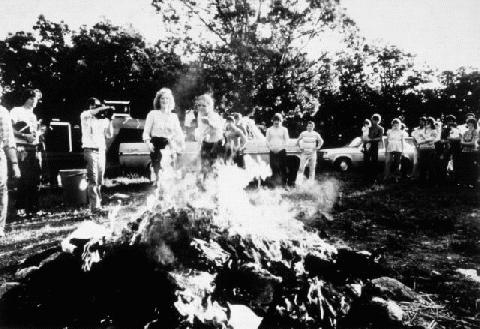
BOOK AND RECORD BURNING, MONTICELLO, MINNESOTA
1982


EARTH ~


And now what will become of us, without any barbarians?
Those people were some kind of a solution.
C.P. Cavafy, Waiting for the Barbarians


We were young when we rode out on the long journey;
Now it seems those grandchildren of ours are riding horses.
We were few when we rode forth on that hard journey;
Now we're called a Great Caravan that left tracks in its wastelands.
The tracks remain out in the wastes, in the valleys and mountain passes, and
There are very many heroes left graveless in the desert.
Do not say graveless: In the tamarisk-reddened wilderness, at
Dawn, in the spring, our graves are covered with rose-blossoms.
Our tracks remain, our dreams remain, everything remains, far away, yet
Even if the wind blows, or the sands shift, they will never be covered, our tracks.
And the caravan will never stop along the way, though our horses are very thin;
One way or another these tracks will be found someday, by our grandchildren;


Or, our great-grandchildren.
~Abdurehim Otkur, Tracks