Showing posts with label Stone Hut. Show all posts

Monday, August 27, 2018

STONE HUT ( 12 ) ~


A stone tower I like somewhere in the White Mountains, N.H.

43


One day, after being my dentist for thirty years, he said to me, “You need a crown, and I need a stone wall rebuilt at my house, can we work something out together?” I had always heard of this professional-barter set up from a few other friends. 

I had a poet friend who exchanged her books with her dentist for what he could do for her. I felt it made the most sense in the world for people who had very little money, but they knew a craft or had a talent to share where money could disappear. It’s a refreshing moment. I immediately felt this when I said, “Sure, we can work something out…what do you need for stone work?” And he told me. And afterwards when I had the crown work done because it took two or three sessions, while I was at the same time laying stone up at his house, I noticed how relaxed the dentist was at preparing the crown work in the same office where he was normally efficient and professional. He now seemed more at ease, one might say maybe too at ease, talking with his wife on the phone while shaping my crown when he got that first fit all wrong. Which only put a chuckle in my head since that’s how I worked on his stone wall — picking up one stone and knowing it wasn’t quite right and trying it anyway and then tossing the stone to the ground and trying another — that beautiful trial and error.


I even had a younger stone loving friend, Greg Joly, stop by one day while I was at work, way off in the countryside, up near one of the apple orchards where this dentist had a house tucked into the brow of a hill with towering shade trees and a comfortable home, and this friend worked with me while we visited for some hours and the stone wall I was mending, rebuilding, lengthening from scratch, built up steam. The dentist was home that day and he invited us both in for tea, and we sat in the man’s den where he had been housecleaning while his wife was off at her job as a school teacher. This dentist was now working only three days a week and was open to new pleasures: like helping out a stone builder and his dental crown, inviting into his house that worker and a complete stranger who’s just dropped by to be with the worker — a break in the day and why not have the two guys in. All the stonework got finished. The last time I saw the dentist at his office, I was there for a third session having the crown filed down into proper shape. Little tweaks and shavings. He wanted to make sure it was just right. He then asked me, “Are we all squared away between the stone wall and my work on the crown?” I thought for a second how the stone wall had reached from the furthest part of his yard up to his house and how I had pretty much run out of stone, even using what I could pull from an old foundation the dentist had on his property that he said was okay to go after. With my tongue I felt the crown and its smoothness. I smiled and said, “We are.”


Bob at work on the house chimney top, Mexican tiles in their temp frame


44


When I look at my stone tool pail of over forty-five years it’s barely changed at all — black metal old can holding stone chisels, star chisels, many-size trowels, pointing tools, hand brushes, measuring tape, old gloves. That’s it. Wait! don’t forget the two or three stone hammers. I keep my sledgehammers and pry bars and crowbars off to one side. Now two wheelbarrows. One handcart. That’s the extent of my hardware. I’ve been able to do what I had to do. The old Willys Jeep that pulled out most of the stone for the stone hut is now on the opposite corner of the yard from the hut, balancing that end with the hut like bookends, and it’s rusted into place while sinking into the ground. The tires are all rotted and flat. The back oak bed of planks is shot and collapsed. The frame is still painted the silver I painted it but it won’t ever work again. The cab doors both open with a yelp. The windows are shocked. The double-paned windshield is vintage and classic, and the floor of the cab that I rebuilt as a young man is tough as ever. The hood lifts to the engine and the works, a flathead six, but nothing’s turning over. It’s no longer a jeep. It’s structure, a monument, a companion, old glory. 


A sawmill I liked once upon a time in Newfoundland

45


I like to take my bicycle and bicycle around, and I like to take my bicycle when Susan takes her bicycle with me. I like this just as much as sitting in a rocking chair on a porch in the evening, or on the step stoop and listening to the day close up. Watch it and feel it. It’s all happening. And when we’re bicycling around I like to find other folks in their rocking chairs doing exactly what I also love to do. I can see they do, too, except there aren’t as many as there once were. A dying breed.

When I was a little boy, no more than five or six, there were two sisters who lived next door to my family, and one of them had hair that reached to the ground. I saw that hair reach to the ground one summer day when she was outside and had just washed her hair and she came outside to comb it and dry it, and it’s still the longest hair I have ever seen on anyone. I had already been strolling over in the evening to be with our wonderful neighbors who I had no idea, then, would later remind me of Gertrude Stein and Alice B. Toklas, but that’s who they were. They had two grand rockers on their wide berth front porch that covered the entire front of the house, and the interior of the house was always with that old lady mauve and lace and shadows and cuckoo clock. I could often be found on the porch rocking with my friends, my feet never close to touching the floor, and they seemed to love whatever it was that came out of my mouth sharing with them the tiny exploits of my day. Where they got the third rocking chair I’ll never know but they got one, and it was for me or some other visitor. In a five year old’s mind it was my chair. 

I see houses that remind me of this house when I bicycle small towns in Vermont and Massachusetts with Susan. We lift our two bikes onto the back of the car or into the old pickup truck and just go. Old Deerfield is a wonderful place for this sort of thing. And usually where one sees someone rocking on a porch, most often always an elder, one also sees a tidy house. A house with trees and flowers and gardens. And around those flowers and gardens and leading many times to their place, it is stone. Walkways, borders, stone walls, pinnacles, totems, breaks to the eye, but it’s stone. The free stuff that can be found at a cost of knowing how to move its weight where someone wants it. The ones rocking and watching and listening know well just how to place the stone. They’ve had good practice.


Carson and Bob building an addition onto the house;
the new rafters are staggered working off the old original
house beams


46


There are two things about stonework — at least two things — but the two essential ones are your physical back and injury to it, and money. 

Now in my early 60s my back has had a lifetime of being grumpy, often shot to hell, one or two months in a row out of commission completely. A lot of the problem was not taking care of myself and just working all the time because I was of a young age and vigor where I could go on forever. Believe it or not, I still have the vigor and stamina and work many long days, but the body listens, as I say, and payback is hell, as someone has certainly already told you. I began yoga exercises far too late, but I did begin ten years ago and it has facilitated remarkably. I’m also steering away from stonework and jobs that make no sense for one man and his wheelbarrow to attempt, which doesn’t mean I’m not fearless — I am — but I’m hopefully not stupid. I’ll still move large rock out of the woodlot with a handcart or wheelbarrow, but instead of hauling all day and driving myself down, I’ll move two dozen large stones and tell the pile, “I’ll see you tomorrow.” And I do. 

Money will help you now make these decisions. If you’ve made enough, you can do just enough. Because I come from two families with completely opposite histories and incomes: one was the big Irish friendly bunch from Belfast, Ireland; and the other was the New England business players, all in the lumber business, and the earlier family members were roughshod loggers and sawyers, but the later twentieth century members were money-driven building contractors or lumber suppliers, overseen by a lumber magnet, my grandfather, who worked the woods as a boy, but I only knew him in a long black coat with two different looking Cadillacs; and I guess he picked which one to drive depending on how he was feeling. One pure white, the other tail-finned, olive green.

Someone would make a big mistake if they thought I had anything to do with this supposed money bonanza, when in fact I had left home at eighteen and struck out for the Vermont woods wishing to make my living at the building trade. I didn’t see a dime from this family. Only recently I found out our grandfather had in fact left a sizeable financial trust to each of his grandchildren, equal amounts, that my father managed to usurp from one child after another, through poor financial management  and schemes. Some more removed grandchildren he ran this trust by were privy to his shenanigans, and I believe they got their share, but his own children were robbed. This doesn’t mean our father was a bad man, or an evil man, he was simply a businessman and businessmen often get into binds and fixes they can’t fix. They get cursed. I can only imagine what my two younger brothers did about their situation — our older sister died too young — while I’ve been in the Vermont woods getting a bad back, loving a long marriage, raising a child, building as well a bookshop and publishing business tiny as a fruit stand and just as sweet. It took believing in a dream, each other, gaining a step at a time at each opportunity, and learning to not push against the river, or the stone. They shape themselves, they shape one another. If at the age of sixty you told me what the kid, called “me,” at age twenty planned to do, I’d have to ask, “Is he nuts?” But good luck to him.


An old flat stone seat I built long ago that slipped off and I
liked how it looked and re-built stone around it


all photographs by Susan Arnold


Stone Hut
a builder's notebook
Bob Arnold
1988, 2013


Monday, August 6, 2018

STONE HUT ( 9 ) ~


The finished stone hut, full pond, maple tree stump from the tree
we dropped


32


It is now late September and enough flat stone has been hunted from the woods to lay down the hut floor. It will be all stone. Mortar the edges. Some stones are over three feet wide and with Susan’s help I loaded them into the Willys. They were found near our old springhouse, mostly flat. But I don’t worry about perfection — what I have is what I have to work with, and it will work. A half day is spent hauling stone to the hut and carefully unloaded; trying to wheel or pivot large stone on the ground close to the doorway. The less handled the better. Half of this work is how you position the material you work with. When the ground is dry the Willys can back tight with the hut and allow easy access. During days of rain, like we had after the floor stone was hauled to the site, I wheelbarrowed the two yards of gravel from the last of the pile across the yard and spread it over the dirt floor as a pad for the stone. A chance is taken the frost won’t settle under and heave the floor. But ledge is everywhere around: the entire rear wall is ledge, and ledge was struck in places when I dug out the side wall footings. I feel pretty secure. When the pond is dry you can see where the ledge pops up into a table shape in the middle and if you follow with your eye further it will run through the western corner of the house and all that is ledge too. A reason for the half-cellar under the house — the old timers knew when to stop digging. And into the front yard, still leaning on the western side, large ledge croppings appear — we planted daylilies around each one. Finally the ledge shows its face again, like it does in the backyard where the hut is, 1200 feet away from the hut in the river. We dive from it when we swim. I spread and tamp the gravel inside the hut, working it under the lip of bottom course stone, then I carried in the stone, easing each into place while shifting them level with my eye. I worked from the rear to the front and saved the widest stone for the width of the doorway and patterned a few of the other large stone into a design with smaller stone. Later, using a 2" x 4" straightedge, I placed a four-foot level on it and roughed together a near level floor. Where there was a dip, the stone was lifted and gravel thickened under it, and where a dip was in the stone itself and couldn’t be helped, I lived with it…laid it in the corner where the woodstove would cover it. In our back door terrace at the house I saved a stone for the top step because it had a dip in it that gathered rain water as a drinking bowl for the cats. Every stone has a use. Now the stone floor was done. It took a half day to mix the mortar and butter it around all the edges — smooth the dips — trowel and pointing tool. When the mortar was between wet and set it was swept with a broom. It grizzled the look of the mortar that much closer to stone.


The old barn wood door, and Bob's stenciling


33


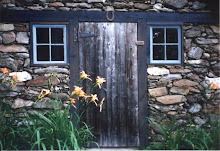
I found the barn board door hung on the hut doorway, which now made it a home, but I won’t say where. Someplace where I was working and this old door was neglected, tipped on its side, bottom edges burned away to ground rot. I had a bowsaw with me on the job and sawed off the exact height to the hut doorway — six-foot six inches — that dropped away the rot to serviceable wood, lovely wood. Darkened just right. I would rip the width of the door when fitted back at the hut. Four strap hinges were already with this door and they came along. I used two of the hinges and saved the other pair for another job someday — hacksawed off the rusted bolts. Back at the hut the door was sized to its three-foot width, and since the door was a single plank thickness I kept that for the exterior but added another thickness to the inside, battening whatever scrap lumber I had horizontally to the interior barn board. That filled all cracks and gave the door twice the weight. I stained the new lumber smoky. Hinged the door to the left doorway post; the same pressure treated post that was set four months ago. The right hand post needed a chisel to nitch out a depth for the draw bolt latch to drive into. Now a door handle had to be found, and for ten dollars my friend Scott, now doing less treework and more ironwork, hammered out a foot long pull handle for me. It took him about a week to forge and mail down from Maine. While waiting, the handmade door jambs were nailed together and stained. That loft railing for Carson was built, plus a ladder. The handle arrived and I screwed it on. There was a subtle swirl to the handle where the hand gripped it that I liked. Scott knew I would.


Bob digging in a stone stairway years later
under the tall maple trees

34


A ladder had to be built to reach from the stone floor to the loft. I went into the woodlot with a bowsaw and found one straight maple sapling growing in a clump and it was a perfect pole shape and just what was needed. I carried the whole sapling back, thirty feet of it, and sawed off the top. With a hatchet I lopped off the lower branches and any burrs on the tree to make a clear surface to nail on the ladder rungs. I narrowed the top and widened the bottom like an orchard ladder. Two poles for ladder stringers nine feet long. I nailed on the 1" x 4" slats for rungs from the butt ends of the strapping saved from the roof job and rounded the edges. Used 8-penny flooring nails which bit into the maple. While rounding edges to the ladder rungs I took a four-inch slat of barn board and drilled a hole in the center, then fastened it with a long screw and washer into the right doorframe post — it worked good as a swivel lock for the door. Turn it and walk inside. There would be no lock on the door. When inside the draw bolt could be used for privacy. I turned the swivel lock and walked inside with the ladder. The stone floor had set for a week but dry mortar was still being swept off the stone. I eased the top of the ladder against the rail of the loft and set the ladder down on the floor. A 10° cut on the bottom of the ladder legs made it stand firm. I climbed up. That evening Susan climbed up while I held Carson, then I took Carson up. The next day our new neighbors were visiting…one at a time they climbed up, especially their five year old son Matthew, and through Matthew I could see what Carson might do with this hut. After everyone was gone I lifted the ladder away from the loft and placed it on top of the length of side wall stone. It had inches to spare between the front wall beam and ledge wall in the rear, and lay over the top of the window frame. That felt good to set it there. I hadn’t planned it that way.


Bob away at work making a living roofing an A-frame


35


All sorts of jobs went on during that six months from May to October beside the work on the hut. The outside jobs paid for the time at home laying stone: Bob Hauptman’s house was framed by mid-August and he would return the following summer and finish the interior work himself. I had three roofing jobs going that summer and fall: for a house, porch, and repair of a large barn. Asphalt, steel, slate were the materials used. I remember nailing the shingles for the porch roof through an October week of rain. At the porch job there was also treework to do. It was a two-man job but I didn’t know anyone nearby to lend a hand so I did it alone —usual story. A sugar maple very close to a house had one of its two main leaders dying and the job was to cut out the dying leader. It took a thirty-foot ladder to reach the crotch of the tree, then to work between a heavy rope and chain saw. Wrapping the rope high on the leader, letting the rope drop through the lower branches to the ground, I would cut with the chain saw at the crotch of the leader, climb down and tug the rope, climb back up and saw more, climb down and pull, etc. Two wedges in the back-cut cracked it into a lean and by pleading with the rope on the ground it began its dive between the house and barn. It takes about an hour for the tension — obtained from the tree’s tension — to quiet down in your own body. It’s just one way to do treework. Other treework was done that fall: a friend had bought land in southern Vermont and wanted a house built. I might be building the house so I went to the land one day to mark trees to clear for the house site, driveway, and yard. The land had good looking trees but not many of tremendous size: black birch, beech, maple, ash, hemlock. I wasn’t planning to drop trees the next day — in fact Susan had plans to climb Mount Monadnock with me and Carson — but this friend was in a hurry, and a job is a job when you are self-employed. Two gallons of gas were emptied into both chain saws the next day. With my friend hand clearing the logs and brush I dropped tree after tree making a swath for the driveway and then cleared a wide area for the house site on an upper shelf of the land. It faced the sun at nine in the morning. Between us we finished the job in a day. And I went back to laying stone the next day and we promised Carson a hike up Monadnock in the spring. He didn’t mind. Life for him, four months old, was a few feet around him, and how much joy he got just from that. Lucky guy. Those six months of building the hut were made up also of slow, dirty, loner jobs, or what Susan terms “junk jobs”…digging an underground electric line with pick and shovel, weeding asparagus gardens, cutting brush, piling brush, burning brush in the rain…and no complaints, it is all part of it. Like Carson I was willing to look only a few feet around me and enjoy it.


all photographs by Susan Arnold


Stone Hut
a builder's notebook
Bob Arnold
1988, 2013


Monday, June 11, 2018

STONE HUT (1) ~


“You just can’t expect to fool with it
without getting it on you.”


— Ken Kesey


Preface


Like a child raised on a farm, I was raised in the lumber business. Since the age of nine I have been consciously aware of it and rubbed shoulders with builders, excavators, lumberyard workers, and forty-five years later I am still hanging around the same company. I have worked on a few carpentry crews but usually work solo, and the bulk of these essays will be concerned with remembering a stone hut I built. I love to build with stone and prefer to build simple — fewer tools and more imagination. Like all builders I have made mistakes and had to bluff my way and learned to laugh at a lot of it. To this day I ask my own father, a lumberman of reputation over sixty years, how to figure certain building procedures. He shows me. And someone showed him. And I’ll show Carson when he is old enough. I like to think I have taught my father some things about stone, what you can do with it. Like me he enjoys watching a building go up, so when he visited us in Vermont he would walk out to the woods edge of the property and study the hut’s progress. Tools, roof pitch, cost, these topics are all minor though necessary to building. Much can be found used, or right under your feet. Knowing the grade of lumber and how the grain works and exactly what type of tree the lumber came from is more essential, and of course all the service a stick of lumber can do. So I taught myself the trees and cut a great deal of them, and turned around and planted as many. It’s important to get a feel for all architecture — my favorite is architecture-without-architects — and what a building is: to look at them, build a few, walk inside hundreds built by the hands of others, and gaze. And then the small ingredients of building become useful: knowing nails, notching, what windows work where best (Carl Larsson had clever installments in his home), how the roof should design and balance. To trace the building all the way back to the shovel work in the foundation, and doing it all, so that the building is felt in the body after it is done and stands to the sky. Of course to most, but not all, this is silly talk. Builders no longer permit themselves the time or desire to have a relationship with what they build — most have two or three houses going at once to stay ahead — so the work is a job and the home built is matched only with the one before. These essays are written for anyone and no one but they might appeal to one who enjoys handcraft and working with two native resources: trees and stone. It’s about not making much money, about Carson’s birth, our family, and our friends. It all started for me around 1973 when an Episcopal minister friend, who eventually sold us his country property, pointed to a long pile of old roadside stone wall and asked, “Ever think about building stone walls, Bob? You could make a living from that.”


Bob Arnold  building "Villa of Souls"


1

The hut I built is made of stone. I call it a hut, its dimensions are good size for a hut, roughly 12' x 12'. The inside is smaller since the walls are laid two feet thick. The back wall, facing north — what is first seen stepping through the door — is an apron of ledge. I began laying stone from this ledge and moved away from it. The hut is twelve feet high from floor to ridgepole, and the floor is all stone — one of the few places mortar will be found in use, edged around each stone, and on the east gable more is tucked behind the stone. Otherwise, the hut is laid dry, the way I like to work with stone. Balance and shimming stone, learning from stone. The ridgepole still has the tire tracks from the Willys jeep driving over it across a wet spot in the woods to get to the stone to build this hut. After the stone was out of the woods and delivered to the hut site I brought this 2" x 6" hemlock plank to the site and made the ridgepole out of it — all one length. Four feet below the ridge is enough head room to fit a 5' x 8' loft — planks nailed on the crossties of the rafters. You can lift yourself to the loft by ladder. There is a small window up there that looks to the woods; so far I’ve been content to lie on my back on those planks and just breathe the white cedar shingles that show above the roof slats. I couldn’t afford red cedar. Roofing nails punch through the slats and Susan said she will help hammer them over, but I’m already ahead of my story. I built this hut for Carson.


Now & then up in the air


2


According to my calendar, work on the stone hut was started May 21st. Already it had been an eventful spring. I had laid a 6' x 6' stone terrace, really a large stoop, outside the kitchen door. Eight yards of gravel was delivered for that job and thinking ahead to the hut. The terrace interior was packed with gravel, having the outside show all dry stone. The flattest stone found — between hunting in the woods robbing old walls and scouting in the river — were used for the top course, and mortar was edged around each stone. A slight pitch away from the kitchen door ran the rain water off, and it could be slippery during the winter. Three stones were found roughly a yard wide to fashion the steps. Two of the three steps were stolen from stone seats I had built around the property over the years. Six of these seats were first made when the town road crew was setting in a new culvert 500 feet from our house — replacing the stone culvert of many generations. Large handsome flat stone were lifted out and flipped around by a backhoe. Instead of watching the bucket shovel them over the bank into the river, I asked the road boss for all of them. He had them pushed to the side of the road, and later that day I went back and hauled them home with a wheelbarrow. Made all these seats in different corners of the yard — isolated spots — usually beneath the shade of a tree, or where the view was the best, or a vantage place to listen to the river. Some of the stone were too good to sit on and better for the foot to step on; they were chosen for the terrace steps and replaced with other sitting stone. It was only April 30th and the terrace was done. Susan was six weeks away from giving birth to Carson.


Halfway through a large stone stoop


3


Around this time Steve Lewandowski would visit with fifty Austrian pine, or “black pine,” for us to plant on our property. He was carrying the pine in his pickup truck from conservation work in upper New York State. I divided the seedlings between a southern and eastern planting. We have a ratty hillside of sumac and brush that I scythe down twice a year and twenty-five pine seedlings in there would improve the landscape. Now one only has to be careful where sweeping the blade, but these black pine are swift growers and it should be only a short time before they can be easily trimmed around. To the south, we have new neighbors building, and the pines are a good neighbor policy of eventually blocking out each other’s view. Fortunately the neighbors are fine people, it’s the thought of seeing another house after all these years of having only woods and river — that’s tough to bear. We’ve been spoiled. For the first few weeks I went around watering the seedlings and clearing brush to encourage growth. If half of the planting survives I’ll be more than pleased. Three seedlings were saved for our friends Bill and Dorothy Loos — they have given us many varieties of daylilies over the years and this was the least we could do — take a gift from Steve, to us, over to Bill and Dorothy. I planted the pines for them thirty feet from their house, with an eastern location, beneath a dying ash tree, but close by a young willow tree was thriving. All good company. Hopefully the black pine would replace the ash one of these days. The same week I was planting pine for the Loos they had me painting and wallpapering their living room. Wallpapering I had never done much before; I’d rather stencil, and twelve years ago, when repairing stone wall and building new stone wall on their property, I was only two years into teaching myself stonework. They hired me anyway.


[ to be continued each Monday
through the summer ]


Stone Hut
a builder's notebook
Bob Arnold
1988, 2013


Friday, February 28, 2014

TUCKED IN ~


Hello, Susan here — while Bob is tucked in recovering from the flu, let me tuck in this review from Gerald Hausman on Bob's new book Stone Hut.

It's a warming note for a bone chilling deep snow end of February.

____________________________________________________


Sunday, February 23, 2014


Once again Longhouse Publishers in Vermont has produced a book exquisite in design, fat enough to be a feast, pretty enough to just wade around in, and deep enough to dive into and stay with for days and weeks and even months on end. Could be it's the first of its kind, a scrapbook novel that is also a how-to and a mystery -- how did he do it, and how does he make rocks balance like Thor?

Author Bob Arnold is a poet, well-known for well-crafted verses of the back country. But Bob Arnold the builder, the stone mason, the rock wall maker is for those of us lucky enough to have gone walking on his grounds or dining in house with his lovely wife, Susan. 

I've known these guys a very long time, but frankly it takes a long time to know people who have the woods in them. They are like trees you love to look at, and you can give them a good hug, but that doesn't mean you know them. It takes years to do that and even then there's more mystery below the bark.

Well, there are years upon years in this shining, stunning photographic book of buildings, walls, stones, woods, flowers, lakes and of course trees. It's a book of family built with love, and like each rock, hand-held and sort of loved into place, it's a book that couldn't have come in a night or a day. It's taken Bob Arnold a lifetime to write it as his life was written around him in loving circles of tribute to his wife and son.

The beauty of this book is that it is truly a scrapbook novel, as solidly true as stone and bark. And it's not about one house, it's about many, and all made by the same man,woman, and son. If you want a life you have to make one. This is the story of a family who did just that. 

http://www.longhousepoetry.com/


Friday, November 29, 2013

ANNOUNCING BOB ARNOLD'S "STONE HUT" ~


Stone Hut is the revised and much expanded edition of Bob Arnold’s book On Stone — with twelve additional chapters added since the first book was published in 1988, including commentary about her reading of On Stone by homesteader Helen Nearing. The original photographs are here, now in color, plus a virtual photo album of job sites and stone structures built by Bob Arnold over forty years. It also remains a family book, with the birth of a granddaughter, furthering the telling.


Stone Hut

NEW & EXPANDED  25th ANNIVERSARY EDITION

Doubled in size from its original edition published by Origin Press in 1988

Expanded chapters on stone work by Bob Arnold

With its original introduction by Cid Corman

160 photographs all in color


Limited to 100 copies in this first edition


$25
plus $3.95 s/h to U.S. addresses
  

Order now with Paypal, US orders postpaid & International (with shipping)


Choose US order or International order


Longhouse Publishers & Booksellers
PO Box 2454

 West Brattleboro, Vermont 05303