Saturday, October 18, 2014

START WITH THE TREE (CODA) ~


The ten inch tee-hinge bolted into place.


Again, use the truck as saw-horse and build the chapel doors.


A view into the work site from the road.


The versatile portable drill, and versatile short screws.


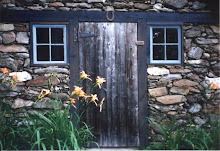
After the traveler passes by on the road along the stone wall comes the chalkboard and often a poem.


One finished pine door, and one more to match. I wanted to build both doors over two days, then take the third day off with Sweetheart and our bicycles.


The overhead lumber rack is now in place.


Bed the screw.


Getting ready to hang two doors.
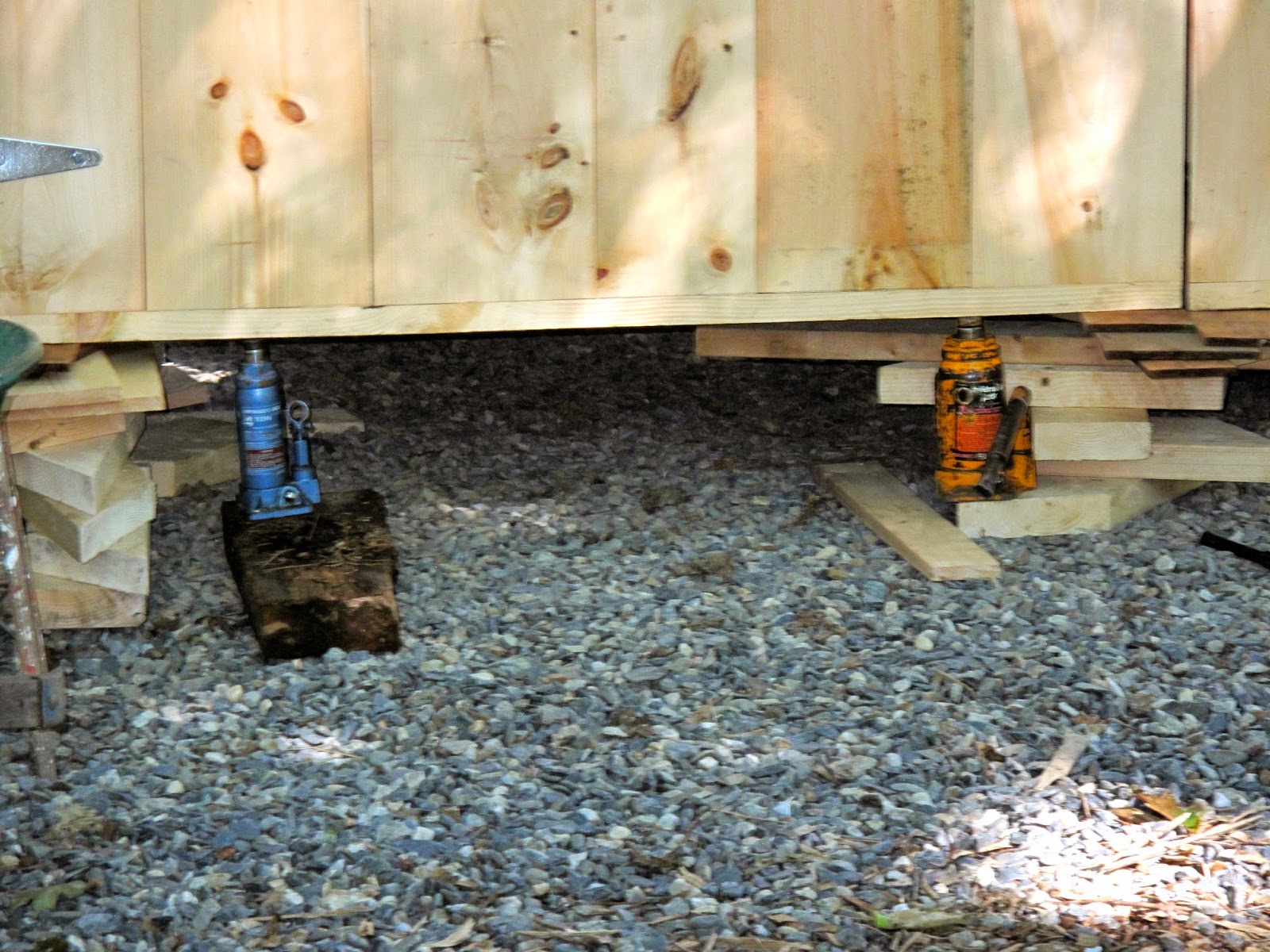


These two jacks, who have traveled with me for decades (and look it) are the helpers deluxe when coming to lift the doors into position. Spruce blocks, wood shingle shims, any old board also help the installment along.


After one of two doors is bolted into place (not screws), measure out and see how the next door has a clearance magic of "1/4." That's what you're shooting for.


Both doors up and plumb, windows aligned, closing without complaint.


Here we have the doors almost finished, painted two-color and a brace against the door waiting for hardware to be installed. The bottom of both doors will have a hinged flap installed to be lifted during deep snow (winter) and back down for normal use.


If you look closely, the day after I finished building the chapel, a tree crew scheduled for October arrived a month earlier than expected, with a crane, and removed a mammoth white pine tree and this twin sugar maple tree right next to the chapel. You can see the saw chips on the stonewall. I asked the crew to leave ten feet of one of the maple trees and level the top. On that top I plan to install something . . . the ideas are percolating. The new sunshine, without the trees, is quite a gift.


Begin stenciling the big doors — one first coat and then go over the petals, free hand, with a second coat. The building will be stenciled with one thick tube of yellow paint.


Tap tap tap the color in and don't let your hand slip. The masking tape doesn't work on the painted steel surface anyway.


The rarely seen back wall faces the woods and for the moment has one line trace of leaves. I will do another line of leaves higher up before snow falls.


Some times with stenciling, a little is better than a lot more.


Remember the scaffolding? — well, after I dismantled that, I chopped some of it up and built this ladder to the second floor loft. It's all built into the space between the studs and takes up no extra room.


The finished building with stenciled doors and both flaps on the bottom of the doors to be lifted only when needed. The extra long 6 x 6 sill to the left of the photograph has since been cut back close to the post and beveled. We're done.


Scott's "Archer" (steward) was sent decades ago here to us from his ironworks in Maine.
We brought him over to this new spot to see how he likes it. So far, not a peep.


fini

photos 2014  © bob & susan arnold


Friday, October 17, 2014

KEN MCCULLOUGH (TRIGGERS) ~


KEN MCCULLOUGH


TRIGGERS


                          “ …that which we call a rose

       By any other name would smell as sweet.”

                             Juliet

                       Romeo and Juliet, Act II, sc.1


There were lots of wild plum trees in the fencerows,

and when they bloomed, they put out a sweet smell

and there are lilacs on almost every farm; in fact,

that big hedgerow over by you has been there forever.

And in the springtime the aroma of the apple trees.

When the white blossoms of the honey locusts

come in, they are pretty to look at, and fragrant, too,

but people think of them as nothing more than weeds.

And this time of the year everybody’s spreading manure

or now its maybe emptying the pit. It smells like liquid gold

because commercial fertilizer costs so much.


The rain itself has a really great smell that I’m sure

is different in different places. But one of the nicest smells

of course, is hay, that’s new cut, alfalfa, and then if

its conditioned, crinkled a bit, the smell of hay when its

dry and ready to bale—or a load of hay in the barn

if it isn’t heating, a load that’s dried and stored.


With good silage I have to pick it up and smell it

because it’s so good. If you are filling silo, a lot

of the silage spills out the side and if you don’t

clean it up and it rains overnight and then it gets

hot and muggy and starts molding—that’s a whole

nuther smell, a bad one, like rancid butter

but one you’d recognize right away. When you

get it on your clothes, it won’t come off. Both our

families were German—we made silage the same way

we made sauerkraut. Dairy farmers back east made it

from green corn fodder and it caught on out here.


There’s the smell of the dairy barn, summer or winter.

We used to milk by hand so you smelled the milk

in the pail and that had a very nice vapor to it.

Even the cows, their breaths can be bad or

it can be pretty good if they are happy—so

a contented barn has its own certain smell, too.


After the cows go out in the pasture, the manure

is loose, it’s very fresh, distinctive, mixed with

the grass, and they’re crushing the grass, and

lying on it, so when the cows are pasturing

there’s a tremendous number of smells that

would trigger your memories of this place.


We used to have hives up here, and when

it was hot, the bees would be fanning.

I’d move in close and the action of their wings

would waft the smell of honey from the boxes.


There are still some wild plums down in the woods

but very few. They used to be kind of thick

in the fencerows --our neighbor, George,

instead of cleaning out the fencerow

he’d just move the fence in a little more

so it came to be about 16 feet wide.

So we had to cut that back. We must have

grubbed out all the plums when I was

in high school, which was bad for the birds

but simplified things. That’s where all the plums were.

We did save a few, transplanted here in the yard

so I can still breathe in their scent, taste that tart jam.


Thanks to Bob Redig                                                                                 8/25/14
                                                                                                        

 KEN MCULLOUGH


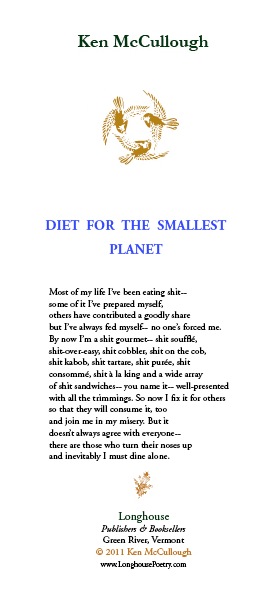
Diet For The Smallest Planet


  Ken McCullough. Diet For The Smallest Planet. In three-color fold out performance. 
 Foldout booklet. $10 postpaid from Longhouse. 


Ken McCullough was born in Staten Island, N.Y., but spent his formative years in St. John’s, Newfoundland. More recently, he has drawn inspiration from the mountains of Montana and Wyoming and the blufflands of the Upper Mississippi. In 1992 he was adopted into the Miniconjou band of the Lakota Nation. He is a graduate of St. Andrew’s School, the setting for Dead Poets Society, and has degrees from the University of Delaware and the Writers’ Workshop of the University of Iowa.

McCullough’s most recent books of poetry are Walking Backwards, Sicomoro.Oropéndola (published in Colombia), and Broken Gates, as well as a book of stories, Left Hand. He has received numerous awards for his poetry. McCullough has worked closely with Cambodian poet U Sam Oeur, survivor of the Pol Pot regime; they have published Sacred Vows, a bilingual edition of U’s poetry, and Crossing Three Wildernesses, a memoir. McCullough has two sons, Galway and Orion. He lives on a farm outside Winona, MN with his wife, Lynn Nankivil, a playwright. In 2014, McCullough will start his second term as Poet Laureate of Winona.


Thursday, October 16, 2014

BOOKSHOP LOVE ~


Fjaerland book town, Norway


Fjaerland is one of Norway’s Book Towns near Jostedalsbreen, the largest glacier in mainland Europe. Old sheds, houses and even a hotel have been converted into bookshops. “During the winter, the bookshop owners have to transport the books from place to place, over the snow, on kick-sleds.”


See other wonderful bookshops here:


DENISE LEVERTOV ~


DENISE LEVERTOV
A Poet's Life
by Dana Greene
University of Illinois Press, 2012


The tone, pacing and fulfillment of this biographer's portrait and study of an American poet is exquisite and accomplished. Even the design of the book and dust jacket photograph of Denise Levertov draws wonder. Don't hesitate.


Wednesday, October 15, 2014

ROBERT SEYDEL ~


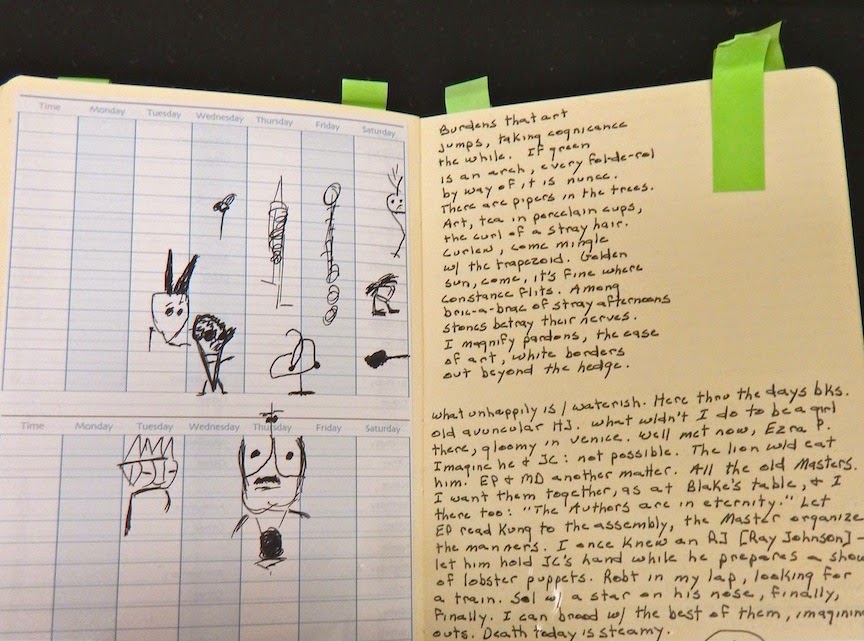
On a very rainy cats & dogs sort of Saturday afternoon we ventured out of the woods and headed to the Smith College sleepy time campus to be with this fine open room Robert Seydel exhibit. There was but one student trying to study at one table in all the big room, probably thinking it might be quiet in there, until we arrived with three other strangers ahead of us on the stairway going up to the third floor. I took these photographs for a friend 3,000 miles away who couldn't be there. I'm sorry about some poor lighting and reflected light — hopefully no one will be offended. The meaning is to share. I want to think the artist would agree.


[BA]


photos 2014  © bob  arnold


Tuesday, October 14, 2014

AROUND THE BOOKSHOP 3 ~


Cid's personal stamps he used on his letters and aerogrammes over the ages. . .stamped and compiled by Bob Arnold into one neat, foldout booklet. Here on display in our bookshop beside a wandering red stenciled rose.


TED ~


SUSAN HOWE (NEW ENGLAND) ~


Back Road Chalkie ~ Susan Howe
October 2014


Sunday, October 12, 2014

DETOUR ~


What I Found on the Detour


That there are other ways to go —


That the Zimmermans sold their cows
And now there is a hillside of sheep


That the fellow who saws and sells firewood
That his work horses look healthy


That there are other towns
One growing & selling the best tasting corn of the summer


That there are small town libraries
That there are small town post offices


That there are people in both ready to help
That I feel robust seeing and knowing this


That everyone, everyone! pulled off to the side
Of our narrow river road and let others come first


That only one fool barked his car horn because
He won't talk, but he was the only one


That the river is shallower south
Than it is in the north


That there are footbridges with cameras
God help us


That engineers describe a bridge plan 600 feet long out in
Splendid nowhere, and drop it like a lead weight


That others actually propose moving the covered bridge
That was certainly built where it is for a reason


That it has earned and survived a 100 year flood to
Stay where it is, more than anything we know


That a state pond has a morning mist
That floats our eyes


That a working farm, open to the wind, has
The only light shining when I pass at 5AM


That a house I also pass, used to be a slaughter-
House I knew, and what a legacy


That at a corner store my wife met a friend for the first time
They started to shake hands, which fell into a big hug


That passing an abandoned sawmill, quiet as a ghost town
A fisher cat could be seen scrambling where logs were yanked


That the day the Green River Covered Bridge re-opened
Reggie from Colrain stopped, both of us driving trucks five


Miles south of the bridge, and pointed to a bald eagle stone
Still in a tree along the river — he wanted to take a photograph —


And instead the eagle flew


~ Bob Arnold


photo & poem 2014  © bob  arnold


Friday, October 10, 2014

PATTI SMITH ~


Patti Smith
in rehearsal and on stage from the film
Another Day, Another Time


long before Led Zeppelin
Anne Bredan wrote and sang this folk song in the late 1950s
Joan Baez recorded the song in 1962
Quicksilver Messenger Service in 1967
Led Zeppelin in 1969


Thursday, October 9, 2014

RED JUICE ( HOA ) ~


Hoa Nguyen has it, the modern click, furthering what has been started by Notley, Mayer, Kyger.
 Hoa is the next step.
 She's amazingly ballsy in the right way on the page.
And with such immaculate swank and precision.
 Half the time not quite knowing exactly what she is doing, which is the best way, refreshingly, she is simply being.
 That's not exactly easy.

[ BA ]


UPSIDEDOWN AGAIN


Held by the roots       like the cilantro

beaten in my mortar

Make a chicken marinade and broil

Could pluck feathers after scalding?


O circled fucked-up change


which is the mother of us

and ethics       What of that

Chicken feathers

to grow your organic vegetables


The wild will root it out

The pigs dig them up               your roots

Lovely smiling pig to string up on a pole

Fatten you          o lovely


I am the omnipotent narrator noting

the age-wrinkles around his neck


The play we make in the snow in Colorado

a survivalist trick          A snow-made den

to live in           or wave your umbrella

from your stranded car

at the rescuing helicopter


I can't stomach all these circles

or my head noise

even cartoon songs

from animated Cat in the Hat

in the woods walking the woo woo

labyrinth       (alone)


I have fetal tissue in my brain

literally


and Chinquapin Oak on my placenta in the rain


It hasn't rained like this

since they were born

meaning our boys


A woman is the person

the first person

like a chicken before an egg


––––––––––––––––––––––––––––––

Hoa Nguyen
Red Juice
Poems 1998-2008
Wave Books, 2014


Wednesday, October 8, 2014

FURTHER IAN HAMILTON FINLAY ~


At Little Sparta
photograph by George Gilliland


October 6, 2014


Hello Bob,

You won't remember me but I got some books off you many years back when I was in Northern Ireland - I was introduced to your work by Alec Finlay.

Anyway, life's quirks and turns have now brought me to where I am gardener at Little Sparta for the past 3 years and I have been enjoying the Birdhouse dispatches - and especially after todays piece thought I should get in touch again.

The house at Little Sparta and Ian's library is turning into a study centre - I don't know if you ever visited, but I came across some of your books as we were moving everything.

The garden has just closed for the year and I am putting everything under wraps - it looks like a ghost of itself….


All best wishes,

George


George Gilliland


_________


October 6, 2014


Dear George,

I have many loves to speak of having your letter today — that you came my way through the book trade, from northern Ireland ( my mother's birthplace! ) and via Eck. Very nice. Quite nice. And everlasting.

Now you tell me you are a gardener at Little Sparta! Exceptional. I've no idea who has an eye on my daily Birdhouse but I am very thankful you dropped me a note about my wee one for Thoreau and Ian. I'll never have letters from him again, or to think he is up and about and capable of making and sending more postcards, booklets, and heaving grand statues onto the landscape. What a fellow.

I'm glad you are there. Ever thanks for letting me know some of my books gifted to Ian are still about the premises.

I never made it over. Ian had some dream notion of having me there to build him a stone hut. Eck said at the time his father was serious. The dream will last me until the end of time.

Take care of the place.

all's well, Bob


Bob Arnold


_________


October 7, 2014


Hello Bob,

Many thanks for your reply - its always fascinating to see how things connect - a grand idea for a stone hut - - pity, it would have sat very well in the landscape here. I write a little bit about the garden each month, which might be interesting for you if only for the photos which show how the garden is now in its maturity, and how it looks out of season too when I have it all to myself - http://www.littlesparta.org.uk/news/gardenersReports.htm

Could you also let me know the price to send a couple of your more recent books to Scotland - Beautiful Days and the Love poems..

Again, all best,

George


_____________


Please tap onto this link for much more of George Gilliland, Little Sparta, and the current rhymes and rhythms of Ian Hamilton Finlay's home and garden. George's monthly garden journal is a treasury ~


  correspondence 2014  © bob  arnold, george gilliland

permission to reprint at A Longhouse Birdhouse was granted by both authors