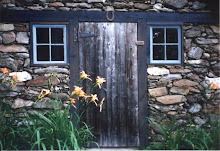
It’s late morning when I see the Fed Ex white pickup truck go down the dirt road, slow up, look in, see under the tall tamarack tree my chalkboard quote with Jimmy Hoffa, and he probably thinks about that a moment. Keeps going. Comes back, slows down again, I wait for him to sum up the right place. We don't use a road # on the house because we like being in the woods, hidden, not some suburbia. So we help people when they are looking for us. He gets out of the truck. "Who you lookin' for?" Looks down at his clipboard, "Susan Arnold?" He appears hopeful. "You found her." He snaps up, "Terrific!" On his shoulder he brings my Mexican tiles. I know they're the tiles. We've been waiting weeks and they never returned our query for a tracking number. Asked 3 times. No answer 3 times. Let's hope they were busy buffing our ceramic tiles instead, down there in old dusty Mexico.
Sets it down. I sign. I then say, "I'm not Susan Arnold, but you've brought me work to do." He looks at me, "I hope that's okay?" I smile, "Couldn't be better." Another "Terrific" from him. Off he goes, happy, did his job. Then he abruptly stops and turns and asks, "Last name?" like he's just recalled his business code of ethics. I say, "Arnold". He's happy again and strides off. I almost said, "Bond. James Bond."
Ah, the box looks like shit. Are the tiles all busted inside? $80 down the drain?
I open the box. Still no breakfast in me and past noon. Inside each tile, 100 of them, are protected in a beautiful styro-wrapping. Couldn't look nicer. I unwrap one bunch and unfold 8 tiles, all shiny and no cracks. Let's hope the bottom of the box looks just the same. I want to save the way it looks for Sweetheart to have a look when she gets home from town so I won't dig deeper. Whoever in Mexico wrapped it up, did as well as I do in Vermont with every book order out of our bookshop. And occasionally I ship out orders in an old lousy box, too.
In his senior year of high school Bob Arnold was thoroughly flunking Algebra II and Chemistry and if memory serves French II. But he won the English Dept. award for excellence. Still, no college wanted him and he didn’t want them. Off to the woods, youngman.
Friday, September 25, 2009
TEXTING
I was in bed at 1 o'clock last night with an Isaac Babel short story when all of a sudden, out of nowhere, came a sound through the trees that didn't sound like a rare vehicle on the dirt road passing at such an hour, but maybe it was, and then a burst of rain released with complete abandon. I loved it. No matter what is in the way, the rain seemed to say, is now getting wet. Down came the torrent, and it lasted only one minute. Like a spigot was turned on and off. I only realized then I had lifted my eyes off Babel's words on the page and was listening eyeless to nothing but the rain. When it stopped, I continued with Babel.
Bob Arnold is the oldest son of four children born and raised in a borough at the foot of Mt. Greylock.
Thursday, September 24, 2009
I SAW THE FLOWERS SHIVERING
I saw the flowers shivering yes actually shivering in the sunshine
they know something we don’t quite know yet about changes to come
summer to autumn and it’s in people too and even the windchimes
Bob Arnold believes a poem a day, at least, keeps the doctor away
My home's a hole, and a hole's where nothing is. Pure, clean, emptiness, to venerate. . . A blazing flower of brightness, sun oh sun . . . Food? Wild plants will make this meager body maigre feast, and a cotton robe's enough to robe illusion . . . Bring all your thousands of Sages, all sorts, here to meet me, what's left of me, and the Heavenly Buddha!
Han Shan COLD MOUNTAIN POEMS EDITED & TRANSLATED BY J.P. SEATON Shambhala
Nothing in the world is finer than more Han Shan, and mostso from the nimble strong-ankled mind of J.P. Seaton. Included in this capsule of heaven are the likes of Han Shan, side-kick Shih Te, and much lesser known devil may-care Wang Fan-chih. Those familiar with Longhouse publications have seen this crew at work, via Seaton's care, for some years now.
Neil Young FORK IN THE ROAD Reprise CD
The Canadian folk rocker's finest fest in years. Back to a grinding guitar used as chain saw and lyrics that take on Empirical rogues. He may be a millionaire, but he shares his wealth.
There's a bailout coming but it's not for me It's for all those creeps watching tickers on tv
PLANTING MELONS
When I follow my nature I'm rash too careless to earn a living this year I tried planting melons in a garden that was mostly weeds the plants all shared the rain and dew but mine ended up in the shade and once spring work got busy the time for hoeing was past the farmers laughed at my useless efforts from dawn to dusk resulting in nothing clearly this isn't my kind of work I'll stick with ancient texts instead
Wei Ying-wu IN SUCH HARD TIMES TRANSLATED BY RED PINE Copper Canyon Press
One more outstanding tome to pass down generations. Like J.P. Seaton's Han Shan above, Porter's scholarship and trail wise ways offers a steady hand at the poems and enriched commentary throughout. Drop out of college for awhile, find the good books!
www.movingmtn.com guest editor: Clemens Starck
From the heart of the Pacific Northwest & ranging a bit down into the Sierra for some of the poets & writers & carpenters & gardeners & fishermen & woods workers & plain fine storytellers that bursts this issue. Seekers please take note.
WOMEN
I'm doing dishes. It's summer. My wife and my mother are outside sitting by the fire laughing so hard I have to set the pans aside and watch.
It's important to pay attention to joy. To love that is serious.
Now they are showing each other earrings, mom's silver bracelet, Pat's jade teardrops looped around her neck. The night sky bringing its own slow jewelry to bear.
It hasn't always been like this. I wasn't an easy son.
To those who say redemption dwells only in the house of the Lord, I say: you haven't met these women.
FINN WILCOX
Are we finally tired of all the documentary films showing pursuists climbing Everest at $40,000 per person and at last count leaving 200 dead bodies up on the mountain? Despite the surf music they often use in these films, everybody doesn't come home. Try the much quieter and brotherly film Blindsight (2006) directed by Lucy Walker. Six blind Tibetan toughies (children) take off on a trek with adult guides to scale 23,000 foot Lkakpa Ri, a northern neighbor of Everest. They share the same Advanced Base Camp. Keep an eye and ear on Erik Weihenmayer, the first blind climber to reach the summit of Everest — he provides just the care as a guide throughout this beauty.
Rebecca Solnit A PARADISE BUILT IN HELL THE EXTRAORDINARY COMMUNITIES THAT ARISE IN DISASTER Viking
Yes! my very thought: the rebellion will come against Kindle and all the toys. The human psyche and frame can take just so much of watching itself dissolve into a micro-bite. It will want itself back. And the young people will rebel against the notion of no books, no vinyl records, no real paintings, no touch. Humans aren't stupid. Individually many are. But this act will come from a unity of spirit and an overview of how the landscape is looking depleted of life. I'm finishing Rebecca Solnit's new book on disasters (like 9/11, like Katrina, earthquakes etc) and the overpowering courage and community that evolves from the survivors. Written during the author's own struggle with an illness, with a pinpointed survey on the media, Hollywood, varied authorities & vigilanties who often think they rule the roost. Here's a cry out to the passionate ones.
~
Since postmoderniem reshaped the intellectual landscape, it has been problematic to even use the term human nature, with its implication of a stable and universal human essence. The study of disasters makes it clear that there are plural and contingent natures — but the prevalent human nature in disaster is resilient, resourceful, generous, empathic, and brave. The language of therapy speaks almost exclusively of the consequence of disaster as trauma, suggesting a humanity that is unbearably fragile, a self that does not act but is acted upon, the most basic recipe of the victim. Disaster movies and the media continue to portray ordinary people as hysterical or vicious in the face of calamity. We believe these sources telling us we are victims or brutes more than we trust our own experience. Most people know this other human nature from experience, though almost nothing official or mainstream confirms it. This book is an account of that rising from the ruins that is the ordinary human response to disaster and of what that rising can mean in other arenas — a subject that slips between the languages we have been given to talk about who we are when everything goes wrong.
REBECCA SOLNIT
TEN SEASONS EXPLORATIONS IN BOTANICS EDITED BY GERRY LOOSE PHOTOGRAPHS BY MORVEN GREGOR Luath Press www.luath.co.uk
autumn wind still alive and seeing ourselves you and me
~ ONITSURA
version by Gerry Loose
TEN SEASONS grew out of Gerry Loose's three years as Poet in Residence at Glasgow's Botanic Gardens. This gathering of texts, along with stunning photographs, shows that poetry, although presented here on the page, in its most portable form, exists off the page, on scraps of material, in stone, even in water. The book both celebrates a particular residency and offers a rich resource for the interaction of botanic gardens and creative language. Plant- lovers and poetry-lovers will find much to enjoy in its pages. ~ Scottish Poetry Library
~
And then this beauty just walked in the door today. . . one large volume collecting twenty of John Martone's small, beautifully fugitive books of poems. You gotta have it.
John Martone KSANA RED MOON PRESS PO Box 2461 Winchester VA. 22604-1661 www.redmoonpress.com
holding a stone moss holds
~
no gloves no money these pockets
~
washing dishes first then shaving
~
autumn woods
on my knees
~
stream boulder
sheep color
JOHN MARTONE
THE DEAD WEATHER HOREHOUND
With an album cover to die-for. No one in this house says "CD cover". Back to the roots ladies & gentlemen. Not all of the album holds, but just unload one-cut "Rocking Horse" (it goes great back-to-back with Beck's "Youthless") with the windows open on the highway late at night and the summer ending — you're ready for winter. With shades of 13th Floor Elevators and produced by johnny-everywhere Jack White (also on drums & vocals), along with Alison Mosshart and other surprise guests.
Philip Whalen THE COLLECTED POEMS OF PHILIP WHALEN Wesleyan
If you own a poetry library, and don't have this book yet, think Loser. Almost 1000 pages of primo and it's not just the poetry, it's the attitude and perseverance and scope and humor and love and protest of the poet that is essential. And it's probably best not to eat too much all at once, so the book becomes truly a companion for months on end. And before you know it, you can't be without the book. The editor and publisher and layout crew have done a splendid job. As terrific as the poems are, don't forget Whalen's brilliant and tricky mind, so read the prose and all the appendix slots at the back of the book. In fact, maybe read those first, like a trail guide before heading in nibbling raspberries. I've selected one stunning poem that has reverberated in my bloodstream for decades, and then a hot lick example of PW prose.
THE LAUNDRY AREA
Each time I hang up a washboard The slenderest thread of cold water Runs down my wrist and into my armpit Without wetting my clothes.
Tassajara 22:iii:78
If my friends had not helped me, I should have starved or gone, at last, to the nuthouse. They fed and clothed and housed me, arranged poetry readings for me, got my work published and reviewed, made other people buy my books, and now they faithfully write letters to me, which I answer promptly. These experiences made me realize that I didn't need money in order to write: what I needed was love and poetry and pictures and music in order to live. This knowledge not only freed me from a lot of old hangups, it also changed my feeling towards poetry and all the other arts. I saw that poetry didn't belong to me, it wasn't my province; it was older and larger and more powerful than I, and it would exist beyond my life-span. ~ PHILIP WHALEN
Pete Nelson NEW TREEHOUSES OF THE WORLD Abrams
I'll ignore just how expensive and ridiculous some of these treehouses are, since many are spectacular, and in the right frame of mind & hand can be built by true builders with used and found material and become genuine arboreal habitats. In my time, I've built a few. And they can't be beat as just the crow's nest to climb into and read all the books mentioned above & below.
~
From Italy:
Just read the Shiki that Walter Franceschi shares with us here and your troubles are over poet!
Kindle-Dindle is what I call it, and publishers going out of business, and great bookstores and all the whoa-is-me. Publish yourself and let the chips fall! Blake and Whitman did; Walter now has. It's in the morning mail for 9/11. All the way from Italy. There were many poems that unfold in the manner we publish in booklets regularly from Longhouse, but I'll keep things somewhat private since Walter expected these for our eyes only, but he already knows I can't help myself and will enjoy sharing a few poems with you here.
Walter Franceschi A FEW MOMENTS OK Buddha (Italy)
Gerrit Lansing HEAVENLY TREE, NORTHERN EARTH North Atlantic Books www.northatlanticbooks.com
A long time coming these collected poems of Gerrit Lansing and done with precision and grace as the inaugural volume in a new series of cloth editions from North Atlantic Books. If this beauty, designed by Jonathan Greene, is any indication of what's ahead, we will have well chosen and lovely books ahead. A big book by Kenneth Irby is next in line.
OCTOBER SONG
Who is rich in love will lay An autumn table for his guests And shape in autumn ornaments The shapes and omens of his love So from these purple frets his love Will take for sure that when they lay Away all summer ornaments And evening is the normal guest He will not be surprised. What guest Would snub his friendly honest love That laughs at foolish ornaments And tumbles them in straw to lay A guest in ornaments of love?
GERRIT LANSING
Mary Oliver EVIDENCE Beacon
In this collection of new poems something has happened with Mary Oliver since the last book. Something important. A loss or a gain or both. She is addressing this theme on almost every page, or wishing to, and May I never not be frisky, / May I never not be risque. Congratulations to a poet who practices what she preaches, or sings.
YELLOW
There is the heaven we enter through institutional grace and there are the yellow finches bathing and singing in the lowly puddle.
LI PO AND THE MOON
There is the story of the old Chinese poet: at night in his boat he went drinking and dreaming and singing
then drowned as he reached for the moon's reflection. Well, probably each of us, at some time, has been as desperate.
Not the moon, though.
SNOWY EGRET
A late summer night and the snowy egret has come again to the shallows in front of my house
as he has for forty years. Don't think he is a casual part of my life,
that white stroke in the dark.
WATER
What is the vitality and necessity of clean water? Ask the man who is ill, who is lifting his lips to the cup.
Ask the forest.
MARY OLIVER
and, lastly greatly
edited with commentaries by JEROME ROTHENBERG TECHNICIANS OF THE SACRED Doubleday/Anchor
Just look at that book cover! I did 40 years ago this year and bought it because I couldn't help myself, after hitchhiking from a college town back home and two very fine bookstores in that town, but neither had a copy of this book. In fact in North Adams, Massachusetts where now Mass MOCA resides, there was no new bookstore in that town in 1969, though somehow a variety store with a rack of newspapers just happened to have this oracle on display. One long look into the book and I was lost forever, or as the wizardly editor described it, appropriately, that where poetry is concerned, "primitive" means complex. I was in my last year of high school and nothing in those 12 years of schooling had remotely come close to touching this.
That there are no primitive languages is an axiom of contemporary linguistics where it turns its attention to the remote languages of the world. There are no half-formed languages, no underdeveloped or inferior languages. Everywhere a development has taken place into structures of great complexity. People who have failed to achieve the wheel will not have failed to invent & develop a highly wrought grammar. Hunters & gatherers innocent of all agriculture will have vocabularies that distinguish the things of their world down to the finest details. The language of snow among the Eskimos is awesome. The aspect system of Hopi verbs can, by a flick of the tongue, make the most subtle kinds of distinction between different types of motion. ~JEROME ROTHENBERG
Keep on bloggin' Til the power goes out Your battery's dead Twist and shout
NEIL YOUNG
REMEMBERING JIM CARROLL
Thursday, September 10, 2009
NUTSHELL IN HELL
Well, Rep. Joe Wilson of South Carolina hollering "You Lie!" at Obama's Health-Care speech (9 Sept 09) only took 10 minutes for Wikipedia to pick it up and have it on Wilson's biography page. Of course it was said because a vast majority of the country remains racist and is just tolerating a black leader. The way they tolerate is by making the black man (and wife) prove themselves. Every inch, every day. It's heartbreakingly mean and corrupt. Think of the opportunities over the last 40 years where "You Lie!" could have been shouted at a President and it would have been the absolute Truth. We remain in outrageous irony.
The speech is all the more flowering considering the horrendous treatment to the American people on top of the general overthrow of our civil liberties and way of life. Little will improve. The elephant in the room is just what damage and desecration the Cheney regime smeared over 8 years. All Obama is doing is picking up shitheads' shit. And the Republican party is essentially a trap of criminals. The Democratic leadership, except for a dozen or so, are wealthy and floundering in their own survival in a takeover economy. Next to none have Obama's abilities to work cross-pollinated, and the Republicans almost down to one or two (two senators from Maine!) have no receptive talent for Obama. The smallest sound is now the loudest Truth.
Wednesday, September 9, 2009
REMEMBERING KENNETH PATCHEN
FROMREGARDING THE NATURE AND ACCOMPLISHMENTS OF HEAVEN [ New Directions ]
Kenneth Patchen was born in Niles, Ohio in 1911. I didn't even have to look that up — I've known it for well over 40 years. A fabulous poet with fabulous book titles like, The Journal of Albion Moonlight, Sleepers Awake andAflame and Afun of Walking Faces. A poet who wrote poems as novels as paintings as poems as painting at once. Who loved Miriam and neither had any children; they were children to one another, the books were children. Jazz recordings with poetry were some of his best work, a few times with Charles Mingus as accomplice. John Cage was another. A hefty and take-charge man, Patchen injured his spine once trying to physically uncouple two vehicles. The injury dogged him and put him into bed for many years of his life, and the paintings and poems continued. Miriam was always there. His main stay publisher New Directions seemed to have the most fun with his books than with of any of their authors. He wrote the grandest poems of humor & protest & love. He should have helped pen The Bill of Rights.
Monday, September 7, 2009
LABOR DAY!
Greg Joly came down this week for part of a day and we hauled out two cord, or ten truck loads, of different size firewood. All two years dry and some extremely small to move by hand. Pick up six at a time. Ideal for the small firebox in the kitchen wood cookstove. It's all worth the effort. Oak, beech, ironwood, some maple, even hemlock, and hornbeam turning a little punky. White birch gone all to punk. Those will go in the camp fire tonight Susan and I will build at dusk to make supper on a grill and watch the damp night fall down around us river sound and last of the insects and all. We asked the worker in the aisles of the town food co-op yesterday just where were the marshmallows; we knew we had seen them once upon a time when we didn't want them. With a campfire tonight we'll need marshmallows. Too bad we don't any longer have a child or friends of the child around. They go well with marshmallows. Hearing the giggles and firelight in their eyes as the white coated soft marshmallow turns maple syrup brown. A shriek when one bursts into small flame. Anyway, the wood has been pulled out of the woodlot just in time.
Yes, the mosquitos, the spider webs! in the woods. With the truck we made tracks up into this part of the woodlot where tracks haven't been for years. Once upon a time I made tracks there with my Willy's jeep all the time. Now it's by wheelbarrow. We built the wood into a two cord wood cairn and I'll share a photograph that Susan snapped. I'm up on a ladder peering over. Greg's posing for the pretty photographer.
We sold our Ford Taurus to my brother in Boston after I bought for Susan a used Subaru for our 35th anniversary. It's got what they call a "moon roof" but so far it seems to work best as a "sun-roof", though we've only driven it two times in the daytime. Never owned such a fancy car. 2001. My mechanic friend who sold it to us thought he was giving us quite a feature, but we almost didn't want it, when we heard the seats actually heated up! Yesterday, while driving, we both noticed two buttons near the seats and no idea what they were for. A few miles went by then it dawned on us. The heated seats. Truth be told it was the moon-roof that sold us the car even before we lifted the hood and checked the oil.
The silly hard working days of late summer.
Saturday, September 5, 2009
HDT
photo susan arnold
Walden Pond 31:viii:09 7 AM Looking dead across water to Henry David Thoreau's hut site
Tuesday, September 1, 2009
BILL PORTER
The Great Kashgar Bus Convoy
In the Fall of 1992 Finn Wilcox and I set out on the Silk Road from its eastern terminus in Sian/Xian. Four weeks later, we were sitting in the lobby of the Chini Bagh Hotel in Kashgar. We had traveled as far west in China as we could go and were waiting for word on how to proceed to our final destination, which was Islamabad. The Karakoram Highway was the only road there, and it had been closed by landslides more than a month. And there were no flights.
The Chini Bagh was where the old British Consulate used to be. The former Russian Consulate was down the street masquerading as the West Gate Hotel. A hundred years earlier, when Russia, Britain and China vied for control of Central Asia, these two consulates, along with the local Chinese yamen, housed the principal adversaries in what became known as the Great Game. During the heady days of imperialist expansion, the empires of China, Russia and Britain all met in Kashgar. For its part, China had preceded its rivals there by 200 years, but Moscow was just as close as Beijing, and Delhi was a lot closer than either.
But the Great Game was over, and Kashgar was once again a city of merchants, especially Pakistani merchants. The Chini Bagh was where most of them stayed, because it was from the Chini Bagh that the chartered buses left that took them and their merchandise home. The landslides that closed the only road to Pakistan had been a disaster for them. Many had to resort to reselling what they had bought in Kashgar to pay for another meal or another night at the Chini Bagh.
The Pakistani sitting next to us said his government was planning to charter several 747s to take him and his countrymen home, although he didn’t know when. Another Pakistani cautioned patience, the road would re-open in a few more days. But a Pakistani tour operator wandering the lobby said it was too dangerous, an American girl who tried to cross one of the landslides had died the previous day, and the Chinese authorities were telling everyone the road wouldn’t re-open for months, if at all.
While the Pakistanis continued trading rumors – and in truth they didn’t have anything better to do, we finished our beers and decided the hell with it. We walked down the street to buy plane tickets back to Sian via the provincial capital of Urumchi. But by the time we reached the local airline office, the front door was locked. A sign said, “Closed for lunch.” We decided to wait and joined another foreigner sitting in the shade. He was from Australia. Like us, he was waiting to buy a ticket to Urumchi to spare himself the agony of the three-day bus ride. But unlike us, he hadn’t come from Urumchi. He said he had just arrived from Islamabad.
What? Islamabad? Wasn’t the road closed? Well, yes and no. He said there were landslides all right, but there were trucks and vans waiting to carry people to the next slide. That was all we needed to hear, and back we went to the Chini Bagh to spread the news. Apparently we weren’t the only ones to meet a recent arrival from south of the border. We no sooner returned to the hotel than the front desk announced the sale of bus tickets. A convoy was leaving the next morning. All the Pakistanis sitting in the lobby rushed to the counter. As luck would have it, we just happened to be standing there and managed to come up with the first two tickets. They weren’t cheap at 150 RMB, or 30 bucks apiece, but they were tickets on a bus heading south. And sure enough, early the next morning two hundred Pakistanis began loading what was left of their merchandise onto the roofs of the five buses that made up the convoy. It took three hours to load it all, and we didn’t leave until midday. But we left. As we followed the old city wall west out of town, no one said a word. No one believed it was actually happening. We expected to turn back any moment. But we kept going.
Once we were out of Kashgar, we entered a landscape barren of everything but rocks and began following the Ghez River upstream into a long, narrow valley of wine-red sandstone cliffs that rose straight out of the river. As the road wound higher and higher onto the Pamir Plateau, my altimeter went from 1,300 meters to 3,200. After struggling over our first pass, the driver stopped, and all the Pakistanis got out, washed their feet in the icy stream at the side of the road, unrolled their prayer mats, faced Mecca, and joined us in praying for our bus.
An hour or so later, our driver stopped again along the edge of a lake, this time for a bladder break. The Pakistanis were all dressed in their knee-length kameez shirts and squatted to pee, while Finn and I stood. But we all gazed in admiration at what was one of the most beautiful scenes in China: the snowy peaks of 7,700-meter Mount Kongur and 7,500-meter Muztagh-ata shimmering in the breathless waters of Lake Karakul. During the summer, the surrounding grasslands were dotted with the yurts and herds of the Kirghiz nomads who lived in that part of China. But it was fall, and they had moved to lower pastures.
~
An hour later the sun set behind the Pamirs, and any warmth that lingered in the bus soon disappeared. To take the chill off, I reached into my pack and pulled out the first of two bottles of Chinese brandy. We were rolling along at an elevation of over 3,600 meters in what was Tajik territory. And we didn’t stop rolling until ten o’clock, when we pulled into the town of Tashkorgan.
When Ptolemy described the limits of the known world in the second century A.D., he called Tashkorgan the westernmost town in the Land of Silk, which was what the Greeks called China in those days. In those days, the inhabitants of Tashkorgan were called Sarikolis, after the river that flowed through the town. The Sarikolis were Tajiks, and unlike other groups that migrated into the area, the Sarikolis depended on agriculture and trade instead of herding. And Tashkorgan was their capital. The name meant “stone fortress,” and its ancient ruins, we were told, were on a hillside south of town. But we arrived at night.
After ten hours on the road, all we could think of was a meal and a bed. As we checked into the bus station hotel, the girl at the desk told us the road ahead was still blocked by landslides. The slides, she said, were all on the Pakistan side, and we were still a hundred kilometers short of the border. The girl added that nothing bigger than a bicycle had made it through for the past forty days and that we would have to walk sixty kilometers to get through all the slides. She laughed at the idea of our convoy making it. (continued)
[ Much more where that came from — see below and click on the image for how to purchase the publication ]
"This account has been edited from a series of 280 two-minute programs on the Silk Road Bill Porter wrote and produced for an English-language radio station in Hong Kong in 1992. We are happy to share this publication with Kyoto Journal."
A poet and publisher I much respect and admire the work of recently wrote that he made it a practice not to publish poetry because poetry doesn't sell. A nail in the coffin statement. If poets think this way, what hope is there for published poetry? Not much. Poets are supposed to be adventurous, ridiculous, dreamers, rabble-rousers, insane, scouts, fools, and in short magnificent. When you start thinking about money and success in publishing poetry you may as well be a tightrope walker who thinks about falling. It has nothing to do with falling. It has to do with floating. In publishing it has nothing to do with money and success, it has everything to do with taking a chance; a craftsman chance. Publishing that book the world needs, not the one they're expecting. When cutting a tree the woodsman who plants trees knows the trees. The tree knows him, too. Often the continuity is filled with grace. But not always, so plan to get dirty.
Laugh at me? I'll laugh at you, but I'm laughing.
Here below in the mail today is a box load of new books the poet Bill Knott has sent to me. I didn't ask. He probably believes he doesn't have to ask, he's adventurous. I've been reading Bill Knott's books since the late 60s and everyone knows the story of his somewhat hot commodity then, dear Saint Geraud, the tiny poems that knocked the block off most, small press and large press publishers, many books and I've read them all in the legit press and many in his latest appearance as self-publisher dynamo. He may have a rotten behavior or he may have inspired behavior, or maybe he's just a whiner, I don't care — at least he's a doer, and he gets his work up and out and about and pays for it somehow and thinks to share it with me and I share it now with you. The books are shiny black and white. If you threw them out into the snow, the words on the cover would shout out! and I even believe endure.
You're looking at a gift horse in the mouth.
WORSE
All my life I had nothing, but worse than that, I wouldn't share it
Bill Knott
FOOTNOTE
All of us who lived on earth and all our loves and wars may not appear at all in the moon's memoirs.
Bill Knott
HUMIDITY'S TONES
Four AM, nothing moving, no hurry, dawn still has time to be choosy selecting its pinks. But now a breeze brushes across me — the way my skin is cooled off by the evaporation of sweat, this artistry, this system sombers me: when I am blown from the body of life will it be refreshed? I dread the color of the answer Yes.
Bill Knott
Friday, August 21, 2009
MAD MEN
Last Monday we planned with Midas to replace and install a new muffler with pipes on our old Toyota pickup. Over in New Hampshire, a haul to get there & back on a hot day. A formal appointment was made for 11 in the morning five days ago. All was on the up & up.
Of course we are there right on the dot today. The woman at the desk who we remember from three years ago (last muffler=why we return=warranty on muffler, not the pipes). She says a 15 minute wait. I check out the two workers, kids, both okay. They're milking their time but still okay, they've been told to work this way. The two managers running the floor are what concern me. One slob who is doing nothing but walking around and joking. TGIF written all over him. Then the shaved head character with tats and goatee and attitude. I also remember him from three years ago, likely he's married to the woman at the desk.
A half hour goes by. Nothing on our truck. At 11:30, with party horn blaring, a van arrives to order their din-din, all the workers pile out of the bays and leave their work to gab for at least 15 minutes while someone in the van makes their junk. Gab. Cars up on lifts unattended. Not a worker working. Our truck still out in the sun and it's 11:45. Hasn't been touched. I tell Sweetheart to hold tight (she's losing it) so I can see if these clowns are actually going to go back and forth and joke with the van from their work, touch a tool, head back, more jokes. During all this time two other bays are free and clear to bring any customer vehicle into.
Our truck sits until noon and then I see one skinny kid go out and bring the truck in and raise it on the lift. It's been an hour. We've been waiting this long just for an estimate. They've known we were coming since Monday. I go out to shaved head and say to him, square in the eye: "I just wanted to see if you would go past an hour before you even thought to touch my truck, which had a 11 o'clock appointment. Get it down off the lift, we're leaving. I'm also writing Midas headquarters." He stares at me.
The kid who takes it down off the lift is a little afraid of me and I smile to let him know nothing is wrong except with management. The kid apologizes and I tell him "all is okay, but it's too bad you aren't allowed to work like a real worker." He nods and actually says, "I know." We leave. Fuck'em. I wouldn't give them a dime if I was broken down on the highway.
The very worse of corporate and government sleaze bag America has now leeched down into the every day worker, the guy who taught me 50 years ago to pick up after myself, wash off the tools, hustle, tie the load down tight, clean out the truck cab, coil the hose, pull out every nail in the board then straighten the nails, wash out the brush, hold the ladder, check the oil, sharpen the blade, watch the line, sweep the floor, hang the door right, to open the door, to greet the day.
Monday, August 17, 2009
PHILIP ROWLAND
PHOTOS OF POETS
poet so sunk in thought it seems doubtful he’ll speak again poet who has clearly done his thinking and attained an unassuming serenity poet with wife and artist-collaborator in bed poet standing dazed in a sunlit glade poet skateboarding a Paris pavement poet making a precise point poet struggling to keep her hair in place poet in a dim light, lit only by his laptop’s glare poet hooded poet pushing back her hair to reveal an underarm tattoo poet who’s clearly made it through the menopause unscathed poet with her little dog, smiling on behalf of them both poet hugging a life-size papier-mâché lion poet with members of the Ladies’ Bicycling Association poet with a ripe apple poet in silhouette cut out from newspaper classifieds poet completely bald, clearly delighted poet stepping eagerly up to the rostrum poet presiding over his bone china collection poet arranging tulips to her incomplete satisfaction poet as a comic book character poet looking kindly in Tibetan robes poet with eyes only showing above his glowing T-shirt poet digitally represented poet with a finger in each ear, listening intently poet on the verge of speech poet with hand on heart and a Panama hat poet with muscular arms crossed, in front of a slatted fence or beach hut poet browsing through his many large books of visual poetry poet holding a disposable camera at arm’s length, photographing himself poet with lips pursed, in mid-decision poet in defiantly heavy lipstick poet nibbling his girlfriend’s ear poet perched on a rock beneath a mountain pine poet hunched attentively forward poet with long hair and prophetic beard who’s just been listening to the Chico Hamilton Quintet poet in conversation with another poet in an otherwise bare corner of an art gallery poet in top hat, holding a rubber toy replica of Godzilla poet in the poetry library’s cafeteria poet in snappy snakeskin suit, perched on the edge of a 70’s hotel room bed poet at an antique desk in a see-through fluffy dress, nibbling her pen-tip poet giving his best man’s speech poet at dawn on the beach poet giving a grizzled, disarmingly direct stare poet gazing out to sea poet awash in books, leaning back in his chair poet teaching cross-legged on a desk poet who refuses to supply a photo, on principle poet carefully lifting the lid of a piano
NO/ON is Philip Rowland's baby — a supremely elegant journal issued at least once a year from the quiet town of Tokyo, Japan. This journal harbors many of the finest poets at work worldwide in the small tool (poem) trade. Philip's latest book of poems is this newly released foldout of long & short poems from Longhouse. We happily share one of those poems from the booklet with you here.
Saturday, August 15, 2009
40 YEARS AGO THIS WEEKEND, THE ULTIMATE WOODSTOCK NATION EXAMPLE
Bob Dylan, once known as "Alias" in a Sam Peckinpah film, was walking around the other day loose (like a Rolling Stone) in some neighborhood in NJ, and came up unrecognized by two cops in their 20s. I keep on saying: they just aren't teaching them like they used to.
One more case, a la Henry Gates, of a neighborhood watchdog calling in the authorities for something, or someone, "unusual".
Rest easy.
Thursday, August 13, 2009
~ TWO SOULFUL INVENTORS HAVE PASSED ON ~
LES PAUL (Guitarist extraordinary)
Guitar mindful wizard and master innovator of the solid body electric guitar, whose childhood piano teacher wrote to his mother, “Your boy, Lester, will never learn music.”
The indifferent rivers Will keep on flowing to the sea Or ruinously overflowing dikes, Ancient handiwork of determined men. The glaciers will continue to grate, Smoothing what lies beneath them. Or suddenly fall headlong, Cutting short fir trees' lives. The sea, captive between Two continents, will go on struggling, Always miserly with its riches. Sun, stars, planets and comets Will continue on their course. Earth too will fear the immutable Laws of the universe. Not us. We, rebellious offspring With great brainpower, little sense, Will destroy, defile, Always more feverishly. Very soon we will extend the desert Into the Amazon forests, Into the living heart of our cities, Into our very hearts.
2 January 1987
translated by Ruth Feldman
Born in Turin Italy and dying there only a few months after writing the poem above, Primo Levi's poetry is probably less known than all of his other writings rich as memoirs, fiction and non-fiction. His slender Collected Poems roughly begins from his Auschwitz captivity, where Elie Wiesel commented at the time of Levi's death (disputed suicide) in 1987 , that "Primo Levi died at Auschwitz forty years earlier." Nonetheless, Levi's poetry speaks for endless time.
[& unable to help myself, here is another from a year earlier]
PROXY
Don't be afraid if the work is hard: You who are less tired are needed. Since your senses are fine-tuned, you hear The hollow sound under your feet. Consider our mistakes again: We have also had among us Someone who set about searching blindly The way a blindfolded man repeats an outline, Someone who set sail like the pirates, And someone who tried his very best. Help, insecure one. Try, though you're insecure, Because you're insecure. See If you can repress the annoyance and disgust Of our doubts and certainties. Never have we been so rich and yet We live in the midst of embalmed monsters, Other monsters obscenely alive. Don't be dismayed by the rubble, Or the stench of refuse dumps: we Cleared them up with our bare hands In the years when we were your age. Continue the race, as best you can. We have Combed the comets' mane, Deciphered the secrets of origins, Trampled the moon's sand, Built Auschwitz and destroyed Hiroshima. See: we have not remained inactive. Take up the cause, perplexed one; Don't call us teachers.
A poem (or more) will be offered by the hour or with the day and at the very least once a week. So stay on your webbed toes. The aim is to share good hearty-to-eat poetry. This is a birdhouse size file from the larger Longhouse which has been publishing from backwoods Vermont since 1971 books, hundreds of foldout booklets, postcards, sheafs, CD, landscape art, street readings, web publication, and notes left for the milkman. Established by Bob & Susan Arnold for your pleasure. The poems, essays, films & photographs on this site are copyrighted and may not be reproduced without the author's go-ahead.
New from Bob Arnold ~ "Faraway Like The Deer's Eye" ~ Bob Arnold Faraway Like the Deer’s Eye — A Saga — FOUR BOOKS IN ONE VOLUME ~ A Poet’s Memoir // 50 Years of Longhouse & Poets // A Builder’s Life, with photo assembly // The Selected Poems of Bob Arnold // An afterword by Andrew Schelling
Longhouse Bibliography Quick Link —
Link to the Birdhouse Bibliography
Read about Longhouse (a press edited by Bob Arnold) ~
"Poets Who Sleep" by Bob Arnold, Longhouse 2019. 500 portraits by Bob Arnold of poets worldwide & others. Please link on image for ordering information.
Link to a Preview of Poets Who Sleep
Shared at "Dispatches from the Poetry Wars"
Heaven Lake by Bob Arnold
Available from Longhouse. Please link on the image for ordering information.
The Woodcutter Talks by Bob Arnold
Available from Longhouse. Please link on the image for ordering information. Drawing from years of poetry and also new poems, The Woodcutter Talks is Bob Arnold at his finest branching love poems with back country work poems and settlement with community, family and individual portraits. The extensive collection also showcases vintage photographs from woodcutters and woodchoppers and big-saw-pullers of old. Sweat runs down the cheeks of the mere literary and they adore one another.
Stone Hut by Bob Arnold
"Once again, my friends, this is your best book! Exquisite in design, fat enough to be a feast, pretty enough to just wade around in, but deep enough to dive into and stay with, all I can say is WOW, you guys really did it – it’s the first of its kind, a scrapbook novel that is also a how-to and a mystery -- how did he do it, and how does he make rocks balance like Thor? — Gerald Hausman" ~
Museum, An Unlikely Meditation, written by the poet Bob Arnold, is as much an unlikely novel. Visit this page for details.
Cid Corman's Of, Volumes 4 & 5 from Longhouse.
ANNOUNCING. The final volumes to Corman's opus in one book ~ of, volumes 4 & by Cid Corman. 1500 poems, 850 pages edited by Bob Arnold, now available in a limited edition from Longhouse, 2015. Please link on the cover image for details & Paypal payment information ~
'Fully a book ~
An interview with Bob Arnold on Cid Corman’s ‘of’
Janina by Janine Pommy Vega
New and available now from Longhouse ~ Janine Pommy Vega Janina Visions, Tales & Lovesongs 288 pages perfect bound packed with poems and photographs. Janine's full course album of photographs, travel journals, poems, facsimile notebooks of poems, childhood photographs, and family, Beat family, plus her unfinished memoir of Jerusalem.
Walking Woman with the Tambourine is the final book of poems by Janine Pommy Vega.
"Walking Woman with the Tambourine is the final book of poems by Janine Pommy Vega. The author completed the manuscript and left it as she wished with her executor Bob Arnold … New and available now from Longhouse ~ Poetry. 144 pages. Perfect bound softcover. Please link on the image for ordering information
New! James Koller : Selected Poems 2003-2004-2005
James Koller — Selected Poems 2003-2004-2005 Longhouse 2016, 72 pages, perfect bound. Please link on the cover image for details & Paypal payment information PLUS more from Longhouse
OPENINGS by JAMES KOLLER
Selected poems 1959 ~ 1985 edited by Bob Arnold. New and available now from Longhouse ~ 72 pages . Perfect bound softcover. Please link on the cover image for details & Paypal payment information PLUS more from Longhouse
Lorine Niedecker's A Cooking Book
A Cooking Book Lorine Niedecker Longhouse 2015 72 pages, perfect bound. Please link on the image to purchase this new title from Longhouse.
Kent Johnson's "I Once Met"
Available once again now in 2022! $25 plus shippingVisit the Birdhouse for Kent's book information :
JD Whitney's Selected Poems
J.D. Whitney ~Sweeping the Broom Shorter Selected Poems 1964-2014 from ~ Longhouse 2014. 192 pages. Please link on the cover image for details & Paypal payment information PLUS more from Longhouse
New! from Longhouse ~ Island Dreams by Gerald Hausman Please link for details & Paypal payment
ISLAND DREAMS by GERALD HAUSMAN Selected Poems 1968 ~ 2015 chosen & edited by Bob Arnold New and available now from Longhouse ~ 160 pages Perfect bound softcover. Please link on the cover image for details & Paypal payment information PLUS more from Longhouse
John Bradley's "And Thereby Everything"
L O N G H O U S E is very proud to announce a new book by John Bradley in their on going series of S C O U T book publications — other titles from the series have been by Kent Johnson, Janine Pommy Vega, James Koller, Bob Arnold and Lorine Niedecker with more in the works. An opening salvo at the front of the book by Patrick Lawler should provide ample cover for what the reader should come to expect. And Thereby Everything John Bradley Longhouse 2015 First edition only issued in softcover 208 pages, perfect bound illustrated throughout by Bob Arnold with 150 photographs
Dudley Laufman : Bull & More Bull
Visit this page for information on this new Longhouse by Dudley Kaufman (2016)
Dudley Laufman's Islandian Poems
The Islandian Poems & Fables Dudley Laufman Longhouse 2015. 72 pages, perfect bound. Please link on the image to purchase this new title from Longhouse.
Duo by Bob Arnold — New from Longhouse Please link to A Longhouse Birdhouse for more information
DUO Bird Poems by BOB ARNOLD. New and available now from Longhouse ~ 92 pages. Perfect bound softcover. Please link on the cover image for details & Paypal payment information PLUS more from Longhouse
Start With The Tree by Bob Arnold
New in 2015. Building a marriage, building a family, building a small barn out in the woodlands together as a family, as a marriage, and seeing the roof go on. Over 150 color photographs
Beautiful Days by Bob Arnold
Beautiful Days ~ new poems of living and working in the Vermont woodlands and to Hurricane Irene
Yokel by Bob Arnold
[from "Yokel, A Long Green Mountain Poem" by Bob Arnold] ~ that and more at Bob Arnold webpage of books & poems: Please link on this image for more
Go West by Bob Arnold
Filled with poems and travel photography — shares one cross-country trip the couple took in the mid-1980s to California from Vermont.
"I'm In Love With You Who Is In Love With Me" by Bob Arnold
from Bob Arnold's new book "I'm In Love With You Who Is In Love With Me" ~~~~~~~40 years of love poems
"Rain Bear" by Bob Arnold
Bob Arnold's first children's book "Rain Bear" New and available now from Longhouse ~ 50 pages. Perfect bound softcover with photographs ~ & drawings by Jason Clark
"Heretic" by John Phillips from Longhouse
New from Longhouse ~ John Phillips "Heretic". Poems with collages by the author. Click on the image for more ~
Kim Dorman — "Owner"
"Owner" by Kim Dorman. Including photographs by Kim Dorman. Selected and edited by Bob Arnold. New and available now from Longhouse 2016 ~ 80 pages. Perfect bound softcover