EARTH ~NOAM CHOMSKY
Part of a US bomber lies in a temple in Phanop village, Laos. 'We keep it here to remind the children of what happened,' the monk said. Photograph: Sean Sutton/Mines Advisory Group
THE IMPERIAL WAY: AMERICAN DECLINE IN PERSPECTIVE PART 1 & 2
Significant anniversaries are solemnly commemorated – Japan's attack on the US naval base at Pearl Harbor, for example. Others are ignored, and we can often learn valuable lessons from them about what is likely to lie ahead. Right now, in fact.
At the moment, we are failing to commemorate the 50th anniversary of President John F Kennedy's decision to launch the most destructive and murderous act of aggression of the post-second world war period: the invasion of South Vietnam, later all of Indochina, leaving millions dead and four countries devastated, with casualties still mounting from the long-term effects of drenching South Vietnam with some of the most lethal carcinogens known, undertaken to destroy ground cover and food crops.
The prime target was South Vietnam. The aggression later spread to the North, then to the remote peasant society of northern Laos, and finally to rural Cambodia, which was bombed at the stunning level of all allied air operations in the Pacific region during second world war, including the two atom bombs dropped on Hiroshima and Nagasaki. In this, Henry Kissinger's orders were being carried out – "anything that flies on anything that moves" – a call for genocide that is rare in the historical record. Little of this is remembered. Most was scarcely known beyond narrow circles of activists.
When the invasion was launched 50 years ago, concern was so slight that there were few efforts at justification, hardly more than the president's impassioned plea that "we are opposed around the world by a monolithic and ruthless conspiracy that relies primarily on covert means for expanding its sphere of influence", and if the conspiracy achieves its ends in Laos and Vietnam, "the gates will be opened wide."
Elsewhere, he warned further that "the complacent, the self-indulgent, the soft societies are about to be swept away with the debris of history [and] only the strong … can possibly survive," in this case reflecting on the failure of US aggression and terror to crush Cuban independence.
By the time protest began to mount half a dozen years later, the respected Vietnam specialist and military historian Bernard Fall, no dove, forecast that "Vietnam as a cultural and historic entity … is threatened with extinction … [as] … the countryside literally dies under the blows of the largest military machine ever unleashed on an area of this size." He was again referring to South Vietnam.
When the war ended eight horrendous years later, mainstream opinion was divided between those who described the war as a "noble cause" that could have been won with more dedication, and at the opposite extreme, the critics, to whom it was "a mistake" that proved too costly. By 1977, President Carter aroused little notice when he explained that we owe Vietnam "no debt" because "the destruction was mutual."
There are important lessons in all this for today, even apart from another reminder that only the weak and defeated are called to account for their crimes. One lesson is that to understand what is happening, we should attend not only to critical events of the real world, often dismissed from history, but also to what leaders and elite opinion believe, however tinged with fantasy. Another lesson is that alongside the flights of fancy concocted to terrify and mobilize the public (and perhaps believed by some who are trapped in their own rhetoric), there is also geo-strategic planning based on principles that are rational and stable over long periods because they are rooted in stable institutions and their concerns. That is true in the case of Vietnam, as well. I will return to that, only stressing here that the persistent factors in state action are generally well concealed.
The Iraq war is an instructive case. It was marketed to a terrified public on the usual grounds of self-defense against an awesome threat to survival: the "single question", George W Bush and Tony Blair declared, was whether Saddam Hussein would end his programs of developing weapons of mass destruction. When the single question received the wrong answer, government rhetoric shifted effortlessly to our "yearning for democracy", and educated opinion duly followed course; all routine.
Later, as the scale of the US defeat in Iraq was becoming difficult to suppress, the government quietly conceded what had been clear all along. In 2007-2008, the administration officially announced that a final settlement must grant the US military bases and the right of combat operations, and must privilege US investors in the rich energy system – demands later reluctantly abandoned in the face of Iraqi resistance. And all well kept from the general population.
Gauging American decline
With such lessons in mind, it is useful to look at what is highlighted in the major journals of policy and opinion today. Let us keep to the most prestigious of the establishment journals, Foreign Affairs. The headline blaring on the cover of the December 2011 issue reads in bold face: "Is America Over?"
The title article calls for "retrenchment" in the "humanitarian missions" abroad that are consuming the country's wealth, so as to arrest the American decline that is a major theme of international affairs discourse, usually accompanied by the corollary that power is shifting to the East, to China and (maybe) India.
The lead articles are on Israel-Palestine. The first, by two high Israeli officials, is entitled "The Problem is Palestinian Rejection": the conflict cannot be resolved because Palestinians refuse to recognize Israel as a Jewish state – thereby conforming to standard diplomatic practice: states are recognized, but not privileged sectors within them. The demand is hardly more than a new device to deter the threat of political settlement that would undermine Israel's expansionist goals.
The opposing position, defended by an American professor, is entitled "The Problem Is the Occupation." The subtitle reads "How the Occupation is Destroying the Nation." Which nation? Israel, of course. The paired articles appear under the heading "Israel under Siege".
The January 2012 issue features yet another call to bomb Iran now, before it is too late. Warning of "the dangers of deterrence", the author suggests that:
"[S]keptics of military action fail to appreciate the true danger that a nuclear-armed Iran would pose to US interests in the Middle East and beyond. And their grim forecasts assume that the cure would be worse than the disease – that is, that the consequences of a US assault on Iran would be as bad as or worse than those of Iran achieving its nuclear ambitions. But that is a faulty assumption. The truth is that a military strike intended to destroy Iran's nuclear program, if managed carefully, could spare the region and the world a very real threat and dramatically improve the long-term national security of the United States."
Others argue that the costs would be too high, and at the extremes, some even point out that an attack would violate international law – as does the stand of the moderates, who regularly deliver threats of violence, in violation of the UN Charter.
Let us review these dominant concerns in turn.
American decline is real, though the apocalyptic vision reflects the familiar ruling-class perception that anything short of total control amounts to total disaster. Despite the piteous laments, the US remains the world dominant power by a large margin, and no competitor is in sight, not only in the military dimension, in which, of course, the US reigns supreme.
China and India have recorded rapid (though highly inegalitarian) growth, but remain very poor countries, with enormous internal problems not faced by the West. China is the world's major manufacturing center, but largely as an assembly plant for the advanced industrial powers on its periphery and for western multinationals. That is likely to change over time. Manufacturing regularly provides the basis for innovation, often breakthroughs, as is now sometimes happening in China. One example that has impressed western specialists is China's takeover of the growing global solar panel market, not on the basis of cheap labor, but by coordinated planning and, increasingly, innovation.
But the problems China faces are serious. Some are demographic, reviewed in Science, the leading US science weekly. The study shows that mortality sharply decreased in China during the Maoist years, "mainly a result of economic development and improvements in education and health services, especially the public hygiene movement that resulted in a sharp drop in mortality from infectious diseases." This progress ended with the initiation of the capitalist reforms 30 years ago, and the death rate has since increased.
Furthermore, China's recent economic growth has relied substantially on a "demographic bonus", a very large working-age population. "But the window for harvesting this bonus may close soon," with a "profound impact on development": "Excess cheap labor supply, which is one of the major factors driving China's economic miracle, will no longer be available."
Demography is only one of many serious problems ahead. For India, the problems are far more severe.
Not all prominent voices foresee American decline. Among international media, there is none more serious and responsible than the London Financial Times. It recently devoted a full page to the optimistic expectation that new technology for extracting North American fossil fuels might allow the US to become energy-independent, hence to retain its global hegemony for a century. There is no mention of the kind of world the US would rule in this happy event, but not for lack of evidence.
At about the same time, the International Energy Agency reported that, with rapidly increasing carbon emissions from fossil fuel use, the limit of safety will be reached by 2017, if the world continues on its present course. "The door is closing," the IEA chief economist said, and very soon it "will be closed forever".
Shortly before the US Department of Energy reported the most recent carbon dioxide emissions figures, which "jumped by the biggest amount on record" to a level higher than the worst-case scenario anticipated by the International Panel on Climate Change (IPCC). That came as no surprise to many scientists, including the MIT program on climate change, which for years has warned that the IPCC predictions are too conservative.
Such critics of the IPCC predictions receive virtually no public attention, unlike the fringe of denialists who are supported by the corporate sector, along with huge propaganda campaigns that have driven Americans off the international spectrum in dismissal of the threats. Business support also translates directly to political power. Denialism is part of the catechism that must be intoned by Republican candidates in the farcical election campaign now in progress, and in Congress, they are powerful enough to abort even efforts to inquire into the effects of global warming, let alone do anything serious about it.
In brief, American decline can perhaps be stemmed if we abandon hope for decent survival – prospects that are all too real, given the balance of forces in the world.
'Losing' China and Vietnam
Putting such unpleasant thoughts aside, a close look at American decline shows that China indeed plays a large role, as it has for 60 years. The decline that now elicits such concern is not a recent phenomenon. It traces back to the end of the second world war, when the US had half the world's wealth and incomparable security and global reach. Planners were naturally well aware of the enormous disparity of power, and intended to keep it that way.
The basic viewpoint was outlined with admirable frankness in a major state paper of 1948 (PPS 23). The author was one of the architects of the "new world order" of the day, the chair of the State Department policy planning staff, the respected statesman and scholar George Kennan, a moderate dove within the planning spectrum. He observed that the central policy goal was to maintain the "position of disparity" that separated our enormous wealth from the poverty of others. To achieve that goal, he advised, "We should cease to talk about vague and … unreal objectives such as human rights, the raising of the living standards, and democratization," and must "deal in straight power concepts", not "hampered by idealistic slogans" about "altruism and world-benefaction."
Kennan was referring specifically to Asia, but the observations generalize, with exceptions, for participants in the US-run global system. It was well understood that the "idealistic slogans" were to be displayed prominently when addressing others, including the intellectual classes, who were expected to promulgate them.
The plans that Kennan helped formulate and implement took for granted that the US would control the western hemisphere, the Far East, the former British empire (including the incomparable energy resources of the Middle East), and as much of Eurasia as possible, crucially its commercial and industrial centers. These were not unrealistic objectives, given the distribution of power. But decline set in at once.
In 1949, China declared independence, an event known in Western discourse as "the loss of China" – in the US, with bitter recriminations and conflict over who was responsible for that loss. The terminology is revealing. It is only possible to lose something that one owns. The tacit assumption was that the US owned China, by right, along with most of the rest of the world, much as postwar planners assumed.
The "loss of China" was the first major step in "America's decline". It had major policy consequences. One was the immediate decision to support France's effort to reconquer its former colony of Indochina, so that it, too, would not be "lost".
Indochina itself was not a major concern, despite claims about its rich resources by President Eisenhower and others. Rather, the concern was the "domino theory", which is often ridiculed when dominoes don't fall, but remains a leading principle of policy because it is quite rational. To adopt Henry Kissinger's version, a region that falls out of control can become a "virus" that will "spread contagion", inducing others to follow the same path.
In the case of Vietnam, the concern was that the virus of independent development might infect Indonesia, which really does have rich resources. And that might lead Japan – the "superdomino" as it was called by the prominent Asia historian John Dower – to "accommodate" to an independent Asia as its technological and industrial center in a system that would escape the reach of US power. That would mean, in effect, that the US had lost the Pacific phase of the second world war, fought to prevent Japan's attempt to establish such a new order in Asia.
The way to deal with such a problem is clear: destroy the virus and "inoculate" those who might be infected. In the Vietnam case, the rational choice was to destroy any hope of successful independent development and to impose brutal dictatorships in the surrounding regions. Those tasks were successfully carried out – though history has its own cunning, and something similar to what was feared has since been developing in East Asia, much to Washington's dismay.
The most important victory of the Indochina wars was in 1965, when a US-backed military coup in Indonesia led by General Suharto carried out massive crimes that were compared by the CIA to those of Hitler, Stalin, and Mao. The "staggering mass slaughter", as the New York Times described it, was reported accurately across the mainstream, and with unrestrained euphoria.
It was "a gleam of light in Asia", as the noted liberal commentator James Reston wrote in the Times. The coup ended the threat of democracy by demolishing the mass-based political party of the poor, established a dictatorship that went on to compile one of the worst human rights records in the world, and threw the riches of the country open to western investors. Small wonder that, after many other horrors, including the near-genocidal invasion of East Timor, Suharto was welcomed by the Clinton administration in 1995 as "our kind of guy".
Years after the great events of 1965, Kennedy-Johnson national security adviser McGeorge Bundy reflected that it would have been wise to end the Vietnam war at that time, with the "virus" virtually destroyed and the primary domino solidly in place, buttressed by other US-backed dictatorships throughout the region.
Similar procedures have been routinely followed elsewhere. Kissinger was referring specifically to the threat of socialist democracy in Chile. That threat was ended on another forgotten date, what Latin Americans call "the first 9/11", which in violence and bitter effects far exceeded the 9/11 commemorated in the west. A vicious dictatorship was imposed in Chile, one part of a plague of brutal repression that spread through Latin America, reaching Central America under Reagan. Viruses have aroused deep concern elsewhere as well, including the Middle East, where the threat of secular nationalism has often concerned British and US planners, inducing them to support radical Islamic fundamentalism to counter it.
The concentration of wealth and American decline
Despite such victories, American decline continued. By 1970, US share of world wealth had dropped to about 25%, roughly where it remains, still colossal but far below the end of the second world war. By then, the industrial world was "tripolar": US-based North America, German-based Europe, and East Asia, already the most dynamic industrial region, at the time Japan-based, but by now including the former Japanese colonies Taiwan and South Korea, and, more recently, China.
At about that time, American decline entered a new phase: conscious self-inflicted decline. From the 1970s, there has been a significant change in the US economy, as planners, private and state, shifted it toward financialization and the offshoring of production, driven in part by the declining rate of profit in domestic manufacturing. These decisions initiated a vicious cycle in which wealth became highly concentrated (dramatically so in the top 0.1% of the population), yielding concentration of political power, hence legislation to carry the cycle further: taxation and other fiscal policies, deregulation, changes in the rules of corporate governance allowing huge gains for executives, and so on.
Meanwhile, for the majority, real wages largely stagnated, and people were able to get by only by sharply increased workloads (far beyond Europe), unsustainable debt, and repeated bubbles since the Reagan years, creating paper wealth that inevitably disappeared when they burst (and the perpetrators were bailed out by the taxpayer). In parallel, the political system has been increasingly shredded as both parties are driven deeper into corporate pockets with the escalating cost of elections – the Republicans to the level of farce, the Democrats (now largely the former "moderate Republicans") not far behind.
A recent study by the Economic Policy Institute, which has been the major source of reputable data on these developments for years, is entitled Failure by Design. The phrase "by design" is accurate. Other choices were certainly possible. And as the study points out, the "failure" is class-based. There is no failure for the designers. Far from it. Rather, the policies are a failure for the large majority, the 99% in the imagery of the Occupy movements – and for the country, which has declined and will continue to do so under these policies.
One factor is the offshoring of manufacturing. As the solar panel example mentioned earlier illustrates, manufacturing capacity provides the basis and stimulus for innovation leading to higher stages of sophistication in production, design, and invention. That, too, is being outsourced, not a problem for the "money mandarins" who increasingly design policy, but a serious problem for working people and the middle classes, and a real disaster for the most oppressed, African Americans, who have never escaped the legacy of slavery and its ugly aftermath, and whose meager wealth virtually disappeared after the collapse of the housing bubble in 2008, setting off the most recent financial crisis, the worst so far.
PART 2
The US's presumed right to impose its will on the world, by force if necessary, has not changed. But its capacity to do so has.
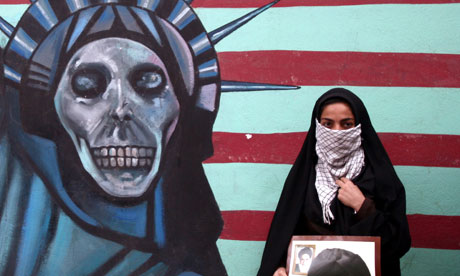
An Iranian female student during a demonstration marking the 32nd anniversary of US Embassy in Tehran, 2011. Photograph: Abedin Taherkenareh/EPA
In the years of conscious, self-inflicted decline at home, "losses" continued to mount elsewhere. In the past decade, for the first time in 500 years, South America has taken successful steps to free itself from western domination, another serious loss. The region has moved towards integration, and has begun to address some of the terrible internal problems of societies ruled by mostly Europeanized elites, tiny islands of extreme wealth in a sea of misery. They have also rid themselves of all US military bases and of IMF controls. A newly formed organization, CELAC, includes all countries of the hemisphere apart from the US and Canada. If it actually functions, that would be another step in American decline, in this case in what has always been regarded as "the backyard".
Even more serious would be the loss of the MENA countries – Middle East/North Africa – which have been regarded by planners since the 1940s as "a stupendous source of strategic power, and one of the greatest material prizes in world history". Control of MENA energy reserves would yield "substantial control of the world", in the words of the influential Roosevelt advisor AA Berle.
To be sure, if the projections of a century of US energy independence based on North American energy resources turn out to be realistic, the significance of controlling MENA would decline somewhat, though probably not by much: the main concern has always been control more than access. However, the likely consequences to the planet's equilibrium are so ominous that discussion may be largely an academic exercise.
The Arab Spring, another development of historic importance, might portend at least a partial "loss" of MENA. The US and its allies have tried hard to prevent that outcome – so far, with considerable success. Their policy towards the popular uprisings has kept closely to the standard guidelines: support the forces most amenable to US influence and control.
Favored dictators are supported as long as they can maintain control (as in the major oil states). When that is no longer possible, then discard them and try to restore the old regime as fully as possible (as in Tunisia and Egypt). The general pattern is familiar: Somoza, Marcos, Duvalier, Mobutu, Suharto, and many others. In one case, Libya, the three traditional imperial powers intervened by force to participate in a rebellion to overthrow a mercurial and unreliable dictator, opening the way, it is expected, to more efficient control over Libya's rich resources (oil, primarily, but also water, of particular interest to French corporations), to a possible base for the US Africa Command (so far, restricted to Germany), and to the reversal of growing Chinese penetration. As far as policy goes, there have been few surprises.
Crucially, it is important to reduce the threat of functioning democracy, in which popular opinion will significantly influence policy. That, again, is routine, and quite understandable. A look at the studies of public opinion undertaken by US polling agencies in the MENA countries easily explains the western fear of authentic democracy, in which public opinion will significantly influence policy.
Israel and the Republican party
Similar considerations carry over directly to the second major concern addressed in the issue of Foreign Affairs cited in part one of this piece: the Israel-Palestine conflict. Fear of democracy could hardly be more clearly exhibited than in this case. In January 2006, an election took place in Palestine, pronounced free and fair by international monitors. The instant reaction of the US (and, of course, Israel), with Europe following along politely, was to impose harsh penalties on Palestinians for voting the wrong way.
That is no innovation. It is quite in accord with the general and unsurprising principle recognized by mainstream scholarship: the US supports democracy if, and only if, the outcomes accord with its strategic and economic objectives, the rueful conclusion of neo-Reaganite Thomas Carothers, the most careful and respected scholarly analyst of "democracy promotion" initiatives.
More broadly, for 35 years, the US has led the rejectionist camp on Israel-Palestine, blocking an international consensus calling for a political settlement in terms too well known to require repetition. The western mantra is that Israel seeks negotiations without preconditions, while the Palestinians refuse. The opposite is more accurate. The US and Israel demand strict preconditions, which are, furthermore, designed to ensure that negotiations will lead either to Palestinian capitulation on crucial issues or nowhere.
The first precondition is that the negotiations must be supervised by Washington, which makes about as much sense as demanding that Iran supervise the negotiation of Sunni-Shia conflicts in Iraq. Serious negotiations would have to be under the auspices of some neutral party, preferably one that commands some international respect, perhaps Brazil. The negotiations would seek to resolve the conflicts between the two antagonists: the US-Israel on one side, most of the world on the other.
The second precondition is that Israel must be free to expand its illegal settlements in the West Bank. Theoretically, the US opposes these actions, but with a very light tap on the wrist, while continuing to provide economic, diplomatic, and military support. When the US does have some limited objections, it very easily bars the actions, as in the case of the E-1 project linking Greater Jerusalem to the town of Ma'aleh Adumim, virtually bisecting the West Bank – a very high priority for Israeli planners (across the spectrum), but raising some objections in Washington, so that Israel has had to resort to devious measures to chip away at the project.
The pretense of opposition reached the level of farce last February when Obama vetoed a UN security council resolution calling for implementation of official US policy (also adding the uncontroversial observation that the settlements themselves are illegal, quite apart from expansion). Since that time, there has been little talk about ending settlement expansion, which continues with studied provocation.
Thus, as Israeli and Palestinian representatives prepared to meet in Jordan in January 2011, Israel announced new construction in Pisgat Ze'ev and Har Homa, West Bank areas that it has declared to be within the greatly expanded area of Jerusalem, annexed, settled, and constructed as Israel's capital, all in violation of direct security council orders. Other moves carry forward the grander design of separating whatever West Bank enclaves will be left to Palestinian administration from the cultural, commercial, political center of Palestinian life in the former Jerusalem.
It is understandable that Palestinian rights should be marginalized in US policy and discourse. Palestinians have no wealth or power. They offer virtually nothing to US policy concerns; in fact, they have negative value, as a nuisance that stirs up "the Arab street".
Israel, in contrast, is a valuable ally. It is a rich society with a sophisticated, largely militarized, high-tech industry. For decades, it has been a highly valued military and strategic ally, particularly since 1967, when it performed a great service to the US and its Saudi ally by destroying the Nasserite "virus", establishing the "special relationship" with Washington in the form that has persisted since. It is also a growing center for US high-tech investment. In fact, high tech and, particularly, military industries in the two countries are closely linked.
Apart from such elementary considerations of great power politics as these, there are cultural factors that should not be ignored. Christian Zionism in Britain and the US long preceded Jewish Zionism, and has been a significant elite phenomenon with clear policy implications (including the Balfour Declaration, which drew from it). When General Allenby conquered Jerusalem during the first world war, he was hailed in the American press as Richard the Lion-Hearted, who had at last won the Crusades and driven the pagans out of the Holy Land.
The next step was for the Chosen People to return to the land promised to them by the Lord. Articulating a common elite view, President Franklin Roosevelt's secretary of the interior, Harold Ickes, described Jewish colonization of Palestine as an achievement "without comparison in the history of the human race". Such attitudes find their place easily within the providentialist doctrines that have been a strong element in popular and elite culture since the country's origins: the belief that God has a plan for the world and the US is carrying it forward under divine guidance, as articulated by a long list of leading figures.
Moreover, evangelical Christianity is a major popular force in the US. Further toward the extremes, End Times evangelical Christianity also has enormous popular outreach, invigorated by the establishment of Israel in 1948, revitalized even more by the conquest of the rest of Palestine in 1967 – all signs that End Times and the Second Coming are approaching.
These forces have become particularly significant since the Reagan years, as the Republicans have abandoned the pretence of being a political party in the traditional sense, while devoting themselves in virtual lockstep uniformity to servicing a tiny percentage of the super-rich and the corporate sector. However, the small constituency that is primarily served by the reconstructed party cannot provide votes, so they have to turn elsewhere.
The only choice is to mobilize tendencies that have always been present, though rarely as an organized political force: primarily nativists trembling in fear and hatred, and religious elements that are extremists by international standards but not in the US. One outcome is reverence for alleged Biblical prophecies, hence not only support for Israel and its conquests and expansion, but passionate love for Israel, another core part of the catechism that must be intoned by Republican candidates – with Democrats, again, not too far behind.
These factors aside, it should not be forgotten that the "Anglosphere" – Britain and its offshoots – consists of settler-colonial societies, which rose on the ashes of indigenous populations, suppressed or virtually exterminated. Past practices must have been basically correct, in the US case, even ordained by Divine Providence. Accordingly, there is often an intuitive sympathy for the children of Israel when they follow a similar course. But primarily, geostrategic and economic interests prevail, and policy is not graven in stone.
The Iranian "threat" and the nuclear issue
Let us turn finally to the third of the leading issue addressed in the establishment journals cited earlier, the "threat of Iran". Among elites and the political class, this is generally taken to be the primary threat to world order – though not among populations. In Europe, polls show that Israel is regarded as the leading threat to peace. In the MENA countries, that status is shared with the US, to the extent that in Egypt, on the eve of the Tahrir Square uprising, 80% felt that the region would be more secure if Iran had nuclear weapons. The same polls found that only 10% regard Iran as a threat – unlike the ruling dictators, who have their own concerns.
In the United States, before the massive propaganda campaigns of the past few years, a majority of the population agreed with most of the world that, as a signatory of the Non-Proliferation Treaty, Iran has a right to carry out uranium enrichment. And even today, a large majority favors peaceful means for dealing with Iran. There is even strong opposition to military engagement if Iran and Israel are at war. Only a quarter regard Iran as an important concern for the US altogether. But it is not unusual for there to be a gap, often a chasm, dividing public opinion and policy.
Why exactly is Iran regarded as such a colossal threat? The question is rarely discussed, but it is not hard to find a serious answer – though not, as usual, in the fevered pronouncements. The most authoritative answer is provided by the Pentagon and the intelligence services in their regular reports to Congress on global security. They report that Iran does not pose a military threat. Its military spending is very low even by the standards of the region, minuscule, of course, in comparison with the US.
Iran has little capacity to deploy force. Its strategic doctrines are defensive, designed to deter invasion long enough for diplomacy to set it. If Iran is developing nuclear weapons capability, they report, that would be part of its deterrence strategy. No serious analyst believes that the ruling clerics are eager to see their country and possessions vaporized, the immediate consequence of their coming even close to initiating a nuclear war. And it is hardly necessary to spell out the reasons why any Iranian leadership would be concerned with deterrence, under existing circumstances.
The regime is doubtless a serious threat to much of its own population – and regrettably, is hardly unique on that score. But the primary threat to the US and Israel is that Iran might deter their free exercise of violence. A further threat is that the Iranians clearly seek to extend their influence to neighboring Iraq and Afghanistan, and beyond, as well. Those "illegitimate" acts are called "destabilizing" (or worse). In contrast, forceful imposition of US influence halfway around the world contributes to "stability" and order, in accord with traditional doctrine about who owns the world.
It makes very good sense to try to prevent Iran from joining the nuclear weapons states, including the three that have refused to sign the Non-Proliferation Treaty – Israel, India, and Pakistan, all of which have been assisted in developing nuclear weapons by the US, and are still being assisted by them. It is not impossible to approach that goal by peaceful diplomatic means. One approach, which enjoys overwhelming international support, is to undertake meaningful steps towards establishing a nuclear weapons-free zone in the Middle East, including Iran and Israel (and applying as well to US forces deployed there), better still extending to South Asia.
Support for such efforts is so strong that the Obama administration has been compelled to formally agree, but with reservations: crucially, that Israel's nuclear program must not be placed under the auspices of the International Atomic Energy Association, and that no state (meaning the US) should be required to release information about "Israeli nuclear facilities and activities, including information pertaining to previous nuclear transfers to Israel". Obama also accepts Israel's position that any such proposal must be conditional on a comprehensive peace settlement, which the US and Israel can continue to delay indefinitely.
This survey comes nowhere near being exhaustive, needless to say. Among major topics not addressed is the shift of US military policy towards the Asia-Pacific region, with new additions to the huge military base system underway right now, in Jeju Island off South Korea and Northwest Australia, all elements of the policy of "containment of China". Closely related is the issue of US bases in Okinawa, bitterly opposed by the population for many years, and a continual crisis in US-Tokyo-Okinawa relations.
Revealing how little fundamental assumptions have changed, US strategic analysts describe the result of China's military programs as a "classic 'security dilemma', whereby military programs and national strategies deemed defensive by their planners are viewed as threatening by the other side", writes Paul Godwin of the Foreign Policy Research Institute. The security dilemma arises over control of the seas off China's coasts. The US regards its policies of controlling these waters as "defensive", while China regards them as threatening; correspondingly, China regards its actions in nearby areas as "defensive", while the US regards them as threatening. No such debate is even imaginable concerning US coastal waters. This "classic security dilemma" makes sense, again, on the assumption that the US has a right to control most of the world, and that US security requires something approaching absolute global control.
While the principles of imperial domination have undergone little change, the capacity to implement them has markedly declined as power has become more broadly distributed in a diversifying world. Consequences are many. It is, however, very important to bear in mind that, unfortunately, none lifts the two dark clouds that hover over all consideration of global order: nuclear war and environmental catastrophe, both literally threatening the decent survival of the species.
Quite the contrary. Both threats are ominous, and increasing.

Noam Chomsky for TomDispatch, part of the Guardian Comment Network