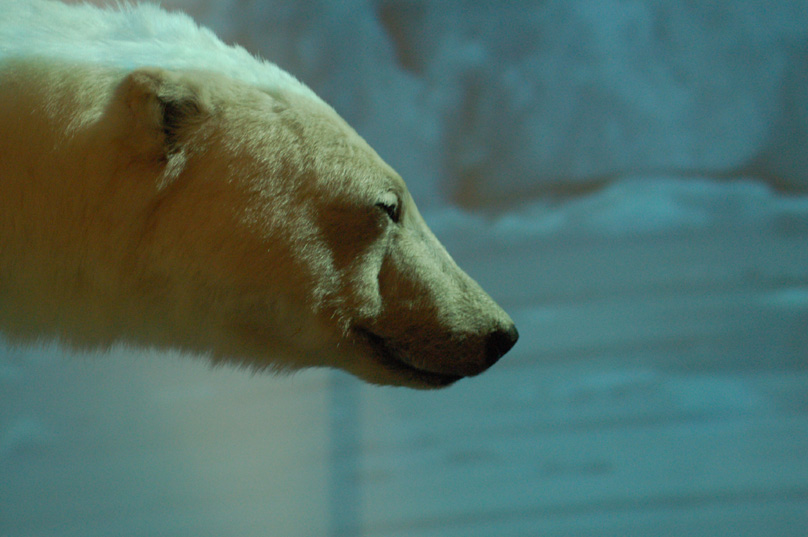
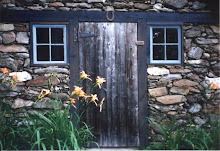
Destruction First of all do you remember the way a bear goes through a cabin when nobody is home? He goes through the front door. I mean he really goes through it. Then he takes the cupboard off the wall and eats a can of lard. He eats all the apples, limes, dates, bottled decaffeinated coffee, and 35 pounds of granola. The asparagus soup cans fall to the floor. Yum! He chomps up Norwegian crackers stashed for the winter. And the bouillon, salt, pepper, paprika, garlic, onions, potatoes. He rips the Green Tara poster from the wall. Tries the Coleman Mustard. Spills the ink, tracks in the flour. Goes up stairs and takes a shit. Rips open the water bed, eats the incense and drinks the perfume. Knocks over the Japanese tansu and the Persian miniature of a man on horseback watching a woman bathing. Knocks Shelter, Whole Earth Catalogue, Planet Drum, Northern Mists, Trucks Tracks, and Women's Sports into the oozing water bed mess. He goes down stairs and out the back wall. He keeps on going for a long way and finds a good cave to sleep it all off. Luckily he ate the whole medicine cabinet, including stash of LSD, Peyote, Psilocybin, Amanita, Benzedrine, Valium and aspirin.
________________ Joanne Kyger
a forever classic ~ with its strength of natural storytelling and aplomb combined with a sheer intelligence of what the poet knows from cultures and the cabin
Magic Words In the very earliest time, when both people and animals lived on earth, a person could become an animal if he wanted to and an animal could become a human being. Sometimes they were people and sometimes animals and there was no difference. All spoke the same language. That was the time when words were like magic. The human mind had mysterious powers. A word spoken by chance might have strange consequences. It would suddenly come alive and what people wanted to happen could happen — all you had to do was say it. Nobody could explain this: That's the way it was. translated from the Inuit by Edward Field __________________________________
FARMS GOT SO POOR "IT TOOK TWO ROOSTERS TO CROW ONCE"
From the song 'My Last Ole Dollar' a classic hard-luck story from North Carolina comes collected by Lee Morris (MS Federal Writers Project):
"Hard luck just runs in my family. I mind the time I couldn't even buy a hen and a chicken. Decided to kill myself. Scared my old pistol wouldn't work, so I bought me a gallon of kerosene, a piece of rope, bottle of rat poison. Rowed down to the lake to where some trees hung way out over the water.
So I stood up and tied the rope round my neck. Bid farewell to this hard old world. Poured kerosene all over myself, et that rat poison and set my clothes afire, figgerin' I'd shoot myself just when I kicked the bat out from under my feet.
But that durn pistol shot the rope in two. I fell in the river and put out the fire on my clothes and got to stranglin' and chokin' that water, and throwed up the poison. Well from that I figgered my luck was changin', so I swum out and put up for the legislature. Durned if I didn't get elected, too!"
(and I believe we saw some of his younger relatives in the U.S. House of Representatives during the impeachment hearings for Donald J. Trump; in fact, I know we did.)
No book I went back to read during the Covid-19 pandemic
treated me better and settled down around my shins finer than
Alan Lomax's The Folk Songs of North America. My copy
is a hardcover still in its decorative dustjacket and the boards
of the book are layered in old moss and smell like I've pulled out
a slate shingle from an old pile instead of a book. Lord knows where
I ever found the book — I first read Folk Song USA (John and Alan Lomax, the power house
father and son team of traveling sleuths and field recorders)
in puffy softcover while in high school and it was just too loaded for bear at the time and age
when listening to Bob Dylan, Richard Farina, Phil Ochs, Dave Van Ronk,
Tom Paxton, Hedy West, Joan Baez who had obviously worked like miners
through this book and the North America bible.
Since Lomax believed the folk song was aligned with
fantasy and the skill of the unconscious where the American dream and
struggle is truly revealed. In the above players mentioned, Dylan's masterpiece
"Highway 61" (1965) may be our best example. The maestro has readily
admitted what he pulled out of the guts of this book and the Lomax (and Harry Smith)
jukebox, and we haven't even touched down into the rich gardens this book
gives (there are 300 songs) through original work by the likes of Merle Travis,
A poem (or more) will be offered by the hour or with the day and at the very least once a week. So stay on your webbed toes. The aim is to share good hearty-to-eat poetry. This is a birdhouse size file from the larger Longhouse which has been publishing from backwoods Vermont since 1971 books, hundreds of foldout booklets, postcards, sheafs, CD, landscape art, street readings, web publication, and notes left for the milkman. Established by Bob & Susan Arnold for your pleasure. The poems, essays, films & photographs on this site are copyrighted and may not be reproduced without the author's go-ahead.
New from Bob Arnold ~ "Faraway Like The Deer's Eye" ~ Bob Arnold Faraway Like the Deer’s Eye — A Saga — FOUR BOOKS IN ONE VOLUME ~ A Poet’s Memoir // 50 Years of Longhouse & Poets // A Builder’s Life, with photo assembly // The Selected Poems of Bob Arnold // An afterword by Andrew Schelling
Longhouse Bibliography Quick Link —
Link to the Birdhouse Bibliography
Read about Longhouse (a press edited by Bob Arnold) ~
"Poets Who Sleep" by Bob Arnold, Longhouse 2019. 500 portraits by Bob Arnold of poets worldwide & others. Please link on image for ordering information.
Link to a Preview of Poets Who Sleep
Shared at "Dispatches from the Poetry Wars"
Heaven Lake by Bob Arnold
Available from Longhouse. Please link on the image for ordering information.
The Woodcutter Talks by Bob Arnold
Available from Longhouse. Please link on the image for ordering information. Drawing from years of poetry and also new poems, The Woodcutter Talks is Bob Arnold at his finest branching love poems with back country work poems and settlement with community, family and individual portraits. The extensive collection also showcases vintage photographs from woodcutters and woodchoppers and big-saw-pullers of old. Sweat runs down the cheeks of the mere literary and they adore one another.
Stone Hut by Bob Arnold
"Once again, my friends, this is your best book! Exquisite in design, fat enough to be a feast, pretty enough to just wade around in, but deep enough to dive into and stay with, all I can say is WOW, you guys really did it – it’s the first of its kind, a scrapbook novel that is also a how-to and a mystery -- how did he do it, and how does he make rocks balance like Thor? — Gerald Hausman" ~
Museum, An Unlikely Meditation, written by the poet Bob Arnold, is as much an unlikely novel. Visit this page for details.
Cid Corman's Of, Volumes 4 & 5 from Longhouse.
ANNOUNCING. The final volumes to Corman's opus in one book ~ of, volumes 4 & by Cid Corman. 1500 poems, 850 pages edited by Bob Arnold, now available in a limited edition from Longhouse, 2015. Please link on the cover image for details & Paypal payment information ~
'Fully a book ~
An interview with Bob Arnold on Cid Corman’s ‘of’
Janina by Janine Pommy Vega
New and available now from Longhouse ~ Janine Pommy Vega Janina Visions, Tales & Lovesongs 288 pages perfect bound packed with poems and photographs. Janine's full course album of photographs, travel journals, poems, facsimile notebooks of poems, childhood photographs, and family, Beat family, plus her unfinished memoir of Jerusalem.
Walking Woman with the Tambourine is the final book of poems by Janine Pommy Vega.
"Walking Woman with the Tambourine is the final book of poems by Janine Pommy Vega. The author completed the manuscript and left it as she wished with her executor Bob Arnold … New and available now from Longhouse ~ Poetry. 144 pages. Perfect bound softcover. Please link on the image for ordering information
New! James Koller : Selected Poems 2003-2004-2005
James Koller — Selected Poems 2003-2004-2005 Longhouse 2016, 72 pages, perfect bound. Please link on the cover image for details & Paypal payment information PLUS more from Longhouse
OPENINGS by JAMES KOLLER
Selected poems 1959 ~ 1985 edited by Bob Arnold. New and available now from Longhouse ~ 72 pages . Perfect bound softcover. Please link on the cover image for details & Paypal payment information PLUS more from Longhouse
Lorine Niedecker's A Cooking Book
A Cooking Book Lorine Niedecker Longhouse 2015 72 pages, perfect bound. Please link on the image to purchase this new title from Longhouse.
Kent Johnson's "I Once Met"
Available once again now in 2022! $25 plus shippingVisit the Birdhouse for Kent's book information :
JD Whitney's Selected Poems
J.D. Whitney ~Sweeping the Broom Shorter Selected Poems 1964-2014 from ~ Longhouse 2014. 192 pages. Please link on the cover image for details & Paypal payment information PLUS more from Longhouse
New! from Longhouse ~ Island Dreams by Gerald Hausman Please link for details & Paypal payment
ISLAND DREAMS by GERALD HAUSMAN Selected Poems 1968 ~ 2015 chosen & edited by Bob Arnold New and available now from Longhouse ~ 160 pages Perfect bound softcover. Please link on the cover image for details & Paypal payment information PLUS more from Longhouse
John Bradley's "And Thereby Everything"
L O N G H O U S E is very proud to announce a new book by John Bradley in their on going series of S C O U T book publications — other titles from the series have been by Kent Johnson, Janine Pommy Vega, James Koller, Bob Arnold and Lorine Niedecker with more in the works. An opening salvo at the front of the book by Patrick Lawler should provide ample cover for what the reader should come to expect. And Thereby Everything John Bradley Longhouse 2015 First edition only issued in softcover 208 pages, perfect bound illustrated throughout by Bob Arnold with 150 photographs
Dudley Laufman : Bull & More Bull
Visit this page for information on this new Longhouse by Dudley Kaufman (2016)
Dudley Laufman's Islandian Poems
The Islandian Poems & Fables Dudley Laufman Longhouse 2015. 72 pages, perfect bound. Please link on the image to purchase this new title from Longhouse.
Duo by Bob Arnold — New from Longhouse Please link to A Longhouse Birdhouse for more information
DUO Bird Poems by BOB ARNOLD. New and available now from Longhouse ~ 92 pages. Perfect bound softcover. Please link on the cover image for details & Paypal payment information PLUS more from Longhouse
Start With The Tree by Bob Arnold
New in 2015. Building a marriage, building a family, building a small barn out in the woodlands together as a family, as a marriage, and seeing the roof go on. Over 150 color photographs
Beautiful Days by Bob Arnold
Beautiful Days ~ new poems of living and working in the Vermont woodlands and to Hurricane Irene
Yokel by Bob Arnold
[from "Yokel, A Long Green Mountain Poem" by Bob Arnold] ~ that and more at Bob Arnold webpage of books & poems: Please link on this image for more
Go West by Bob Arnold
Filled with poems and travel photography — shares one cross-country trip the couple took in the mid-1980s to California from Vermont.
"I'm In Love With You Who Is In Love With Me" by Bob Arnold
from Bob Arnold's new book "I'm In Love With You Who Is In Love With Me" ~~~~~~~40 years of love poems
"Rain Bear" by Bob Arnold
Bob Arnold's first children's book "Rain Bear" New and available now from Longhouse ~ 50 pages. Perfect bound softcover with photographs ~ & drawings by Jason Clark
"Heretic" by John Phillips from Longhouse
New from Longhouse ~ John Phillips "Heretic". Poems with collages by the author. Click on the image for more ~
Kim Dorman — "Owner"
"Owner" by Kim Dorman. Including photographs by Kim Dorman. Selected and edited by Bob Arnold. New and available now from Longhouse 2016 ~ 80 pages. Perfect bound softcover