Wednesday, November 9, 2011

DELTA ~


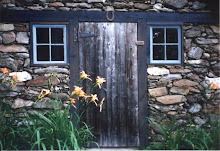
"Three pictures from a recent excursion around the Delta and Hill Country."

That's what Longhouse friend Whit Griffin wrote to us this morning and I thought the setting and timing was quiet enough to share.

Whit often takes photographs and sends them our way from his travels. I didn't even ask him this time if it was okay to post — it always seems okay between us. I kinda wanted to surprise him back with the shots.


The legendary life dates for Robert Johnson are barely wide enough to get a breath taken. Just one song from him is worth a life time.


I remember reading once that Fred McDowell's original gravestone (where his name was spelled incorrectly) had been damaged and replaced by this one above. Bonnie Raitt paid for the new stone, and that photograph of the great bluesman on the stone, born in Tennessee, may have been taken the year he died.

Rest in peace, and song.


photos © whit griffin


OCCUPY ~


Ishmael Reed


Tuesday, November 8, 2011

EARTH ~


land of well being


the world is flat, then, after all. musically
curved at its finite edges, where
the few houses stand like scattered dice.
this lake, i'm told, is called green shimmer.
how reluctantly the light leaves the water,
the gentlest waves, tiny wrinkles, still
faintly illuminated. such magnanimity.
panoramas, not extending sideways,
not stretching like straight lines, broadly
from east to west, not these tired perspectives,
but curving round behind me with a whisper,
as if of their own accord, joining
to make a perfect shape, the circle.
"a parte ante" and "a parte post", i read
there, are the names given to the parts
of eternity that lie in front of me and behind,
and i thought to myself: what the heck.


each and every one


feelings like dropped pebbles, show me your hand.
the oval shape of summer, do you remember: euglena,
it will all be simple, all of it, and each and every one a nucleus,
it's like chemistry, your elements are void, void, void,
you repeat yourself, you're adrift, the stroke of the hour smudges.
shoot skywards, with the crazed efficiency of a water sprout
then crown the stalk with a ring of withered leaves: this year you can do.
the letting go, two people descending into formlessness.


jardins des tuileries


in the gardens a sweltering inclination
to symmetry, box trees, conically civilized,
heat, and once again the selfsame fountain,
overloaded, mirrored along a psychic axis,
just faintly confusing. so hot. then me
as a variant, holding his sweaty hand, a veil,
like an inner mist, condensation, droplets,
we think with our hair, with our cilia, and
where it exits the body it enters again,
it's warm like stepping indoors,
a steamy room in the lung's midst perhaps,
the cunning softness of oriental cushions,
devotion to the beat of chopping hands and
the symmetrical aftertaste of our boundaries.


my thinking


today, around lunchtime, i saw my thinking,
it was a meadow, grazed bare, with hummocks. though
it could have been foothills of moss-covered mountains,
the kind of fuzzy green carpet fed on by reindeer.
no, just a busily bulging landscape beyond
the tree line, and it sure was close-cropped.
the thoughts passed over it, a little light-headed,
like currents of air made visible, no, more
like a fleet of immaterial hovercrafts. they used
the hummocks----------------------as ramps.


tour de trance
my task, she said, was poisoning time


how everything turned, repeated, expanded
and rotated, heat was a space so vast,
so disastrously large, was an arena
in which the wreckage of objects drifted,
savage impacts in the distance, no one heard,
everyone felt, the pulsing aftershocks.
where something was missing, it all got bigger,
turned, rotated, lurched about
and then came to rest in the centre.
fatigue was a cure, the weight
of the atmosphere, hallucinogenic heaviness
cushioned, it was turning less now,
as if the impacts, in their very substance,
were subject to dilution, as if
time, torrential space, were being precisely and
tenderly poisoned, the chemical weakness
rising in its fabric, frothing, suffocating,
the accumulated white layer of
crusts becoming richer, the impacts
fading into toxic noise, it turns,
turns imperceptibly, and stops.


MONIKA RINCK
to refrain from embracing
translated from the German by Nicholas Grindell

www.burningdeck.com

Spectacular Diseses
Paul Green
83b London Rd
Peterborough, Cambs. PE2 (BS
England


monika rinck b. 1969 Zweibrucken and lives today in Berlin.
www.begriffsstudio.de


Monday, November 7, 2011

KEYSTONE ~


Surrounding the White House with a Pipeline


Sunday, November 6, 2011

QUIET ~


Greta Garbo


EARTH ~


While we turn the clock back . . .


Wizz Jones


nite~nite


Saturday, November 5, 2011

WITH ME ~


Rick Danko


Personally, I got a real thing for people shambling in with their heart on their sleeves. It may appear sloppy, noisy, jangling, disruptive, and it often is, and if that's all that it is, I'm not interested. But if it has that other little ingredient, the sleeve and the heart, with the sleeve wiping the mouth of soup, well okay.


Rick Danko of The Band and other bands (Paul Butterfield's etc) always came across to me when performing as the kid with heart. You get to watch it all through Martin Scorsese's seminal concert film The Last Waltz, where Rick Danko and The Band are in their prime. If you've never seen this film, you can't leave the earth before doing so. Please proceed.


Then return sometime and listen to this one song, sloppy and heart felt, that I've pulled from the film that you may click on below. It's Rick Danko up and down.


And years later when he grew older and slower and died far too young, the same rock 'n' roll kid forever came through. I see him as a guy who would have traveled awhile with Woody Guthrie or Joe Hill; who would have fought in the Civil War and survived, who would like to sing to the troops at Occupy Wall Street; who would have said, 'Sure, I'll help you unload that load' when the truck backed in to the drive. Someone to miss when he's gone.


photo:
planetlyrics.co


Friday, November 4, 2011

MORE NOVICA TADIC´ ~


IF YOU WERE TO GET A JOB


If you were to get a job

you'd become some kind of big shot

and give me a job in turn.

Then your head would swell,

and I'd suffer.

It's better that you don't get a job,

that we continue to live here

--in the cardboard box.

I only need bread and milk

and a blanket to cover our limbs.


=


NIGHT PASSES


1.


Poor us, we are all kings
when we gaze at the starry sky.


2.


The noise of the crowd grows faint
on the town square and in our blood.


3.


The voice will re-enter the angel's trumpet.
Once again hell will rise on its feet.


translated from the Serbian by Charles Simic
Dark Things (BOA Editions, 2009)


1st photo:
© by Gardabelle


Thursday, November 3, 2011

EARTH ~


We worked six weeks since Hurricane Irene on our island by the river and cleared up all the mess. Call it what it was — a mess, with full trees smashed together with everything else plus the kitchen sink, wrapped up in the trees debris. It made us plenty of firewood. Some dry elm, ready immediately and in the woodstove as I write.


I won't bore you how we got the wood cut, split, lugged, and back home. Think: little engines that could. I’ve become a lousy writer retelling this story over and over as if the work drill has been unavoidable from the actual work to what is caught in the cycle of my brain. Repetitious log lugging by foot over land and water with only my mind and landscape as company? What luxury, if keeping with the right attitude. Work like a work horse, speak like a work horse? I think so.


A respiratory cough also came with the flood aura and work. Talk to many who have been working steadily around flood damage and wet conditions and there's a cough.


While working on the island, large cottonwood style poplar trees were dislodged and instead of carting all of that home, I sculptured out by chain saw four chairs and one stump table seen above in the photograph. All the background oak logs were bucked up, split and carried home.


One morning we decided to bring breakfast down to the island. Hobos retreat.


The tree damage was severe but it brought us firewood. Much land was washed away but it brought us a fresh crop of stone. We make things.


And then — heavy, heavy early snow for Halloween! Everything in this photograph, but Sweetheart, is now buried.


Since October snows at almost two feet it has melted down to one foot the third day of November, but it looks more like March melting to April. Except the oak and beech leaves are golden and dying instead of greening. If climate change is here, we may have to change the names of the months.


photo © bob arnold


Wednesday, November 2, 2011

BEDTIME STORY ~


read more!
http://www.goodnightkeithmoon.com/index.html


I put this on for our son Carson, who over a period of his early years, we read Goodnight Moon to at every bedtime. Even after we all memorized the book, we still read from the book. One had to have the pictures. And lo and behold Carson grew up to be a musician and drummer.


OCCUPY ~


MOVE YOUR MONEY ~ IF YOU GOT ANY


film by:
eugene jarecki


Tuesday, November 1, 2011

OCCUPY ~


They say the "homeless" are coming in droves, or infiltrating, or bothering the protestors at the Occupy sites nation wide. Blending in. Bothering with their unreeled minds, madness, appearance, what have you.


I have a home, you may have a home, at least a computer, even if borrowed in a library setting, or cafe, call it a momentary home.


But the way this country and world has become we are all "homeless", until we wake up to the fact anyone made homeless, especially by banking and mortgage and false-swap thieves right in our midst! then we are all of the 99%, homeless. One false move, hiccup, accident, and you could be there.


Those ghosts, those phantoms, those zombies, those human beings left to cold, left to rust, left to rot, are you. Are me. Are you.


A guy my age, dressed quite like me, asked me for 25 cents on a bridge yesterday. He said he needed it for the bus. I gave it to him. Then I watched him run for the bus.


photo © bob arnold


Monday, October 31, 2011

JOSE SARAMAGO ~


Jose Saramago


JOSE SARAMAGO: September 18 - George W. Bush,
or the Age of Lies


I wonder why it is that the United States, a country so great in all things, has so often had such small presidents. George W. Bush is perhaps the smallest of them all. This man, with his mediocre intelligence, abysmal ignorance, confused communication skills, and constant succumbing to the irresistible temptation of pure nonsense, has presented himself to humanity in the grotesque pose of a cowboy, who has inherited the world and mistaken it for a herd of cattle. We don't know what he really thinks, we don't even know if he does think (in the noble sense of the word), we don't know whether he might not be just a badly programmed robot that constantly confuses and switches around the messages it carries around inside it. But to give the man some credit for once in his life, there is one program in the robot George Bush, president of the United States, that works to perfection: lying. He knows he's lying, he knows we know he's lying, but being a compulsive liar, he will keep on lying even when he has the most naked truth right there before his eyes — he will keep on lying even after the truth has exploded in his face. He lied to justify waging war in Iraq just as he lied about his stormy and questionable past, and with just the same shamelessness. With Bush, the lies come from very deep down; they are in his blood. A liar emeritus, he is the high priest of all the other liars who have surrounded him, applauded him, and served him over the past few years.

George Bush expelled truth from the world, establishing the age of lies that now flourishes in its place. Human society today is contaminated by lies, the worst sort of moral contamination, and he is among those chiefly responsible. The lie circulates everywhere with impunity, and has already turned into a kind of other truth. When a few years ago a Portuguese prime minister — whose name for charity's sake I will not mention here — stated that "politics is the art of not telling the truth," he could never have imagined that some time later George W. Bush would transform this shocking statement into a naive trick of fringe politics, with no real awareness of the value or the significance of words. For Bush, politics is simply one of the levers of business, and perhaps the best one of all — the lie as a weapon, the lie as the advance guard of tanks and cannons, the lie told over the ruins, over the corpses, over humanity's wretched and perpetually frustrated hopes. We cannot be sure that today's world is more secure, but we can have no doubt that it would be much cleaner without the imperial and colonial politics of the president of the United States, George Walker Bush, and of the many — quite aware of the fraud they were perpetrating — who allowed him into the White House. History will hold them to account.
(2008)


JOSE SARAMAGO: February 4 - Bankers


What can be done about the bankers? They tell us that the founders of the banking system, back in the sixteenth and seventeenth centuries, at least in Central Europe, were in general Calvinists, folk with an exigent moral code who, at least for a while, had the laudable scruple to labor honestly at their profession. That period must have been short, given the infinite power of money to corrupt. Gradually, the banks changed a great deal, and always for the worse. Now, in the midst of an economic crisis affecting financial systems around the world, we are beginning to experience the uncomfortable sensation that those who are going to come off best from the financial storms are precisely our Senhores Bankers. Everywhere governments, following the logic of the absurd, rushed to rescue the banks from losses for which, for the most part,those self-same bankers were responsible. Millions of millions left state coffers (or the accounts of the bankers' clients) in order to keep hundreds of major banks afloat and to allow them to resume one of their principal functions, that of providing credit. It would seem there are serious signs that bankers had their wits about them, abusively assuming that the money was theirs simply because it happened to be in their grasp and, as if all this weren't already more than enough, reacting coldheartedly to pressure from their governments to put the cash rapidly into circulation, the one way to save thousands of businesses from failure and millions of workers from unemployment. It is now clear that the bankers are not men to be trusted, the proof being the disdain with which they bite the hand that feeds them. (2009)


young Saramago


Born in Portugal to landless peasants 16 November 1922, and passing away in Spain 18 June 2010 at age 87, Jose Saramago won the Nobel Prize for Literature in 1998. The above is taken from The Notebook, a year (2008-2009) in the life of a terrific blogger, published by Verso in 2010.


Sunday, October 30, 2011

OCCUPY ~


The Supreme Court as Nascar Drivers


For all those with queries about Occupy Wall Street and befuddled why anyone would be questioning authority ~ perhaps this Sunday New York Times article by Thomas Friedman will shed some light:


photo:
thedaviedemocrat.com


EARTH ~


Just came in, after two-hours hand-shoveling the driveway of a near two feet of snow (the Berkshire towns Windsor and Savoy, my neighbors as a boy, had over two-feet) to homemade apple pie, scrambled eggs, hash browns, turkey bacon, mugs of orange juice and hot tea and letting all the clothes and boots dry by the woodfire before we head out in the afternoon for another round of shoveling.


The power was also restored at dawn after disappearing into the wilds of overnight. A remarkable recovery since it looked like it might be out for days.


The heavy snow arrived exactly two months to the day since Hurricane Irene. So this is what she is saying: I hope you got onto the point after the hurricane and repaired your roads and bridges and house stoops and landscape, and in the meantime got your firewood in for winter, and chopped your cabbage out of the garden, and covered what needed to be covered, because there is a new snow date in my mind since I was a boy with a snow shovel in the Berkshire Hills circa 1950s. . .then, it was November 15th have-everything-ready-for-snow. Now it's Halloween.

No foolin'.


photo © bob arnold


Saturday, October 29, 2011

LORINE ~


University of Wisconsin Press
uwpress.wisc.edu


"My concern for and with LN will be as long as my life. Her style was neat, unaggressive without being timid or diffident. She knew what she felt and what she wanted, but she would not impose either feeling or desire on others.

Her poems are often "literary"; that is, related to her reading — but they never are merely intellectual or abstract. You can feel her delight in the experience of others and especially the language in which experience have been couched and realized. She has an exquisite ear for detail. Every word is lived. You can feel her in them. She culls them. This is provender.

She had ample cause to be selfpitying and bitter, but her letters to me show no trace of either qualification. Her complaints, when they occur, and only rarely do they occur, are clearly hard wrung and never in excess of provocation. She is unusually well-balanced in her judgements and perspicacious and particular. She is both unpredictable and characteristic. She has learned from others, but projects her own music and her own realizations. There is no sense of complacency.

She is utterly without moralizing. She is never petty. Her warmth of relation to living and dead is pervasive. It is impossible not to love her. I never saw her handwriting — with its immaculate clear modest script — without at once feeling a twinge of pleasure — at whatever she has to say. I always anticipated some shared delight, or pain — which is never unalloyed. She didn't oversimplify, but she never merely decorated. Her haiku-like brief poems are as fine as any short poems of our or any time. . . .

She is never mystical and yet one feels a certain awe at times, a profound giveness to the mysteries. Most often she reverts to some natural relation, to water or work or plants or animals or acquaintances, books and news, the sense of locality.

It aches me yet — her absence. . . .Poetry was her life and her life remains for us as poetry — thanks to her magnanimous gift."

~ from a letter, Cid Corman to Gail Roub


Lorine at the door


Once one becomes one with the poetry of Lorine Niedecker, there are no comparisons — no Emily Dickinson, no Marianne Moore, no H.D. Poets don't like to be compared. And it's becoming rather silly having to tolerate Lorine gaining an audience by forever comparing her to Emily Dickinson. In fact, the power of both was their greater unknown during their lifetimes and just watching a public come to their doors and be overwhelmed.


Poetry is all about being overwhelmed. When you are, go with it. Trust it.


Margot Peters' moving biography of Lorine Niedecker is a tremendous boost to the glory of Lorine Niedecker. There will be quibbles about the portrait from some, and that's okay and in some cases justified — Niedecker research is still a widely exploratory search into the background and earth of this poet. A poet who unlike most poets didn't grow out of an academic background and following, or even out of strictly being a poet. Like Thoreau, and here the comparison I believe is ideal, it was "to live at home like a traveler" as HDT professed and which they both did, about a century apart in time. Like Thoreau and unlike most poets, Lorine Niedecker grew out of the earth of her own private reading and the earth itself — that river swum shoreline of Blackhawk Island in Wisconsin, and except for a cereal bowl of poets as her close readers (and what poets! : Williams, Zukofsky, Bunting, Rakosi, Finlay, Creeley, Corman, J. Williams) she was almost forever alone and unknown.


The Peters' biography doesn't even begin to scratch the rural hardship and life of where Lorine Niedecker was raised, and this will be crucial one day for someone to delve into and come up good and sweet smelly; instead the portrait glides along as a proper introduction through the various stages of the poet's life and writing. And on the sticky subject and background of one Louis Zukofsky, Peters does quite well. The obstacles for privacy in the Zukofsky family tree can be daunting.


Although when you read Cid Corman's words above — and no one knew Lorine Niedecker as so alive as poet and person than Corman (he was the only one with the moxie to get her to record her poems onto a homemade tape) — I was stunned when I read Cid's letter (above) on page 257-258 of the biography, only to be followed by Peters' personal announcement on page 258: "Appreciators though they were, Corman, Bunting, and Jonathan Williams tended to underestimate her poems as subtle, frail blossoms. Zukofsky and William Carlos Williams knew better." Better? Corman and Jonathan Williams staked decades of their personal lives (probably not a penny earned) broadcasting Niedecker's poems to the four winds with the utmost care. They personally Johnny Appleseeded this poet's life, work and legacy while she was alive and long after she was gone (1970); and on top of that, they nurtured a whole next generation of poets and readers into her arms. And she was ready for them. You can make up your own minds just how much of a saint Mr. Zukofsky was to Lorine Niedecker. She loved him, and I prefer Lorine Niedecker to speak for herself.


I can imagine a poet someday coming to Lorine Niedecker the same way Genevieve Taggard held Emily Dickinson when she wrote her singular biography. As if she had the ability to speak before, during, and after the life of the poet. A haunting and forgotten book.


By page 250 and 251 of Margot Peters' biography of Lorine Niedecker I had tears in my eyes. Not saccharine, just the truth. Partly due to the aviation skills of the biographer bringing this bird depth flight of a poet down for a landing, and of course the bird herself.


~BA


If I could float my tentacles / through the deep . . . / pulsate an invisible glow


&


http://www.lorineniedecker.org/index.cfm


poetryfoundation.org

Friday, October 28, 2011

EARTH ~


EMERSON 1862


When newly awaked from lively dreams, we are so near them, still in their sphere; — give us one syllable, one feature, one hint, and we should re-possess the whole; hours of this strange entertainment and conversation would come trooping back to us; but we cannot get our hand on the first link or fibre, and the whole is forever lost. There is a strange wilfulness in the speed with which it disperses, and baffles your grasp.


Cannot we let people be themselves, and enjoy life in their own way? You are trying to make that man another you. One's enough.


Hitch your wagon to a star. Do the like in your choice of tasks. Let us not fag in paltry selfish tasks which aim at private benefit alone. No god will help. We shall find all the teams going the other way. Charles's Wain, the Great Bear, Orion, Leo, Hercules. Every god will leave us. Let us work rather for those interests which the gods honour and promote: justice, love, utility, freedom, knowledge.


Thoreau. Perhaps his fancy for Walt Whitman grew out of his taste for wild nature, for an otter, a woodchuck, or a loon. He loved sufficiency, hated a sum that would not prove; loved Walk and hated Alcott.


The old school of Boston citizens whom I remember in my childhood had great vigour, great noisy bodies; I think a certain sternutatory vigour the like whereof I have not heard again. When Major B. or old Mr. T.H. took out their pocket handkerchiefs at church, it was plain they meant business; they would snort and roar through their noses, like the lowing of an ox, and make all ring again.


Sam Staples yesterday had been to see Henry Thoreau. "Never saw a man dying with so much pleasure and peace." Thinks that very few men in Concord know Mr. Thoreau; finds him serene and happy.


The first care of a man settling in the country should be to open the face of the earth to himself by a little knowledge of Nature, or a great deal of knowledge, if he can, of birds, plants and astronomy; in short, the art of taking a walk.


Henry Thoreau (died May 6, 1862) remains erect, calm, self-subsistent, before me, and I read him not only truly in his Journal, but he is not long out of mind when I walk, and, as to-day, row upon the pond. He chose wisely no doubt for himself to be the bachelor of thought and nature that he was, — how near to the old monks in their ascetic religion! He had no talent for wealth, and knew how to be poor without the least hint of squalor or inelegance. Perhaps he fell — all of us do — into his way of living, without forecasting it much, but approved and confirmed it with later wisdom.
If there is a little strut in the style of Henry, it is only from a vigour in excess of the size of his body.


A man's connections must be looked after. If he surpasses everybody in mother wit, yet is scholar like the rest, be sure he has got a mother or father or aunt or cousin who has the uncorrupted slang of the street, the pure mind, and which is inestimable to him as spice and alterative, and which delights you in his rhetoric, like the devil's tunes when put to slow time in church-music.


The art of the writer is to speak his fact and have done. Let the reader find that he cannot afford to omit any line of your writing, because you have omitted every word that he can spare.
You are annoyed — are you? — that your fine friends do not read you. They are better friends than you knew, and have done you the rarest service. Now write so that they must.


As people rise in the social scale, they think more of each other's opinion than of their own. And it is hard to find one who does not measure his business and daily performance from the supposed estimate. And yet, his own is the only standard. Down in the pits of hunger and want life has a real dignity, from this doing the best, instead of the seemly. The sailor on the topmost in a storm, the hunter amidst the snowdrifts, the woodman in the depth of the forest, cannot stop to think how he looks, or what London or Paris would say, and therefore his garb and behaviour have a certain dignity, like the works of Nature around him; he would as soon ask what the crows and muskrats think of him.


When I bought my farm, I did not know what a bargain I had in the bluebirds, bobolinks, and thrushes; as little did I know what sublime mornings and sunsets I was buying.


from The Journals of Ralph Waldo Emerson (Modern Library)


Henry David Thoreau


Each time I find another edition of Emerson's Journals, feeling right in the hand, I take it up and read from it again. Bring it home. I may have some version of the Journals in every room of our house. Not unusual, there's a lamp in every room of the house.


Thursday, October 27, 2011

LYNDA BARRY ~


THE IMAGE ~
(for a moment)


Lynda Barry


EARTH ~


"Exxon Mobil, the largest U.S. oil company, reported that its net income rose to $10.33 billion in the three months through September, from $7.35 billion a year earlier, helped by an increase in oil prices of about 48 percent from a year ago. "


read more:


society.ezinemark.com
ny times


A MOMENT OF CLARITY ~


Wednesday, October 26, 2011

BELIEVE YOU ME ~


We remember the white building with the mossy cedar shingles on the roof to be a bank at one time. When I wasn't looking it became an insurance company. This small building under the maple trees. Before they built the shopping center behind it, which once was a farmer's pasture. Everyone in town has their own memory of the location. What had once been there. The shopping center came in with a grocer and a Home Depot that folded up its tent in less than a year. We're in a builders region, but we all like our local hardware store. Shoo.

So when we bought our week of groceries and figured we may as well have supper off the grocer's salad bar, the only spot that looked halfway quiet in a loco area was over under the maple trees near the old white building. We'd stay in our pickup truck and have a picnic in the cab, all easy to do with the company you love. We drove over 100 feet from where we had parked and we were there. Our backs to the parking lot, facing the white building, some of the tree shade and still some of the late summer sunshine.

Except just as we were arranging our spread, a car pulled up on our driver side. Funny, who would park here? The business is all over-there. It couldn't possibly be another picnic bunch, could it?

For a moment we stopped our picnic to see what would happen. Maybe it was all a fluke and the couple was disoriented.

But no, a woman got out on the passenger side while a silhouette-figure of a man sat at the wheel. The woman hesitated a moment and then proceeded over the unmowed lawn, seemingly oblivious to the sallow look of the building, the dark windows, the poor roof. She came to the front door and found it bolted. As soon as she touched and felt the lock she shot a glance straight back to her companion who remained where he sat. In her plain and gray skirt and top, the woman returned the same way. She hesitated a moment at the car door and took another look at the building, then through the window to her companion, before opening the door and getting back inside. They didn't wait long. The car started back up and moved out toward the shopping center parking lot. But we noticed it didn't move like a car as much as it flew like a bird, as if floating on its wheels. It was so softly unusual that I had to look away, as if I wasn't sure what it was I was looking at. Hours later I would know.

For ten minutes we joyfully ate and talked and tried not to mess ourselves or the truck. Fresh fruit is always a wise choice when altering the taste of the salad bar. Neat slices of pineapple and melon.

Suddenly, right before our eyes out the windshield, a solo figure appeared at the back car port of the white building. Where cars used to drive through making their money transactions. Where the furry moss cedar shingles on the roof looked the worst. This was a young man, t-shirted, well suntanned, built and scruffy trousered, like he knew physical work and he moved about with an easy agility. His first plan of action was to peer into one of the building's windows. Nothing of course. Then he tried the window and turned away all with a split second instinct of giving a try and knowing it wasn't working. The brains and touch of hand movement. He moseyed unnoticed, except by us, across the small lawn and out from under the trees and into the parking lot where as soon as he was there, he seemed to vanish.

We were becoming full of food, lazy now with our perceptions. It wasn't dawning on us at that time we were seeing ghosts.

It was only hours later in the night asleep I woke up with a start. Yes, the first couple had perished in a house fire and they were returning to the insurance company, long after it had gone out of business. To the dead there is no end to the story. As to the solo young man — a motorcycle fatality. He had borrowed money years earlier from the bank and had business to finish up.

Try to go back to sleep.


photo & story © bob arnold
from a possible eden (longhouse)


Tuesday, October 25, 2011

SHARE & SHARE ALIKE ~


STRAIGHT TALK ~


George Carlin