Monday, January 27, 2014

OLGA CABRAL ~


_______________________________________


Olga Cabral was born in 1909 in the West Indies, the daughter of Portuguese parents.  She was taken as a child to Winnipeg, Canada, and shortly thereafter to New York City where she married the Yiddish poet Aaron Kurtz and lived there for the rest of her life. She began publishing poetry in  magazines and journals in the 1930s, although her first volume of poetry, Cities and Deserts, did not appear until 1959 (under the marker of the legendary expatriate Bob Brown's press "Roving Eye").  Her next book of poems The Evaporated Man appeared in 1968, followed by Tape Found in a Bottle (1971), The Darkness Found in My Pockets (1976), Occupied Country (1976), In the Empire of Ice (1980), and The Green Dream (1990).  In 1993 the stallwart West End Press published a collective volume titled Voice/Over: Selected Poems. 

Olga was a generous friend and supporter to many, including myself, in the years as a young poet and editor soliciting poems and networking with much older and experienced poets in the trade. She sent to Longhouse her own poems without a hitch, plus others poems (Thomas McGrath, a mutual liking between us, as well as Walter Lowenfels), postage stamps for mailing/sharing, and always some communal funds to keep us going. She was a glowing activist and our world lost one more light when she passed away in 1997.

I know Olga, she would have been thrilled to be side by side with Juan Gelman on the Birdhouse.


_______________________________________________


Poems shown are from the following books by Olga Cabral


Tape Found in a Bottle, 1971
The Darkness in My Pockets, Gallimaufry 1976
The Green Dream, Contact II Publications, 1990
Voice / Over Selected poems of Olga Cabral, West End Press, 1993


The Breathing Night


Chin on paws the night sleeps
a huge dark animal breathing
as earth keeps time breathing
as sleeping birds respire
breathing softly in and out
wrapped in their folded wings
as fish at rest in dark waters
breathe darkness through their gills
as trees and grasses breathe
each leaf and blade together
and the whole planet turns
upon its side inhaling exhaling
dreaming its green dream.


At the Jewish Museum


("Kaddish for the Little Children", an
environment, consisting of a room 28 x 17 x 8 ft.,
by the sculptor, Harold Paris)


Only what I bring to this room will exist here.
For the room is empty.
Empty as the inside
of a cold oven.
Narrow passageway in.
Narrow passageway out.
At the entrance, bronze scrolls.
Words:
the alphabet of mysterious
tablets.
May words guide me through this place.

Enter.
Did I expect to find
darkness?
Did I hope for blindness?
Worse than absence of light this
gloom and evil glint of some
metal object. Is it
a box?
a receptacle for —
what?
An artifact
of a door in the mind?
(Metal door that
clangs, clangs —.)
Walls bare.
Naked brick.
Nothing to see.
Nothing.

In this room there were never clocks or calendars
or daily lists of little things to be done.
No one ever had any birthdays.
No one ever put on a hat.
Neither star nor spider came here.
Nor mouse nor cricket.
There is no trace of the memory
of a swirl of dust
of a fly
crawling on the wall.

A room without history of furniture
of broken plates or cups
of diaries
lost buttons
of shreds of cloth
of colors.
A room filled with absence
a room filled with loss
a room with no address
in a city in a country
unknown to mapmakers.

Once and only once
God
a trembling old man leaning on a cane
passed by but did not dare
look in.

Perhaps the black metal object
is a box with names.
Perhaps nobody had a name.
It was all done with numbers.
It meant less that way.
Perhaps the box is filled with numbers.
Perhaps the walls and ceiling —
shadow walls and shadow ceiling
bulging with emptiness
are receding rapidly to the edge
of the visible universe where objects
tend to disappear —

where all the names have gone
the diminutives
the sweet
nicknames
beyond reach of our most cunning
telescopes
and nets to catch the whispers
of the stars.


 Woman Ironing


I am ironing the dress in which I ran from the prom
I am ironing my favorite dresses of long ago
I am ironing the dresses I did not have
and the ones that I did have, stitched so finely of fog
I am ironing the dress of water in which I met you
I am ironing our tablecloth of sun and our coverlet of moon
I am ironing the sky
I am folding the clouds like linen
I am ironing smoke

I am ironing sad foreheads and deep wrinkles of despair
I am ironing sackcloth
I am ironing bandages
I am ironing huge damp piles of worries
I am smoothing and patting and folding and hanging over chairs to air out and dry
I am ironing the tiniest things but for whom or for what I cannot imagine
I am ironing my shadow which is ironing me.


 Lillian's Chair


                     for Lillian Lowenfels                                                           

Lillian has just arisen from her chair.
She has gone into her garden to commune with snails
to answer the birds' questions.
She has left her shawl and her cane
and that iron leg brace.
Won't she need her shawl in the garden?
Won't she be feeling the cold?

And she has forgotten her sling
thrown it carelessly aside -
the crumpled black satin
in which she cradled her dead arm
for seventeen years.
In one hand she took her straw basket
in the other her pruning shears:
"That bush needs seeing to," she muttered
and went looking for red clover, queen anne's lace.

What is she doing so long in the garden?
Where has she gone with her red hair?
She just grew tired of sitting and watching.
A vivid light pulled her into the leaves.
Woolen shawl, satin sling, iron brace -
she just walked out on them all.

Left us this empty chair.


 An Ancient Alphabet

                                  - for Aaron 
                                              

 Because you were writing your poems backward
an ancient alphabet
from right to left as in mirrors
because the letters resembled doorways
of cedar beams
letters like pillars
in rows like walls or palisades
because they rose like cities on the page
because they danced in black gabardine
because they were the strong black birds of prophecy
that flew out of the fires of immolation
because I saw these letters resembled commandments
commandments to live
because they stormed across the page
an ancient alphabet
like brotherly armies with linked arms
I knew your poems sere strong and beautiful
I knew they were invincible
because you were writing your poems backward
I loved you then and forever
for one and twenty years.


 O The White Towns


O the white towns with picket fences,
and the green lawns, in the blue hills –
the courthouse bells are tolling, tolling
as for a pestilence:
and schoolbells ring an hour late,
a century late, to empty halls,
and the schoolhouse fortress stands besieged, ringed round with bayonets.

O the white towns with white courthouses
under oaks that stand for a hundred years –
who is the enemy? Where is the stranger?
Why do the lock-lipped people stand
under the oaks in the courthouse square,
with ashen jaws and haunted air?
Show us, good folk, the enemy
that has come to despoil the September sun,
rot the white fences of your trim towns
and rock your cardboard pillars down –
show us, good folk, the enemy
that has brought you here at bay.

Low hang their heads. . . tight clench the fists.
A smell of fear, rank as a beast's
runs through the crowd – and fingers lock
on primeval club: an empty bottle: a hidden gun
snatched from its rusted mausoleum
on an ancestral wall:
and a man on the steps points – there!
And the crowd breaks with a yell
as the last floodgates give
and the full roaring tide of hate
sweeps onward to the schoolhouse gate.

There, in his strength, is the dreaded enemy:
two black children, clean and scrubbed
as the new September morning:
a child of ten and a child of eight
hand in hand at the schoolhouse gate:
two black children, very small
to face that shouting, dreadful wall
of faces chalk-white, paper-white,
obsessed with storm.

Children, children – why do you come
this dangerous road, this forbidden road
this morning in September?
Today's the day I came to learn.
Took a notion to go to school
and teach white folks the Golden Rule.
And if they slam the door
and lock me out, there's more of me, and more.

O you white towns with picket fences,
with your green lawns and you blue hills –
nothing will ever be the same!
Look behind the cardboard porches:
peer through the slits in the tight drawn shutters:
in the ancestral gloom
fear sifts, like a thin gray ash
staining the polish, staining the air –
but a man sits alone with his shame
and a woman sobs to herself.
The mindless mob is running outside,
the sick of soul are jeering at children,
but behind the shutters is anger and shame –
and nothing will ever be the same.


 Tree full of birds


I had thought the tree
was alive with birds
hearing the fury
of so many small wings
but it was only the leaves
wanting so much to fly

And there was no wind at all
but the storm from the tree
the leaves lashing and flailing
hundreds of leaves together
wrestling with gravity

Then a noise like a great river
and airborne at last
the tree flew off into the sun
borne by constellations
of green birds
all its leaves come alive.


 The Music of Villa-Lobos


Someone is speaking a lost language.
It is the music of Villa-Lobos.
I try to remember: where was I
born?  And from what continent
untimely torn?  I might have been
a priestess among the caymans
guarding the eye-jewel of the
crocodile god.  I might have sailed
orinocos of diamonds, seas of coconuts,
leased the equator for life and learned
my ancestral language.

But I have only some old sleeves of rain
in a trunk with spiders
to remember my ancestors by.
They have left me
nothing, and I have forgotten
that island of my birth
where the sun in his suit of mirrors
was seen once only with my vast fetal eye.

But in the music of Villa-Lobos
a god with a tower of green faces
comes striding across cities
of permafrost, and I am summoned
once again to the jaguar gardens
guarded by waterfalls
where the hummingbird people are at play
far from the cold auroras of the north.


To Spain
 

Jarama, Teruel, Guadalajara –
who does not remember?
Their sounds tap on the mind’s window
toll memory wakes and the air is hollow with knocking –
the urgent hands of a hunted brother outside in the dark…
Badajoz, Manzanar, Santander –
who does not remember?
Who has forgotten holy Guernica?

Sun, and the blood of the brigades soaked your battlefields.
They came, the brigade brothers
and left their young bones on your ancient soil.
The brigades died, and the land died with them –
but you went down fighting.

My forefathers too were Iberian,
a people gentle and proud,
like your people dark-browed, dark-souled
speaking the same tongue.
In my bones I know your sun-scarred hills
wrinkled brown and dry like the face of an old woman;
there grows the scraggly olive, covered with a fine gray dust.
in my veins I know your untamed rivers
born amid steep and lifeless crags,
dancing a wild jota down to sunbaked plains
and sudden green groves of citron and of lemon.
And in my mind I know your vast uplands,
bleak and harsh as the fate of your people,
where never the song of a bird is heard –
it is too lonely there, too windswept, too naked of trees.
Old is your land, old
with the wine-grapes of Carthage and the silver olives of the traders from Tyre.
Often have I pondered the classic names of your cities:
Toledo, Zaragoza, Valladolid;
Granada, Cordoba, Castille.
O cities of Lorca, your nightingales are silent now, your bells are stopped with dust!
O cities of El Greco, you stand on a harsh and lonely plain,
Bathed in the green light of storm!

People of Lorca -
I remember how you were learning to read.
Between battles, with your bayonets,
you scrawled the letters of the alphabet in the dust.
As the war progressed, the day came when you could write your name entire,
and proudly you signed the post-card to the Ministry of Education:
Today for the first time in centuries, I Sancho Panza, soldier of the Republic,
was able to write my name.
Thank you, dear Republic,
for not keeping me ignorant.
But now it has all been taken from you,
They want you ignorant as animals,
Your work-twisted hands must know neither pen nor bayonet.

And they want you poor,
poor with the poverty of centuries.
A heavy cross of gold, laid on your backs, crushes you to your knees.
For the tearing cramps of hunger you are given incense no eat.
The droning of parish priests drowns out the vast groaning
from cell and dungeon-keep.
The Caudillo struts in his leather boots –
his paramours long since lie
under the Reichstag, in a criminal’s grave in Italy;
yet, with mincing steps, he tramples on your dreams.
And still, while the parish priests drone orisons,
while leather jackboots click on cobbled streets,
and eye speaks to an eye;
a heart turns over its treasure on the deep and lonely night:

They say
El Caudillo knows –
there are men in the hills who have never surrendered!
They live there as the eagles do,
they bide their time as Boabdil…

Dear land
your children are scattered far:
from Perpignan
where welcoming arms of barbed wire awaited them
to far-flung continents.
But deep underground are the shoots of the dream,
In the high pinnacles of your hearts you have never surrendered,
And eagles soar there still in lonely flight.

Our is an age of exiles,
of lands bereft and hunted men.
Yet, from the high Pyrenees, as from the mountains of Macedonia,
the unconquered shall return.
The children of Perpignan shall have their land again.
Ibarruri – you shall embrace your beloved miners.
And from far continents, from lands of friendship and from hostile lands,
from all the island abattoirs
that dot the fair Aegean,
from all the barbed-wire hells –
salud, my brothers! We shall meet again!
We shall all come home!


 __________________________________

Olga Cabral 


Olga's kid's book, too ~


poems compiled by bob arnold

Sunday, January 26, 2014

JUAN GELMAN ~


Juan Gelman
b. 1930, in Buenos Aires ~ 2014


History


Studying history,

dates, battles, letters written on stone,

famous phrases, luminaries smelling of sanctity,

I see only dark, metallurgical,

mining, sewing, slaves' hands

creating the brilliance, the adventure of the world,

they died and their fingernails still grew.


[translated by Robert Marquez]
 Latin American Revolutionary Poetry
(Monthly Review 1974)


Saturday, January 25, 2014

BILL FAY ~


Bill Fay, born and still living in north London, released two albums by 1971 on the Deram label — Bill Fay (1970) and Time of the Last Persecution (1971). Following the release of his second album, Fay was dropped by Deram, but he kept a cult following. Fay wouldn't record another album, outside of his home recordings and dealings with friends, for over forty years. In 2012 arrived Life Is People, a full album of new material. We thank producer Joshua Henry, who listened as a youngster to his father's early recordings of Fay, up in the foothills of Nevada City, California. A great showing of hand-me-down.


Friday, January 24, 2014

BALTHUS 2 ~


Balthus
The White Skirt (1937)


 Vanished Splendors
  (Chapter 33) 


  The humility of the early Italian painters constantly compels me to imitate them. Personality cults by contemporary painters infuriate me. One must seek the opposite, fade away more everyday, find exactingness only in the act of painting, and always forget oneself. Instead, one sees nothing but self-exhibitionism, personal confessions, intimate avowals, auto-voyeurism, and egotistic declarations. I often say that one mustn't try to explain or express oneself, but rather the world and its darkness and mystery. Along the way, one might find some clues to one's own personality, but that isn't the point. Sometimes I feel annoyed and resentful over not having had the easy career, open doors, and royal welcome that some painters have found easily, perhaps too quickly. But I've always persisted on the path of solitude and exactingness. painting cannot be done amid the world's hubbub, by adopting its rhythm and complaisance. It is better to seek solitude and silence, to be surrounded by past masters, to reinvent the world, not be cradled by false sirens, cash, galleries, fashionable games, etc.

  Real modernity is in the reinvention of the past, in refound originality based on experience and discoveries. I felt most liberated when, as a young man, I copied paintings by Poussin and Piero della Francesca at the Louvre and in Arezzo. What modernity I found in them! The painter is nothing in the adventure of painting; he's merely a hand, a tool, or link that transmits and leads, not always knowing where he himself is going, but acting as a transmitter of dreams, of the unknown, unreadable, and secret.

  We know when we've touched on something essential, when there's a point of juncture or welding between oneself and what one is trying to reach. It's a sacred story, like the fingers of God and Adam that join in Michelangelo's Sistine Chapel painting.

  Yes, painting is at this border or boundary. To get there, it must be understood that one needs to divest oneself, leaving aside one's puny ego.

  Paint amid the trills of Cosi fan tutte, because genius roams there, paint while looking again and always at Courbet, Cezanne, Delacroix, and my beloved Italians. The painter exists only in this personal availability and humility. Let others try to interpret, understand, and analyze by any light they choose. The painter knows nothing of this. He paints, that's all, and does not seek to translate.

  Silence is what he must try to attain by all means. That's why I find any verbal approach to painting derisory and superfluous. What word or words could capture the silent, secret, and dark spaces in which we try to find meaning, and bring back some traces of it?


_____________


Balthus (Balthasar Klossowski)
Vanishing Splendors
Ecco, 2001
translated from the French by
Benjamin Ivry


Thursday, January 23, 2014

JOHNNY CASH ~


To date, the best biography of Johnny Cash — even more bite to it than the musician's own autobiographies — the one to read, in book form (not laptop stuff). Take it acoustic.

_______________

Johnny Cash, The Life
by Robert Hilburn
Little, Brown 2013


Tuesday, January 21, 2014

WANDA COLEMAN ~


Ode for Donny Hathaway


and then there are the one-hit zombies
cursed to an eternity of Monday nights

who runs our music does not make it
controls manufacture and marketing of rhythm
schemes on and fixes the charts. it’s polyphonic
from the dark of the chitlin to solid gold dawn
doublecrossed over

a love come down

after the plunge
sloshing around in limbo

that too sweet gospel splash


_________________
from Hand Dance
  (Black Sparrow Press, 1992)


Wanda Coleman | 1946 - 2013


Monday, January 20, 2014

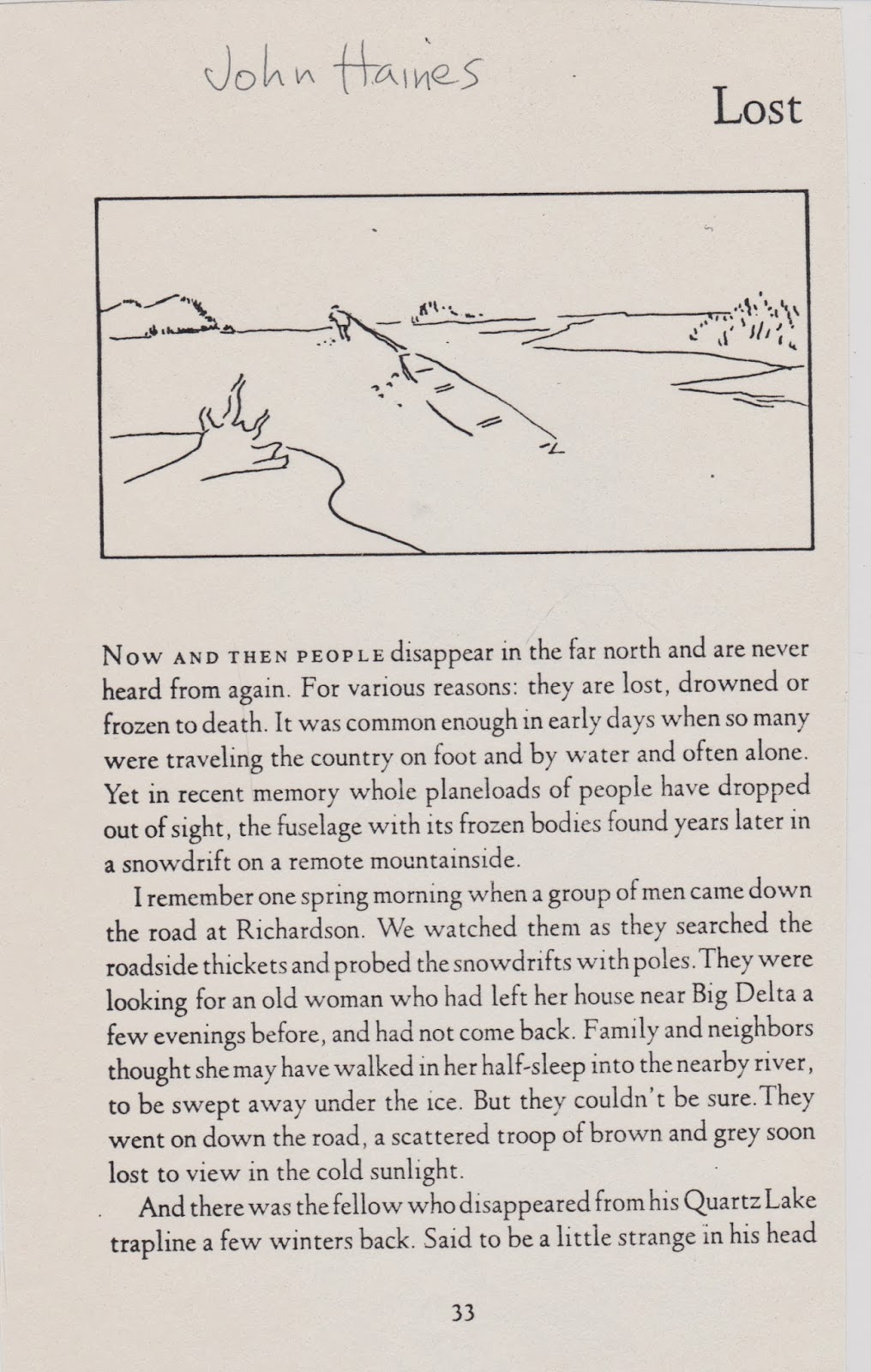
JOHN HAINES "LOST" ~


John Haines
Other Days
Graywolf Press
1982


Longhouse archive


Sunday, January 19, 2014

Saturday, January 18, 2014

JAKE BUGG ~


Great name. And British (Nottingham).
Already looks young for the rest of his life at nineteen.
Opened last year for the Rolling Stones at Hyde Park, maybe you remember.
He does look here like a very young Keith Richards.
Two albums now under his wing.
I've drawn 10 songs here mainly from his first album Jake Bugg, recorded when he was 17.
It doesn't hurt him a bit you can hear Hank Williams in the closing song.
But wait until you get there.


JAKE BUGG by Susan Arnold on Grooveshark


Friday, January 17, 2014

LESTER YOUNG ~


_____________________

Lester Young
interviewed by Francois Postif
The Cool School
writing from America's hip underground
edited by Glenn O' Brien
Library of America
2013


Thursday, January 16, 2014

E.E. CUMMINGS 2 ~


I wasn't planning on another round of Cummings, but then a good friend in England, a poet, had seen I was reading through the new and hefty Complete Poems of Cummings, which by the way I don't own but borrow from an out of state library, three cheers for every librarian that is alive! and my friend wondered if this poem he remembers as a young man was in the book — Yes, it is — and since he doesn't have a copy, and I do, I can type it out just for him which is also just for you.


LVII


somewhere i have never travelled,gladly beyond
any experience,your eyes have their silence:
in your most frail gesture are things which enclose me,
or which i cannot touch because they are too near

your slightest look easily will unclose me
though i have closed myself as fingers,
you open always petal by petal myself as Spring opens
(touching skilfully,mysteriously)her first rose

or if your wish be to close me,i and
my life will shut very beautifully,suddenly,
as when the heart of this flower imagines
the snow carefully everywhere descending;

nothing which we are to perceive in this world equals
the power of your intense fragility:whose texture
compels me with the colour of its countries,
rendering death and forever with each breathing

(i do not know what it is about you that closes
and opens;only something in me understands
the voice of your eyes is deeper than all roses)
nobody,not even the rain,has such small hands


from  W [ ViVa ]

________________


E.E. Cummings
Complete Poems 1904-1962
Revised, corrected, and expanded edition
edited by George James Firmage
Liveright 2013


Wednesday, January 15, 2014

READING NOW ~


film © bob arnold
january 2014

Tuesday, January 14, 2014

BALTHUS ~


 Vanished Splendors
 (chapter 28)


  Drawing is a great school of truth and exactingness. It brings us closer to nature's most secret geometry, which painting doesn't always allow us to do, since more imagination, stage direction, and spectacle go into it. By contrast, drawing necessitates abstraction in some way, since it is about going beyond facial and bodily appearance and reaching their light.

  It's a more austere and, perhaps, more mystical project. It entails reaching the flame of an incandescent blaze. With just a few lines the fire, despite its transience, may be stolen, captured, and grasped in its glimpsed-at splendor. I was able to do this in my portrait of poor Artaud doodled on a cafe table. By this I mean that the painter must have a spiritual approach, because fire is spirit and he himself is life. The painter's gaze contains spirituality, and his ability to attain it captures his model's essential nature, and deepest, most unsettling structure. Then a crossing occurs, a clairvoyance that Arthur Rimbaud wrote about.

Today, when my vision prevents me from drawing, I still have the blessing of painting. I see colors. This is a mysterious fact that Setsuko finds difficult to understand, although she witnesses it daily. I know when she gives me the wrong color, as a kind of transfiguration takes place, an alchemical process, and I know when a little bit more Rosso Pezzari or Egyptian blue is needed; I cannot see anymore, yet I see color combinations on a canvas.

  A miracle.


____________________


Balthus (Balthasar Klossowski)
Vanishing Splendors
Ecco, 2001
translated from the French by
Benjamin Ivry


Monday, January 13, 2014

E.E. CUMMINGS ~


45


i love you much (most beautiful darling)

more than anyone on the earth and i
like you better than everything in the sky

—sunlight and singing welcome your coming

although winter may be everywhere
with such a silence and such a darkness
noone can quite begin to guess

(except my life)the true time of year—

and if what calls itself a world should have
the luck to hear such singing(or glimpse such
sunlight as will leap higher than high
through gayer than gayest someone's heart at your each

nearerness)everyone certainly would(my
most beautiful darling)believe in nothing but love


from 95 Poems

____________________

E.E. Cummings
Complete Poems
1904-1962
revised, corrected, and expanded edition
edited by George James Firmage
Liveright, 2013


Sunday, January 12, 2014

VIRGINIA RODRIGUES ~


From her second album "Nós."
 Brazilian native Rodriguez was discovered by Caetano Veloso in her thirties  
and has made splendid music for the world ever since.
She is on the Birdhouse because she sings like one.


Saturday, January 11, 2014

JEFFERY BEAM READS BOB ARNOLD ~


Hello! A rare posting by Susan on an ice cold day and a sunny walk along our river, to return home and receive a cue from Bob's friend John Phillips in England — take a look at this! Forget the deep freeze, and feeding the wood fires —  I'd rather share Jeffery Beam's loving generous essay at Oyster Boy Review 21, now gathered here below for you. While Bob's books may be found on Amazon, they are available locally here at Longhouse Publishers & Booksellers. With much appreciative thanks to Jeffery ~ 
                                                                      

Susan


Plain-Spoken Love
Books by Bob Arnold
Jeffery Beam


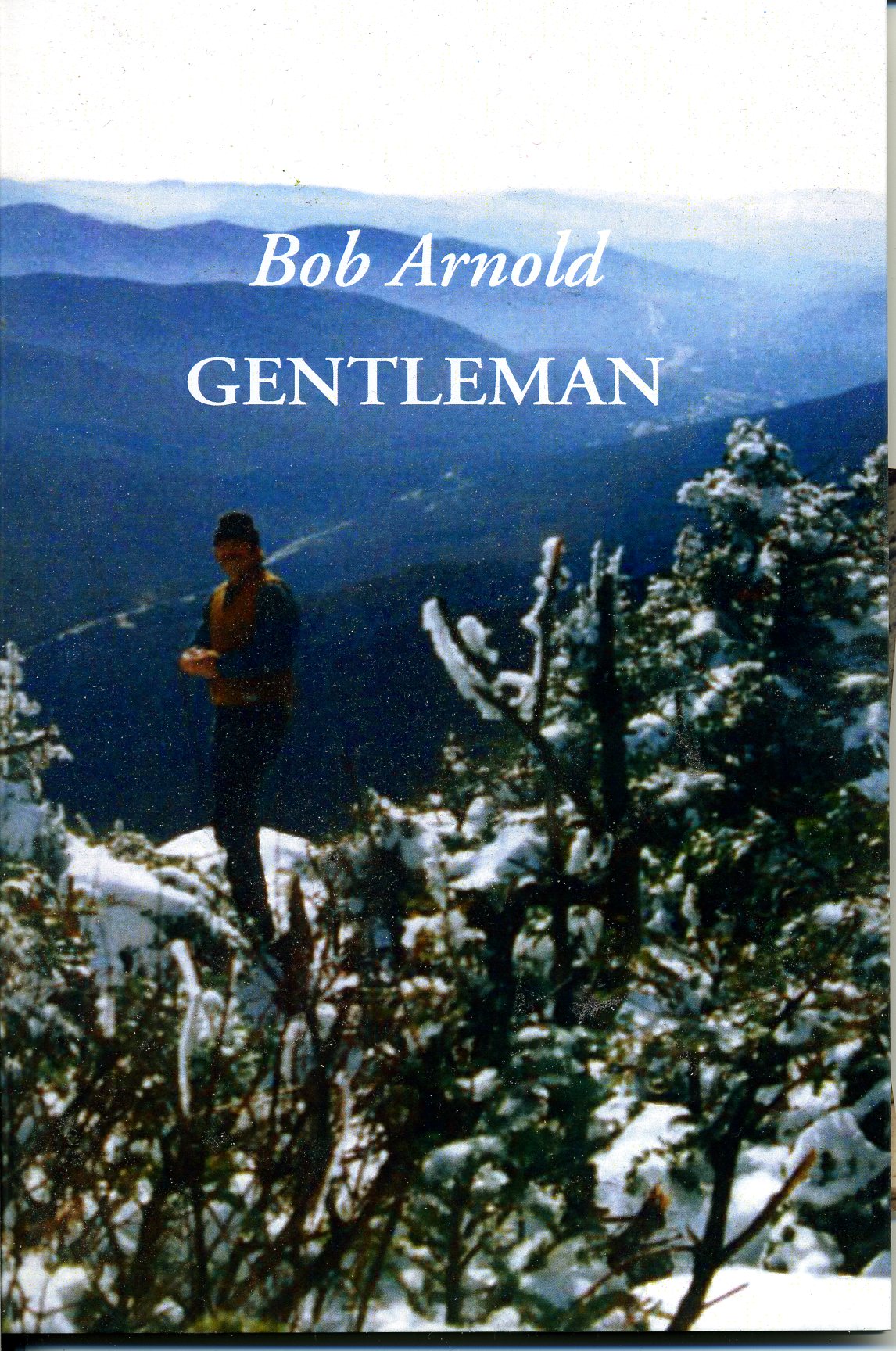
Gentleman.
Bob Arnold.
Woven/Longhouse Publishers & Booksellers, 2011.
39 pages, $20 (paperback).
ISBN: 1929048106.
Buy at Amazon.


Yokel: A Long Green Mountain Poem.
Bob Arnold.
Longhouse Publishers & Booksellers, 2011.
139 pages, $18 (paperback).
ISBN: 1929048090.
Buy at Amazon.


I'm in Love with You Who Is in Love with Me.
Bob Arnold.
Longhouse Publishers & Booksellers, 2012.
151 pages, $18 (paperback).
ISBN: 1929048114 (Library of Congress).
Buy at Amazon.


___________________


There's nothing imagined about Bob Arnold, and yet his whole life has been the product of imagination, and imaging a life that is as forceful as a wood chop, as clear as a woodpecker's call, as circular and varied as tree rings, as fragrant as a strip of cedar wood. Arnold's a master stonemason; a builder in the old ways of form, function, and perfect fit; a friend to chainsaws, pick-up trucks, stonecutter's tools, rivers, and grosbeaks; a lover of women (one woman in particular for over forty years); and a man's man—meaning the kind of man that knows himself and who you are (male and female or whatever new way you define yourself) and welcomes whatever that is with equanimity and generosity round the campfire.

But Arnold's also one of the finest poets writing in America, one of the cleanest and purist, and without self-aggrandizement. Although he's been published by some of the finest small presses around, and at this point in his life is probably well known in the poetry world beyond his close cadre of admirers, he still keeps himself whole and wholesome in his country Vermont retreat, with wife and soul-mate Susan. You won't find him bandied about by the academic world or the slick world of poetry celebrity, and he still publishes many of his books himself, but Arnold is the real thing. The thing that lasts. That sticks. That will be as solid a long time after the celebrity poets have slipped into storage stacks.

Arnold, too, has earned a deep appreciation from many poets and writers, including myself, for his Longhouse poetry publishing projects and his blog postings about poetry, literature, art, culture, and politics. His poetry reflects the kind of respect for the language, and for the world and the people and things in it, that's quite rare. It's a poetry laid down with as fine a mind and hand as the walls he builds—responding always to the lay of the land. Simple and spare when required. More discursive and filled with storytelling verve and kick when necessary. Always, however, ringing in the mind with spiritual light, the sound of a thing well-said and carefully thought-out, both visceral and enlightened, tender and spot-on, good-humored, patient, loyal, and resolute. There's a charismatic human spirit behind this work, that appeals because its charm is sincere and without airs. Each poem is a hot cup of tea on a below freezing morning, or a tumbler of cool spring water when the heat's got at you.

I've never met Arnold, although I will name him as a friend, a mentor, and an inspiration for close to a decade now. So, you can take my words with a grain of salt if you want, but seek out two interviews in Jacket magazine, follow his care-taking of the estates of Cid Corman and Lorine Niedecker, and read the work. You can't disagree.

The latter two of these books are part of a trilogy. Bob's words (I'll call him Bob now that I've revealed myself as one of his devotees): "The trilogy is called Woodlanders. The first two books are Yokel and I'm in Love with You Who Is in Love with Me. I'm the idiot, certainly not you, having to tell you these titles but I have to get in the groove. The third book, forthcoming, is titled The Woodcutter Talks. The trilogy covers poems and life over 40 years in the same place in Vermont, home, marriage, building work, stonework, woods river, and that psych-folk son." The Woodcutter Talks, the third book, is just out. Get it. There's no preferred order. Like the tree-rings, their order is circular.

A handful of poems in the small chapbook Gentleman reappear in I'm in Love for it was published as a tribute (as many of Bob's books are) to Susan. It's a lovely thing to hold, and would make a sweet gift book to a beloved, or to a nature enthusiast. For some reason the poems herein remind me of James Laughlin's poems. I think it's the off-hand charm, the small ironies and little twists of thought and language that take the reader to a place not only pleasantly in the Now but also so richly sensual. "To have every bird in the woods / Finally sing and I am known to it / Is all the morning I ask // To see the flower garden / Move as a dress on your body / Is all the day I wish // To have the stars rise from the river / And you think of me not as crazy / Has to be the night ahead." ("To Have") There's a relaxed sexiness to these poems—I'm In Love bursts with it. Bob's love for the earth is just as vibrant and coyly robust as it is for Susan: "Early in the day / Building a house / Far from any town / With no other sound / But the river and the / Rhythm of nails pounding— / And once between raps of / The hammer I heard nearby / A woodpecker answer." ("Answer") That woodpecker sound is as naked and attractive and absorbed into the poet as Susan's body under her dress. I think of these poems as if Jean Follain might have written such if his world had not been one of such a magnitude of loss.

I wrote Bob upon receiving and reading Yokel. "Dear Bob. Just a note to say how much I've enjoyed reading Yokel. The people are all drawn with such a clear plain love—a plain-spoken love drawing them out. They live on the page and, of course, remind me of many of the kind of folk with which I grew up in North Carolina country. It's the generosity and good humor of your portraits that's so compelling—and the ease with which you evoke your woodland community—and how it holds together even when the facts say it shouldn't. I love too the way you've strung the poems like a necklace of acorns around your life and the energies of Yokel, Sweetheart, Preacher, and Native making the strand. As always there are so many poems I love it would just mean listing the contents. Wisdom and storytelling all combined with your usual energy, grace, tongue-in-cheek, hand-on-hammer, hand-in-pocket, kiss on Susan's lips. I think it one of your major accomplishments."

Yokel is a book about being human, how unlike and alike we are, and is built in praise of the colloquial. It's Our Town and Edwin Arlington Robinson and Frost and Whitman and Jonathan Williams' Appalachia, but not. Bob has taken his wide reading from Rimbaud to Asian poetry, from Woody Guthrie to H.D. and understands how the colloquial is the Classic, and the romance of the backwoods a philosophical inquiry into living. It's also about how Bob and Susan have, over their years in Vermont, become native, become local, while keeping their private intelligences to themselves, bringing them out for sharing with the right visitor or neighbor. Bob doesn't leave out the invasion of the modern into his idyllic countryside and a number of poems track the challenges of old colliding with the new. In "Earrings" Yokel who would "plow snow / all his life" recalls "from a heated / Cab tonight / Coffee thermos / Between his legs" seeing a pretty woman on a back road with "Four earrings in / Each ear and her / Friend had one / Stuck through / Her nose." Or as in "Old Town": "When proudly announced at town meeting / Cable was coming to the area / In the front row one old native raised an arm / Asking, Does that mean I have to get a TV?"

I look forward to reading The Woodcutter Talks. I know it'll be full of pithy sayings and wise observations brought on my tree and storm and river, nail and roof and board. I'm In Love seems appropriate as middle volume for the trilogy. Susan sandwiched between their lives as neighbors and locals, and Bob's livelihood taking care of their and other's buildings and the landscape that nourishes their rural life. You got a flavor of the poems earlier. Suffice it to say, that if you are loved, or ever have been, or will be, Bob's kind of love is what you are after. Worshipful—but not to detriment, honest, playful, wise, tender, and with just the right amount of rubosto. He's Adam and Romeo, Orpheus and Odysseus, Shah Jahan and Rama. And he can build and fix whatever you want (and welcomes your help as well as a back rub), and is a perfect father too. Dante nor Petrarch loved no more: "They have been together and in love so long now / That when they think of an earlier life apart, it / Isn't possible. Or it seems another life entirely. / After all it was childhood only before they met." ("In the Land of Slush") That's the kind of forthright take-no-prisoners kind of adoration Laughlin writes too. "It was childhood only" a killer line. Everything in Bob's world is touched by Susan's presence—mittens, stray dogs, candy wrappers, and fireflies. It all evokes wonder and delight, and most of all, gratitude in Bob's eyes, manifesting in his words some of the most delightful, endearing, joyful, and spiritual rich love poems ever written.
I could go on. Let Bob speak, I hear a voice tell me. It can be a big bad rotten / world out there— / find a leaf / hide under it / float upon it / clothe yourself. ("Make Do") 


http://www.oysterboyreview.org/issue/21/

 Oyster Boy Review
Post Office Box 1483
Pacifica, CA 94044