Showing posts with label Charles Simic. Show all posts

Tuesday, January 10, 2023

CHARLES SIMIC ~


C H A R L E S     S I M I C


for his mother & father: "Dusan Simic"


Monday, December 19, 2022

CHARLES SIMIC ~


R E A D    S O M E    P O E M S


_____________________

Charles Simic

No Land In Sight

Knopf, 2022


Tuesday, June 21, 2022

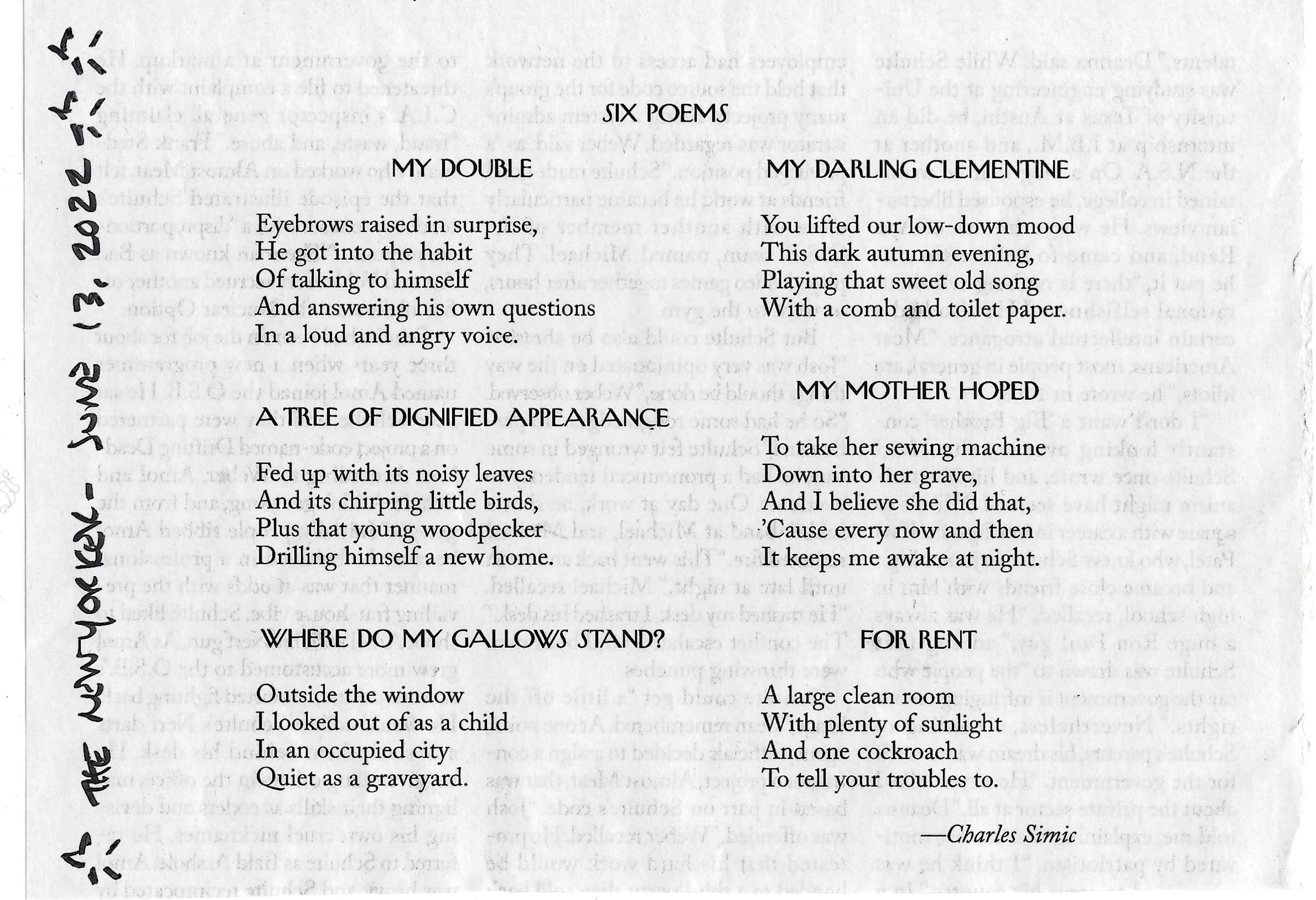
ARCHIVE (CHARLES SIMIC) ~


He's still got it.

The New Yorker

June 13, 2020


Friday, January 28, 2022

FOUND AT THE DUMP ~


what wonders to be found

(poem) THE NEW YORKER


Friday, October 30, 2020

RE-READING ALEKSANDAR RISTOVIC ~


from Whores


With me is a railroad man

in a railroad uniform,

with a railroad whistle and pocket watch,

and a railroad cap.


He talks about trains,

the express, the cannonball.

He remembers a girl

he left behind on the train.


Before he lies down

he turns off the lamp.

Outside, falling snowflakes

mingle with electric sparks.


Asleep he holds me

by my breasts,

still wearing his wool socks

with a toe sticking out of each one.


In the morning he runs

across the tracks.

He loses his cap.

He finds his cap.


~


With me is a man

who talks too much,

talks about everything,

so he sees nothing.


The washpan with red

and blue roses,

or the frog in the pan

with twelve baby frogs.


Sees neither my left

nor my right shoulder,

nor my cheeks caked

with thick powder.


Sees neither my thing,

nor his thing,

babbling so much he forgets

why he came.


I stuck a finger

under his tongue

and my finger stayed

in his mouth.


~


With me is a young woman

who loves only women.

She smokes unfiltered cigarettes,

sways while she walks,


pays for my services

in foreign currency.

Her breasts are still

just two drops of honey,


she uses a whip,

sips ghastly concoctions.

We dream of each other,

exchange places.


When I wake, I see beside me,

my own funny childlike face

with buck teeth

and high cheek bones.


At night, a beard and a mustache

grow on her. In the morning,

she is again herself,

neither better nor worse than she is.


~


With me is a long-legged,

long-eared stallion.

His other horsy virtues

I won't even mention.


He bolted from under

his master's whip.

He's tired of high-class mares,

he wants only me.


He strokes me with his head

and his tufted mane.

He's happy when I ride him

naked, wearing only boots.


His eye is human

and so is his impatience

and his well-developed

sense of humor.


He eats blue-tinted sugar cubes

out of my hand.

In some respect, he's a man.

In others, just a horse.


~


With me is a grinning

skeleton,

when he walks, the bones

make a racket.


At times he loses

some small bone,

so we look for it

among the bedding.


Expertly, I fit

the missing bone between two others

It's tiring work,

but it gives me pleasure.


At times, he tries to drink

from my glass.

The way the wine puddles on the floor

makes him truly miserable.


If he had any nerves,

he'd lose them in bed

having to listen

to the rattle of his bones.


~


With me is the God

of all gods.

I have no other god

but him.


Without fuss

he kisses me everywhere;

on my head, on my forehead,

on my undone hair,


on my mouth while I speak,

in my armpits,

on my wet tits,

on my left and on my right knee,


inside my lungs, in my heart,

in my bowels,

in both kidneys,

and in my full and in my empty gut.


With great art he handles

the venerable tool.

God is truly within me,

or any other girl like me.


____________________
Devil's Lunch
Aleksandar Ristovic
selected poems
translated by Charles Simic


I'm always returning to Ristovic.
There is a accent mark over the "c"
I can't do it, but I do it with a pen in hand.
And again Charles Simic at the helm.
They should give him a prize for his
decades of work as translator, always
sizzling, and maybe they have.
The only prizes I pay attention to now
are the birthdays of our two
granddaughters, the rest
is filigree.
I also adore this edition
and design from Faber & Faber.
Did you know there was only one Faber?


Thursday, October 29, 2020

RE-READING MILAN DJORDJEVIC ~


Book Burning


We are out of wood to heat the house,

and still the weather is cold.

I did something that did not make me happy.

My first book of poems,

ON BOTH SIDES OF THE SKIN,

yes, we brought the copies up from the cellar,

took them out of the packages they're wrapped in,

and threw them in the yellow tile stove

and the black metal one. I'm burning books

I wrote a long time ago and doing so remember

other burnings, the many cruel ones in history,

and especially the ones in the twentieth century.

To my books I add literary magazines.

Listen, people, it's just my books I'm burning!

From the paper covered with words many ashes remain.

The stove heats up from the pages in flames.

We feel warmer and perhaps closer to spring,

the sun shining, balmy weather, clear skies.

Perhaps, we'll be forgiven for this fire

by the stern judges whose forgiveness we seek?

Nevertheless, I ask myself, is there an excuse for this.

Will my conscience bother me because of what I've done?

Should one sacrifice in everything for higher things?

Perhaps, friends, freezing in a cold house

is not something one should resist in this way

and burn books, words, sentences, white paper

and get from them black and gray ashes and a little warmth.


______________
Milan Djordjevic
Oranges and Snow
translated from the Serbian
by Charles Simic
Princeton, 2010


When I really need to dig in, I go eastern european —
it's on the way to Asia from where I live


Monday, December 2, 2019

Sunday, November 3, 2019

TOYS, DREAMS ~


Toys, Dreams


Tonight my mother was born


her infant cry

filled our house

at the outskirts


bathed and so clean

I wrapped her

                        in a diaper

and laid her in a crib


from the corner I brought

toys

         blew twice

into a small plastic trumpet


Made the black wooden horse rock


____________________

Novica Tadic
Night Mail: Selected Poems
translated by Charles Simic
Oberlin College Press


Thursday, July 20, 2017

CHARLES SIMIC ~


READ     ME


This book was gifted to me knowing, as the presenter
does, that I read everything by Simic. Simic actually
advises this for poets, young ones, so I must still be young: read
everything and pretty much do your own thing as a writer.
He left off: and accept the consequences.
We are throttled by poetry schools, foundations, houses,
frat-party poetics, mean and lean criticizing threshers,
swords with blood on them, so you take your chances writing
as you wish. But please do so. I want to read you. I am reading
this new Simic slender book of poems in early June and
because I am always reading, and writing, and doing as I wish,
this won't appear until sometime in July.
The Birdhouse is nicely bottled up and singing.
If we're still here.
There's a Menace in the White House
also doing as he wishes.


The Week


Monday comes around with a new tattoo

It won't show us and here's Tuesday

Walking its latest nightmare on a leash

And Wednesday blind as the rain tapping

On a windowpane and Thursday sipping

Bad coffee served by a pretty waitress

And Friday lost in a confusion of sad

And happy faces and Saturday flashing

Like a pinball machine in the morgue

And Sunday with a head of crucified Christ

Hanging sideways in a bathroom mirror


———————————
CHARLES SIMIC


Wednesday, April 15, 2015

CHARLES SIMIC, THE LUNATIC ~


THE HORSE


I awoke in the middle of the night to find

A horse standing quietly over my bed.

My friend, I'm so glad you're here, I said,

It's snowing and you must've been cold

And lonely in your stable down the road

With the farmer and his wife both dead.


I'll throw a blanket over you and check

If there is a lump of sugar in the kitchen,

Like the one I saw a man in a top hat

Slip to a mare in a circus, but I fear you might

Be gone when I get back, so I better stay

And keep you company here in the dark.


__________________


CHARLES SIMIC
The Lunatic
Ecco, 2015


"All writers have some secret about the way they work. Mine is that I write in bed."
CHARLES SIMIC


Monday, September 8, 2014

INGEBORG BACHMANN ~


Anxieties


What then will remain?
I sigh, suffer, search,
and my wanderings
will never end.
The dark shadow
which I have followed from the start
leads me into the deep loneliness of winter.
There I stand still.
The frost coats my hair
and the cold burns through my limbs.
Melodies of dead silence play a dance,
endlessly turning round each other.
Blue spirits leap into the room —
the departed who wandered off before me
desiring, like lords, an ancient right.
Now they will be paid with blossoms
which many summers saw
and which break and fall this winter.
The trees exude the cold from within,
and tears, which the moonlight draws out,
hangs as thin cones coated in ice.
Over there, above the glacier,
the long departed pour out their blood,
and so I follow their example and do the same to them.
I listen close to the centuries,
though I don't want to be swallowed up by them.
Into the shadow which wants to stretch this far
I try to press a vestige of myself,
despite the idle fear of wasting my leaf.


Libraries


The shelves sag.
The volumes are weighted down with the past.
Their sweat is dust.
Their impulse is rigidity.
They no longer struggle.
They have saved themselves
upon the island of knowledge.
Sometimes they've lost their conscience.
Here and there, protruding
from them, human fingers
point directly towards life
or towards heaven.


[ I'm still afraid]


I'm still afraid to snare you with my breath,
drape you with blue banners of the dream,
or outside the misty door of my darkened castle,
burn torches, such that you'd find me . . .

I'm still afraid to free you from shimmering days,
from the golden river bed of time's own river of sun,
fearing my heart would burst silvery above the moon's
own terrible countenance.

Look up and don't look at me!
The banners are sinking, the torches have been extinguished,
the moon follows the course it traces.
It's time you came to seize me, holy madness!


I Know of No Better World


Who knows of a better world should step forward.
Alone, no longer out of bravery, not wiping away this saliva,
this saliva worn upon the cheek
as if to a coronation, as if redeemed, whether at communion
or among comrades. The weak rabbit,
the rat, and those fallen there, all of them,
no longer alone, but as one, though still afraid,
the dream of returning home
in the dream of armament, in the dream
of returning home.


The Radical Means


Wasteland, but only to the eye

that serves life,

feather-light rubble.


__________________


Darkness Spoken, with a foreword by Charles Simic, gathers together Ingeborg Bachmann’s two celebrated books of poetry Borrowed Time and Invocation of the Great Bear, as well as early and late poems not collected in book form, over 100 of them appearing in English for the first time, as well as 25 poems never before published in German. Bachmann is considered one of the most important poets to emerge in postwar German letters, and this volume represents the largest collection available in English translation. Influencing numerous writers from Thomas Bernhard to Christa Wolf to Elfriede Jelinek (winner of the 2004 Nobel Prize in Literature), Bachmann’s poetic investigation into the nature and limits of language in the face of historical violence remains unmatched in its ability to combine philosophical insight with haunting lyricism.

Bachmann was born, the eldest of three children, in 1926 in Klagenfurt, Austria. She studied philosophy at the universities of Innsbruck, Graz, and Vienna. In 1953 she received the poetry prize from Gruppe 47 for her first volume, Borrowed Time (Die gestundete Zeit). Her second collection, Invocation of the Great Bear (Anrufung des großen Bären), appeared in 1956. Her various awards include the Georg Büchner Prize, the Berlin Critics Prize, the Bremen Award, and the Austrian State Prize for Literature. Writing and publishing essays, opera libretti, short stories, and novels as well, she divided her time between Munich, Zurich, Berlin, and Rome, where she died in 1973 from a fire in her apartment caused by her falling asleep in bed while smoking a cigarette  — she awoke to find herself surrounded in flames. Horribly burned at age forty seven the poet was gone to us three weeks later.


The translator, Peter Filkins has published two volumes of poetry, What She Knew (1998) and After Homer (2002), and has translated Bachmann’s The Book of Franza and Requiem for Fanny Goldmann. He is the recipient of an Outstanding Translation Award from the American Literary Translators Association and the Berlin Prize from the American Academy in Berlin. He teaches at Simon’s Rock College of Bard in Great Barrington, Massachusetts.


Saturday, September 21, 2013

LOST & FOUND ~


April 15th was a momentous day for us in the U.S. On that day two bombs exploded at the Boston marathon, killing three people. The atrocity was covered around the clock for weeks. I received e-mails from different friends in Iraq expressing their condolences and sadness. April 15th was also a momentous day in Iraq. I cannot help wondering how many people in the US heard about the eighteen bombs that went off throughout Iraq that same day. At least thirty-two people were killed. And on April random attacks left 111 Iraqis dead. On April 24th at least eighty-six were killed, and another ninety-six on April 25th. And this has been the reality in Iraq for over ten years now.

In the eight years since the onset of Operation Iraqi Freedom until the end of 2011, 4, 480 US troops have died in Iraq. This is a figure commonly cited in the US media. A figure we might not have heard is the following: 4, 471 Iraqi civilians died as a result of ongoing violence in 2012 alone.

Cathy Breen, "Iraq: Hope Amidst Tragedy", The Catholic Worker August-September, 2013


young Wendell Berry


ONE RIGHT STANDARD

[The following letter was written by Wendell Berry, author, farmer
and environmentalist, to John Held, in support of the campaign against
frac sand mining - Eds. note]


Dear John,

You have offered me the privilege of joining by letter with you and your friends in Winoa, Minnesota in opposition to "frac sand mining" and I am happy to accept.

I will say, first, that there is never, for any reason, a justification for doing long-term or permanent damage to the ecosphere. We did not create the world; we do not own it, and we have no right to destroy any part of it.

Second, most of our politicians and their corporate employers are measuring their work by the standards of profitability and mechanical efficiency. Those standards are wrong. There is one standard that is right: the health of living creatures and the living earth.

Third, we must give our need to eat, drink and breathe absolute precedence over our need for mind fuels.

I wish you well.

Sincerely,
Wendell Berry


from The Catholic Worker, August-September 2013


However, other times there’d be a book I’d start reading and couldn’t put down. Here, for example, is the opening of one called Business be Damned—not a very promising title—by someone called Elijah Jordan, published in 1952 by Henry Schuman, New York, and presented at some unknown date to the library of Southwestern University in Georgetown, Texas by its original owner, Dr. Joe Colwell, and subsequently removed from their collection:

    "There have always been businessmen and business in the world. But never in history till today was business accepted as a morally honorable activity for men; never before was the businessman permitted to dominate the affairs of men. Today the rule of the businessman, accepted, justified and glorified, has become undisputed and absolute.

    Until lately, however, the activity of the businessman has always been questioned as to its moral rightness. The formulation of this doubt has been the negative or critical premise upon which every developed moral system and every cultured religious system has been founded. The new fact, therefore, in what is called modern civilization, is the acceptance of business activity as morally honorable, the approval of the capacities and the characteristics of the businessman, and the assumption that these capacities are appropriate for rule and control of human affairs."

This is extraordinary, I said to myself. Jordan (1875-1953), who was a professor of philosophy at Butler University for many years, saw the writing on the wall, pointing out already back then that business had become the dominant force in our lives with all other human interests in this country subservient to it. Religion, politics, government, morality, art were all being asked to acknowledge its absolute right and absolute power to be the final arbiter.

If he came back from the dead today, Jordan would be surprised that his fellow Americans still haven’t caught on that they are being taken to the cleaners. On the contrary, many of them now believe that the solution to all our problems, be it failing schools or expensive healthcare, is to hand over every publicly run institution to profit-seeking private companies, which, thanks to their knowhow and the magic of the free market, will save tons of money for the tax payers. This is what is known as “privatization” today, the scam that makes everything from private prisons, the vast growth of our surveillance state, and our global military presence, a hugely lucrative enterprise. Voters, one can’t help but conclude, no longer seem to have any problem with fortunes acquired dishonestly and at their expense, some of them even going into huge debt to send their sons and daughters to prestigious business schools so they can go to work for these hucksters and emulate their success.

Charles Simic, "The Books We've Lost" The New York Review of Books, August 13, 2013


Isma’il Kushkush/The New York Times


KHARTOUM, Sudan — On the corner of an old colonial building in downtown Khartoum sits the city’s oldest bookstore, Sudan Bookshop. It was established in 1902, three years after Britain established control over Sudan, and for a long time it was a magnet for the city’s civil servants, politicians and intellectuals.  (read more...)

http://www.nytimes.com/2013/09/18/world/africa/in-a-faded-literary-capital-efforts-at-a-revival.html?pagewanted=2&hp&pagewanted=all