Showing posts with label Stone building. Show all posts

Monday, May 4, 2020

HYPAETHRAL, or WINTER THEN SPRING ~


Winter then spring was the title of an early poem of mine,
a poem I always liked, and a time of year I've always looked forward to.
This winter into spring Susan broke her ankle on February 10th
while hiking through snow to fetch a funnel from the work truck
while we worked in the woods. I'll never forget her scream.

I had a doctor's appointment and took Susan along
for my doctor to take a peek at Susan's badly bruised and swollen ankle,
swollen to the size of an eggplant — he thought it might be a bad sprain 
and asked us if we wanted to get x-rays of the ankle. 
That's often a bad sign when a doctor is asking you!

In an air cast Susan walked on the "sprain" for a week
until unbearable was unbearable, including the doctor's
front office who at one point was arguing with Susan
because she was now insisting on having x-rays.
Another doctor stepped in and x-rays were given.

Broken ankle. Getting away from one doctor and into
the hands of a surgery team was another winter into spring
moment (bliss), as we climbed the stairs up to the surgery team's 
office we were greeted by a nurse who asked,
"How are you walking?"

Susan entered surgery and post-exams, casts, x-rays etc
all happened as the first Covid-19 face masks appeared
in the hospital waiting rooms, foyers and elevators.
We came home to the woods for two months and
counting of isolation, or hermitage.

In that time I took care of Susan, who crawled around
this 220 year old New England farmhouse on her hands
and knees (with my work knee pads) — I'll never take for
granted the ankle again — hospital issued crutches
were put aside; I bought Susan nice cushioned blue ones.

I also went back to work at carpentry, stone work
and tree work from March through April —
listened to the river break open from its ice for good,
heard the titmouse song come closer, followed
the crows in the sky, barked back at them.


The first building job was a little roof over the Ranger Station,
all used materials I had on hand, including the cedar shingles.
My stencil work attached the new work into the old work all over again.


Next was to buck up a blown down ash tree up in the
woodlot and cart it home with the Ranger. I hand-split
everything up at the job site as usual and stacked the wood
in my customary cairn style roundness.


Before I built this sunroom (seven years ago) we had a stairway
I built from a lower deck to the upstairs bedroom porch. I removed
the old stairway, built the sunroom (from field stone walls I built
when younger and now stole back to make this building) and always
wanted a stairway some day again. As far as the month of March goes,
this one was fairly benign and I was able to drive the Ranger up into
the woodlot where I felled one good size hemlock tree which I
liked because it had a slight sway to its length and I thought
might make an ideal log ladder. I built the ladder all from
one tree. Skinned it at home and set the ladder up.
The bark was later used for kindling.


Here's the finished ladder. Beside its friend the rain barrel.
 The flat rock at the base weighs as much as two of me. 
I took it from the front of the Studio where I once placed it in 
as an ideal sun rock to sit or lay down on. Susan would come
out on her crutches on the sunniest day and do just that.
When I took it away for the log ladder, I had other plans for the Studio.


But first, it's been six weeks, three casts, and now it was
time to remove Susan's final cast, the one that was on the longest.
I had stenciled all the casts but in this photograph you don't see any
pretty stenciled cast, it looks like a crime scene. The surgery team
has a special saw to remove the casts. I had my tool box of hand tools.
Most people seeing me come in with a chisel would ask, "What's
that for?" Susan just smiled.


I have plans to build a wrap around deck for the Studio but before
I get onto that job I wanted to treat all the log work I built into The Lookout,
a two storey and multiple decked cottage built on the nose of ledge, actually
the same ledge that backs the wall of the stone hut you can see in the background
that I built in 1985. I plan to talk a great deal more about The Lookout one day,
maybe write a book about its construction. It was my job site in 2019
from April-November.


Now to the Studio, which I built in 2001 with my teenage son Carson.
It was time to tear down into this building and see how the foundation was
holding up (fine) and see about building a wrap-around porch. Everything
starts at ground level, on your knees, there is plenty of stone
to move out and also into place, including that huge flat rock at the
base of the log ladder, and stone steps I built just a few years ago
and I had plans to keep in place until I started framing the porch.
As you frame, everything becomes a new frame to look through.
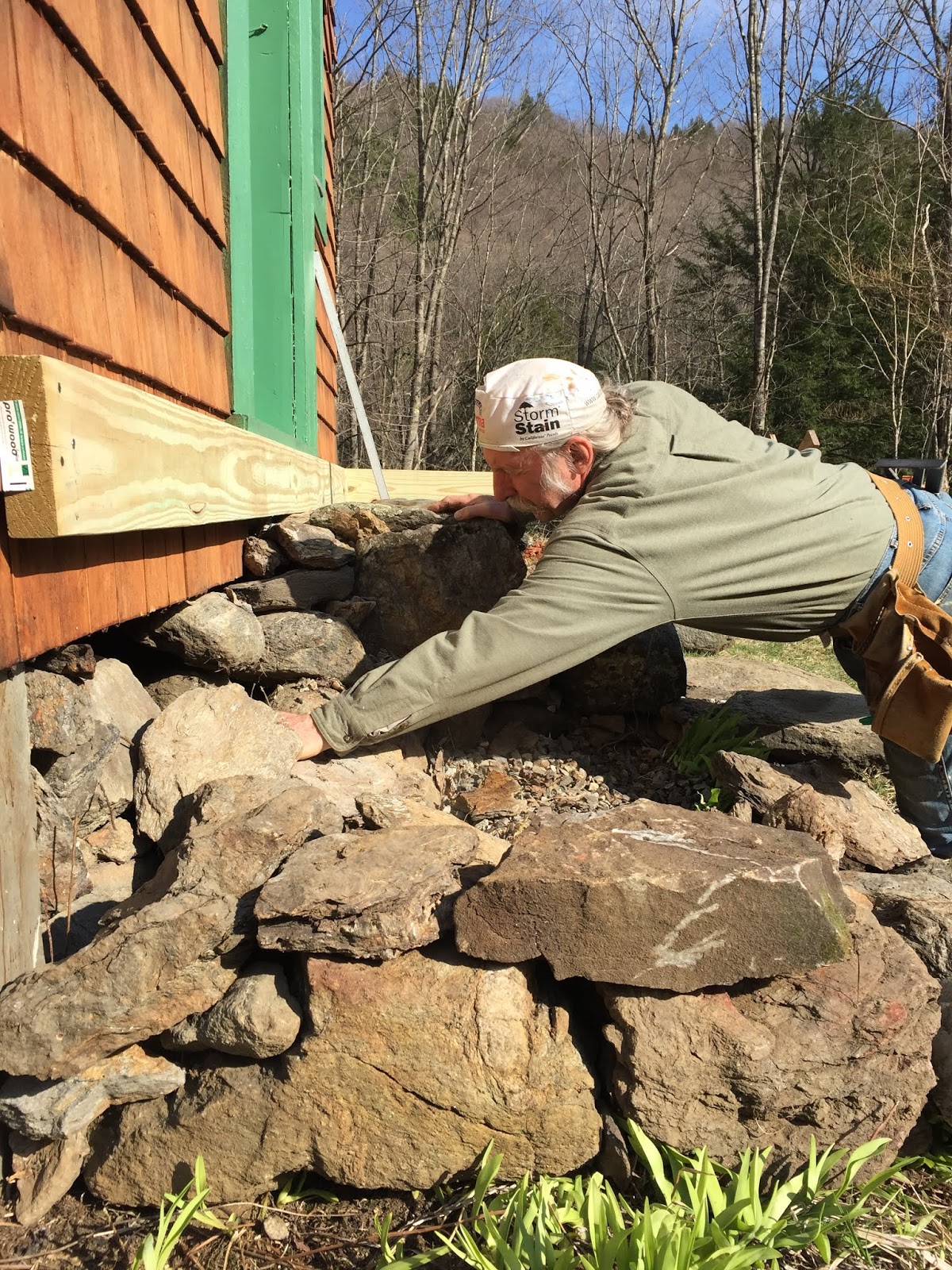


If you look at the center of this starter frame work you can
see the stone steps I was planning to keep, in fact the stone
stayed there until I had half the deck built and was a moment away
from cutting down the center of the deck to expose the stone stairway
and I saw it was a bad idea — better to keep the new and long and
sleek first half of the wrap around deck and build new stone steps
elsewhere. Elsewhere will be found as you go.


Here is the 90 degree turn for the wrap-around deck
and as I framed with lumber I followed along and laid up the stone work 
underneath. I love using log posts with large flat stone footings because it's
all around me, I'm in Vermont, and the pressure-treated lumber costs enough.


Those log posts will be eventually brushed stained dark
and in time, when we can get into a store, I'll find just the
stone hue color I'm after to blend the log work into the stone.
It's plenty strong. It's now all about pleasing the eye.


There is nothing like simple balance.


Or a level world 


All along I am saving just the right stone and rock for the new
stone steps. Stone is flat with at least one fine looking face to it,
rock are the knuckleheads. Rock is sometimes how you sum up
what you're looking at here, a rock pile. A stone pile doesn't sound right.
That original stone steps I built at the front of the studio have now all
been moved out and brought to this rock pile. They're talking to one another,
waiting to see what I'm going to do with them.


I'm working on this day at the height of the Covid-19 "quarantine"
and I can't believe the amount of bicyclists, joggers, hikers, cars,
trucks, many from out of state, are slowly drifting by. There's the river
we love to the right of this photograph and at least half the passersby
are looking up and waving to me. I wave back. 
I don't know them. They don't know me. 
In fifty years in this same spot I have never seen this many people, 
or as many happy people. One pick-up truck
slowed down, window down, and is studying where I am working.
The driver shouts up to me, "You do good work!" 
Gotta wave back.


I build with wood, have since I was ten years old, but it's stone work
that is my calling, so as I'm framing in this porch deck I take a
break and start shoving stone into place, all to allow me a
certain eyeball as to what sort of stone steps I'll finally get into
place. The quality of the stone is essential, important, and I
don't have the best in this region, but I'll do my best.


Rest your back.
Smile at the camera.


I now have the porch deck all squared up,
turned right, and screwed down. The stone is happy.
I want Susan to be able to step up onto the new deck with
little trouble as she remains wobbly on the new ankle.
This is a good day to begin laying down the large, heavy stones.
The sun is landing on the stone just right.


While I have been building this porch deck, up behind the studio
are a dozen logs I cut out of the woodlot last fall waiting 
to be peeled: cherry and pine. I plan to use all the cherry as structural
posts for the porch and roof. This deck will be all undercover. I've
also built a small road at the backside of the studio to open up an old stone wall
I built in my thirties and that wall I removed to give me the
stone for this porch. I left enough stone back there to build
a stone cairn sculpture some time in May.


The new road also allows access to this drop-down frame
which will become a small woodshed to hold one cord
of wood. I'll extend the original lean-to shed you can see here,
something I built a few years ago for equipment and storage,
and this little woodshed will be a fine strong ender
for the new porch. We'll be able to access the firewood
from all three left-open sides. A roof will be there to keep all dry.


Here's the view from the second storey porch 
down to the Studio and the new porch deck, also showing the woodshed
I built a few years ago and it's all important overhang arch which is ideal
to store lumber for on-going building projects, and by late Fall, a perfect
location to stack up two cord of firewood for immediate use. The woodshed
itself is stacked tight with eight cords of firewood. There is another woodshed
out of the photograph just as big and just as full of firewood and attached to
the house that we use regularly. The woodshed you are looking at
is Mr Back-up.


Now to lay in stone.
There is no guide.
You feel it as you work.
Big stone and little stones
love one another.


A wheelbarrow load of pea stone
is pennies from heaven.
Set it in under stone, next to stone,
it allows water to drain and
stone to breathe.


Down on hands and knees
is the best view.
Two wide steps are built
and there will be a third.


The third step is there,
it's just not set in.


You wear work gloves, wisely, until you
just have to have a better feel of the rock,
mostso working in the smaller stone shims.
Off go the gloves.


That hand-cart, now at my age, saves my life.
That stone hammer on the ground has been with me 50 years.


Not often, but some times, I'll shape a stone
but usually I like to use what I have as I find
it and then find its home. When the stone fits
into place, it's to my mind, as beautiful
as any well made poem.


Kind of a distorted bottom step with those
wedge pieces between the two large stones
which I am trying to like and every day I'm
liking it more and more. One day in the woods
working I'm going to find just the rock to bring
home to fit into that cleft. Or I won't.


Susan came out and went right up those new stone
steps on her new ankle. Passed inspection. These
two roustabouts are what greet me when I come in
after work. It's lovely to see Susan back on her two legs.
Kokomo wants me to feed him.


_____________________________
 Bob Arnold


May Day 2020

photographs © by Susan & Bob Arnold 

________

"Hypaethral" is a word Thoreau uses in my favorite
book of his "A Week On the Concord and Merrimack Rivers"
(1849) describing the book as "a hypaethral or unroofed book,
lying open under the ether and permeated by it, open to all
weathers, not easy to be kept on a shelf." 
Naturally, the book for Thoreau remained unsold.


Fini
(for the moment)


Monday, September 30, 2019

BOB ARNOLD / DWELLING ~


Twelve Bells Press, once upon a time, asked me for a piece on stone work that was pulled from my book ON STONE (Origin 1988) and I was happy to comply. Here is the full published booklet, now I believe long out of print.


Monday, August 13, 2018

STONE HUT ( 10 ) ~


One of the cairns Bob built in the garden


36


The small jobs on the hut were the last things to do. It was October, windy colored leaves were falling, some stuck wet by rain on the hut roof. I loaded the Ashley woodstove into the Willys and drove it to the hut. It was light. I could load it on and off the Willys alone. I carried it into the hut and placed it in the rear left corner, and eyed up through the box cut out in the loft where a stovepipe would pass into the metal chimney installed when I was nailing on the shingles. Stove in. The stovepipe — all used pipe, but sound — had been fastened together with screws the night before at the house. Over eight feet tall, it was now in place. Ready for a fire. The damper twisted away from rust with a pinch of oil. When we use the stove, firewood will be wheelbarrowed from the house woodshed; bring it as we need it. Burn poplar since the space to heat is small. Save the hardwood for the house. One other job was to flash the rear corners of the roof where it met ledge. In fact one rafter in the rear of the hut was built on ledge — I slipped a slate shingle under to keep it off the dirt. Since the hut was built into ledge I had to work lumber to stone and the last touches of flashing with the ledge. Otherwise rain and snow would shed the roof, splash on the ledge and leak into the hut. I flashed heavily but tried to hold the flashing to a subtle art — it has to be used but shouldn’t be seen — so with bending tricks and a dap of mortar it attached to ledge. Now with most of the hut built there was time to visit it — test the door, wash the windows, climb to the loft, climb down, sweep the floor. Sweeping the stone floor was my gift to the hut at each visit. It was an exercise between us. I liked sitting up there, but sitting on the doorway stone step was too low. The only furniture I gave the hut was a stone seat built outdoors into the bank on the right corner — it was eighteen inches off the ground made of one thick flat stone. One could sit on it and lean against the hut corner and the sun was there most of the day. One more stone was left over from the time the stone culvert was dug up out on the road, it was used here. And when my final job was to trim the butt ends of the beams that ran long over the side of the hut, I stood on the stone seat for half of the job — leaned a step ladder on the other side. Used a hatchet, handsaw, and plane to shape the beams an arrow design. Stained the fresh open wood the same smoke color. I returned to the stone seat until snow fell. After a few snowstorms and winter had settled in and a 40° day in the sun felt warm again, I would visit; sweep off the door step, sweep the inside, then walk out and sweep off the stone seat, and sit awhile.


A section of "Villa of Souls" a long stonewall with cairns atop
far up the mountain road of our woodlot


37


I always called both sets of grandparents “nana and papa.” My sister Sherry remembers when I was still too young to talk right I would mouth out a “banana” for “nana.” We had a wealthy grandfather who owned a lumber business and a grandfather who owned nothing but his house and his large family of daughters and sons who all had families that would come to visit. The grandfather with the large family was my mother’s father and his name is David Scott, Sr. His oldest son would also be named David, my uncle, and he was the first carpenter I ever met. He taught me things. But my Papa Scott was the first workingman I ever knew. The toil of manual labor showed on his hands, in his face, the strength of his body. I would visit Nana and Papa Scott with my mother when I was a child. We would arrive in time to sit with my grandfather at the kitchen table while he ate his supper, and I didn’t know if he was coming or going from his job at the paper plant. My grandmother would be on her feet at the stove baking soda bread, and my grandfather would eat large servings of food and very slow and he would talk to me in his thick Irish voice which I loved. We all sat at the table. My grandmother served tea wiping her hands on an apron skirt and a pot of tea was left on the table. One of my mother’s sisters was usually visiting at the same time and the tiny apartment became crowded with people. Plastic over the furniture, plastic runners on the carpet. It was a cellar apartment under my uncle David’s house. The only window in the kitchen was a narrow casement high on the back wall level with my uncle’s driveway. When people walked by you saw their feet. I would sit at the table with everyone listening to my grandfather talk, watched how he held his fork when he ate. I wanted to hold my fork that way but my father wouldn’t let me. The soda bread mixed with egg yolk on the plate. Soda bread that came like all of the family from Belfast, Ireland. It might be a reason for my stonework and back then I was picking up the rhythms. Papa Scott was the only man in my young life to show me the love for the woods, nature, the signs to be found there. We would hike into the woods owned by my other grandfather at every visit — jump the streams, climb the old apple trees, feel our legs go places. He showed me how to bend down and drink from that stream with my cupped hands. I still do it. Think of him. Later my grandmother died too sudden for all of us, and it left my grandfather half alive, but he refused to show it. But we all knew. He moved out of the cellar apartment into a trailer and worked as a house painter and janitor in a bank. People always liked him. He bought a bicycle and like his Belfast days would ride sometimes fifty miles in a day, all through the Berkshire Hills. That sparkle in the stream water I cupped in my hands I always saw in his eyes. When I was building the stone hut he visited with my mother and held Carson and rode in the Willys with me into the woods for stone. He’s eighty years old. Body hurt from years of working and doing things for others. He watches me load stone, knowing exactly how it feels.


My Grandfather Scott at work as a baker in Belfast Ireland with his horse and cart.
He had also been a policeman on a bicycle.


My grandfather's daughter "Penny", my mother, back visiting Belfast
and one of its many stone walls.

38


My father liquidated his lumber business in 1985. Given another three years and it would have been 200 years old. Known as the oldest family lumber business in America, at its height it was five lumberyards strong, all in the western hills of Massachusetts and Vermont, and over 400 houses were built in those hills alone. I was brought up in that lumberyard, as were my older sister and younger brothers, and Sherry has a lumberyard with her husband Ron in Great Barrington — tradition is tough to kill. I learned how to work in the backyards of the lumber business. From the age of nine I was stocking the paint room, sweeping the railroad tracks, brooming between the plywood racks. I didn’t love the work, but it was a weekly allowance, and I imagine a way for my father to teach his middle-class kids how to work. The dullest job was resorting the hundreds of spilled nails around the open nail bins. On my hands and knees distinguishing a 10-common nail from a 12-common. I swore at the job but when I look back at it now I see the pick and choose of stonework taking place; the eye to hand ability, the solitary corner of the job. I watched carpenters walk into the nail room and leave the floor a mess — their carpentry work usually matched it. Same with the ones who walked in, knew what they wanted, loaded the scale, and if a nail dropped they went after it. I enjoyed being around those builders and later I would build with them. As a teenager I started to load the lumber trucks for house deliveries and rode with the drivers to unload the same load, sometimes we’d be gone all day. Into southern Vermont, the Catskills of New York…seeing houses go up, crews of carpenters moving, sounds among men. I unloaded boxcars packed with western spruce, hot as an oven in there, me and another kid — all day, all week, all summer. You begin to learn the smell of the western lumber and its grade, superior to the eastern pine we handled. One day I brought home a small bag of pine knots — knocked out of the lumber we unloaded — as a gift for my sister. The lumber was ruined after that, but what did I know! The knots were beautiful. At age fourteen I began to work with carpenters on house jobs but didn’t touch a hammer for two summers. I spread stone for leach fields one summer, carried lumber to the carpenter with the hammer the next summer. By the third summer I was framing, using a shovel, jackhammer, tarring the foundations. I tucked a book in my lunchpail and when others broke for lunch I would listen to the chatter, eat, and read. Earned the nickname “preacher,” never mind being the boss’ son. No harm. Most of those guys showed me how to work…Freddie Zarek, Jim Duffy, Big John were their names…I always enjoyed being in their company. My father had his eye on his oldest son picking up the business end of the lumberyard, but I had no interest. It wasn’t easy for either of us. Generally I’ve never had much respect for businessmen — their attitude is power, intimidation, and of course money. My father was a good businessman, I looked up to him, even though we fought. His lumber knowledge was learned the hard way — under his own father — and he put me in with the workers to learn. And when it was time to let me go, he let go.

Three generations Bob, Carson and my father, also "Bob"
standing at the tail end of his lumber business,
whittled down from a once sawmill and five lumberyards


39


The town of Carmel, California can be easily bypassed, but the coastline can’t. If you do, you will miss what surf and stone is all about. There was a stonemason who once lived in Carmel, who worked around that surf and stone, who gathered the granite from the coastline to build his home. House, garden walls, and even a tower he shaped with his hands. All of it looked back at the Pacific where it came from. Robinson Jeffers looked like he came from the Pacific, just like his stone. His wife Una’s favorite poet was Yeats and when standing on the shore staring up on the bluff where the stone property is encircled by cypress and eucalyptus trees you can hear and feel Yeats’ lines “hammer your thoughts into unity” all over the stonework. When Susan and I were searching for the house, we knew this place was it by its location with the sea, the wind, the long grass blowing from the coast road up into the yard. We stayed away. Walked the road around it, connecting with a street bunched with wealthy houses which made the Jeffers home appear more of a survivor. Everything in its landscape was interesting: being a forester Jeffers had planted trees all over his land only to have them chopped apart as progress advanced. But some have withstood, enough to give the land ocean breeze movement. The house and tower are rock, not pretty, but they have the lasting appearance of being from the land. There is another stone house nearby which I didn’t give a second glance to — it was built I’m sure by a crew of masons, and while it is massive and correct, it is devoid of feeling. It’s too correct. The Jeffers house is squat, like an animal on its haunches, many small windows give it eyes that look to the Pacific. The tower, better known as Hawk Tower, is a signature to anyone who must see it for the first time that some different kind of people must be living here. “Here” was known as Tor House, and different Jeffers was. Called eccentric, loner, hermit, antihuman — people read his poetry too much and don’t visit his landscape where he carved out the life poem. The poems really live on the land he loved with his wife and twin sons. You can see a lot of humanity on that land, and where the eyes look up and down the coast that’s where the long poems came from — the legends, the stone, the combined rhythms of surf and stone. There is a tour during the week into the Jeffers house but we were there on the wrong day. Besides, the house is enough to watch from the outside, and if Jeffers were still alive that’s where most of us would have to stand to see it. You need to have the ocean in your ears. I had been reading his work for years before we arrived there. I studied the photographs of the house, read his letters, but nothing prepared me for the real thing. It is a quiet location, almost unnoticed, having lost its face long ago to nature. We were up at Fort Ross a day before looking at historical redwood log work. At Tor House it took only a minute — a long swallowed look — to know the work, the poems, the life were true.

Detail of a stonewall Bob built on the way to Brattleboro


all photographs by Susan Arnold


Stone Hut
a builder's notebook
Bob Arnold
1988, 2013