Showing posts with label Thomas Merton. Show all posts

Wednesday, March 15, 2023

THE MONK'S RECORD PLAYER ~


R E A D    M E


An ugly as sin dust jacket but

the book is a delight to read


Thursday, November 28, 2019

Thursday, January 31, 2019

ON THOMAS MERTON ~


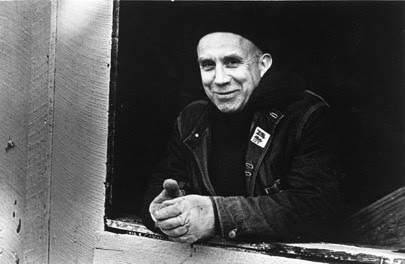
Thomas Merton, looking younger each year,
in an undated photography in Kentucky
in front of his hermitage


A mainly Buddhist publisher took a chance on this
Catholic writer and her Catholic subject ~
you can as well.

A lovely addition to the Merton library.


Shambhala
Boulder
2018


Wednesday, October 26, 2016

UTOPIA ~


U T O P I A     D R I V E


E R I K     R E E C E


once again — a moment to grumble on book design
this one is quite unique for subject and we are
moving along on the highway, two-lane, lots of bends, hill country
searching for the lost utopia
in a one guy and his pickup truck
and we haven't seen a book quite like this one in adventurous spirit
since Blue Highways
but like I say, we are digging into the worm of the apple here —
utopian communities that at one time were speaking to this same
violent america as a possibility of
peace on earth —
indeed, bury it swiftly!
so the book is moving
allow it more space, wider margins,
a more relaxed and less jammed typography —
is the book world really going out as cheapskates?

If there is anyone in the younger generation
learned from the likes of Wendell Berry, Guy Davenport, Wes Jackson
I believe Eric Reece may be the one.

__________________________


[Yet] "the Shakers lasted one hundred years at Pleasant Hill; the perfectionists turned a completely successful experiment in socialism into a wildly successful joint-stock company; Modern Times gave up equitable commerce only after proving that it worked. To say that these communities no longer exist — and as Twin Oaks proves, many of them still do exist — is not the same things as saying that they failed. The angel of history may yet salvage their blueprints from the detritus of the past. Because, after all, we still need these ideas so badly. In fact, we need them now more than ever before. During my utopian summer, the western ice sheet of Antarctica began breaking off into the ocean, which will cause sea levels to rise far more than scientists had predicted. Back in my hemisphere, the American Congress passed fifteen bills into law — total. Five percent of Americans continue to control 85 percent of this country's wealth, and since 1980, the wealthiest Americans have seen their incomes quadruple, while those of the poor and middle class have flatlined. The more this inequality grows, the sicker and more punitive our country becomes. The epidemiologists Richard Wilkinson and Kate Pickett have recently shown that every single societal problem, with no exception, can be tied directly to income inequality. As a result, the United States has higher levels of mental illness, infant immortality, divorce, obesity, violence, incarceration, and substance abuse than all the other countries north of the equator. "In more unequal societies," they wrote, "people are five times as likely to be imprisoned, six times as likely to be clinically obese, and murder rates may be many times higher." Consider these two statistics: the United States makes up5 percent of the world's population, but we consume 25 percent of its resources and we incarcerate 25 percent of its population. I don't believe those numbers are a coincidence Almost all the wealth from extracting those resources, those fossil fuels, goes to the very richest, and the very poorest end up in jail because either they can't get by or they find illicit ways to get by or simply cope. Money that might go into education or even food stamps goes instead into the penal system. Money that might fund badly needed American infrastructure instead funds 761 military bases all over the world. Money that might be loaned by a community bank is paced as a Wall Street bet that a bond will default. Money that might reward real work circulates instead inside the same echo chamber of less and less tangible securities. Wealth becomes less accessible to most Americans, while the wealthy themselves use their power to ensure that politicians do their bidding, mostly in the form of lowering their tax rates and deregulating the industries they control. Large corporations shell out $6 billion annually to employ thirty-five thousand D.C. lobbyists to protect their wealth. Such game rigging has bred cynicism and pessimism among the body politic, and as a result, we have the lowest voter turnout on the world's forty industrial democracies. The more we retreat from, or are pushed from, the public sphere of influence, the more we lose trust in our public institutions and in one another According to the National Opinion Research Center, levels of trust in the United States have fallen from 60 percent in 1960 less than 40 percent in 2004. Into that vacuum, the imperious One Percent pours more money and accrues more power. That decline in trust has paralleled a widening income gap in the United States — currently the largest of any country in the Northern Hemisphere and the largest in this country's history, according to the 2009 census. When trust weakens and economic inequality widens, an epidemic of social maladies follows What it all adds up to, said the Supreme Court justice Louis Brandeis, is this: "We may have democracy, or we may have wealth concentrated in the hands of the few, but we can't have both."


"We obviously have the latter in this country, and I've come to believe that things will only get worse if we don't engage in some serious utopian thinking. Fighting for something like campaign finance reform is laudable, but that isn't what I consider utopian thinking because it is an effort to fix a plutocratic system that doesn't deserve to be salvaged. It isn't enough. Utopian thinking by contrast and by definition, works outside the system, in a bottom-up fashion, to create a new paradigm and thus create a true form of democracy that is worthy of its name. In my view, such thinking must begin by addressing this country's most intractable problems, namely, our gross disparity in wealth and a fossil fuel-based economy that is completely unsustainable in the face of climate change, resource depletion, and the degradation of our ecosystems."

(typed with book open on my knees from pages 327-329, if you, reader, are following along)


from UTOPIA DRIVE
Erik Reece
FSG, 2016


Thursday, October 13, 2016

KENTUCKY RENAISSANCE ~


Ralph Eugene Meatyard, Jonathan Williams, Thomas Merton
Guy Davenport, Jonathan Greene, Wendell Berry,
Van Deren Coke, Robert C. May
James Baker Hall, Cranston Ritchie

A terrific book!


Cincinnati Art Museum
Yale University
2  0  1  6


Monday, February 15, 2016

ROBERT LAX ~


Duke University, 2015


Yes, the new Lax biography by Michael N. McGregor is very good, if not a bit tedious in how the author has to work through so many personal passages of his own but after a bit of time I started to fall into his affection for Lax, which I already have, and now we are one happy family as I come to the home stretch. The period when Lax was publishing little strips of publications with Emil Antonucci I was living through as he was sending them to me and somewhere I have a few of those, and elsewhere I have picked them up and sold them as a bookseller. Sometimes what we have sold has paved the way for publishing a new book by another poet. It’s the balancing act. And it isn’t so much just the poetry of Lax that gets to me, many poems are wrung our twists of things, it’s simply his look (wiry and odd and gentle) and his way of living and just how he went about writing and living his poetry that greatly grabbed me from the start. These three small Greek islands — Kalymnos, Patmos, and Lipsi — long his home. Who would suspect he had been great friends with the Trappist monk Thomas Merton, had his poems highly supported by John Ashbery and James Laughlin, that he had run away with the circus for a time, worked on scripts in Hollywood, was on the staff at The New Yorker and through it all kept his head? Today many of his thin booklets of poems fetch hundreds of dollars, whereas he lived a spartan and seemingly joyous life. By the way, may the author repair the typo to John Martone's publication "tel-let" (and not "tel-net") on page 387. Lax would encourage that repair since he so believed in the smallest of the small poetry journals.


[ BA ]


R O B E R T     L A X


Tuesday, March 3, 2015

Saturday, January 31, 2015

HAPPY BIRTHDAY THOMAS MERTON! ~


How to Enter a Big City 
Thomas James Merton
(1915-1968)
 

I

Swing by starwhite bones and
Lights tick in the middle.
Blue and white steel
Black and white
People hurrying along the wall.  
”Here you are, bury my dead bones.“

Curve behind the sun again  
Towers full of ice. Rich  
Glass houses, “Here,
Have a little of my blood,”  
Rich people!”

Wheat in towers. Meat on ice.
Cattlecars. Miles of wide-open walls.  
Baseball between these sudden tracks.  
Yell past the red street—
Have you any water to drink, City?  
Rich glass buildings, give us milk!  
Give us coffee! Give us rum!

There are huge clouds all over the sky.
River smells of gasoline.
Cars after cars after cars, and then
A little yellow street goes by without a murmur.

There came a man
(”Those are radios, that were his eyes“)  
Who offered to sell us his bones.

Swing by starwhite buildings and  
Lights come to life with a sound  
Of bugs under the dead rib.

Miles of it. Still the same city.  


II

Do you know where you are going?  
Do you know whom you must meet?

Fortune, perhaps, or good news  
Or the doctor, or the ladies  
In the long bookstore,
The angry man in the milkbar  
The drunkard under the clock.  
Fortune, perhaps, or wonder  
Or, perhaps, death.

In any case, our tracks
Are aimed at a working horizon.
The buildings, turning twice about the sun,  
Settle in their respective positions.
Centered in its own incurable discontent, the City  
Consents to be recognized.


III

Then people come out into the light of afternoon,  
Covered all over with black powder,
And begin to attack one another with statements  
Or to ignore one another with horror.
Customs have not changed.
Young men full of coffee and
Old women with medicine under their skin
Are all approaching death at twenty miles an hour.

Everywhere there is optimism without love
And pessimism without understanding,
They who have new clothes, and smell of haircuts  
Cannot agree to be at peace
With their own images, shadowing them in windows  
From store to store.


IV

Until the lights come on with a swagger of frauds  
And savage ferns,
The brown-eyed daughters of ravens,
Sing in the lucky doors
While night comes down the street like the millennium  
Wrapping the houses in dark feathers
Soothing the town with a sign
Healing the strong wings of sunstroke.
Then the wind of an easy river wipes the flies
Off my Kentucky collarbone.

The claws of the treacherous stars  
Renegade drums of wood
Endure the heavenward protest.  
Their music heaves and hides.  
Rain and foam and oil
Make sabbaths for our wounds.  
(Come, come, let all come home!)
The summer sighs, and runs.
My broken bird is under the whole town,  
My cross is for the gypsies I am leaving  
And there are real fountains under the floor.


V

Branches baptize our faces with silver
Where the sweet silent avenue escapes into the hills.  
Winds at last possess our empty country
There, there under the moon  
In parabolas of milk and iron  
The ghosts of historical men  
(Figures of sorrow and dust)
Weep along the hills like turpentine.  
And seas of flowering tobacco
Surround the drowning sons of Daniel Boone.


_________________________________

The Collected Poems of Thomas Merton
(New Directions)


Thursday, July 4, 2013

CHOOSING TO LOVE THE WORLD ~


Thomas Merton
photo : Edward Rice


One thing I know — that it is my destiny to be a contemplative, a Christian, and an American. I can satisfy my vocation with nothing that is partial or provincial. I cannot be a "North American" who knows only the rivers, the plains, the mountains, and the cities of the north, the north where there are a few Indians, where the land was colonized and cultivated by the Puritans . . . .This north is grand, powerful, rich, intelligent; it has a warmth all its own, a surprising humility, a charity, an inner purity that the stranger does not know. But it is incomplete. It is neither the better or the richer part of the hemisphere . . . . It lacks the roots of the old America, the America of Mexico and the Andes, where silent and contemplative Asians came millenniums ago to construct their hieratic (highly stylized and priestly) cities. It lacks the intense fervor and fecundity of Brazil, which is also African, which smiles with the grin of the Congo and laughs with the childlike innocence of Portugal. The northern half of this New World lacks the force, the refinement, the prodigality of Argentina with all the lyricism of its tormented and generous heart.


photo : Jonathan Williams


He who attempts to act and do things for others or for the world eithout deepening his own self-understanding, freedom, integrity and capacity to love, will not have anything to give others. He will communicate to them nothing but the contagion of his own obsessions, his aggressiveness, his ego-centered ambitions, his delusions about ends and means, his doctrinaire prejudices and ideas. There is nothing more tragic in the modern world than the misuse of power and action to which we are driven by our Faustian misunderstandings and misapprehensions. We have more power at our disposal today than we have ever had, and yet we are more alienated and estranged from the inner ground of meaning and of love than we have ever been. The result of this is evident. We are living through the greatest crisis in the history of man; and this crisis is centered precisely in the country that has made a fetish out of action and has lost ( or perhaps never had ) the sense of contemplation. Far from being irrelevant, prayer, meditation and contemplation are of utmost importance in America today.


Thomas Merton's hermitage in Kentucky
photo : Thomas Merton


We have an instinctive need for harmony and peace, for tranquility, order and meaning. None of these seem to be the most salient characteristics of modern society . . . . We must face the fact that the mere thought of contemplation is one which deeply troubles the person who takes it seriously. It is so contrary to the modern way of life, so apparently alien, so seemingly impossible, that the modern man who even considers it finds, at first, that his whole being rebels against it. If the ideal of inner peace remains attractive, the demands of the way to peace seem to be so exacting and extreme that they can no longer be met. We would like to be quiet, but our restlessness will not allow it. Hence we believe that for us there can be no peace except in a life filled with movement and activity, with speech, news, communication, recreation, distraction. We seek the meaning of our life in activity for its own sake, activity without objective, efficacy without fruit, scientism, the cult of unlimited power, the service of the machine as an end in itself.


Thomas Merton passed away at the age of 53 in Bangkok Thailand in 1968. Trappist monk, mystic and author of more than 70 books, he was born in France on the last day of January 1915. He lived the greatest part of his life at the Abbey of Gethsemani in Kentucky. He was ordained to the priesthood in 1949 and given the name Father Louis.


Merton passages from
Choosing to Love the World
by Thomas Merton
(Sounds True, 2008)


Friday, February 3, 2012

EARTH ~


Dorothy Day on her chair-cane, in calm conversation with armed police just before her arrest picketing with striking farm workers
photo: Bob Fitch, 1971


I first met Dorothy Day a few days before Christmas in 1960 while on leave from the U.S. Navy After reading copies of The Catholic Worker that I had found in my parish library, and then reading Dorothy's autobiography, The Long Loneliness, I decided to visit the community she had founded. I was based not so far away in Washington D.C.


Arriving in Manhattan for that first visit, I made my way to Saint Joseph's House — then in a loft on Spring Street, on the north edge of Little Italy in the Lower East Side of New York City. Discovering that it was moving day, I joined in helping carry boxes from an upstairs loft to a three-storey brick building at 175 Chrystie Street, a few blocks to the east. Jack Baker, one of the other people assisting with the move that day, invited me to stay in his apartment in the same neighborhood.


Rita Corbin's artwork


A few days later I visited the community's rural outpost on Staten Island, the Peter Maurin Farm. Crossing Upper New York Harbor by ferry, I made my way to an old farmhouse on a rural road just north of Pleasant Plains near the island's southern tip. In its large, faded dining room, I found half-a-dozen people, Dorothy among them, gathered around a pot of tea at one end of the dining room table.


At the time, Dorothy was only sixty-three, though to my young eyes she seemed old enough to have known Abraham and Sarah. But what a handsome woman! Her face was long, with high, prominent cheekbones underlining large, quick eyes, deep blue and almond shaped, that could be teasing one moment, laughing the next, then turn grave an instant later. Her gray hair, parted in the middle, was braided and circled the back of her head like a garland of silver flowers. She had a fresh, scrubbed look with no trace of cosmetics. The woolen suit she wore was plain but well-tailored and good quality. (I only recently learned from her goddaughter, Johannah Hughes Turner, that her suit was probably a gift from her sister, Della Spier. "Dorothy was tall and hard to fit," Johannah told me. "Rarely did she find anything in the Catholic Worker clothing room that she could use. Della enjoyed dressing Dorothy and could afford to provide her with solid, classic suits and dresses.")


Thomas Merton
photo: Ralph Eugene Meatyard


I gave Dorothy a bag of letters addressed to her that had been received in Manhattan. Within minutes, she was reading the letters aloud to all of us.


The only letter I still recall from that day's reading was from Thomas Merton, the famous monk whose autobiography, The Seven Storey Mountain, had held many people in its grip, including me. In 1941, Merton had withdrawn from "the world" to a Trappist monastery in Kentucky with a slam of the door that eventually was heard around the world. I had assumed that he wrote to no one outside his family. Yet here he was in correspondence with someone who was not only in the thick of the world, but one of its more engaged and controversial figures.


In his letter, Merton told Dorothy that he was deeply touched by her witness for peace, which in recent years had five times resulkted in her arrest and imprisonment for refusing to take shleter during civil defense drills. "You are right going along the lines of satyagraha [Gandhi's term for nonviolent action]. I see no other way. . . .Nowadays it is no longer a question of who is right but who is at least not criminal. . . .It has never been more true than now that the world is lost in its own falsity and cannot see true values. . . .God bless you." Ten months later, Merton published an essay in The Catholic Worker — "The Root of War Is Fear" — and immediately got into trouble with his religious superiors and others both inside and outside the monastery.


Cesar Chavez, Coretta King & Dorothy Day


Merton was one of countless people drawn to Dorothy and influenced by her. She had a great gift for making those who met her, even if only through letters or her published writings, look at themselves in a new light, questioning previously held ideas, allegiances and choices.


I was another of those whose life took an unexpected turn thanks to Dorothy Day. Five months after that first encounter, I was granted an early discharge from the Navy on grounds of conscientious objection. At Dorothy's invitation, I became part of the staff at Saint Joseph's House in New York.


from ALL IS GRACE
a biography of Dorothy Day
by Jim Forest
Orbis Books
www.orbisbooks.com


Jim Forest, activist