Showing posts with label Ian Hamilton Finlay. Show all posts

Monday, February 14, 2022

CONCRETE POETRY ~


______________________________________________

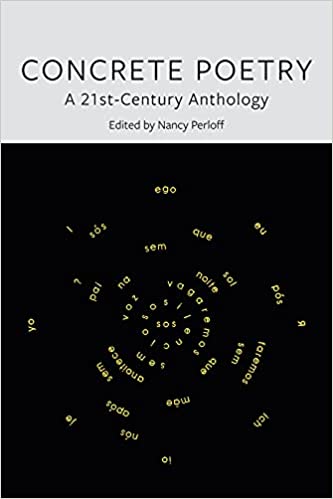
The apple doesn't fall too far from the tree —

Nancy Perloff (daughter of Marjorie Perloff)

has edited an exceptional and dutifully global

appreciation of this diverse art form 

with an expert introduction by Perloff, along with

marvelous showcases by Augusto de Campos,

Ian Hamilton Finlay, Eugen Gomringer,

and now Susan Howe has entered the 

lexicon along with Dieter Roth and

many other naturals. 

Too bad Aram Saroyan wasn't included — 

the anthology is

missing that extra touch of play —

beautifully designed and with

fine detail on each biography.

The international breath

is the ticket.

{ BA }


eyeye

ARAM SAROYAN


Wednesday, January 6, 2021

NIEDECKER / EDWARD DORN ~


 Niedecker / EDWARD DORN


The strict eye

of  sparrowhawk evenly

in her survey of reality


The firm bone of the woman

at the well


The line of a simply exquisite rope


________________________

Epitaphs for Lorine

Jargon 74

Thirty-two poets celebrate

Lorine Niedecker (1903-1970)

The Jargon Society, 1973


I took this book out of the new, tall and very narrow

built-in bookcase I built in our bedroom and saw it was

ideal for the tiniest books in my library, and this little gem

I often return to from Jargon fit the bill. I built the bookcase

a week before Christmas 2020 the same time I was finishing

an equally tall and narrow jewelry cabinet for Sweeheart. Both

situated left and right of the doorjamb of our bedroom. As a 

builder, I like that little forgotten space where the likes of jewelry, 

tiny books (and I have many) and even CDs where long ago I built

two cabinets for all my Blues CDs left and right of the doorjamb

in the living room. It's wasted space until you discover it. The above

Dorn poem knows all about space — sparrowhawk, woman, rope.


[ BA ]


[ Ian Hamilton Finlay ]


Friday, November 27, 2020

RE-READING IAN HAMILTON FINLAY ~


— Finlay’s work, both as a poet and as a visual artist, is deeply traditional, in that it depends upon elements drawn from the whole history of Western culture; at the same time, it is deeply experimental, in that the deployment of these elements takes place in ways that are new, unexpected, and demanding. The method of reading each poem is not explained in advance by poetic conventions: it has to be intuited from the form presented by each individual poem.

                                                — Stephen Scobie


A wonderful glimpse of Finlay's correspondence
with a number of poets, including Robert Creeley,
Gael Turnbull, Ronald Johnson, Louis Zukofsky
and the editor of this volume Thomas A. Clark
on poetry and making. Finlay 1964:
"I am now very interested in the idea of using
poetry in architecture, and have designed poems for
large sheets of glass, and for the outsides of houses. . .though 
none of these projects have yet been realised. I am
sure they will, though, one day. I am also very
interested in toys — not for children, though,
but as pure objects. . .with simple shapes,
in bright colours. I would like to do many things,
when there is the opportunity."

There is a spirit here in Ian that only the birds know.

[ BA ]


Thursday, June 4, 2020

EMBARK ~


I A N     H A M I L T O N     F I N L A Y

B A C K     R O A D     C H A L K I E

___

J u n e  2 0 2 0


photo by Bob & Susan Arnold


Monday, May 20, 2019

HEAVEN LAKE ( 34 ) ~


For Ian Hamilton Finlay

______________________________________________________


Hear


oriole by

itself made

the yard


                         Boy


                                               an airport —

                         on the kitchen table


In


the rain

the geese


                                             Simple


                                                 the canoe

                            does no-

                            thing on

                                          land


___________________

Bob Arnold
Heaven Lake
Longhouse 2018


Sunday, December 11, 2016

AVANT - FOLK ~


Avant-Folk: Publishing in the Vernacular
dreamt up and real by Ross Hair


Thomas A. Clark
Simon Cutts
Ian Hamilton Finlay
Lorine Niedecker
Erica Van Horn
Jonathan Williams


Published by the UEA Publishing Project
for the exhibition at theSmall Publishers Fair
Conway Hall, London
4-5 November 2016


Cover: IAN HAMILTON FINLAY Christmas gift, 2001


Friday, January 2, 2015

LETTERS FROM IAN HAMILTON FINLAY ~


"Oh I am so tired of mean ness of spirit. I am a low, tired, weary, twisted person, but I long, long for some GOODNESS and CLARITY. If we cannot put First Things First, could we not Put Them Third, at least, for a wee while . . . All those people of Breadth: they are people without centres . . . and without shame."

Ian Hamilton Finlay in correspondence with Stephen Bann
13 October 1969


Wilmington Square Books
London
2014
426 pages
w/ photographs

a wonder


Wednesday, October 8, 2014

FURTHER IAN HAMILTON FINLAY ~


At Little Sparta
photograph by George Gilliland


October 6, 2014


Hello Bob,

You won't remember me but I got some books off you many years back when I was in Northern Ireland - I was introduced to your work by Alec Finlay.

Anyway, life's quirks and turns have now brought me to where I am gardener at Little Sparta for the past 3 years and I have been enjoying the Birdhouse dispatches - and especially after todays piece thought I should get in touch again.

The house at Little Sparta and Ian's library is turning into a study centre - I don't know if you ever visited, but I came across some of your books as we were moving everything.

The garden has just closed for the year and I am putting everything under wraps - it looks like a ghost of itself….


All best wishes,

George


George Gilliland


_________


October 6, 2014


Dear George,

I have many loves to speak of having your letter today — that you came my way through the book trade, from northern Ireland ( my mother's birthplace! ) and via Eck. Very nice. Quite nice. And everlasting.

Now you tell me you are a gardener at Little Sparta! Exceptional. I've no idea who has an eye on my daily Birdhouse but I am very thankful you dropped me a note about my wee one for Thoreau and Ian. I'll never have letters from him again, or to think he is up and about and capable of making and sending more postcards, booklets, and heaving grand statues onto the landscape. What a fellow.

I'm glad you are there. Ever thanks for letting me know some of my books gifted to Ian are still about the premises.

I never made it over. Ian had some dream notion of having me there to build him a stone hut. Eck said at the time his father was serious. The dream will last me until the end of time.

Take care of the place.

all's well, Bob


Bob Arnold


_________


October 7, 2014


Hello Bob,

Many thanks for your reply - its always fascinating to see how things connect - a grand idea for a stone hut - - pity, it would have sat very well in the landscape here. I write a little bit about the garden each month, which might be interesting for you if only for the photos which show how the garden is now in its maturity, and how it looks out of season too when I have it all to myself - http://www.littlesparta.org.uk/news/gardenersReports.htm

Could you also let me know the price to send a couple of your more recent books to Scotland - Beautiful Days and the Love poems..

Again, all best,

George


_____________


Please tap onto this link for much more of George Gilliland, Little Sparta, and the current rhymes and rhythms of Ian Hamilton Finlay's home and garden. George's monthly garden journal is a treasury ~


  correspondence 2014  © bob  arnold, george gilliland

permission to reprint at A Longhouse Birdhouse was granted by both authors


Monday, October 6, 2014

VISITING THOREAU & FINLAY ~


Henry David Thoreau's hut site, October 1, 2014


Long ago, but not really long ago (40 years — and in those 40 years Earth has lost half of its wildlife) one could drive Route 2 along the top edge of the Massachusetts plain and pretty much have a countryside drive until one reached Concord, home of Henry David Thoreau.


Walden Pond, October 1, 2014


When hiking around Walden Pond my hiking partner will ask whose land it was that Thoreau built his hut upon, and I'll say Emerson, while steering at our hike on the sandy beach around the emerald pond. Ralph Waldo Emerson was another rock star resident of Concord. That countryside drive could be excused around cities like Leominster and Gardner because they were still populated by town folk who had been raised by country folk, and those two folk together allowed for a certain calmer behavior. There were working farms and farm stands selling produce just around the corner from Walden Pond. Big pumpkins rolled out of pumpkin patches this time of year. Now all disappeared. Vanished. Most likely never to return. They call it "progress" all this traffic and all this noise and all this continuous construction along the highway seemingly never ending and advancing inches. I call it the end of the world.


Dare to watch what this world is becoming, but I've given up on that ride, or even hope, and am planning to continue to build, as I always have, tiny books and booklets, now smaller living structures, quieter habitats, and join those people who live and do much the same. We'll all go down in Charley Patton's high water, or flames. We could try to heal Earth, but we seem to have lost our way.


The Present Order is the Disorder of the Future  [ Saint-Just ]
1984


So a notice to all zombies — you need the world of Thoreau and Finlay. 19th and 20th century marvels who were shunned for the greater part of their lives and slowly but surely gained some glory after their deaths. Men who built things outdoors. Who lived by the commerce of sunshine and rain. Who never needed you but eventually you'll get to them.


100 Postcards
1968-1998


It's 89 miles according to Google, but we don't need Google except my partner has told me it is spot-on with the calculated distance from our back door to Thoreau's back door at Walden Pond. Not 90 miles, but 89 on the button. Same distance from Florida to Cuba. We drive down in a day of rain. We're coming to hike the pond since we last hiked it one May evening this year and now we want to hike it before breakfast in October. Usually swimmers are in the pond no matter the time of day but this morning we only catch one swimmer lifting out of the pond as we arrive and he's quickly aiming for his towel. Slim and fit like all the swimmers are at Walden Pond. It's a deep pond, over 100 feet (according to Thoreau and everyone who have measured since Thoreau) and standing along any part of the shore line returning from the hut one can see a quick drop off a few steps into the pond. Three steps and you're over your head. It's a deep bowl kettle. New England serious.


the divided exhibit


 One can take a drive on Route 2 in Massachusetts and visit either the birth places and or graves of the three giant beatific figures of the 19th-20th century, the real deals, the real mccoys, and I call them beatific, working toward and away from the over used word "beat," as classic examples of going by the route of the individual drummer: Henry David Thoreau, Herbert Huncke, Jack Kerouac. All Massachusetts born. And in these three gems we receive the literature, the lifestyle, and the complete aura of the free spirit. Two would pass from this world cruelly before the age of 50, and one would hang in there by a thread, maybe electrified by amphetamine. All three makeup the frontier and pioneer and the modern of American literature. Ginsberg, Ferlinghetti, Burroughs and the like would have been diminished without them. Add as a final note, since he is always forgotten, and always taking up the rear: John Clellon Holmes, the fourth corner of this Massachusetts-born cube, who wrote the first Beat novel "Go," and we get to them all by wandering on and a bit away from Route 2.


Today, a mere stone's throw off Route 2, we came to see Ian Hamilton Finlay. Not Ian himself, since he passed away in Scotland in 2006, but a fine fiddle exhibit spanning an attractive portion of his life.


The poet, the gardener, the activist, the fighter, the classicist, the prankster, the publisher, the artist. A very full life, lived for the greater part with himself in rural Scotland, small family, small pond, windy mowing, grandeur designed buildings, sculptures, pathways, delightfully historical and personal at once. Much like Thoreau — his neighbor the last five months while this exhibit has been up at deCordova Sculpture Park and Museum in Lincoln, MA., — a once in a lifetime individual. They certainly would have visited one another.


The exhibit is grand and Finlay is well appreciated. There are maybe two faults about the exhibit though: in one example they divide Ian's portion up with another artist in the same large room not at all pulling the Finlay magic, even if the artist is borrowing Emily Dickinson's poems, and another poet's, it all feels forced and unrealized. Exaggerated. Maybe a better choice, at the very least complimentary and of contrast, would have been the art world of Jenny Holzer. Some of her outdoor landscape art may be seen at The Clark Museum in Williamstown going in the other direction on grand Route 2. Or the Robert Seydel exhibit currently on display at Smith College, down the road from Route 2. But perhaps the best choice would be Tomi Ungerer (see Longhouse Birdhouse for October 5, 2014) like Finlay, Ungerer is drawing straight from his own straw and guts. By dividing Finlay's great share this way, asking us to move to another floor to continue our Finlay quest (and Ian can handle it), we lose the wonderful opportunity to feel a continuity of the whole Finlay world pulsing inside one large room. It would have. I'm missing that.


The second cringe is seeing all one hundred of Finlay's beautifully printed broadsides and small posters and poem cards displayed more for the benefit of an irritating artful design (half the problem with museums) in five broad rows of frames and only the bottom row is at our eye level. The rest of the frames you have to crane your neck and look up, as the already smaller and humble gifts of each piece diminishes by the mere distance between the artifact and the viewer. And these are each distinguished pieces meant to be seen, read and soaked into. You can't. I can imagine Ian sort of dying at seeing this part of the display. Since there is plenty of open space to reveal each frame down at eye level around the pie wedge arena.


Other than that, the exhibit is gorgeous, generous, and we can easily adopt to the next floor of more Finlay by enjoying how two parts of the exhibit vibrate because they have been sequestered into smaller rooms. In there you get more of Ian the sailor, and Ian with Saint-Just of the guillotine lore. Both rooms will nicely overwhelm.


Outdoors, if you don't mind getting wet in the day's rain, you can find one of Ian's sundials. It loves the rain. There are well crafted stonewalls natural to the museum grounds that work splendidly with Finlay. I would even bet there are very few locations in the United States that match the Finlay spirit as well as this once former castle on wealthy grounds in Lincoln.


Stonypath  /  Little Sparta


You have less than a week to get there for the show.


I was lucky, a friend who comes and goes, notified me of the exhibit or else I would have been lost.


Ian


There was a time when Ian Hamilton Finlay wrote to me handwritten letters straight off his writing tablet and folded these letters up into little gifts like books and cards and even once a whistle. The whistle was old and it was still in its box that was old and that maybe told me it once was Ian's. 


~ Bob Arnold


text  2014  ©  bob arnold

photos 2014  © bob & susan arnold

while hiking around walden pond

and attending the Ian Hamilton Finlay exhibit

pointing the camera at sculptures,

works on paper

&

a video of Ian and Stonypath

running in one quiet corner

as a continuous loop. 


––––––––––––––––––––––––––


http://www.ianhamiltonfinlay.com/ian_hamilton_finlay.html

 http://www.thoreausociety.org/life-legacy

http://www.decordova.org/