Showing posts with label Wendell Berry. Show all posts

Monday, March 30, 2026

Saturday, November 26, 2022

THE NEED TO BE WHOLE ~


R E A D    M E


The Need To Be Whole

essays by Wendell Berry

Shoemaker & Hoard, 2022


Friday, August 5, 2022

WENDELL BERRY ~


Stay Home


I will wait here in the fields

to see how well the rain

brings on the grass. 

In the labor of the fields

longer than a man's life

I am home. Don't come with me.

You stay home too.


I will be standing in the woods

where the old trees

move only with the wind

and then with gravity.

In the stillness of the trees

I am at home. Don't come with me.

You stay home too.


_______________

Wendell Berry

New Collected Poems

Counterpoint Press, 1980


Saturday, May 13, 2017

KATHLEEN RAINE ~


Counterpoint 
Berkeley
2017


"If, on the other hand one takes not the materialist approach —
man's rights — but the spiritual approach — man's duties — the
poet has his place. It is not the State who should support the
poet, but the poet who should save the State — the poet together
with the saint and all lovers of the three verities. For civiliz-
ation depends finally upon those who give more than they receive."

K A T H L E E N     R A I N E


Friday, January 20, 2017

Thursday, November 24, 2016

ROOTS TO THE EARTH ~


A SMALL PORCH ~


Wendell Berry with horses on his farm
Courtesy of Platform Media Group


VIII.

A SMALL PORCH IN THE WOODS


9.


To care for what we know requires

care for what we don't, the world's lives

dark in the soil, dark in the dark.


Forbearance is the first care we give

to what we do not know. We live

by lives we don't intend, lives

that exceed our thoughts and needs, outlast

our designs, staying by passing through,

surviving again and again the risky passages

from ice to warmth, dark to light.


Rightness of scale is our second care:

the willingness to think and work

within the limits of our competence

to do no permanent wrong to anything

of permanent worth to the earth's life,

known or unknown, now or ever, never

destroying by knowledge, unknowingly,

what we do not know, so that the world

in its mystery, the known unknown world,

will live and thrive while we live.


                     .    .    .


And our competence to do no

permanent wrong to the land

is limited by the land's competence

to suffer our ignorance, our errors,

and — provided the scale

is right — to recover, to be made whole.


_________________


WENDELL BERRY
A Small Porch

Sabbath Poems 2014 and 2015
together with 
"The Presence of Nature in the Natural World:
A Long Conversation"

C O U N T E R P O I N T, 2016


Saturday, August 22, 2015

GUY DAVENPORT ~


G U Y    D A V E N P O R T   &   W E N D E L L    B E R R Y


The Paris Review Interview
w/ Guy Davenport


Tuesday, November 25, 2014

IF THERE'S HELL BELOW ~


(Don't Worry) If There's a Hell Below We're All Going to Go by Curtis Mayfield on Grooveshark


H2Ogate Blues by Gil Scott-Heron & Brian Jackson on Grooveshark


The Purge by The Game on Grooveshark


Backlash Blues by Nina Simone on Grooveshark


Likambo Ya Ngana by Franco on Grooveshark


compiled by BA the night of ferguson, mo. grand jury release
disbelief disbelief disbelief
 chose not to indict
 Darren Wilson
 in the fatal shooting
 of Michael Brown
even after all these years
of knowing better
naturally
a verdict
for  us &
Thanksgiving


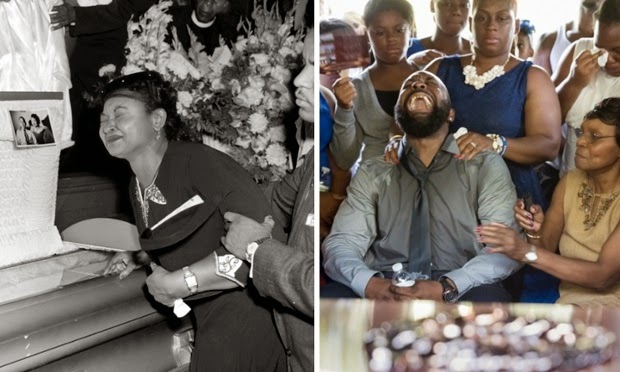
Mamie Till, summer 1955                                               Michael Brown Sr, summer 2014
Photograph: Chicago Sun-Times via AP                                                      Richard Perry / AFP / Getty      


___________________


If the white man has inflicted the wound of racism upon black men, the cost has been that he would receive the mirror image of that wound into himself.

W E N D E L L   B E R RY
The Hidden Wound
1970


NEW YORK TIMES ~

http://www.nytimes.com/2014/11/26/opinion/the-meaning-of-the-ferguson-riots.html?hp&action=click&pgtype=Homepage&module=c-column-top-span-region&region=c-column-top-span-region&WT.nav=c-column-top-span-region


http://www.washingtonpost.com/opinions/ferguson-wasnt-black-rage-against-copsit-was-white-rage-against-progress/2014/08/29/3055e3f4-2d75-11e4-bb9b-997ae96fad33_story.html?tid=pm_opinions_pop


Tuesday, May 20, 2014

HEY NEIGHBOR ~


Here we have 250 letters between two poet friends
 ~ 1973 to 2013 ~
spanning from the Sierra Foothills to a Kentucky hillside farm


Distant Neighbors
The selected letters of
Wendell Berry & Gary Snyder
edited by Chad Wriglesworth
Counterpoint 2014


Saturday, September 21, 2013

LOST & FOUND ~


April 15th was a momentous day for us in the U.S. On that day two bombs exploded at the Boston marathon, killing three people. The atrocity was covered around the clock for weeks. I received e-mails from different friends in Iraq expressing their condolences and sadness. April 15th was also a momentous day in Iraq. I cannot help wondering how many people in the US heard about the eighteen bombs that went off throughout Iraq that same day. At least thirty-two people were killed. And on April random attacks left 111 Iraqis dead. On April 24th at least eighty-six were killed, and another ninety-six on April 25th. And this has been the reality in Iraq for over ten years now.

In the eight years since the onset of Operation Iraqi Freedom until the end of 2011, 4, 480 US troops have died in Iraq. This is a figure commonly cited in the US media. A figure we might not have heard is the following: 4, 471 Iraqi civilians died as a result of ongoing violence in 2012 alone.

Cathy Breen, "Iraq: Hope Amidst Tragedy", The Catholic Worker August-September, 2013


young Wendell Berry


ONE RIGHT STANDARD

[The following letter was written by Wendell Berry, author, farmer
and environmentalist, to John Held, in support of the campaign against
frac sand mining - Eds. note]


Dear John,

You have offered me the privilege of joining by letter with you and your friends in Winoa, Minnesota in opposition to "frac sand mining" and I am happy to accept.

I will say, first, that there is never, for any reason, a justification for doing long-term or permanent damage to the ecosphere. We did not create the world; we do not own it, and we have no right to destroy any part of it.

Second, most of our politicians and their corporate employers are measuring their work by the standards of profitability and mechanical efficiency. Those standards are wrong. There is one standard that is right: the health of living creatures and the living earth.

Third, we must give our need to eat, drink and breathe absolute precedence over our need for mind fuels.

I wish you well.

Sincerely,
Wendell Berry


from The Catholic Worker, August-September 2013


However, other times there’d be a book I’d start reading and couldn’t put down. Here, for example, is the opening of one called Business be Damned—not a very promising title—by someone called Elijah Jordan, published in 1952 by Henry Schuman, New York, and presented at some unknown date to the library of Southwestern University in Georgetown, Texas by its original owner, Dr. Joe Colwell, and subsequently removed from their collection:

    "There have always been businessmen and business in the world. But never in history till today was business accepted as a morally honorable activity for men; never before was the businessman permitted to dominate the affairs of men. Today the rule of the businessman, accepted, justified and glorified, has become undisputed and absolute.

    Until lately, however, the activity of the businessman has always been questioned as to its moral rightness. The formulation of this doubt has been the negative or critical premise upon which every developed moral system and every cultured religious system has been founded. The new fact, therefore, in what is called modern civilization, is the acceptance of business activity as morally honorable, the approval of the capacities and the characteristics of the businessman, and the assumption that these capacities are appropriate for rule and control of human affairs."

This is extraordinary, I said to myself. Jordan (1875-1953), who was a professor of philosophy at Butler University for many years, saw the writing on the wall, pointing out already back then that business had become the dominant force in our lives with all other human interests in this country subservient to it. Religion, politics, government, morality, art were all being asked to acknowledge its absolute right and absolute power to be the final arbiter.

If he came back from the dead today, Jordan would be surprised that his fellow Americans still haven’t caught on that they are being taken to the cleaners. On the contrary, many of them now believe that the solution to all our problems, be it failing schools or expensive healthcare, is to hand over every publicly run institution to profit-seeking private companies, which, thanks to their knowhow and the magic of the free market, will save tons of money for the tax payers. This is what is known as “privatization” today, the scam that makes everything from private prisons, the vast growth of our surveillance state, and our global military presence, a hugely lucrative enterprise. Voters, one can’t help but conclude, no longer seem to have any problem with fortunes acquired dishonestly and at their expense, some of them even going into huge debt to send their sons and daughters to prestigious business schools so they can go to work for these hucksters and emulate their success.

Charles Simic, "The Books We've Lost" The New York Review of Books, August 13, 2013


Isma’il Kushkush/The New York Times


KHARTOUM, Sudan — On the corner of an old colonial building in downtown Khartoum sits the city’s oldest bookstore, Sudan Bookshop. It was established in 1902, three years after Britain established control over Sudan, and for a long time it was a magnet for the city’s civil servants, politicians and intellectuals.  (read more...)

http://www.nytimes.com/2013/09/18/world/africa/in-a-faded-literary-capital-efforts-at-a-revival.html?pagewanted=2&hp&pagewanted=all


Thursday, April 26, 2012

EARTH ~


Wendell Berry


I've watched Wendell Berry's NEH speech (linked below, go for it). He's not a great speaker, too dry, a bit feeble (don't blame him, it's hard work having a conscience), lacking a humor that is important to start into and thread a long speech, though a few in the audience admit to their opening moments of nervous laughter.


Of course the speech has a great theme: affection, and written well by the farmer/poet who has shown the same in many of his best poems.


I note almost all the past NEH speakers are from safe ground: no Gary Snyder, no Noam Chomsky, no Susan Sontag, no Studs Terkel, no Amiri Baraka. We continue to die a slow death.


I have to say a color guard at the start of the program, and two holding rifles (loaded?), doesn't make me feel comfortable for anyone in the audience. Its choreography looked clumsy indoors, even a parody. Recent blitzed minds holding US service rifles and what they have done with them is inches from one day one of these militants turning it on the audience. Or the speaker.


The aura of the pre-speech felt like faded glory. A much younger writer should have been chosen to read the Berry poem ( we are talking here of sustainability, right? ). I know they have young and authentic Kentucky poets and writers all over the blue grass state. Our moderator had to make sure the speech afterwards was thoroughly rinsed with bleach by saying it didn't reflect the opinions of the US government (to say the least!). Somehow it is lost on those in power that a poet, teacher, farmer, neighbor, essayist like Berry — who has made a lifetime of books (and readers) to fill whole shelves and with the potential of being stocked in every library around the world — is the voice of the citizen, and so the greater voice of any government.


Of the writers Wendell Berry bravely learned and quoted from: Wallace Stegner, Wes Jackson, Albert Howard, Aldo Leopold and even E.M. Forster — except in their regional roosts (Leopold/Wisconsin etc) just go try to find these authors' books in your local bookstore. You say you no longer have a local bookstore? Ah, yes, more of the problem.


Wendell Berry is hardly a modern Henry David Thoreau, as he's often described. That distinction might better be served by his friend the late Harlan Hubbard. Get out there and beat the bushes for Hubbard's "Walden" of a sort — his masterpiece volume Payne Hollow.


It's long been known Berry doesn't use a computer. I'm far but a good example for one using modern conveniences — though it could be argued that one, like Berry, who calls himself an environmentalist and is often championed as one — is, in fact, out of touch with the current environment without a computer. Before your backwoods brains boil over, think about it. In this case, a computer as tool. As accessibility. As electronic pathway and still keeping all the trees. As canoe. Some computer users have the agility to glide.


For this speech Thoreau would have definitely shown up open collared, quoted John Brown, Walt Whitman and perhaps passages from the Gita, and told the authorities there would be no speech until they get rid of the armed soldiers who have nothing to arm at such a speech. He would have made some people unhappy. Some of those unhappy would then make their own stormy speeches and articles how Thoreau once almost burned down his town with a got-away grass fire. All true, he was an adventurous young man. Balanced and sustained everything he touched with an exploratory and inventive way. To this day he has no one, like John Muir in the west, who can rival his hardscrabbled and persistent methods. A whole other era, a whole other heaven — a time of foot-to-mind powers. Both fellows were hikers, dreamers, doers, travelers, mystics, working authors, field hands, respectful trespassers.


Wendell Berry is a farmer in the truest sense, with a long family heritage. I can close my eyes and imagine this speech being said on a milking stool, late in the day, dim lights in all the barn windows, and everything in the barn, including the pesky swallows that nest, falling peacefully asleep.


photo: guy mendes


Friday, January 15, 2010

SOMETIMES THE DAY IS JUST RIGHT WITH ONE POEM, ONE HAND WAVE, ONE SMILE.

HERE'S ONE POEM ~


WENDELL BERRY


from SABBATHS (2008)


I.


After the bitter nights
and the gray, cold days
comes a bright afternoon.
I go into the creek valley
and there are the horses, the black
and the white, lying in the warm
shine on a bed of dry hay.
They lie side by side,
identically posed as a painter
might imagine them:
heads up, ears and eyes
alert. They are beautiful in the light
and in the warmth happy. Such
harmonies are rare. This is
not the way the world
is. It is a possibility
nonetheless deeply seeded
within the world. It is
the way the world is sometimes.


My sense of Wendell Berry — farmer, author, family man, teacher and poet, is this is almost the culmination of the farmer and the poet come to rest in one late in life poem. It seems it just had to take a farmer and a poet to see this image magnifico: lying in the warm
shine on a bed of dry hay. The sight, the texture and the sure-step sound of it all.