daydreaming w/ Bob Arnold

Dorothy Day's final arrest,
protesting with striking farm
workers in California, 1973
Photo by Bob Fitch


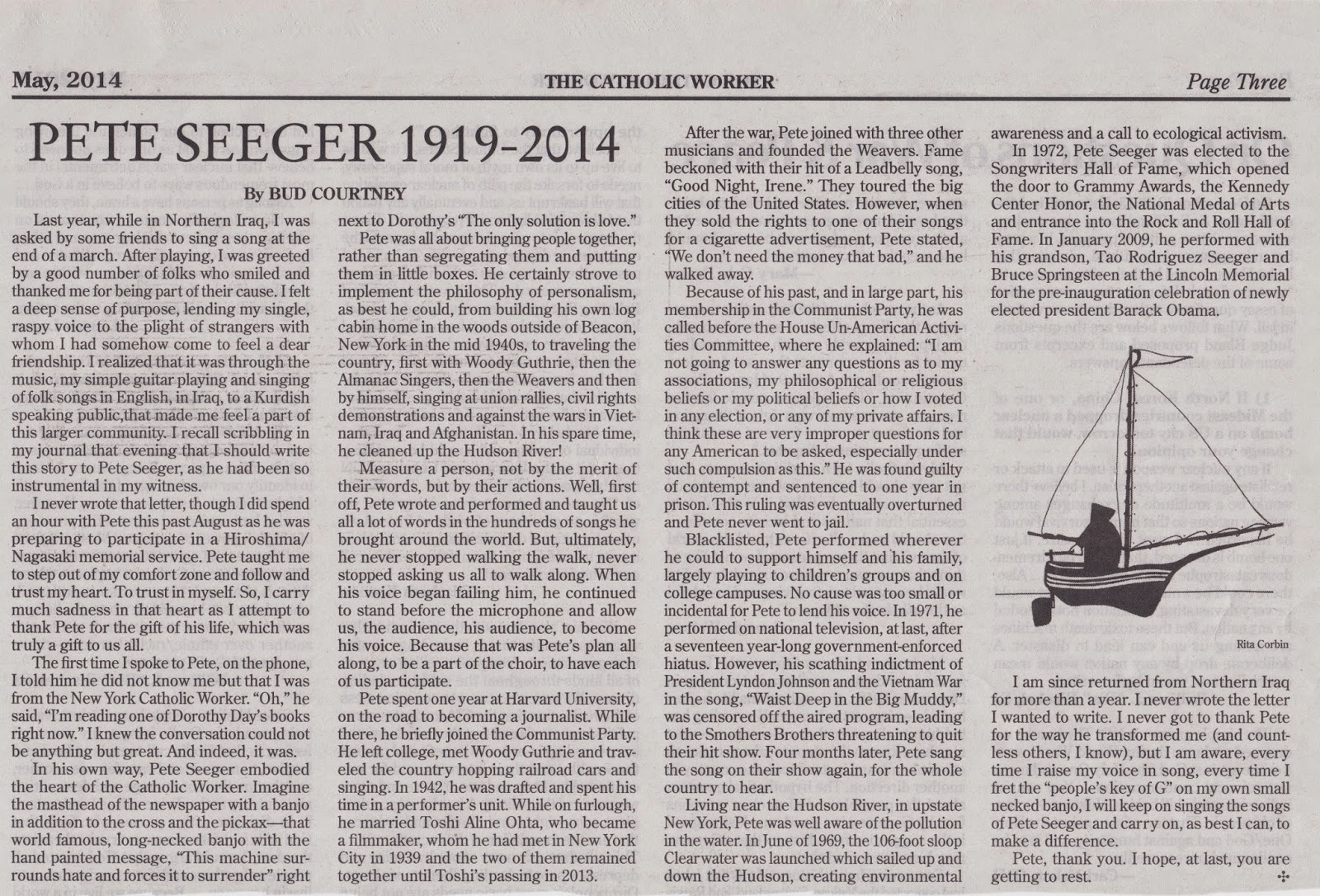


Artist Rita Corbin, whose tender line drawings graced the pages of Catholic Worker journals for decades, died Nov. 17 from injuries suffered in a car crash. She was 81.
Corbin decided early in life to become an artist, choosing to major in art while attending Cathedral High School in New York City.
"The school was keen on turning out secretaries," she said, "but I refused to learn to type. I knew I didn't want to go into business on pure instinct, I guess. I needed a major and art appealed to me the most."
For Corbin, the artistic endeavor could not be separated from one's political and religious consciousness. She considered the work of the artist to be "a real struggle to bring some kind of form and feeling out of the materials one uses and the society one lives in."
Corbin's society included the natural world as well as the poor. Both were frequent subjects of her illustrations. Her etchings and pen and ink drawings of trees, flowers and birds have been described as lyrical celebrations of nature. Her figurative work has been likened to that of German painter, printer and sculptor Kathe Kollwitz.
Unassuming in demeanor, Corbin was a prolific artist. Over the course of her life, she produced a voluminous and expansive body of work that explored a variety of styles and subject matter. Much of this art was created while Corbin was living in pacifist collectives and raising children. She donated a lot of her work and later said, "In retrospect, maybe I shouldn't have given away so much to people who could pay for it. It's not fair to other artists for me to work entirely for free."
Her artwork enjoyed wide-ranging publication. Corbin's images appeared in Commonweal, Harvard Theological Review, several pacifist magazines and numerous Catholic and liturgical publications. She illustrated books, including Thomas Merton's Ishi Means Man, painted a mural in Chicago and annually produced Christmas cards and a calendar.
But Corbin is best known for her countless contributions to The Catholic Worker newspaper first published in New York in 1933. She, along with liturgical artist Ade Bethune and illustrator Fritz Eichenberg, formed what one editor of The Catholic Worker referred to as the "Holy Trinity" of artists whose work shaped the look and feel of the newspaper during its formative years.
Her now-famous etching contrasting the Works of War with the Works of Mercy was emblematic of the Catholic Worker movement's commitment to Christian pacifism and solidarity with the poor. It has been reproduced in Catholic Worker journals all over the country.
Editors described her as a most agreeable and responsive artist, able to produce images in a timely manner.
"If we said we needed something for the newspaper, Rita would do it. She understood the importance of the work," said Patrick Jordan, a former editor of The Catholic Worker and now managing editor of Commonweal.
Rita Corbin's famous depiction of the works of mercy, seen in Catholic Worker communities across the country.Jordan said Corbin "had a way of picturing the poor that was obvious it wasn't from afar. ... There was one picture she drew of a woman at the [Catholic Worker] soup kitchen standing beside a dining room table where someone had scrawled, 'Joy, Joy, Joy.' Rita caught that detail. For a journal that didn't use photographs, she conveyed a great deal with a certain clarity that worked very well for a newspaper."
Writer and publisher Robert Ellsberg, who edited The Catholic Worker in the late 1970s, praised Corbin's regard for the natural world.
"A lot of the famous Catholic Worker artists like Bethune and Eichenberg brought a heavy, narrative approach to the paper," he said. "Rita always brought a more celebratory and decorative approach that came out of the [Catholic Worker] farming communities. Her images from nature reflected as much of a concrete dimension of the Catholic Worker movement as those depicting the Houses of Hospitality."
Indeed, Corbin said she considered some of her best art to be her drawings of nature and the poor, "those on the fringes of society, the same kinds of people Christ came to heal and teach."
Born May 21, 1930, in Indianapolis, Corbin was the youngest daughter of Carmen and Hubert Ham. The family was very poor and traveled throughout the country while Hubert Ham, an organist, played for magic shows.
After graduating from Cathedral High School, Corbin remained in New York to pursue training in art. She was awarded a scholarship to Franklin School of Professional Art, a three-year advertising school, then later studied with Hans Hoffman, a master of abstract expressionism. She also took classes at the Arts Student League of New York City.
But Corbin said much of her artistic education came from wandering through New York's galleries and parks, simply observing.
Upon graduating from advertising school, Corbin was offered a job at an agency, which she declined. When later asked if she regretted refusing a potentially lucrative career, Corbin said, "What I do is kind of commercial, but I have control. I consider myself an artist illustrator, not a fine artist, not a commercial artist."
Corbin first visited the New York Catholic Worker on New Year's Day in 1950. Like many before her, she was immediately recruited to help in the kitchen. She made friends with the Catholic Workers and kept coming back to their home on the Lower East Side to attend Friday night meetings, bake bread, serve soup, support a strike or demonstrate against the city's civil defense drills.
"The Catholic Worker was my school, my education," she once said.
The Catholic Worker first published Corbin's art in 1954. Two years later she married Marty Corbin, a Catholic intellectual. For 10 years, the couple lived in Glen Gardner, N.J., in an intentional community founded by pacifist Dave Dellinger.
As artist and writer, the Corbins contributed to Liberation, a radical, pacifist monthly. Conditions in Glen Gardner were very tough. The Corbins lived in an un-insulated chicken coop. Their firstborn, a son, died in infancy, the first of many losses in Corbin's life. Three daughters were also born in Glen Gardner.
In the mid-'60s, the family moved to the Catholic Worker farm at Tivoli, N.Y. Marty Corbin edited The Catholic Worker. A son and another daughter were born.
After spending 10 years at Tivoli, the Corbins relocated to Montreal, where Marty taught English at a local college. Rita separated from her husband four years later, and with her children, moved back to the United States. She lived in Poughkeepsie, N.Y., then Weston, Vt., where she became art director of Growth Associates publishers, then Worcester, Mass., where she studied printmaking with artist activist Tom Lewis.
At the time of her death, Corbin was living in Brattleboro, Vt., near her five children and grandchildren.
Once asked what advice she would give to young artists, Corbin said, "Keep working at it. It doesn't come easy. It's very fulfilling. A lot of young people think in terms of jobs and not vocations. It's very schizophrenic."
for National Catholic Reporter
Rita Corbin poses for a photo in 2008 at the 75th anniversary celebration of the Catholic Worker movement in Worcester, Mass. (Photo courtesy of Bob Fitch)
Claire Schaeffer-Duffy is a longtime NCR contributor. She writes from Worcester, Mass., where she lives and works at the Ss. Francis and Therese Catholic Worker.
http://ncronline.org/news/people/rita-corbin-catholic-worker-artist-dies-81