Friday, July 2, 2010
Thursday, July 1, 2010
ALL THIS WEEK ~
NEW BOOKLETS FROM LONGHOUSE !
GEORGE KALAMARAS
click on images to enlarge
If you would like to purchase the new booklet, please link here
For the complete Longhouse titles we offer, please link here
Wednesday, June 30, 2010
LENORE KANDEL ~
POETRY IS NEVER COMPROMISE ~ LENORE KANDEL
Lenore Kandel in the center of things, 1967
foundsf.org/index.php?title=LENORE_KANDEL
Writer and actor Peter Coyote remembering his close friend Lenore Kandel at a memorial for LK in January 2010
POETRY IS NEVER COMPROMISE ~ LENORE KANDEL
Lenore Kandel in the center of things, 1967
foundsf.org/index.
Monday, June 28, 2010
FRANK SAMPERI
Let me introduce myself. I am Claudia Samperi-Warren, the daughter of the American Poet Frank Samperi. This blog will be in honor of my father's life as a poet.
Frank Samperi was born in Brooklyn in 1933. Discovered by Louis Zukofsky and Cid Corman, he published some twenty books of poetry and appeared prominently in journals such as Origin and Caterpillar.
Master of the lyric and an autoddact steeped in Dante, Aquinas, and Shankara, Samperi created a unified, highly original lifepoem of pilgrimage through the American City and world of the spirit.
He passed away in Sun City, Arizona in 1991. He is survived by his daughter, Claudia & son, David.
As a poet, as in other respects, Frank Samperi stood apart. Orphan and first generation Italian-American, he discovered Dante in a Brooklyn institution, taught himself Aquinas in Latin, studied the Indian philosopher Sankara, non-Euclidean geometry and astrology. His work was not just counter-cultural but also counter-fashionable. Although discovered by Louis Zukofsky and Cid Corman, and appreciated by other poets of his generation, including Robert Creeley, Robert Kelly, and Will Peterson, as well as other "knowing readers," Samperi's poetry has heretofore been available only in limited editions.
With recent works like, Spiritual Necessity produced by John Martone and others we hope that this web site will bring to light his voice to a new generation of thinkers.
*From the introduction of Spiritual Necessity by John Martone, Huntington, NY 2003
Sunday, June 27, 2010
EARTH ~

HUMMINGBIRD
Rarely pausing
Though I have seen
It stop the flutter
Of its amazing
Wings and perch
Nearly invisible
On a wire against
The evening sky —
And be sighted —
And being very
Still, be thought
Of as not there
LOSS
Put no trust in nothing, not even yourself
Yesterday was like summer, today snow blows
I’ve walked six miles with an axe and wedge
Actually make my living near a river running bright water
Home to a small hawk found mangled in the woodshed
Eyes opening, I load my rifle but won’t use it
Instead talk with the closest thing to me right now
Heavy gloves moving back short feathers
The break in its neck, claws no use, eyes closing
from Where Rivers Meet, Bob Arnold
photo © bob arnold
HUMMINGBIRD
Rarely pausing
Though I have seen
It stop the flutter
Of its amazing
Wings and perch
Nearly invisible
On a wire against
The evening sky —
And be sighted —
And being very
Still, be thought
Of as not there
LOSS
Put no trust in nothing, not even yourself
Yesterday was like summer, today snow blows
I’ve walked six miles with an axe and wedge
Actually make my living near a river running bright water
Home to a small hawk found mangled in the woodshed
Eyes opening, I load my rifle but won’t use it
Instead talk with the closest thing to me right now
Heavy gloves moving back short feathers
The break in its neck, claws no use, eyes closing
from Where Rivers Meet, Bob Arnold
photo © bob arnold
Saturday, June 26, 2010
EARTH ~
ROPE OF BELLS
It is the
Rope of bells
You have put behind the door
That let me know
Whenever one of us goes
To the privy
The woodshed
The outdoors
Lovely
WINTER
Just before supper
I watched a storm draw in
Taking light
The trees toss
No matter
I have finished carrying
Elm from the edge of the woods
Bucked, split then stacked
I am done
Well used
Come snow
HOW WE BUILD
It is a day
Of sawing slab wood
Splitting
Then stacking
And be done
Tucking away insulation
Fixing windows
Sharpening every tool
The happy moment
Is there are still
Small grasshoppers
In the slip of meadow
That it is 28 degrees
At 7 this morning
And I wash your hair
In one bucket of
Strong spring water —
There is nothing like it
from Where Rivers Meet, Bob Arnold
photo © bob arnold
Friday, June 25, 2010
SONIC YOUTH
(Kim Gordon & Thurston Moore)
JAMES TENNEY
JAMES TENNEY
What do you get when you bond two sonic and tonal mavericks together?
~ lend your ears.
Sonic Youth have been jamming, performing, busting into smaller groups and headlines and re-grouping like a force of nature since 1981. I've seen smaller portions of the group play in a bar and even a church.
Electronic and computer composer (& so much more) "James Tenney" (1934-2006) is the answer given by John Cage when he was asked in 1989 who he would study with if he were young.
~ lend your ears.
Sonic Youth have been jamming, performing, busting into smaller groups and headlines and re-grouping like a force of nature since 1981. I've seen smaller portions of the group play in a bar and even a church.
Electronic and computer composer (& so much more) "James Tenney" (1934-2006) is the answer given by John Cage when he was asked in 1989 who he would study with if he were young.

JAMES TENNEY
SONIC YOUTH
photos:
Thursday, June 24, 2010
EARTH ~

STEVE SANFIELD
Once upon a time in Nevada City, California Susan and I and young Carson arrived early in the day after days on a train. We had a few names and addresses in our heads, and Steve Sanfield was one. Steve's been on the same road address for as long as I can remember. Since we were in the post office to start the day off and sending out some postcards to folks back home, I thought I'd ask if they could tell me where this road was. Nope. Nobody knew. Nobody knew when later in the day we asked about another friend in Grass Valley. I was nicely impressed with how the neighborhood was mum. People were pleasant but they had that look that said — I don't know you and I don't know why you're asking. Fair enough. Steve and I have yet to meet in almost 35 years of sending our poetry back and forth to one another. We have mutual friends and we all like one another's poetry. Nothing at all wrong with that picture.
This morning in the mail Susan brought back from her hike up river a new book by Steve, beautifully designed and hand printed by Jerry Reddan at Tangram. Steve sent this with a note inside, always a friendly note from Steve inside. Often Jerry sends things, and I always send things back to them both. Sometimes I read a postcard poem or broadside Jerry has printed and it's in me enough to part with — someone else might like this, so I set it in the bookshop. Some I'll need to read over and over for years and years. The Perfect Breeze is one. Here's a few warm water drops.
STEVE SANFIELD
Once upon a time in Nevada City, California Susan and I and young Carson arrived early in the day after days on a train. We had a few names and addresses in our heads, and Steve Sanfield was one. Steve's been on the same road address for as long as I can remember. Since we were in the post office to start the day off and sending out some postcards to folks back home, I thought I'd ask if they could tell me where this road was. Nope. Nobody knew. Nobody knew when later in the day we asked about another friend in Grass Valley. I was nicely impressed with how the neighborhood was mum. People were pleasant but they had that look that said — I don't know you and I don't know why you're asking. Fair enough. Steve and I have yet to meet in almost 35 years of sending our poetry back and forth to one another. We have mutual friends and we all like one another's poetry. Nothing at all wrong with that picture.
This morning in the mail Susan brought back from her hike up river a new book by Steve, beautifully designed and hand printed by Jerry Reddan at Tangram. Steve sent this with a note inside, always a friendly note from Steve inside. Often Jerry sends things, and I always send things back to them both. Sometimes I read a postcard poem or broadside Jerry has printed and it's in me enough to part with — someone else might like this, so I set it in the bookshop. Some I'll need to read over and over for years and years. The Perfect Breeze is one. Here's a few warm water drops.
the old man's place
filled with stuff
never to be used again
changing the stream's song
simply by moving
a stone or two
twenty-five years later
still dazzling in or out
of her clothes
for Sarah
long after
breaking the cup
still finding the pieces
the death of an ancient pine
presents us with a view
we never wanted
wrote the poem
that said it all
can't seem to find it

Thanks Steve & Jerry ~ the perfect visit.
filled with stuff
never to be used again
changing the stream's song
simply by moving
a stone or two
twenty-five years later
still dazzling in or out
of her clothes
for Sarah
long after
breaking the cup
still finding the pieces
the death of an ancient pine
presents us with a view
we never wanted
wrote the poem
that said it all
can't seem to find it

Thanks Steve & Jerry ~ the perfect visit.
Wednesday, June 23, 2010
MORE ~ ANNA SWIR
Anna Swir (Swirszczynska) 1909-1984
SOUP FOR THE POOR
Through the streets of Warsaw
kitchens for the poor are hauled.
The poor stand in lines,
they warm themselves by bonfires
which are lit for them
in the streets of Warsaw.
It is the First World War.
Mother put on a kerchief,
covered her face, went out
into the street to stand in line
for the soup of the poor.
Mother was afraid
that the janitor's wife would see her.
Mother after all was
the wife of an artist.
THEY SAVED ME
Twenty-four hours
I was dying of fever.
Twenty-four hours
mother knelt
and prayed by my bed.
Twenty-four hours
father lay, face down
on the floor.
They saved me.
I AM FILLED WITH LOVE
I am filled with love
as a great tree with the wind,
as a sponge with the ocean,
as a great life with suffering,
as time with death.
I SLEEP IN BLUE PAJAMAS
I sleep in blue pajamas,
at my right my child sleeps.
I have never cried,
I will never die.
I sleep in blue pajamas,
at my left my man sleeps.
I have never knocked my head against the wall,
I have never screamed out of fear.
How large this bed is
if it had room enough
for such happiness.
WHAT IS A PINEAL GLAND
You lie asleep,
warm as a small heating plant.
Your lungs move, viscera digest,
glands diligently work,
biological processes of your sleep
make grow
the vegetation of dreams.
Do you belong to me?
I myself do not belong to you.
I touch my skin,
lungs move inside me,
viscera digest,
the body performs its work
with which I am not acquainted.
I know so little about the activity of the pineal gland.
Really, what do I have in common
with my body.
I touch your skin and my skin,
I am not in you
and you are not in me.
It's cold here.
Homeless, I tremble looking
at our two bodies
warm and quiet.
I CANNOT
I envy you. Every moment
You can leave me.
I cannot
leave myself.
THE SAME INSIDE
Walking to your place for a love feast
I saw on a street corner
an old beggar woman.
I took her hand,
kissed her delicate cheek,
we talked, she was
the same inside as I am,
from the same kind,
I sensed this instantly
as a dog knows my scent
another dog.
I gave her money,
I could not part from her.
After all, one needs
someone who is close.
And then I no longer knew
why I was walking to your place.
LARGE INTESTINE
Look in the mirror. Let us both look.
Here is my naked body.
Apparently you like it,
I have no reason to.
Who bound us, me and my body?
Why must I die
together with it?
I have the right to know where the borderline
between us is drawn.
Where am I, I, I myself?
Belly, am I in the belly? In the intestines?
In the hollow of the sex? In a toe?
Apparently in the brain. I do not see it.
Take my brain out of my skull. I have the right
to see myself. Don't laugh.
That's macabre, you say.
It's not me who made
my body.
I wear the used rags of my family,
an alien brain, fruit of chance, hair
after my grandmother, the nose
glued together from a few dead noses.
What do I have in common with all that?
What do I have in common with you, who like
my knee, what is my knee to me?
Surely
I would have chosen a different model.
I will leave both of you here,
my knee and you.
Don't make a wry face, I will leave you all my body
to play with.
And I will go.
There is no place for me here,
in this blind darkness waiting for
corruption.
I will run out, I will race
away from myself.
I will look for myself
running
like crazy
till my last breath.
One must hurry
before death comes. For by then
like a dog jerked by its chain
I will have to return
into this stridently suffering body.
To go through the last
most strident ceremony of the body.
Defeated by the body,
slowly annihilated because of the body
I will become kidney failure
or the gangrene of the large intestine.
And I will expire in shame.
I PROTEST
Dying
is the hardest
work of all.
The old and sick
should be exempt from it.
WHERE I AM DIGGING POTATOES
I am digging potatoes for dinner,
an ant climbs my naked leg.
— Ant, what do you think
of eternity?
The ant has a superhuman face
like chemical processes
in the sun.
The ant can educate me
in questions of eternity.
Digging potatoes
improves the mind.
SAD LOVERS
Like an eye and an eyelid
United by a tear.
A DOUBLE RAPTURE
Because there is no me
and because I feel
how much there is no me.
LOVE WITH RUCKSACKS
Two rucksacks,
two grey heads.
And the roads of all the world
for wandering.
from, TALKING TO MY BODY (Copper Canyon)
translated by Czeslaw Milosz and Leonard Nathan
"Anna Swir (Swirszczyska) was born in Warsaw in 1909, the daughter of a painter. As she herself says, she literally grew up in her father's workshop, sleeping and preparing her lessons there. The poverty in which the family lived forced her to look for work early in life. In her own words: "I was then terribly shy, ugly, and crushed by a mountain of complexes." She put herself through the university, studying medieval and baroque Polish literature and discovering the Polish language of the fifteenth century, which according to her, is the most vigorous. Her first poems, published in the 1930s, bear the marks both of her upbringing in the artistic milieu (images taken from paintings and albums of reproductions) and of her fascination with the Middle Ages. These are mostly short poems in prose, sophisticated miniatures, from which any personal accents are carefully eliminated. The form of the miniature was to return later, while the reticence about her personal life was to disappear."
SOUP FOR THE POOR
Through the streets of Warsaw
kitchens for the poor are hauled.
The poor stand in lines,
they warm themselves by bonfires
which are lit for them
in the streets of Warsaw.
It is the First World War.
Mother put on a kerchief,
covered her face, went out
into the street to stand in line
for the soup of the poor.
Mother was afraid
that the janitor's wife would see her.
Mother after all was
the wife of an artist.
THEY SAVED ME
Twenty-four hours
I was dying of fever.
Twenty-four hours
mother knelt
and prayed by my bed.
Twenty-four hours
father lay, face down
on the floor.
They saved me.
I AM FILLED WITH LOVE
I am filled with love
as a great tree with the wind,
as a sponge with the ocean,
as a great life with suffering,
as time with death.
I SLEEP IN BLUE PAJAMAS
I sleep in blue pajamas,
at my right my child sleeps.
I have never cried,
I will never die.
I sleep in blue pajamas,
at my left my man sleeps.
I have never knocked my head against the wall,
I have never screamed out of fear.
How large this bed is
if it had room enough
for such happiness.
WHAT IS A PINEAL GLAND
You lie asleep,
warm as a small heating plant.
Your lungs move, viscera digest,
glands diligently work,
biological processes of your sleep
make grow
the vegetation of dreams.
Do you belong to me?
I myself do not belong to you.
I touch my skin,
lungs move inside me,
viscera digest,
the body performs its work
with which I am not acquainted.
I know so little about the activity of the pineal gland.
Really, what do I have in common
with my body.
I touch your skin and my skin,
I am not in you
and you are not in me.
It's cold here.
Homeless, I tremble looking
at our two bodies
warm and quiet.
I CANNOT
I envy you. Every moment
You can leave me.
I cannot
leave myself.
THE SAME INSIDE
Walking to your place for a love feast
I saw on a street corner
an old beggar woman.
I took her hand,
kissed her delicate cheek,
we talked, she was
the same inside as I am,
from the same kind,
I sensed this instantly
as a dog knows my scent
another dog.
I gave her money,
I could not part from her.
After all, one needs
someone who is close.
And then I no longer knew
why I was walking to your place.
LARGE INTESTINE
Look in the mirror. Let us both look.
Here is my naked body.
Apparently you like it,
I have no reason to.
Who bound us, me and my body?
Why must I die
together with it?
I have the right to know where the borderline
between us is drawn.
Where am I, I, I myself?
Belly, am I in the belly? In the intestines?
In the hollow of the sex? In a toe?
Apparently in the brain. I do not see it.
Take my brain out of my skull. I have the right
to see myself. Don't laugh.
That's macabre, you say.
It's not me who made
my body.
I wear the used rags of my family,
an alien brain, fruit of chance, hair
after my grandmother, the nose
glued together from a few dead noses.
What do I have in common with all that?
What do I have in common with you, who like
my knee, what is my knee to me?
Surely
I would have chosen a different model.
I will leave both of you here,
my knee and you.
Don't make a wry face, I will leave you all my body
to play with.
And I will go.
There is no place for me here,
in this blind darkness waiting for
corruption.
I will run out, I will race
away from myself.
I will look for myself
running
like crazy
till my last breath.
One must hurry
before death comes. For by then
like a dog jerked by its chain
I will have to return
into this stridently suffering body.
To go through the last
most strident ceremony of the body.
Defeated by the body,
slowly annihilated because of the body
I will become kidney failure
or the gangrene of the large intestine.
And I will expire in shame.
I PROTEST
Dying
is the hardest
work of all.
The old and sick
should be exempt from it.
WHERE I AM DIGGING POTATOES
I am digging potatoes for dinner,
an ant climbs my naked leg.
— Ant, what do you think
of eternity?
The ant has a superhuman face
like chemical processes
in the sun.
The ant can educate me
in questions of eternity.
Digging potatoes
improves the mind.
SAD LOVERS
Like an eye and an eyelid
United by a tear.
A DOUBLE RAPTURE
Because there is no me
and because I feel
how much there is no me.
LOVE WITH RUCKSACKS
Two rucksacks,
two grey heads.
And the roads of all the world
for wandering.
from, TALKING TO MY BODY (Copper Canyon)
translated by Czeslaw Milosz and Leonard Nathan
"Anna Swir (Swirszczyska) was born in Warsaw in 1909, the daughter of a painter. As she herself says, she literally grew up in her father's workshop, sleeping and preparing her lessons there. The poverty in which the family lived forced her to look for work early in life. In her own words: "I was then terribly shy, ugly, and crushed by a mountain of complexes." She put herself through the university, studying medieval and baroque Polish literature and discovering the Polish language of the fifteenth century, which according to her, is the most vigorous. Her first poems, published in the 1930s, bear the marks both of her upbringing in the artistic milieu (images taken from paintings and albums of reproductions) and of her fascination with the Middle Ages. These are mostly short poems in prose, sophisticated miniatures, from which any personal accents are carefully eliminated. The form of the miniature was to return later, while the reticence about her personal life was to disappear."
— Czeslaw Milosz
Tuesday, June 22, 2010
SUMMERTIME ~
MAXINE BROWN
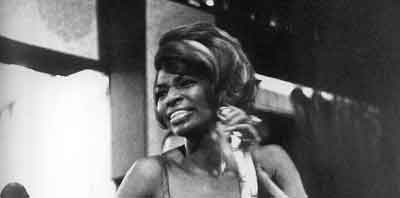
She's still out there performing...South Carolina born 1939, Maxine Brown started out in gospel and within a short time excelled in R&B, soul, jazz, pop with hits and not the best of luck. On the Wand label she recorded some of her finest work, including the Carole King/Gerry Goffin wonder "Oh No Not My Baby". It still gives me goose bumps and I still play it over and over. Nothing will ever be quite like first hearing the song in my mother's blue Impala, parked in the garage, rain on the roof, the radio on.
She had the same back-up singers as Elvis.
Monday, June 21, 2010
READER ~
SYLVIA BEACH


The Letters of Sylvia Beach, edited by Keri Walsh
(Columbia)

In 1940 Paris, the great Left Bank bookseller & publisher Sylvia Beach wrote to the other great Paris bookseller Adrienne Monnier and listed the English writers she favored. Beach published James Joyce's Ulysses in 1922. Monnier had asked Beach who were her favorites. The two most famous booksellers in the modern era would become lovers for twenty years.
"First, it's no longer a secret that my favorites are my associate "Bill" Shakespeare, William Blake and James Joyce. And I like DeQuincey and Melville."
She continued on a bit later, "It's thus that Mrs. Norledge made me read one of the most beautiful works in the world, 'The Story of My Heart' by Richard Jeffries."
I agree. A book that easily slips away hidden on my bookshelf.
Beach goes on to ruminate about other authors dear to her: DH Lawrence, Huxley, Hemingway, Faulkner, Norman Douglas, Dos Passos, Yeats, Dorothy Richardson, TS Eliot, Marjorie Rawlings, John Steinbeck. . .
Like a bookseller and publisher and reader she just can't stop listing writers and books, mostso to the woman she loves and who was her mentor...with a bookshop right across the street. I'd give anything to walk down that vanished location today. Those double-barrel bookshops.
The year Sylvia Beach was born — 1887 in Baltimore — construction of the Eiffel Tower in Paris started in earnest.
Through the influence of her parents and travel to Europe, Beach settled in Paris and around the age of 30 opened Shakespeare and Company, an English language bookshop.
Quick on her feet, by 1922, she will have published the first edition of Ulysses. (Forty years later Borges will call it "unreadable"). It will take twelve more years (1934) for the notorious one to be brought to America via Random House, where 35,000 copies will sell in the first four months. The crunch of the Depression. More copies were sold in those four months than all the dedicated years of Beach peddling her discovery.
In five more years the German army will occupy France. Samuel Beckett joins the Resistance and within a year James Joyce dies, too young in Zurich, and blind. By 1942 the Nazis are crawling throughout Paris and we find Beach hiding her prized bookstore stock in her apartment. Found to be an American, she is arrested and sent to an internment camp for a half year.
The books survive, but even Ernest Hemingway can't "liberate" the shop back into the fold when he shows up in 1944.
Beach never opens her quixotic shop as a business again.
In 1951, a year after she translated and published with New Directions A Barbarian in Asia by Henri Michaux, Beach allowed George Whitman to use her famed bookshop name, but in another location, where he situated his own legendary book nest. The name lives on.
In 1955 Adrienne Monnier can withstand her suffering no longer (Meniere's Disease etc) and takes her life. A lover gone.
The following year Beach published her classic memoir Shakespeare and Company. One not to miss today, even after we've gone to the moon, are destroying our planet with ooze, and losing our minds to pods.
In 1962, with the helping hands of friends and others, the one who gave so much to many, is able to keep her apartment in Paris where she passes away on October 6th.
Sylvia Beach's grave is in Princeton, New Jersey, her childhood home.
"First, it's no longer a secret that my favorites are my associate "Bill" Shakespeare, William Blake and James Joyce. And I like DeQuincey and Melville."
She continued on a bit later, "It's thus that Mrs. Norledge made me read one of the most beautiful works in the world, 'The Story of My Heart' by Richard Jeffries."
I agree. A book that easily slips away hidden on my bookshelf.
Beach goes on to ruminate about other authors dear to her: DH Lawrence, Huxley, Hemingway, Faulkner, Norman Douglas, Dos Passos, Yeats, Dorothy Richardson, TS Eliot, Marjorie Rawlings, John Steinbeck. . .
Like a bookseller and publisher and reader she just can't stop listing writers and books, mostso to the woman she loves and who was her mentor...with a bookshop right across the street. I'd give anything to walk down that vanished location today. Those double-barrel bookshops.
The year Sylvia Beach was born — 1887 in Baltimore — construction of the Eiffel Tower in Paris started in earnest.
Through the influence of her parents and travel to Europe, Beach settled in Paris and around the age of 30 opened Shakespeare and Company, an English language bookshop.
Quick on her feet, by 1922, she will have published the first edition of Ulysses. (Forty years later Borges will call it "unreadable"). It will take twelve more years (1934) for the notorious one to be brought to America via Random House, where 35,000 copies will sell in the first four months. The crunch of the Depression. More copies were sold in those four months than all the dedicated years of Beach peddling her discovery.
In five more years the German army will occupy France. Samuel Beckett joins the Resistance and within a year James Joyce dies, too young in Zurich, and blind. By 1942 the Nazis are crawling throughout Paris and we find Beach hiding her prized bookstore stock in her apartment. Found to be an American, she is arrested and sent to an internment camp for a half year.
The books survive, but even Ernest Hemingway can't "liberate" the shop back into the fold when he shows up in 1944.
Beach never opens her quixotic shop as a business again.
In 1951, a year after she translated and published with New Directions A Barbarian in Asia by Henri Michaux, Beach allowed George Whitman to use her famed bookshop name, but in another location, where he situated his own legendary book nest. The name lives on.
In 1955 Adrienne Monnier can withstand her suffering no longer (Meniere's Disease etc) and takes her life. A lover gone.
The following year Beach published her classic memoir Shakespeare and Company. One not to miss today, even after we've gone to the moon, are destroying our planet with ooze, and losing our minds to pods.
In 1962, with the helping hands of friends and others, the one who gave so much to many, is able to keep her apartment in Paris where she passes away on October 6th.
Sylvia Beach's grave is in Princeton, New Jersey, her childhood home.

The Letters of Sylvia Beach, edited by Keri Walsh
(Columbia)
A lovely to hold in the hand volume, design-wise, with sublime care by the editor.
Sunday, June 20, 2010
VISITORS!

COUSIN REDWOOD:
Dead
-------and still
standing.
— JD Whitney, All My Relations
(Many Voices Press)
Nothing like a Sunday morning with Roberto Bolano, hangover and all. Start anywhere, he's ready for you. I was intrigued by the last story first: "Meeting With Enrique Lihn". You will, too.
Robert Bolano, The Return
(New Directions)
Then, there's nothing like reading aloud the snap and crackle of "Three-Ten To Yuma", as alive and full as the original film (skip the remake), read in what seems a matter of moments. This is the cheesy book club edition. A bang-up copy for the saddlebag.
Elmore Leonard, The Complete Western Stories
(Morrow)
Heading into the whole summer with Nathaniel Mackey's three in one volume cries to the 'Angel of Dust'. Now if I could only hook up with the Crossroads Choir.
Nathaniel Mackey, From A Broken Bottle Traces of Perfume Still Emanate
(New Directions)
COUSIN REDWOOD:
Dead
-------and still
standing.
— JD Whitney, All My Relations
(Many Voices Press)
Nothing like a Sunday morning with Roberto Bolano, hangover and all. Start anywhere, he's ready for you. I was intrigued by the last story first: "Meeting With Enrique Lihn". You will, too.
Robert Bolano, The Return
(New Directions)
Then, there's nothing like reading aloud the snap and crackle of "Three-Ten To Yuma", as alive and full as the original film (skip the remake), read in what seems a matter of moments. This is the cheesy book club edition. A bang-up copy for the saddlebag.
Elmore Leonard, The Complete Western Stories
(Morrow)
Heading into the whole summer with Nathaniel Mackey's three in one volume cries to the 'Angel of Dust'. Now if I could only hook up with the Crossroads Choir.
Nathaniel Mackey, From A Broken Bottle Traces of Perfume Still Emanate
(New Directions)
50 ELEPHANTS
Thanks, Whit,
one more strong article about the Gulf oil tragedy, from in-field research and understanding:
www.guardian.co.uk/theguardian/2010/jun/19/naomi-klein-gulf-oil-spill
But ~
The wider subject hasn't quite been touched on yet.
Those of us grown up inside a Vietnam experience already knew 40 years ago about the depths and criminal nature of those "In Charge".
BP is hardly a new reaction on the block.
It's been forming for decades, and all the while a larger portion of Americans have gone drunk drinking oil and buying vehicles (in many households EVERYBODY has a car, and if you're Jay Leno the sky's the limit) and heating their homes with the sweet tooth of a crazed adolescent.
Ever follow a Winnebago pulling a pickup truck trailed by a family member in a car?
This is the much tougher and dirtier picture than a continuous dumping upon the executives of the world.
They are already a dead species on this organic and leafy planet, despite their overbearing powers.
The vast majority have allowed their existence.
This is the 50 elephants in the room moment.
If you can't live with oil destroying your world:
start bicycling
start walking
plant a tree every week for a year
plant something / get the hands dirty, dirty is involvement
make a garden even if it is in a shoebox
know every time you fly in a plane you are spewing a ton of fossil-fuel garbage into the atmosphere
recycle recycle recycle
shut off the damn lights in every room in the house
pack a lunch
hang your wash out on the line
get on the bus!
remember how your grandparents lived
and, recognize finally true criminal behavior
and try those fairly where they will be shown prison
obvious is obvious
and set the unlucky and unfortunate free
the cruelty has gone on long enough

Those who can make you believe absurdities
can make you commit atrocities
VOLTAIRE
one more strong article about the Gulf oil tragedy, from in-field research and understanding:
www.guardian.co.uk/theguardian/2010/jun/19/naomi-klein-gulf-oil-spill
But ~
The wider subject hasn't quite been touched on yet.
Those of us grown up inside a Vietnam experience already knew 40 years ago about the depths and criminal nature of those "In Charge".
BP is hardly a new reaction on the block.
It's been forming for decades, and all the while a larger portion of Americans have gone drunk drinking oil and buying vehicles (in many households EVERYBODY has a car, and if you're Jay Leno the sky's the limit) and heating their homes with the sweet tooth of a crazed adolescent.
Ever follow a Winnebago pulling a pickup truck trailed by a family member in a car?
This is the much tougher and dirtier picture than a continuous dumping upon the executives of the world.
They are already a dead species on this organic and leafy planet, despite their overbearing powers.
The vast majority have allowed their existence.
This is the 50 elephants in the room moment.
If you can't live with oil destroying your world:
start bicycling
start walking
plant a tree every week for a year
plant something / get the hands dirty, dirty is involvement
make a garden even if it is in a shoebox
know every time you fly in a plane you are spewing a ton of fossil-fuel garbage into the atmosphere
recycle recycle recycle
shut off the damn lights in every room in the house
pack a lunch
hang your wash out on the line
get on the bus!
remember how your grandparents lived
and, recognize finally true criminal behavior
and try those fairly where they will be shown prison
obvious is obvious
and set the unlucky and unfortunate free
the cruelty has gone on long enough

Those who can make you believe absurdities
can make you commit atrocities
VOLTAIRE
Subscribe to:
Posts (Atom)