43 years later ~ what a way to hear this song
Friday, September 17, 2010
Thursday, September 16, 2010
DAHLIA RAVIKOVITCH ~
THE END OF THE WAR
He came at midnight, both legs lopped off,
Though his old wounds had long since healed.
He came through the third-story window —
I was struck with wonder at how he got in.
We'd lived through an age of calamity;
Many had lost their closest kin.
In streets sown with shredded papers
The orphan survivors were skipping about.
I was frozen as crystal when he came.
He thawed me like pliant wax,
Altered me even as the pall of night
Turns into the feather of dawn.
His bold spirit translucent as mist
That streams from the morning clouds.
SURELY YOU REMEMBER
After they all go home
I remain alone with the poems,
some of my own,
some of others.
Poems that others have written I love best of all.
I remain in the silence
and the choking in my throat relaxes.
I remain.
Sometimes I wish they would all go home.
Writing poems may be a pleasant thing to do.
You sit in your room and the walls grow taller.
Colors grow bolder.
A blue kerchief turns into the depth of a well.
You wish everyone would leave.
You don't know what's the matter with you.
Perhaps you'll think of a thing or two.
Then it will all pass, and you'll be pure crystal.
And then love.
Narcissus was so much in love with himself.
Only a fool doesn't see that he loved the river too.
You sit alone.
Your heart pains you, but it's not going to break.
The faded dramatis personae are erased one by one.
Then the flaws are erased. Then a sun
sets at midnight. You remember
that dark flowers too.
You wish you were dead or alive or anyone else.
Isn't there even one country you love?
Isn't there even one word?
Surely you remember.
Only a fool lets the sun set at its own pleasure.
It always sets off too early westward for the islands.
Sun and moon, winter and summer will come to you.
Infinite treasure.
IN CHAD AND CAMEROON
By the oases of Chad and Cameroon
European settlers sit around all afternoon,
despairing of life.
They no longer care about manners.
Not far from them a band of lepers
passes by.
The elders with no fingers.
At eventide, no wind in the sky.
It's as hot as always. But then
a pinkish glow rises from the waters
in Chad and Cameroon
and falls upon the European men.

EVEN FOR A THOUSAND YEARS
I cannot bring a world quite round
and there's no sense trying.
Day unto day and day unto night utter nothing.
Sweet peas, margosas and roses bloom in the spring,
all of them life size and in full color.
The truly original doesn't sprout up here,
not once in ten years.
Whoever wants to breathe attar of roses
let him gather it from the wind,
and whoever wants to plant a tree
let him plant a fig tree
for the benefit of generations to come.
Ask me if I've ever seen beauty
and I'll answer, Yes, quite a bit,
but not where it should be.
Say, that cataract on the river:
Of course I've seen it,
so what?
Mighty waterfalls are not such a pleasant sight.
The truly beautiful doesn't stroll around outside,
sometimes it comes to pass in a room
when the doors are locked, the shutters drawn tight.
The truth is, a thing of beauty
isn't a river or a mountain or an ocean view.
I know too much about all of them to delude myself
and think up something new.
What's left after the pain is just curiosity
to see how things turn out.,
what they'll come to in the end,
all those beautiful things.
I know: I don't have to plant a fig tree.
There are other options.
One could always wait for spring, roses and gladioli.
But time makes people grow tough as fingernails,
gray as rocks
stubborn as stone.
It's a seductive prospect, perhaps — to turn into a block of salt.
With mineral power.
To stare empty-eyed at this potash and phosphate factory
even for a thousand years.
DEEP UNTO DEEP
In Jerusalem I had my days of roses.
What is Jerusalem if not one neighborhood after another?
I came to her young and came back years later
like some odd creature.
Alone
in a house not my own,
I lifted mine eyes unto the hills
to see if help was nigh.
There before my eyes
clouds reached out to one another,
dark cypresses rustled beneath me.
Suddenly from the ends of the West
an eccentric shard of sun
swooped from on high.
And my longings flooded me like the sea,
sawed in my head kike a cricket,
swarmed like a hornet's nest —
so delirious was I.
POEM OF EXPLANATION
Some people know how to love,
for others it's just not right.
Some people kiss in the street
while others would rather not
— and not just in the street.
I think it's a talent like any other,
that may be its power.
Like the rose of Sharon
that knows how to flower,
like the lily of the valley
that chooses its color.
You know
a rose or a lily in bloom
can dazzle a man's eyes.
I don't mean to offend:
I'm aware there's more than one kind.
Honeysuckers are the loveliest of birds
to my mind,
but if someone is so inclined,
let him go to the sparrow.
Even so, I keep telling myself,
a sparrow that struts and frets,
a ram with three heads,
an apple that never grows red
— no, that's not me.
TWO ISLES HATH NEW ZEALAND
Africa's not the place to go right now.
Plagues, famine — the human body can't bear it.
Brutality. They flog human beings with bullwhips.
Asia — it would make your hair stand on end.
Trapped in the mountains, trapped in the swamps.
The human body can't bear it,
there are limits to the life's force, after all.
As for me,
He shall make me lie down in green pastures
in New Zealand.
Over there, sheep with soft wool,
the softest of wools,
graze in the meadow.
Truehearted folk herd their flocks,
on Sundays they pay a visit to church
dressed in sedate attire.
No point hiding it any longer:
We're an experiment that went awry,
a plan that misfired,
tied up with too much murderousness.
Why should I care about this camp or that,
screaming till their throats are raw,
splitting fine hairs.
In any case, too much murderousness.
To Africa I'm not going
and not to Asia, either.
I'm not going any place.
In New Zealand
in green pastures, beside still waters,
kindhearted folk
will share their bread with me.
Translated from the Hebrew by Chana Bloch and Chana Kronfeld
Dahlia Ravikovitch (1936-2005), mother, peace activist, and above from her collected poems:
Hovering At A Low Altitude (Norton)
THE END OF THE WAR
He came at midnight, both legs lopped off,
Though his old wounds had long since healed.
He came through the third-story window —
I was struck with wonder at how he got in.
We'd lived through an age of calamity;
Many had lost their closest kin.
In streets sown with shredded papers
The orphan survivors were skipping about.
I was frozen as crystal when he came.
He thawed me like pliant wax,
Altered me even as the pall of night
Turns into the feather of dawn.
His bold spirit translucent as mist
That streams from the morning clouds.
SURELY YOU REMEMBER
After they all go home
I remain alone with the poems,
some of my own,
some of others.
Poems that others have written I love best of all.
I remain in the silence
and the choking in my throat relaxes.
I remain.
Sometimes I wish they would all go home.
Writing poems may be a pleasant thing to do.
You sit in your room and the walls grow taller.
Colors grow bolder.
A blue kerchief turns into the depth of a well.
You wish everyone would leave.
You don't know what's the matter with you.
Perhaps you'll think of a thing or two.
Then it will all pass, and you'll be pure crystal.
And then love.
Narcissus was so much in love with himself.
Only a fool doesn't see that he loved the river too.
You sit alone.
Your heart pains you, but it's not going to break.
The faded dramatis personae are erased one by one.
Then the flaws are erased. Then a sun
sets at midnight. You remember
that dark flowers too.
You wish you were dead or alive or anyone else.
Isn't there even one country you love?
Isn't there even one word?
Surely you remember.
Only a fool lets the sun set at its own pleasure.
It always sets off too early westward for the islands.
Sun and moon, winter and summer will come to you.
Infinite treasure.
IN CHAD AND CAMEROON
By the oases of Chad and Cameroon
European settlers sit around all afternoon,
despairing of life.
They no longer care about manners.
Not far from them a band of lepers
passes by.
The elders with no fingers.
At eventide, no wind in the sky.
It's as hot as always. But then
a pinkish glow rises from the waters
in Chad and Cameroon
and falls upon the European men.

EVEN FOR A THOUSAND YEARS
I cannot bring a world quite round
and there's no sense trying.
Day unto day and day unto night utter nothing.
Sweet peas, margosas and roses bloom in the spring,
all of them life size and in full color.
The truly original doesn't sprout up here,
not once in ten years.
Whoever wants to breathe attar of roses
let him gather it from the wind,
and whoever wants to plant a tree
let him plant a fig tree
for the benefit of generations to come.
Ask me if I've ever seen beauty
and I'll answer, Yes, quite a bit,
but not where it should be.
Say, that cataract on the river:
Of course I've seen it,
so what?
Mighty waterfalls are not such a pleasant sight.
The truly beautiful doesn't stroll around outside,
sometimes it comes to pass in a room
when the doors are locked, the shutters drawn tight.
The truth is, a thing of beauty
isn't a river or a mountain or an ocean view.
I know too much about all of them to delude myself
and think up something new.
What's left after the pain is just curiosity
to see how things turn out.,
what they'll come to in the end,
all those beautiful things.
I know: I don't have to plant a fig tree.
There are other options.
One could always wait for spring, roses and gladioli.
But time makes people grow tough as fingernails,
gray as rocks
stubborn as stone.
It's a seductive prospect, perhaps — to turn into a block of salt.
With mineral power.
To stare empty-eyed at this potash and phosphate factory
even for a thousand years.
DEEP UNTO DEEP
In Jerusalem I had my days of roses.
What is Jerusalem if not one neighborhood after another?
I came to her young and came back years later
like some odd creature.
Alone
in a house not my own,
I lifted mine eyes unto the hills
to see if help was nigh.
There before my eyes
clouds reached out to one another,
dark cypresses rustled beneath me.
Suddenly from the ends of the West
an eccentric shard of sun
swooped from on high.
And my longings flooded me like the sea,
sawed in my head kike a cricket,
swarmed like a hornet's nest —
so delirious was I.
POEM OF EXPLANATION
Some people know how to love,
for others it's just not right.
Some people kiss in the street
while others would rather not
— and not just in the street.
I think it's a talent like any other,
that may be its power.
Like the rose of Sharon
that knows how to flower,
like the lily of the valley
that chooses its color.
You know
a rose or a lily in bloom
can dazzle a man's eyes.
I don't mean to offend:
I'm aware there's more than one kind.
Honeysuckers are the loveliest of birds
to my mind,
but if someone is so inclined,
let him go to the sparrow.
Even so, I keep telling myself,
a sparrow that struts and frets,
a ram with three heads,
an apple that never grows red
— no, that's not me.
TWO ISLES HATH NEW ZEALAND
Africa's not the place to go right now.
Plagues, famine — the human body can't bear it.
Brutality. They flog human beings with bullwhips.
Asia — it would make your hair stand on end.
Trapped in the mountains, trapped in the swamps.
The human body can't bear it,
there are limits to the life's force, after all.
As for me,
He shall make me lie down in green pastures
in New Zealand.
Over there, sheep with soft wool,
the softest of wools,
graze in the meadow.
Truehearted folk herd their flocks,
on Sundays they pay a visit to church
dressed in sedate attire.
No point hiding it any longer:
We're an experiment that went awry,
a plan that misfired,
tied up with too much murderousness.
Why should I care about this camp or that,
screaming till their throats are raw,
splitting fine hairs.
In any case, too much murderousness.
To Africa I'm not going
and not to Asia, either.
I'm not going any place.
In New Zealand
in green pastures, beside still waters,
kindhearted folk
will share their bread with me.
Translated from the Hebrew by Chana Bloch and Chana Kronfeld
Dahlia Ravikovitch (1936-2005), mother, peace activist, and above from her collected poems:
Hovering At A Low Altitude (Norton)
tabletmag.com
Tuesday, September 14, 2010
CIVILWARS ~
Blind Willie McTell first showed up on Bob Dylan's album Highway 61 Revisted as "Georgia Sam he had a bloody nose"...Georgia Sam being one of the many recording names by McTell. Dylan has had a few aliases of his own. Born blind in one eye in 1898, McTell would become totally blind by late childhood, making his living busking and recording with his indelible 12-string finger picking Piedmont blues. He would record almost 150 songs from 1927-1956. A stroke took him from us in 1959 in the town of Milledgeville, Georgia, where Flannery O'Connor lived and wrote up a storm. Let's imagine she heard him sing, alive as you or me.
One could say Dylan returned to his fold millions of listeners around the world when he resurrected "Delia" on his album World Gone Wrong. It was after the lost years, which may have stretched a decade for him, through most of the 80s, when someone right now is reading this and ready to pick a fight by exclaiming: "But those are my favorite years for Dylan!" Maybe so. I have to tell you since 1964 I've never given up on him, and I was but a babe in 1964 holding on like it was a bible to my copy of Another Side of Bob Dylan. Those were poems on the back cover of the album — them-there-liner-notes — and I would protect that thought with every English teacher I had the next six years. Sides were drawn, you held fast.
Since those times at least two academics have risen faithfully and personally and done very well for the Dylan cause, which is really the cause of Harry Smith's archival recordings, big awful blowing fields of grain Carl Sandburg (who Dylan made sure to visit and pay homage to in his wildest years), slavery songs, and the Industrial Revolution burying the likes of Ma & Pa Kettle ; something one of the academics Greil Marcus calls "Old Weird America". But of course there is nothing weird about it. It's your forefathers & mothers, and gorgeous elm and oak and maple trees I can still find, and which were planted by somebody (Lorine Niedecker's pop was a treeplanter in Wisconsin) in old town America everywhere I go. The smarmy Capitalists built then killed off the factories and the jobs, the schools, and boarded up the neighborhoods and inducted us all to drugs and very cheap living and begging, but they haven't yet got all the trees. I've been making miniature documentaries with my camera visiting some small towns and falling in love with the grandeur of their trees. Just waiting there for us. Too big sometimes to move, even by the best of the narrow-minded earth moving denizens, who believe 'another building' is just what 'space' needs. No, space evolves in space. And this is where Dylan has always worked out of — space — and to this day. He may look like a crafty-one in the photograph above, most likely is. Most likely has taught himself how to be, survival instincts and all that. He's got a message and he plans to see it through. His voice, that many have high-tailed it to the hills to get away from, is just about at that point of entering the league of the true blues singers pantheon.
The second academic, Sean Wilentz, is the other one you simply must read — he is just as much the true blue American story and the ideal candidate to write this half-century old tale of Dylan wonder. Nothing weird about any of this. It's apple pie and timber; FDR, Truman, the bomb, Eisenhower, new highways and Kerouac; pretty girls and mainly savages. Did you hurt yourself? Did you hurt some others? Imagine as a child running free all day and into the night, no money in my pockets. As a child my wife rode her bicycle like one more angel down the Sunset Strip. No harm. Bukowski was prowling a couple of neighborhoods over, but no one knew yet. Not really. Nothing weird about any of it. Farms existed, extended families worked the tractor, hitched a plow, barns grew full of slated sunshine and hay. John Locke said years before any of this (said has always been there before written, never forget that poets): In the beginning all the world was America. Dylan put that in his pipe and smoked it. It got weird after that, awful weird.
A book with handsome paper stock for a change in a land of cheapened cloth copy books, excellent and new to the field photographs, Al Kooper endorsed.
BOB DYLAN
"Blind Willie McTell" is one of Bob Dylan's greatest ballads — some days it is his greatest ballad — written in 1983 and for whatever reason left off his album Infidels. Officially released in 1991 on his Bootleg Series Vol 1-3, it features Dylan grand on piano and Mark Knopfler on 12-string guitar, the very instrument McTell preferred for its "loudness". You can play this song and achieve an audience from kindergartens-to-prisons.Blind Willie McTell first showed up on Bob Dylan's album Highway 61 Revisted as "Georgia Sam he had a bloody nose"...Georgia Sam being one of the many recording names by McTell. Dylan has had a few aliases of his own. Born blind in one eye in 1898, McTell would become totally blind by late childhood, making his living busking and recording with his indelible 12-string finger picking Piedmont blues. He would record almost 150 songs from 1927-1956. A stroke took him from us in 1959 in the town of Milledgeville, Georgia, where Flannery O'Connor lived and wrote up a storm. Let's imagine she heard him sing, alive as you or me.
One could say Dylan returned to his fold millions of listeners around the world when he resurrected "Delia" on his album World Gone Wrong. It was after the lost years, which may have stretched a decade for him, through most of the 80s, when someone right now is reading this and ready to pick a fight by exclaiming: "But those are my favorite years for Dylan!" Maybe so. I have to tell you since 1964 I've never given up on him, and I was but a babe in 1964 holding on like it was a bible to my copy of Another Side of Bob Dylan. Those were poems on the back cover of the album — them-there-liner-notes — and I would protect that thought with every English teacher I had the next six years. Sides were drawn, you held fast.
Since those times at least two academics have risen faithfully and personally and done very well for the Dylan cause, which is really the cause of Harry Smith's archival recordings, big awful blowing fields of grain Carl Sandburg (who Dylan made sure to visit and pay homage to in his wildest years), slavery songs, and the Industrial Revolution burying the likes of Ma & Pa Kettle ; something one of the academics Greil Marcus calls "Old Weird America". But of course there is nothing weird about it. It's your forefathers & mothers, and gorgeous elm and oak and maple trees I can still find, and which were planted by somebody (Lorine Niedecker's pop was a treeplanter in Wisconsin) in old town America everywhere I go. The smarmy Capitalists built then killed off the factories and the jobs, the schools, and boarded up the neighborhoods and inducted us all to drugs and very cheap living and begging, but they haven't yet got all the trees. I've been making miniature documentaries with my camera visiting some small towns and falling in love with the grandeur of their trees. Just waiting there for us. Too big sometimes to move, even by the best of the narrow-minded earth moving denizens, who believe 'another building' is just what 'space' needs. No, space evolves in space. And this is where Dylan has always worked out of — space — and to this day. He may look like a crafty-one in the photograph above, most likely is. Most likely has taught himself how to be, survival instincts and all that. He's got a message and he plans to see it through. His voice, that many have high-tailed it to the hills to get away from, is just about at that point of entering the league of the true blues singers pantheon.
The second academic, Sean Wilentz, is the other one you simply must read — he is just as much the true blue American story and the ideal candidate to write this half-century old tale of Dylan wonder. Nothing weird about any of this. It's apple pie and timber; FDR, Truman, the bomb, Eisenhower, new highways and Kerouac; pretty girls and mainly savages. Did you hurt yourself? Did you hurt some others? Imagine as a child running free all day and into the night, no money in my pockets. As a child my wife rode her bicycle like one more angel down the Sunset Strip. No harm. Bukowski was prowling a couple of neighborhoods over, but no one knew yet. Not really. Nothing weird about any of it. Farms existed, extended families worked the tractor, hitched a plow, barns grew full of slated sunshine and hay. John Locke said years before any of this (said has always been there before written, never forget that poets): In the beginning all the world was America. Dylan put that in his pipe and smoked it. It got weird after that, awful weird.
A book with handsome paper stock for a change in a land of cheapened cloth copy books, excellent and new to the field photographs, Al Kooper endorsed.
Coda ~
As I was finishing stitching this piece together Irwin Silber passed away. He was one of the grand American folklorists, founder (with Pete Seeger and others) of Sing Out! magazine. Husband to another folk hero singer Barbara Dane. Great roots. Early in Bob Dylan's career he took him on with an open letter published in Sing Out! It went in part:
“I saw at Newport how you had somehow lost contact with people,” he wrote, (ed. Newport Folk Festival 1964). “It seemed to me that some of the paraphernalia of fame were getting in your way.”....
“Your new songs seem to be all inner-directed now, inner-probing, self-conscious — maybe even a little maudlin or a little cruel on occasion. And it’s happening onstage, too. You seem to be relating to a handful of cronies behind the scenes now — rather than to the rest of us out front.”
Irwin Silber, Sing Out! November 1964
Maybe Dylan was addressing Silber later on with one of his masterpieces on the subject of cruelty "Positively 4th Street". Who knows, who cares. Silber did nail Dylan, and I believe correctly, but he might have been a bit more cautious to what he was taking on.
Dylan has forever been a change-up artist: protest songs for some years, then a year after the Silber fracas he goes into the studio and cuts one of the greatest examples of rock 'n' roll meets the blues (which means folk, or as Thelonious Monk once informed Dylan, "We all play folk music.") with the album Highway 61 Revisited. And if that didn't send you swooning (or screaming) it was followed the year later by a double album extravaganza Blonde on Blonde. The first ever studio recorded double album. The Mothers of Invention would unleash their double album Freak Out! six weeks later.
Decades onward we'd receive the Baul singer Purna Das on the album jacket photograph with Dylan and other merry pals for John Wesley Harding, Johnny Cash in duet with Dylan on Nashville Skyline, the creme de creme of Nashville musicians often working with him, the religious songs, the Hurricane, Froggie Went A-Courtin', that Rolling Thunder, drugs, mischief, divorce, backup singer lovers, old tunes, crooning tunes, a cowboy hat, deckled suits, a big jump start on a memoir in many volumes — I once saw him perform in a hoodie he never removed — Children of Paradise white face, and so much more. A folk artist if there ever was one. Irwin Silber (1925-2010), I believe, lived long enough to witness.
As I was finishing stitching this piece together Irwin Silber passed away. He was one of the grand American folklorists, founder (with Pete Seeger and others) of Sing Out! magazine. Husband to another folk hero singer Barbara Dane. Great roots. Early in Bob Dylan's career he took him on with an open letter published in Sing Out! It went in part:
“I saw at Newport how you had somehow lost contact with people,” he wrote, (ed. Newport Folk Festival 1964). “It seemed to me that some of the paraphernalia of fame were getting in your way.”....
“Your new songs seem to be all inner-directed now, inner-probing, self-conscious — maybe even a little maudlin or a little cruel on occasion. And it’s happening onstage, too. You seem to be relating to a handful of cronies behind the scenes now — rather than to the rest of us out front.”
Irwin Silber, Sing Out! November 1964
Maybe Dylan was addressing Silber later on with one of his masterpieces on the subject of cruelty "Positively 4th Street". Who knows, who cares. Silber did nail Dylan, and I believe correctly, but he might have been a bit more cautious to what he was taking on.
Dylan has forever been a change-up artist: protest songs for some years, then a year after the Silber fracas he goes into the studio and cuts one of the greatest examples of rock 'n' roll meets the blues (which means folk, or as Thelonious Monk once informed Dylan, "We all play folk music.") with the album Highway 61 Revisited. And if that didn't send you swooning (or screaming) it was followed the year later by a double album extravaganza Blonde on Blonde. The first ever studio recorded double album. The Mothers of Invention would unleash their double album Freak Out! six weeks later.
Decades onward we'd receive the Baul singer Purna Das on the album jacket photograph with Dylan and other merry pals for John Wesley Harding, Johnny Cash in duet with Dylan on Nashville Skyline, the creme de creme of Nashville musicians often working with him, the religious songs, the Hurricane, Froggie Went A-Courtin', that Rolling Thunder, drugs, mischief, divorce, backup singer lovers, old tunes, crooning tunes, a cowboy hat, deckled suits, a big jump start on a memoir in many volumes — I once saw him perform in a hoodie he never removed — Children of Paradise white face, and so much more. A folk artist if there ever was one. Irwin Silber (1925-2010), I believe, lived long enough to witness.
Sunday, September 12, 2010
We hit the finish line on the roof job on Labor Day. Doesn't that feel quite apropos? We thought so.
We had worked all through Saturday and Hurricane Earl, a zenith of a day. Blue sky and white fantasy clouds, not that I had much time to look at them. I saw them in a corner of the eye.
On Sunday we got in the car with two apples and a map we didn't need and took off north. Returned for twilight. That was a day off. But we hiked until our legs were sore.
Labor Day we decided it was time to finish. As the roof work narrows, so does the footing purchase. This job is better known as mountain climbing, layer over layer of ladders and hooks and ladders and purlins to grab a toe-hold, and minding gravity.
We kept up the ramp I had built on Saturday and used that for the final sheets, now working on the hook and ladder to get across for sinking in the screws.
On the very last sheet, Susan walking it backwards with me, all 17 feet and we have to find a passageway around the front of the yard, around the hedges, every stonewall I built over years, flower gardens, and still going the long way around for a clear shot at the ramp...I see bicyclists have stopped, a couple, to take a look at things. That means our chalkboard of a poem or quote (Emily Dickinson), and they tell us "the stonewalls", and "the color of the house". I nod up hello holding onto the sheet. Susan in her blue cap for the sun.
These are the very ones I thought might turn up, the ultimate strangers, but I can't ask them to join in and give us a hand at setting the very last steel sheet up against the ramp. Nice idea but I stay quiet. They watch from the road. Maybe they are snapping a photograph, all I know is we're getting this one up and finished before dinner time.
I love it that Greg set a hand in on this job, and Susan put in an equal hand and handled as many sheets with me, and we finished this together almost closing in on 40 years at the same homestead. I'm betting the roof will last 40 more years. There's a house down the road that I built and put the roof on 30 years ago, and back then we used nails and not screws, and I know the steel was bright red when we put it down and today it's faded only to tomato soup. Still strong.
Some people can't stand the sound of rain on metal. We await it.
photos © susan & bob arnold
Saturday, September 11, 2010
VIKING ~
David Johansen and the Harry Smiths
"Old Dog Blue" has been kicking around now for well over a century out of minstrel shows, fairs, the best wooden back porches, and my favorite version by Jim Jackson from 1928. Go find it. It has a union between man and beast as fine as the Bible.
New York Doll, David Johansen is now 60 years old and here he takes a great whack at the adventure with his band of cut throats the Harry Smiths.
Johansen is the son of Irish and Norwegian American parents. It's one of many reasons why he looks a bit like a Viking.

"Old Dog Blue" has been kicking around now for well over a century out of minstrel shows, fairs, the best wooden back porches, and my favorite version by Jim Jackson from 1928. Go find it. It has a union between man and beast as fine as the Bible.
New York Doll, David Johansen is now 60 years old and here he takes a great whack at the adventure with his band of cut throats the Harry Smiths.
Johansen is the son of Irish and Norwegian American parents. It's one of many reasons why he looks a bit like a Viking.

Friday, September 10, 2010
WEDDED ~
Okay, the last time we saw our merry band of roofers they were sailing along, slowed down at chimney duties, snagged with crummy material/double-crumbed with damaged replacement materials/up in arms momentarily with authorities, and all the while the torrid weather beat down on Mother Earth.
That was then.
By Saturday the soft windy edges of Hurricane Earl reached the maple leaf shores of Vermont and threatened to put a damper on the spirits of our revitalized roof crew, Sweetheart and me. Greg was down in Massachusetts for the day tending to a family wedding. The Irish and the Polish. Sweetheart and I were up here saying aloud to Earl, "Calm down a second, willya, just give us a second." And you know what? Earl did comply.
That's all I needed to build up an 18-foot ramp so we could get our steel sheet onto that, raise it 3 feet up onto a crossbar, and with it all leaning and buttoned in on the high scaffold, while one of us shot up the ladder to hold the high end, the other steadied down below. If Earl passed by, and he would, we would hold firm. As the winds died down, the ground person would join the co-worker up on the scaffold and with a minute or two of luxury time before the next wind came through, lift the tall sheet, tilt upward onto the roof, and I'd sally it up to the ridge using the purlins as footing and Sweetheart would steady and move sideways below. Within seconds the sheet was in place. Take a breather. Yes, feel the return of the wind across your back, hang tight, wind passes, chop in a first screw and we're anchored.
The rest is falling in love.
Okay, the last time we saw our merry band of roofers they were sailing along, slowed down at chimney duties, snagged with crummy material/double-crumbed with damaged replacement materials/up in arms momentarily with authorities, and all the while the torrid weather beat down on Mother Earth.
That was then.
By Saturday the soft windy edges of Hurricane Earl reached the maple leaf shores of Vermont and threatened to put a damper on the spirits of our revitalized roof crew, Sweetheart and me. Greg was down in Massachusetts for the day tending to a family wedding. The Irish and the Polish. Sweetheart and I were up here saying aloud to Earl, "Calm down a second, willya, just give us a second." And you know what? Earl did comply.
That's all I needed to build up an 18-foot ramp so we could get our steel sheet onto that, raise it 3 feet up onto a crossbar, and with it all leaning and buttoned in on the high scaffold, while one of us shot up the ladder to hold the high end, the other steadied down below. If Earl passed by, and he would, we would hold firm. As the winds died down, the ground person would join the co-worker up on the scaffold and with a minute or two of luxury time before the next wind came through, lift the tall sheet, tilt upward onto the roof, and I'd sally it up to the ridge using the purlins as footing and Sweetheart would steady and move sideways below. Within seconds the sheet was in place. Take a breather. Yes, feel the return of the wind across your back, hang tight, wind passes, chop in a first screw and we're anchored.
The rest is falling in love.
drawing © bob arnold
Thursday, September 9, 2010
GYPSY ~
One of 13 children, a Missouri boy, like Jesse James, Harold Eugene Clark was born in 1944 and died way too young in 1991. Pulverized by heavy drinking and drug use, often abused due to his chronic travel anxiety, Clark all his life was an itinerant musician. Starting as a flash in the pan with the New Christy Minstrels, his name was made forever from 1964-66 when he formed The Byrds with Roger McGuinn. He would go on to write many of the group's memorable songs, and his songwriting continued through a variety of bands, solo acts, and some of his finest work showing, with Carla Olson, a few years before his passing away.
No other.
No other.
Wednesday, September 8, 2010
Lordy Lord there's always a snag. Every worker knows this, it's etched on their faces. If not too many, or too deadly, it won't drive them to drink. Maybe.
Our little snag arrived with the initial steel roof order. I'll spare the name of the company, because I've always liked 'em and always used 'em over 30 years of putting up these steel roof suckers. Lots of thrills and good rides with various co-workers.
So the pallet of steel arrives, dumped off the lumber truck which is packed to take this pounding. Doesn't hurt a thing. And the steel is packed in bands and hardwood pallet boards and both sides are equally protected with cover sheets of steel. Don't ever throw those cover sheets away! Over these 30 years I've squirreled away enough steel cover sheets to have a nifty cache, and I'm planning at least two old roofs to steel over with them. Woodshed structure type, and maybe even the stone hut if it comes to that. I'm awful partial to cedar shingle and would roof every late August through October with cedar if I could find the work and someone wanted to pay for the material cost. It's like handling books, or stout pages, broadsides, crisp and aromatic. Top of the line.
Back to the steel roofing on this job — bust the pallet open and start to work. Three sheets in and we find a damaged sheet. Easy to detect: there are evenly scored scratches running a foot long alongside each rib of the three foot wide sheet. Bend down closer and inspect the scratches and you will find a finely rolled ball of paint. That's the paint come off your new roofing. Either rollers or some procedure when packing the sheets, uniformly scratched every third sheet because when we set aside the first damaged sheet and worked with the next three sheets, up came the second damaged sheet. The exact same description and problem.
Believe me reader, I've been there, on almost any other job these scratched sheets are going up on the roof. "No one's going to see them 30 feet away on the ground". And they are right. And they are wrong.
At that point you call the lumberyard who delivered the order. If you're lucky, as I am, you get an owner who is understanding. In fact he will bend over backwards to deal with this headache, although it is no worse than yours for sure — your job has stopped. It's kicked apart all scheduling. Now we have to work backwards to the steel company who issued the order and await replacement sheets. No one's digging any further down into the pile of delivered steel. Once you start fussing with steel you start scratching steel, so I leave be the good 6-7 sheets left to almost finish the job and with the torrid weather, duck out of the sun and await the replacement sheeting.
You wait a week, maybe two weeks. You are waiting for two replacement sheets. It's a surprise when one day you return from another job and there flat bam left in the yard is a 17 foot pallet dressed out just like the first order of steel sheets. This is the replacement order. The sample of touch up paint you requested from the good lumberyard owner isn't here, because another worker took that message and he, well, forgot to order the paint. I've run forklifts in lumberyards since I was 12 years old, on and off them, and off them is the worker who drops down stakes and watches how the forks slide under the merchandise. Twenty feet away from this new order I can clearly see where the forks have busted the sides of my replacement sheets. Ruined in other words. Weirdly, and just like that, my replacement sheets are gone, and weirdly a third sheet (not requested) sits there fancy and perfect. So I'm halfway home.
Still without one sheet, and already waiting almost two weeks, phone calls begin. It's Labor Day weekend and no one is thinking much about labor. I call the manufacturer and make things known, then call the lumberyard and do the same. Of course no one knows how the replacement sheets have been damaged but damaged they are. It's the new zen koan of the modern era. The Shit Happens era. Even spending some hours in my mind with vice grips and tender loving care can I think of twisting out the delicate over-flap and all important edge that have been ruined. Of course it would be the important edge to each sheet. If the damage was on the other side of the sheet we could have tucked it in and buried it.
With the sales rep at the steel manufacturer's location I ask for his name, his boss's name, this region's rep's full name, and while we're at it, let's have the name of the President of the company. Not an underling, but the one who wakes up every morning and thinks about his/her company, how'd they'd like to see it run. He or she probably wants to see his company run the same way I want to see a steel roof built and sewn. Water tight. Now this sale rep is worried he needs "a lawyer". I assure him there is nothing lawyer about me. He's just met someone who has watched a job site of materials fall apart right before his eyes and I'm past curious why. There is a why to why.
There is a reason why the materials were packed and delivered damaged. Honestly, there is. There is a reason why the replacement sheets were damaged and still delivered that way. If the driver — and this lumberyard always has square-shooters at the wheel — was halfway decent, he would have reported the damage as soon as he returned to headquarters. When I called bright and early the next morning the owner knew nothing about it. Holy-moly do I miss the old ways. This long about many decades worth of fear and trembling is for the birds.
So the steel manufacturer and the lumberyard — guys making trouble but I also think guys wanting to make things right — will continue with us into September.
The big bad trapezoid shape roof old estate farmhouse built by a revolutionary war soldier and his family and tended to by my family now for many decades will persist, and I promise you, finish.
Tuesday, September 7, 2010
STAND ~
What do I know, except there is something quite lovely how Chrissie Hynde is talking, while performing on stage, with a few women in the front row. For a long time, many of us have had an affection for any artist that works this way. I sense a certain women bonding and joy at the moment and just how Hynde goes on to sing the song. Somebody's video/cell phone gives us the capture in time. And for whatever reason I woke up this morning thinking of this, only learning at the end of my little escapade, that today (7 September 1951) is Chrissie Hynde's birthday.
Hynde is the owner of a vegan restaurant in her hometown of Akron, Ohio. "The VegiTerranean.
Oh yes, since 1970s she has been a driving force in the punk/rock 'n' roll scene, a ground-breaker one could say. Some women have been known to bring down monolithic scenery of rock 'n' roll history; with a slinging guitar, vocals, stamina, and songwriting verve, Hynde has been the mainstay of The Pretenders. No one wears boots like her.
What do I know, except there is something quite lovely how Chrissie Hynde is talking, while performing on stage, with a few women in the front row. For a long time, many of us have had an affection for any artist that works this way. I sense a certain women bonding and joy at the moment and just how Hynde goes on to sing the song. Somebody's video/cell phone gives us the capture in time. And for whatever reason I woke up this morning thinking of this, only learning at the end of my little escapade, that today (7 September 1951) is Chrissie Hynde's birthday.
Hynde is the owner of a vegan restaurant in her hometown of Akron, Ohio. "The VegiTerranean.
Oh yes, since 1970s she has been a driving force in the punk/rock 'n' roll scene, a ground-breaker one could say. Some women have been known to bring down monolithic scenery of rock 'n' roll history; with a slinging guitar, vocals, stamina, and songwriting verve, Hynde has been the mainstay of The Pretenders. No one wears boots like her.
Monday, September 6, 2010
Greatness sometimes walks around with a one-word name, even greater might walk around with a state name before his name. John Smith Hurt was born in Teoc Mississippi in either 1892 or 1893; anyway, it was a few years after Ezra Pound, and he would die in 1966 after many long years of hard lived obscurity as a musician, and those last re-discovered years with an affection from devoted followers and fans. His music began in the 20s when he was first recorded by Okeh Records, which went belly up in the Great Depression, sending Hurt back to the fields of labor. There, hidden, he stylized his own home remedy of country flavor, and no one but no one has been able to copy it to this day. Many try. Before Okeh quit, they gave him the moniker "Mississippi John Hurt" as a gimmick, but he spun it into legend.
crossroadsclub27biographies.blogspot.com
Sunday, September 5, 2010
Born outside Manchester UK, 1941. A self-employed musician — the majority of his recordings can be found on his own label Science Friction — and he's played with all styles from skiffle, folk, ballads, rock 'n' roll, full jam, with a devoted following. Nearing his 60th year in 2000 Harper released one of my favorite of his recordings The Green Man. Sylvan through and through. I found myself playing the song below late Saturday night into Sunday morning.
Friday, September 3, 2010
EARTH ~
We're on the home stretch of rebuilding the roof, setting on the spruce purlins for nailers, and getting the last leg of steel roofing up and anchored on. I'm curious to see if between Sweetheart and me we can rig up a ramp system to slide the seventeen foot sheets six-feet up the ramp and then climb onto the scaffold and pull the sheets up and onto the roof. More husband and wife team stuff. We do it all the time with stone, logs, and snow, why not steel? Seven years ago on the back roof we pulled up 18 footers, but we had boy wonder Carson with us then. Nothing like a young lad. I'll have to see after I build the ramp, and lock it in at a comfortable angle onto the scaffold, then watch how the material slides and how well we can maneuver ourselves ground-to-roof. We're still pretty quick. If it becomes obviously nuts, Greg will come down and help give us a lift. Nothing like a friend. I've even thought of grabbing the first stranger going by: walking, bicycle, scooter "Hey, want to help us a moment and give this sheet a lift?" The ever grounded feeling of common community.
Getting up high with the last pieces of 16-foot spruce purlins. It's a Sunday morning, maybe nearing on 11AM and the roof asphalt must be 110 degrees. I mean hot.
I love the new jiffy handsaws, so I keep mine close by hung on a temporary nail. As I need to lop off a short end piece to fit in the purlin I do it from the high staging with my trusty handsaw. No nailguns on this job.
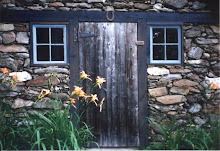
The old steel ridgecap we'll remove from the house roof I'll be putting right onto the stone hut's ridge. You can see it needs a new one. I built this hut 25 years ago, all laid up dry except for the gable end. I started on it the day our son Carson was born. The stone all came off our land, hauled by old jeep and wheelbarrow to the site. The windows came from a friend stopping by before moving to Arizona. He unloaded what he owned to lighten his load for the journey.The old barn board door came from barn boards I found in a barn and brought home and built as a door. The chapel style window came from a chapel. That's a second run of cedar shingles on the roof. The first were white and worthless for roof work but what are you going to do when no money? Years later bought red cedar from British Columbia and cut in that star. So many basics in New England. It's only when you head down to Baltimore and remember that Edgar Allan Poe termed the Transcendentalists "frogpondians", it's all together perfect. I chuckle way high on the roof staging thinking of this.
Here's old friend white pine seen from the scaffold, directly east of the house, over the river. No one lives anywhere near it. The land over there has been heavily logged twice since we've been here forty years, and no one has taken the tree. Looking now at the tree it seems to have two out stretched arms, an arched back, and it's singing.

At the west gable of the house, where the steel roof will finish up.
We're working through two layers of asphalt shingles and setting in 3/4 inch spruce strapping. I've even stripped the first layer of shingle tabs to get closer to solid footing. You want a 3-inch screw to go along here and there with the regular ringshank nails, and you want to try to remember where the chestnut 4 x 4 beams are below. Sink a screw or a nail into one of those as much as you can. At best they were set in where the setting-in was best. Farmers built this place. Otherwise, it's a full one inch softwood deck under the shingles. It'll grab.
We're on the home stretch of rebuilding the roof, setting on the spruce purlins for nailers, and getting the last leg of steel roofing up and anchored on. I'm curious to see if between Sweetheart and me we can rig up a ramp system to slide the seventeen foot sheets six-feet up the ramp and then climb onto the scaffold and pull the sheets up and onto the roof. More husband and wife team stuff. We do it all the time with stone, logs, and snow, why not steel? Seven years ago on the back roof we pulled up 18 footers, but we had boy wonder Carson with us then. Nothing like a young lad. I'll have to see after I build the ramp, and lock it in at a comfortable angle onto the scaffold, then watch how the material slides and how well we can maneuver ourselves ground-to-roof. We're still pretty quick. If it becomes obviously nuts, Greg will come down and help give us a lift. Nothing like a friend. I've even thought of grabbing the first stranger going by: walking, bicycle, scooter "Hey, want to help us a moment and give this sheet a lift?" The ever grounded feeling of common community.
Getting up high with the last pieces of 16-foot spruce purlins. It's a Sunday morning, maybe nearing on 11AM and the roof asphalt must be 110 degrees. I mean hot.
I love the new jiffy handsaws, so I keep mine close by hung on a temporary nail. As I need to lop off a short end piece to fit in the purlin I do it from the high staging with my trusty handsaw. No nailguns on this job.
The old steel ridgecap we'll remove from the house roof I'll be putting right onto the stone hut's ridge. You can see it needs a new one. I built this hut 25 years ago, all laid up dry except for the gable end. I started on it the day our son Carson was born. The stone all came off our land, hauled by old jeep and wheelbarrow to the site. The windows came from a friend stopping by before moving to Arizona. He unloaded what he owned to lighten his load for the journey.The old barn board door came from barn boards I found in a barn and brought home and built as a door. The chapel style window came from a chapel. That's a second run of cedar shingles on the roof. The first were white and worthless for roof work but what are you going to do when no money? Years later bought red cedar from British Columbia and cut in that star. So many basics in New England. It's only when you head down to Baltimore and remember that Edgar Allan Poe termed the Transcendentalists "frogpondians", it's all together perfect. I chuckle way high on the roof staging thinking of this.
Here's old friend white pine seen from the scaffold, directly east of the house, over the river. No one lives anywhere near it. The land over there has been heavily logged twice since we've been here forty years, and no one has taken the tree. Looking now at the tree it seems to have two out stretched arms, an arched back, and it's singing.
This is what a day off from the roof job looks like. Fellow worker Sweetheart.
At the west gable of the house, where the steel roof will finish up.
The safe passageway, kept mainly clean, of an obedient scaffold.
We're working through two layers of asphalt shingles and setting in 3/4 inch spruce strapping. I've even stripped the first layer of shingle tabs to get closer to solid footing. You want a 3-inch screw to go along here and there with the regular ringshank nails, and you want to try to remember where the chestnut 4 x 4 beams are below. Sink a screw or a nail into one of those as much as you can. At best they were set in where the setting-in was best. Farmers built this place. Otherwise, it's a full one inch softwood deck under the shingles. It'll grab.
There's always a place to hang a saw.
photos © susan & bob arnold
Labels:
Bob Arnold,
Carson Arnold,
Edgar Allan Poe,
Greg Joly,
Susan Arnold
Subscribe to:
Posts (Atom)


