“You just can’t expect to fool with it
without getting it on you.”
— Ken Kesey

Preface
Like a child raised on a farm, I was raised in the lumber business. Since the age of nine I have been consciously aware of it and rubbed shoulders with builders, excavators, lumberyard workers, and forty-five years later I am still hanging around the same company. I have worked on a few carpentry crews but usually work solo, and the bulk of these essays will be concerned with remembering a stone hut I built. I love to build with stone and prefer to build simple — fewer tools and more imagination. Like all builders I have made mistakes and had to bluff my way and learned to laugh at a lot of it. To this day I ask my own father, a lumberman of reputation over sixty years, how to figure certain building procedures. He shows me. And someone showed him. And I’ll show Carson when he is old enough. I like to think I have taught my father some things about stone, what you can do with it. Like me he enjoys watching a building go up, so when he visited us in Vermont he would walk out to the woods edge of the property and study the hut’s progress. Tools, roof pitch, cost, these topics are all minor though necessary to building. Much can be found used, or right under your feet. Knowing the grade of lumber and how the grain works and exactly what type of tree the lumber came from is more essential, and of course all the service a stick of lumber can do. So I taught myself the trees and cut a great deal of them, and turned around and planted as many. It’s important to get a feel for all architecture — my favorite is architecture-without-architects — and what a building is: to look at them, build a few, walk inside hundreds built by the hands of others, and gaze. And then the small ingredients of building become useful: knowing nails, notching, what windows work where best (Carl Larsson had clever installments in his home), how the roof should design and balance. To trace the building all the way back to the shovel work in the foundation, and doing it all, so that the building is felt in the body after it is done and stands to the sky. Of course to most, but not all, this is silly talk. Builders no longer permit themselves the time or desire to have a relationship with what they build — most have two or three houses going at once to stay ahead — so the work is a job and the home built is matched only with the one before. These essays are written for anyone and no one but they might appeal to one who enjoys handcraft and working with two native resources: trees and stone. It’s about not making much money, about Carson’s birth, our family, and our friends. It all started for me around 1973 when an Episcopal minister friend, who eventually sold us his country property, pointed to a long pile of old roadside stone wall and asked, “Ever think about building stone walls, Bob? You could make a living from that.”
 |
| Bob Arnold building "Villa of Souls" |
1
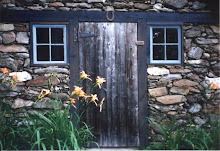
The hut I built is made of stone. I call it a hut, its dimensions are good size for a hut, roughly 12' x 12'. The inside is smaller since the walls are laid two feet thick. The back wall, facing north — what is first seen stepping through the door — is an apron of ledge. I began laying stone from this ledge and moved away from it. The hut is twelve feet high from floor to ridgepole, and the floor is all stone — one of the few places mortar will be found in use, edged around each stone, and on the east gable more is tucked behind the stone. Otherwise, the hut is laid dry, the way I like to work with stone. Balance and shimming stone, learning from stone. The ridgepole still has the tire tracks from the Willys jeep driving over it across a wet spot in the woods to get to the stone to build this hut. After the stone was out of the woods and delivered to the hut site I brought this 2" x 6" hemlock plank to the site and made the ridgepole out of it — all one length. Four feet below the ridge is enough head room to fit a 5' x 8' loft — planks nailed on the crossties of the rafters. You can lift yourself to the loft by ladder. There is a small window up there that looks to the woods; so far I’ve been content to lie on my back on those planks and just breathe the white cedar shingles that show above the roof slats. I couldn’t afford red cedar. Roofing nails punch through the slats and Susan said she will help hammer them over, but I’m already ahead of my story. I built this hut for Carson.
 |
| Now & then up in the air |
2
According to my calendar, work on the stone hut was started May 21st. Already it had been an eventful spring. I had laid a 6' x 6' stone terrace, really a large stoop, outside the kitchen door. Eight yards of gravel was delivered for that job and thinking ahead to the hut. The terrace interior was packed with gravel, having the outside show all dry stone. The flattest stone found — between hunting in the woods robbing old walls and scouting in the river — were used for the top course, and mortar was edged around each stone. A slight pitch away from the kitchen door ran the rain water off, and it could be slippery during the winter. Three stones were found roughly a yard wide to fashion the steps. Two of the three steps were stolen from stone seats I had built around the property over the years. Six of these seats were first made when the town road crew was setting in a new culvert 500 feet from our house — replacing the stone culvert of many generations. Large handsome flat stone were lifted out and flipped around by a backhoe. Instead of watching the bucket shovel them over the bank into the river, I asked the road boss for all of them. He had them pushed to the side of the road, and later that day I went back and hauled them home with a wheelbarrow. Made all these seats in different corners of the yard — isolated spots — usually beneath the shade of a tree, or where the view was the best, or a vantage place to listen to the river. Some of the stone were too good to sit on and better for the foot to step on; they were chosen for the terrace steps and replaced with other sitting stone. It was only April 30th and the terrace was done. Susan was six weeks away from giving birth to Carson.
 |
| Halfway through a large stone stoop |
3
Around this time Steve Lewandowski would visit with fifty Austrian pine, or “black pine,” for us to plant on our property. He was carrying the pine in his pickup truck from conservation work in upper New York State. I divided the seedlings between a southern and eastern planting. We have a ratty hillside of sumac and brush that I scythe down twice a year and twenty-five pine seedlings in there would improve the landscape. Now one only has to be careful where sweeping the blade, but these black pine are swift growers and it should be only a short time before they can be easily trimmed around. To the south, we have new neighbors building, and the pines are a good neighbor policy of eventually blocking out each other’s view. Fortunately the neighbors are fine people, it’s the thought of seeing another house after all these years of having only woods and river — that’s tough to bear. We’ve been spoiled. For the first few weeks I went around watering the seedlings and clearing brush to encourage growth. If half of the planting survives I’ll be more than pleased. Three seedlings were saved for our friends Bill and Dorothy Loos — they have given us many varieties of daylilies over the years and this was the least we could do — take a gift from Steve, to us, over to Bill and Dorothy. I planted the pines for them thirty feet from their house, with an eastern location, beneath a dying ash tree, but close by a young willow tree was thriving. All good company. Hopefully the black pine would replace the ash one of these days. The same week I was planting pine for the Loos they had me painting and wallpapering their living room. Wallpapering I had never done much before; I’d rather stencil, and twelve years ago, when repairing stone wall and building new stone wall on their property, I was only two years into teaching myself stonework. They hired me anyway.
 |
[ to be continued each Monday
through the summer ]

Stone Hut
a builder's notebook
Bob Arnold
1988, 2013
a builder's notebook
Bob Arnold
1988, 2013