Thursday, December 3, 2009
MOTHERS

BOB ARNOLD

LUCKY
She is right, this woman
I love, it has been a windy
Fall. And her blonde hair slips
Apart in long strands and with
One hand she combs it away from
Her face and she is smiling. For
Lunch she eats an apple and suns
Her legs, a summer skirt raised.
She is mother. A small boy is
Napping upstairs in the house.
When awake he will chase
Leaves that fall down from the
Sky, that’s how he sees it.
He calls me daddy because I am.
When I was off at work this
Morning up river laying stone
Along the road in the village
A blonde woman and her young son
Visited me. Hands cold gripping
Wet stone, boots chalked. This
Woman carried her little boy
In her arms, his green sweater
Was like the one my son wears
His mother knitted, ah the love
of mothers! and I gathered stone
By hand and thought of blue sky
Above, day clear as the river,
And why you must love what you do.

FATHERS

WELD
Oh yes, I've known welders
They're all by themselves
Their work smell is a strict greeting
From the Industrial Revolution
Years ago I knew a welder who worked
In town out of his one red garage
Doors always open wide, even in the rain
A fire of some kind burning
Victor in his helmet and torch in hand
Boots splattered, old pants------- cement floor
I've arrived to have one more truck bumper torn off
From the mud rides out of this valley brazened back on
He'll do what he can------- backside of town
Near the river------- some tall maple trees
Beautiful old homes going the way of no money any more
Look at all those slate roofs!
So many years later, Victor all gone, red garage is still there
And I'm visiting all over again the same location because
Our son has just moved into a rental in
The old house where maybe Victor lived
To my mind Victor just lived in the garage------- What's a house?
I mention how I've been here before to our son who has no
Idea really what I'm talking about except it's on
The way to just one more of his father's stories. . .


BOB ARNOLD

LUCKY
She is right, this woman
I love, it has been a windy
Fall. And her blonde hair slips
Apart in long strands and with
One hand she combs it away from
Her face and she is smiling. For
Lunch she eats an apple and suns
Her legs, a summer skirt raised.
She is mother. A small boy is
Napping upstairs in the house.
When awake he will chase
Leaves that fall down from the
Sky, that’s how he sees it.
He calls me daddy because I am.
When I was off at work this
Morning up river laying stone
Along the road in the village
A blonde woman and her young son
Visited me. Hands cold gripping
Wet stone, boots chalked. This
Woman carried her little boy
In her arms, his green sweater
Was like the one my son wears
His mother knitted, ah the love
of mothers! and I gathered stone
By hand and thought of blue sky
Above, day clear as the river,
And why you must love what you do.

FATHERS

WELD
Oh yes, I've known welders
They're all by themselves
Their work smell is a strict greeting
From the Industrial Revolution
Years ago I knew a welder who worked
In town out of his one red garage
Doors always open wide, even in the rain
A fire of some kind burning
Victor in his helmet and torch in hand
Boots splattered, old pants------- cement floor
I've arrived to have one more truck bumper torn off
From the mud rides out of this valley brazened back on
He'll do what he can------- backside of town
Near the river------- some tall maple trees
Beautiful old homes going the way of no money any more
Look at all those slate roofs!
So many years later, Victor all gone, red garage is still there
And I'm visiting all over again the same location because
Our son has just moved into a rental in
The old house where maybe Victor lived
To my mind Victor just lived in the garage------- What's a house?
I mention how I've been here before to our son who has no
Idea really what I'm talking about except it's on
The way to just one more of his father's stories. . .
for Gerry Loose

photos © bob arnold
"Lucky" from Once In Vermont (Gnomon, 1999)

Saturday, November 28, 2009
STONE


heavy and light of leaf

balanced just-so

follow along touching with your fingertips

into the sunshine

just at your height

listeners. . .

rolling over hill & dale

stand there, year by year, rain, wind, snow

stack up, make yourself

and lean into the work

Villa of Souls
Here's where you might rest from your climb
heavy and light of leaf

balanced just-so

follow along touching with your fingertips

into the sunshine

just at your height

listeners. . .
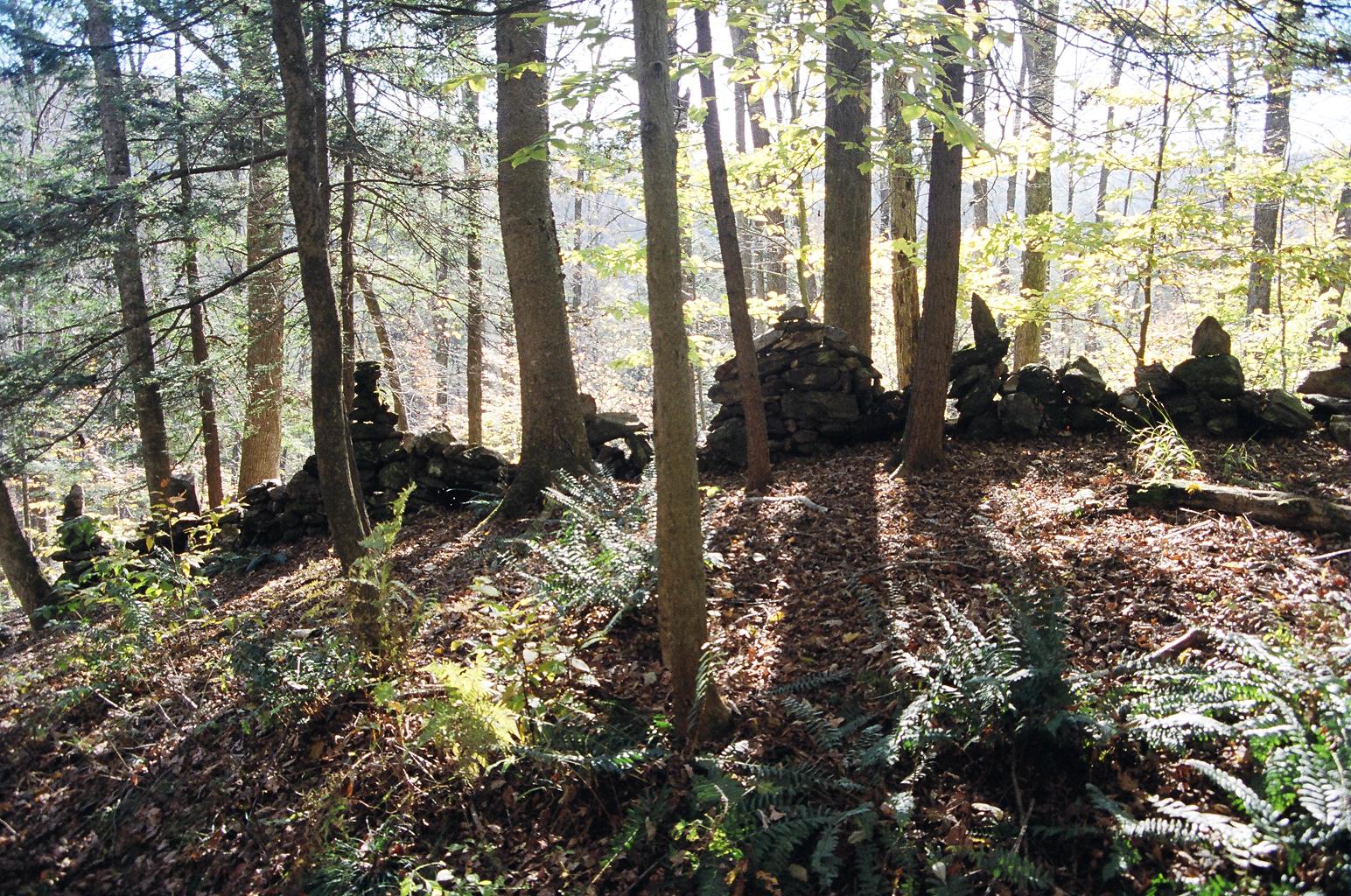
rolling over hill & dale

stand there, year by year, rain, wind, snow

stack up, make yourself

and lean into the work
— Bob Arnold
stonemason & photographer
~
remembering
Charis Wilson
stonemason & photographer
~
remembering
Charis Wilson

Monday, November 23, 2009
ILLINOIS


One morning when Hatrack the Horse went away from his shanty, he put three umbrellas in the corner next to the front door.
His pointing finger pointed at the three umbrellas as he said, "If the three wild Babylonian Baboons come sneaking up to this Shanty and sneaking through the door and sneaking through the house, then all you three umbrellas open up like it was raining, jump straight at the baboons and fasten your handles in their hands. Then, all three of you stay open as if it was raining—and hold those handles in the hands of the baboons and never let go till I come."
Hatrack the Horse went away. The three umbrellas stood in the corner next to the front door. And when the umbrellas listened they could hear the three wild Babylonian Baboons sneaking up to the shanty. Soon the baboons, all hairy all over, bangs down their foreheads, came sneaking through the door. Just as they were sneaking through the door they took off their hats to show they were getting ready to sneak through the house.
Then the three umbrellas in the corner opened up as if it was raining; they jumped straight at the three wild Babylonian Baboons; and they fastened their handles tight in the hands of the baboons and wouldn't let go.
So there were the three wild Babylonian Baboons, each with a hat in his left hand, and an open umbrella in his right hand.
When Hatrack the Horse came home he came, quiet. He opened the front door, quiet. Then he looked around inside the house, quiet.
In the corner where he had stood the three umbrellas, he saw the three wild Babylonian Baboons on the floor, sleeping, with umbrellas over their faces.
"The umbrellas were so big they couldn't get through the door," sat Hatrack the Horse. For a long time he stood looking at the bangs hanging down the foreheads of the baboons while they were sleeping. He took a comb and combed the bangs down the foreheads of the baboons. He went to the cupboard and spread bread and butter. He took the hats out of the left hands of the baboons and put the hats on their heads. He put a piece of bread and butter in the hand of each baboon.
After that he snipped each one across the nose with his finger (snippety-snip! just like that). They opened their eyes and stood up. Then he loosened the umbrella handles from their right hands and led them to the door.
They all looked out. It was raining. "Now you can go," he told the baboons. And they all walked out of the front door, and they seemed to be snickering and hiding the snickers.
The last he saw of them they were walking away in the rain eating bread and butter. And they took off their hats so the rain ran down and slid off on the bangs of their foreheads.
Hatrack the Horse turned to the umbrellas and said, "We know how to make a surprise party when we get a visit from the Babylonian Baboons with their bangs falling down their foreheads—don't we?"
That is what happened, as Hatrack the Horse told it to the night policeman in the Village of Cream Puffs.
from Rootabaga Stories, illustrated by Maud and Miska Petersham
The Rick of Green Wood
In the woodyard were green and dry
woods fanning out, behind
----------------------------------------a valley below
a pleasure for the eye to go.
Woodpile by the buzzsaw. I heard
the woodsman down in the thicket. I don't
want a rick of green wood, I told him
I want cherry or alder or something strong
and thin, or thick if dry, but I don't
want the green wood, my wife could die
Her back is slender
and the wood I get must not
bend her too much through the day.
Aye, the wood is some green
and some dry, the cherry thin of bark
cut in July.
My name is Burlingame
said the woodcutter.
My name is Dorn, I said.
I buzz on Friday if the weather cools
said Burlingame, enough of names.
-------Out of the thicket my daughter was walking
singing—
------------backtracking the horse hoof
-------gone in earlier this morning, the woodcutter's horse
-------pulling the alder, the fir, the hemlock
-------above the valley
---------------------------------in the november
air, in the world, that was getting colder
as we stood there in the woodyard talking
pleasantly, of the green wood and the dry.

~
A river I couldn’t find
flows through my head.
You are standing
below the cottonwood tree
on the river’s bank.
I listen to the wind
move the tree’s leaves.
Your long dark hair
wraps around you.
I can’t see your face.

TOM CLARK

What Is That Bright Star Next to the Moon Tonight?
Out late and looking again to the hazed red urban evening sky for a sign
What is that bright star next to the moon tonight?
Asking myself this among other questions of fleeting consequence
I watched Jupiter the great fluid king of the night
With his rude belching gases and submissive fluctuating moons
His swashbuckling bright streaks flaunted like sans culottes
Boiling firestorm spots and magnetic auroras
Cozying up, it seemed, to the chaste and shying
Waxing gibbous Lady Luna — seeming so close,
Though in reality far more distant and intense,
With nothing of her ethereal luminous
Silent running beauty, her unearthly milky violet glow —
Challenging her brightness perhaps
Though hardly her pulchritude —
Until my view grew occluded under the constellated neons
Of the Pyramid Ale House
Long known to California, Tom Clark was referred to Charles Olson by Ed Dorn as a "Chicago buster." Tom says that was a downstate sodbuster's way of referring to a Chicago boy. Longhouse recently published Tom Clark's Single and here is a piece from that. Much more of Tom's world may be found from his blog: Tom Clark: Beyond the Pale

AUSTIN SMITH

Instructions For How To Put an Old Horse Down
This is what you need to do:
wait for one of those mornings
that seems as if it will never come,
and when it comes, wait for evening.
While waiting for evening,
do as little as possible,
and don’t visit the horse:
you’ll only lose heart.
Remind yourself that she
is suffering and that
her time has come.
One thing you can do
is find a length of rope
hanging in the shape
of a racetrack in the barn:
you won’t need it
but it’s a good thing to find.
If you have kids, tell them
what’s going to happen
sometime in the afternoon.
They’ll understand.
If you wait and tell them
afterwards what you’ve done,
they’ll never forgive you.
Finally, in that hour when
you usually visit her,
walk into the field with oats
in your pockets.
Let her eat them
out of your hand
until they’re gone,
then lead her in.
Then lead her in.

photo Ed Dorn: courtesy The Poetry Project Photo Archive
photo James Koller: courtesy NEW (Paris)
photo Tom Clark: copyright Gerard Malanga
photo Austin Smith: copyright Austin Smith

CARL SANDBURG

How the Three Wild Babylonian Baboons Went Away in the Rain Eating Bread and Butter
One morning when Hatrack the Horse went away from his shanty, he put three umbrellas in the corner next to the front door.
His pointing finger pointed at the three umbrellas as he said, "If the three wild Babylonian Baboons come sneaking up to this Shanty and sneaking through the door and sneaking through the house, then all you three umbrellas open up like it was raining, jump straight at the baboons and fasten your handles in their hands. Then, all three of you stay open as if it was raining—and hold those handles in the hands of the baboons and never let go till I come."
Hatrack the Horse went away. The three umbrellas stood in the corner next to the front door. And when the umbrellas listened they could hear the three wild Babylonian Baboons sneaking up to the shanty. Soon the baboons, all hairy all over, bangs down their foreheads, came sneaking through the door. Just as they were sneaking through the door they took off their hats to show they were getting ready to sneak through the house.
Then the three umbrellas in the corner opened up as if it was raining; they jumped straight at the three wild Babylonian Baboons; and they fastened their handles tight in the hands of the baboons and wouldn't let go.
So there were the three wild Babylonian Baboons, each with a hat in his left hand, and an open umbrella in his right hand.
When Hatrack the Horse came home he came, quiet. He opened the front door, quiet. Then he looked around inside the house, quiet.
In the corner where he had stood the three umbrellas, he saw the three wild Babylonian Baboons on the floor, sleeping, with umbrellas over their faces.
"The umbrellas were so big they couldn't get through the door," sat Hatrack the Horse. For a long time he stood looking at the bangs hanging down the foreheads of the baboons while they were sleeping. He took a comb and combed the bangs down the foreheads of the baboons. He went to the cupboard and spread bread and butter. He took the hats out of the left hands of the baboons and put the hats on their heads. He put a piece of bread and butter in the hand of each baboon.
After that he snipped each one across the nose with his finger (snippety-snip! just like that). They opened their eyes and stood up. Then he loosened the umbrella handles from their right hands and led them to the door.
They all looked out. It was raining. "Now you can go," he told the baboons. And they all walked out of the front door, and they seemed to be snickering and hiding the snickers.
The last he saw of them they were walking away in the rain eating bread and butter. And they took off their hats so the rain ran down and slid off on the bangs of their foreheads.
Hatrack the Horse turned to the umbrellas and said, "We know how to make a surprise party when we get a visit from the Babylonian Baboons with their bangs falling down their foreheads—don't we?"
That is what happened, as Hatrack the Horse told it to the night policeman in the Village of Cream Puffs.
from Rootabaga Stories, illustrated by Maud and Miska Petersham
When not writing his biography of Lincoln, or his poems to the People, to Chicago, to the workers and the ways of the Great Plains, or playing his guitar, or welcoming the likes of a pilgrimage by Bob Dylan, Carl Sandburg wrote terrific lively fully all-sense/nonsense stories for children and the young at heart. He's little read these days compared to his grand years, and is often even ridiculed and laughed at. Imagine that.

EDWARD DORN

The Rick of Green Wood
In the woodyard were green and dry
woods fanning out, behind
----------------------------------------a valley below
a pleasure for the eye to go.
Woodpile by the buzzsaw. I heard
the woodsman down in the thicket. I don't
want a rick of green wood, I told him
I want cherry or alder or something strong
and thin, or thick if dry, but I don't
want the green wood, my wife could die
Her back is slender
and the wood I get must not
bend her too much through the day.
Aye, the wood is some green
and some dry, the cherry thin of bark
cut in July.
My name is Burlingame
said the woodcutter.
My name is Dorn, I said.
I buzz on Friday if the weather cools
said Burlingame, enough of names.
-------Out of the thicket my daughter was walking
singing—
------------backtracking the horse hoof
-------gone in earlier this morning, the woodcutter's horse
-------pulling the alder, the fir, the hemlock
-------above the valley
---------------------------------in the november
air, in the world, that was getting colder
as we stood there in the woodyard talking
pleasantly, of the green wood and the dry.
If there's one poem allowed to remember Ed Dorn by, this is my choice. And this one was recently sent to me by one of his closest friends. It was no coincidence we were both thinking of the same poem in November.
JAMES KOLLER
~
A river I couldn’t find
flows through my head.
You are standing
below the cottonwood tree
on the river’s bank.
I listen to the wind
move the tree’s leaves.
Your long dark hair
wraps around you.
I can’t see your face.
All Illinois boys have a steady eye and it often ripraps through their poems. James Koller and Coyote's Journal has long been associated with Longhouse. We're always happy to share Jim's work.
TOM CLARK

What Is That Bright Star Next to the Moon Tonight?
Out late and looking again to the hazed red urban evening sky for a sign
What is that bright star next to the moon tonight?
Asking myself this among other questions of fleeting consequence
I watched Jupiter the great fluid king of the night
With his rude belching gases and submissive fluctuating moons
His swashbuckling bright streaks flaunted like sans culottes
Boiling firestorm spots and magnetic auroras
Cozying up, it seemed, to the chaste and shying
Waxing gibbous Lady Luna — seeming so close,
Though in reality far more distant and intense,
With nothing of her ethereal luminous
Silent running beauty, her unearthly milky violet glow —
Challenging her brightness perhaps
Though hardly her pulchritude —
Until my view grew occluded under the constellated neons
Of the Pyramid Ale House
Long known to California, Tom Clark was referred to Charles Olson by Ed Dorn as a "Chicago buster." Tom says that was a downstate sodbuster's way of referring to a Chicago boy. Longhouse recently published Tom Clark's Single and here is a piece from that. Much more of Tom's world may be found from his blog: Tom Clark: Beyond the Pale
It won't waste your time.

AUSTIN SMITH

Instructions For How To Put an Old Horse Down
This is what you need to do:
wait for one of those mornings
that seems as if it will never come,
and when it comes, wait for evening.
While waiting for evening,
do as little as possible,
and don’t visit the horse:
you’ll only lose heart.
Remind yourself that she
is suffering and that
her time has come.
One thing you can do
is find a length of rope
hanging in the shape
of a racetrack in the barn:
you won’t need it
but it’s a good thing to find.
If you have kids, tell them
what’s going to happen
sometime in the afternoon.
They’ll understand.
If you wait and tell them
afterwards what you’ve done,
they’ll never forgive you.
Finally, in that hour when
you usually visit her,
walk into the field with oats
in your pockets.
Let her eat them
out of your hand
until they’re gone,
then lead her in.
Then lead her in.
Austin Smith was born and raised on a family farm in Illinois. The son of the poet Daniel Smith, Austin has had two publications issued from Longhouse: Wheat & Distance and Instructions for How to Put An Old Horse Down. The family have recently moved their good work and farm chores to rural Wisconsin.

photo Ed Dorn: courtesy The Poetry Project Photo Archive
photo James Koller: courtesy NEW (Paris)
photo Tom Clark: copyright Gerard Malanga
photo Austin Smith: copyright Austin Smith
Saturday, November 21, 2009
DOROTHEA TANNING


I stood before this painting today for a good 15 minutes after being stuck away in the woods all week. It's nice to visit a town. And to be allowed in free to see such a painting as Dorothea Tanning's To the Rescue. On the same floor with a Mark Rothko, a gruelling oil by Ivan Albright, and a small but enduring Rauschenberg exhibit holding up everything from the first floor. Dorothea Tanning has not had enough said about her, and she is nearly 100 years old. She has been waiting for us.
Here is another:

Like Carl Sandburg, Dorothea Tanning was born in Galesburg, Illinois.

In 1946 she became Max Ernst's fourth and last wife

Today she paints, has poems published in the New Yorker, and writes books like we may never see again
Here is another:

Like Carl Sandburg, Dorothea Tanning was born in Galesburg, Illinois.

In 1946 she became Max Ernst's fourth and last wife

Today she paints, has poems published in the New Yorker, and writes books like we may never see again
To the Rescue (1965 ), Dorothea Tanning, Hood Art Museum
Insomnies (1957), Dorothea Tanning
photo of Dorothea Tanning (1943), Robert Bruce
A Little Night Music (1946), Dorothea Tanning
Insomnies (1957), Dorothea Tanning
photo of Dorothea Tanning (1943), Robert Bruce
A Little Night Music (1946), Dorothea Tanning
Thursday, November 19, 2009
WOOD


photo © susan arnold

TODAY I DROPPED SOME HIGH AND STANDING DEAD WHITE PINE TREES
Today I dropped some high and standing dead white pine trees. 75 feet tall. Sweetheart stood far away, but I wanted her to watch how beautifully they fell. So what the workmanship — it's the tree, the tree — the falling from grace. Dead and only to rot on the ground, though we will bust off the dry limbs for kindling. And if we were still tapping maple trees for making syrup, we'd grab all this deadwood for the hopper. After I dropped the trees the woods started to look cleaner and retrieve that old brown and green needle pine look of the healthier trees. Before I dropped the dead ones, Sweetheart said they reminded her of bears when she hikes through the woods and sees them. I have two more to drop but I'll save those for the next thrill day. They can kill you in a second with a widow maker or any damn thing since they're unpredictably tall and dead, so I have to be in the cutting mood. We also worked down on the river with the chain saw and wheelbarrow and scraped up a big load of dry apple wood we're burning right now. From river to woodstove. No middle man, except us, but we're part river and part wood.
THE CHERRIES
Great weather has kept me in the woods with both chain saws. A tall and gangly cherry went the other way, which was no surprise; it was nearly straight up without much of a lean. What I didn't like after I cut it loose was that it took down an equally tall cherry tree. One I would have liked to save...but inspecting the root system later, curious why it toppled, I could see it wasn't long to go. On ledge and probably a heavy wind would take it. Also 75 feet to the tippity-top. Now I have both trees lodged up, and the knocked over one is hung up in a group of trees...so the afternoon got longer. I get paid to drop trees exactly where I want them or the customer would like them, so this was something different. I didn't care where it fell. I just wanted it down safely. But not into the other tree. Mucho firewood is the result. Today I'll go back and make more cordwood lengths, stack logs and buck up the larger logs no one can handle without a tractor. It'll be fine stovewood. Too crotched-out to make any sound lumber. But this felling is just the stories other choppers have. The one that got away. The one that made sure if it was going to fall it was going to take a brother tree along with it. Sweetheart hiked out to the job after she heard all saw work was quieted down and reminded me, "You said it could fall either way." In a woodlot you want the tree down closest at hand (this one is), and you just want no one hurt. The earth is waiting for what drops, however it comes.
Bob Arnold says, know where you stand but don't ever think you know enough

THE CHERRIES
Great weather has kept me in the woods with both chain saws. A tall and gangly cherry went the other way, which was no surprise; it was nearly straight up without much of a lean. What I didn't like after I cut it loose was that it took down an equally tall cherry tree. One I would have liked to save...but inspecting the root system later, curious why it toppled, I could see it wasn't long to go. On ledge and probably a heavy wind would take it. Also 75 feet to the tippity-top. Now I have both trees lodged up, and the knocked over one is hung up in a group of trees...so the afternoon got longer. I get paid to drop trees exactly where I want them or the customer would like them, so this was something different. I didn't care where it fell. I just wanted it down safely. But not into the other tree. Mucho firewood is the result. Today I'll go back and make more cordwood lengths, stack logs and buck up the larger logs no one can handle without a tractor. It'll be fine stovewood. Too crotched-out to make any sound lumber. But this felling is just the stories other choppers have. The one that got away. The one that made sure if it was going to fall it was going to take a brother tree along with it. Sweetheart hiked out to the job after she heard all saw work was quieted down and reminded me, "You said it could fall either way." In a woodlot you want the tree down closest at hand (this one is), and you just want no one hurt. The earth is waiting for what drops, however it comes.
Bob Arnold says, know where you stand but don't ever think you know enough

photo © bob arnold
Tuesday, November 17, 2009

LULJETA LLESHANAKU

VERTICAL REALITIES
Waking is an obligation:
three generations open their eyes every morning
inside me.
The first is an old child — my father;
he always chooses his luck and clothes one size too small for him.
Next comes grandfather...In his day, the word "diagnosis" did not exist.
He simply died of misery six months after his wife.
No time was wasted. Above their corpses
rose a factory to make uniforms for dock workers.
And great=grandfather, if he ever existed,
I don't even know his name. Here my memory goes on hiatus
my peasant origins cut like the thick and yellow nails
of field workers.
Three shadows loom like a forest over me
telling me what to do
and what not to do.
You listened to me say "good morning"
bit it was either an elephant pounding on a piano
or the seams coming apart in my father's little jacket.
Indeed, my father, his father. and his father before that
are not trying to change anything
nor do they refuse to change anything; the soap of ephemerality
leaves them feeling fresh and clean.
They only wish to gently touch the world again
through me, the way latex gloves
lovingly touch the evidence
of a crime scene.
translated from the Albanian by Henry Israeli and Shpresa Oatipi
From the second book of poems in English by this Albanian native. To be published by New Directions in February 2010.

RAINER MARIA RILKE

POEMS FROM THE BOOK OF HOURS
Put out my eyes, and I can see you still;
slam my ears to, and I can hear you yet;
and without any feet can go to you;
and tongueless, I can conjure you at will.
Break off my arms, I shall take hold of you
and grasp you with my heart as with a hand;
arrest my heart, my brain will beat as true;
and if you set this brain of mine afire,
upon my blood I then will carry you.
translated by Babette Deutsch
from the original bilingual edition published by
New Directions in 1941, now with an introduction by
Ursula K. Le Guin — we haven't yet found quite the
perfect stocking-stuffer that beats this one.

PAAVO HAAVIKKO
from BIRTHPLACE
And yet, we must have a word with happiness,
Build the house to catch the sun's light,
Open our windows on the valley;
So, be seated under the tree and listen to it,
Exchange pleasantries, talk to it.
Give up all hating, see the fir growing, and the rose
How it flowers there, by the field,
Before the lake freezes over you hear the horsemen
On their way to the forest, before the mountains grow
----dark in Bohemia,
The Bohemia mountains, the Bohemian forests,
Deep down to the forests of the Balkan,
Deep down into Balkan dust
Where pine, fir and wallow rise out of the sand, a white
----bird perches
On the far side of the Danube, utters a pitiful cry.
translated from the Finnish by Anselm Hollo

I love these three poets of the heart and the home, be-it home wherever you may be at this very moment.
photograph of Luljeta Lleshanaku courtesy New Directions
photograph of Paavo Haavikko by Pekka Tynell
photograph of Paavo Haavikko by Pekka Tynell
Monday, November 16, 2009

ENTOURAGE
Yesterday we were at a book sale in an old meeting house (center of a small town, wide doors, old creaking floors, maybe 1000 books) and brought home a few boxes of well chosen books. All at a modest cost and three hours of concentrated work — half of that time spent waiting for the event to start.
Outside it was raining, people were coming into a place lit by tall broad windows and almost every person was over 40 years of age. It was like a secret meeting place of older folk. The books like ancient texts. Everyone stationed to take the money for the books were over 70 years of age, at least. You could watch them work with poor eyesight and hearing. Adding numbers even took effort. They had had a life of raising children, growing vegetables, tending farm animals, adjusting to losses of loved ones and their own abilities. These were all people with no parents on earth any longer. Their clothes were practical and completely simple. They were supporting a cause that raised money for a library, and the library had cut back its hours over the years, because all its benefits from long ago were now gone to the greed of war capitalists and money grubbers.
The irony is that we were in a small New England town, one of the quaintest, and all the buildings in the vicinity were required to be painted almost a cleansed pure white. The very wealthy have visited this town for its splendid foliage and simple ways that can be predicted and schedules made by its enduring clock. The limousines have been seen, but nowhere in this crowd. Even the big drafty whale-like building we were in like Pinocchio was bold and white and the bright windows were the size of rowboats. I had looked the building over while I waited to get inside for the books, and it had gone a little shabby from what the original settlers would have maintained.
These are the times, tough times when you think of what has been lost. As I watched the elders come in for books, shedding rain gear and old hats, I seemed to be in a private counsel celebration with my own kind. My young son was nowhere to be seen and none of his friends or anyone his age. I've seen them buying books elsewhere, but not this morning out of the rain, a chilly early hour of the day, finding something very good to read before the fire as winter approaches, understanding loss and maybe even vitality, and that feeling of a friend.
The book sale was indoors and a smart move. The bake sale went on as planned — a half dozen hardy women, with a tableware of goodies for sale, out in the rain.
Saturday, November 14, 2009

photo © bob arnold
BOB ARNOLD

DREAMERS
To reach down at knee height
And bring your hands up under
Her dress and rise without
Hesitation or any resistance
Is naked
KINDNESS
No one spoke to her much, how strange —
Not family or friends and even those who
Sat with us at meals couldn’t say a word to her
Or even look her way. That must be beauty.
But every time she went to town and was alone —
A pretty scarf, an intriguing handbag, forever
And ever elderly women in parking lots and
Aisles of stores sought her out. This daughter
Whose own mother wouldn’t speak to her
Had women without daughters
Eating seed from her hand.
A HAPPENING
A year, at least, since I’ve
Had the chance to talk
To any neighbor
From afar I see one hike
The muddy road in bright
Pants and dull winter coat
For some reason she turns around
So I lift my arm and wave
And she waves

photo © susan arnold
DAWN
To live by a woods river
Forever is to finally
Forget it
& to remember
It again
Is something
NO OTHER
After she was sick awhile
She became thinner
Still young enough and strong
Her moves sexy
I couldn’t keep my hands off her hips
The attention delighted her
She blushed instead of being too confident
Her hair fell to pieces like always
When she looked up my sky was blue
At night she fell asleep by the wood fire
There never would be another woman
Rain at the windows for days was welcome
In times of trouble no one wanted to listen to this stuff
ONE WORD
Finally a blue sky day
And you do the wash!
Then you go and hang everything
Out on the line, a place reached
Through two feet of snow, rotten
Ice and a pathway I shoveled
Colorful wash all day
Blowing in the wind
At dusk you go pick
Dry clothes off a rope —
For a moment your billowy
Red skirt, violet sweater,
Bright long hair blowing
In the same breeze
I come to help as
You hold one garment up to
Your face breathing in the
Fresh wash and all you
Say with a smile is
“Woodsmoke”

photo © bob arnold
AWASH
That night it rained through the woods —
The moon was gone after days
& days of brilliant light
Love a world
You can’t
Control
Thursday, November 12, 2009
BOB ARNOLD

IN THE LAND OF SLUSH
They have been together and in love so long now
That when they think of an earlier life apart, it
Isn’t possible. Or it seems another life entirely.
After all it was childhood only before they met.
Somewhere within the love a child was born,
Came into his own, left. They returned to what
They had before the child was born as if wooded
Branches closed in together like wings of a large bird.
When he told her she was beautiful during a quiet
Meal, it was as if she had never heard the word before
Even though he brought it to her in every imaginable
Way each day. Walking together in a land of slush at
The end of winter in a bleak town meant very little
When there is beauty. It could vanish in an instant
So don’t be bothered with those who hate you for it.
In that same instance others would grab it, gladly, and
You would be looking in. She carried a heavy package,
The rain was new spring but cold as snow, you held
The umbrella for her as you both walked, & talked.
IN THE LAND OF SLUSH
They have been together and in love so long now
That when they think of an earlier life apart, it
Isn’t possible. Or it seems another life entirely.
After all it was childhood only before they met.
Somewhere within the love a child was born,
Came into his own, left. They returned to what
They had before the child was born as if wooded
Branches closed in together like wings of a large bird.
When he told her she was beautiful during a quiet
Meal, it was as if she had never heard the word before
Even though he brought it to her in every imaginable
Way each day. Walking together in a land of slush at
The end of winter in a bleak town meant very little
When there is beauty. It could vanish in an instant
So don’t be bothered with those who hate you for it.
In that same instance others would grab it, gladly, and
You would be looking in. She carried a heavy package,
The rain was new spring but cold as snow, you held
The umbrella for her as you both walked, & talked.
Subscribe to:
Posts (Atom)