Saturday, May 19, 2012

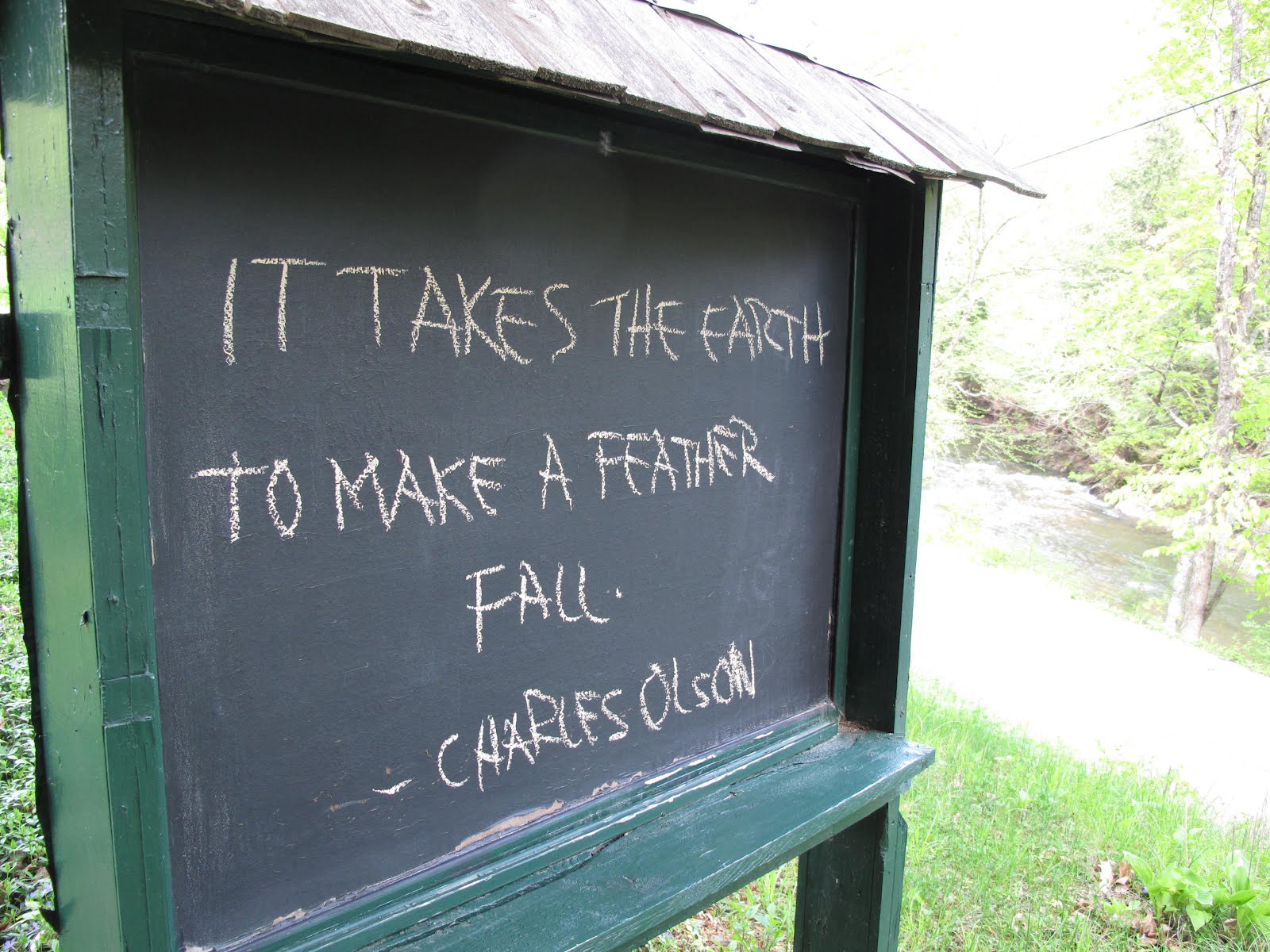
EARTH ~


SINCE HURRICANE IRENE IN VERMONT:


If we are to survive in the environment we have made for ourselves, may we have to be monstrous enough to greet our predicament? ~ Nicholas Mosley


We're all in the struggle. Let's help one another out.


I've had to scribble a little bit more
after almost a year since Hurricane Irene and my earlier postings about the rocky storm. I'm writing here about an overall corrosive element in society, no matter urban or rural, it has seeped in: the lack of etiquette and good manners. Subjects that are now mocked, ridiculed and easily laughed at, as we go down the drain. As a lawman said to me today in so many words, trooper hat off, sitting in my house, raining outside, "Your life style is pretty much over no matter how great you made it, there's only a few of you left. I admire it. But the bad stuff is now epidemic." It was nearly a line or two borrowed out of the film Shane.


I like this lawman, he works his trade with a thorough hand, and like me he likes straight-talk. He also was active with his whole department deployed into the field during Hurricane Irene saving lives, escorting very large machinery onto narrow highways or over mountain passes into small towns drowning in mud, sludge, broken buildings and rising water.

In the meantime, we are back to almost normal and the roads are repaired. Bridges are back. They may not be the original bridges, but they're bridges. We're crossing.


I watched our road that hugs the Green River in Vermont that was completely wiped out in long sections be rebuilt within months of the water avalanche. Remarkable work by a small town work crew and abiding towns. We hiked down into Massachusetts a day after the flood and had to portage our bicycles on shoulders to get to the next town. A normal half hour bicycle ride became a three hour hike. Where there once had been road — all gone. Sheer ledge, not a grain of gravel from the original road anywhere in sight. This was all rebuilt inch by inch by cribbing new large stone, backfill, plodding forward with what machines and trucks were available. It was a hallmark of individual duty unified. Including many neighbors taking part in the general repair. Vermont can be, when it wants to be, a maple tree with many branches.


That's all the good news. Plus our covered bridge is still standing, if a little wracked and leaning to the right. Go see for yourself when you walk or drive through the bridge from west to east. I've watched buildings stand for decades looking just like this, just a little weary, worn torn but with character and heart. We have to allow our buildings more & more heart.
Tear-down has become two miserably unwise words.


Bad news is trespassers moved in, and I don't mean interlopers not part of the road, or strangers. No, strangers have all been curious and polite. While working our river land for months after the flood at woodcutting detail I had a few wayfarers come around wanting to search up some distinctive small rock or gems that had maybe come forth with the flood. They walked up to me and asked permission. They talked, held conversation, showed themselves, and I saw a person. This is always very good. They poked around for 15 or 20 minutes and the next thing I saw was someone giving me a wave of "thanks" and driving off. Maybe he found something, maybe he didn't. But we met.


Then there's a few locals, bad apples who think they are doing good, providing a service. They speak and communicate to the ones they wish to speak to, and they banner their goodwill under a self-leadership of a "cleanup crew", never once giving a thought that they may be on someone's land who doesn't wish their brand of cleanup. In this case, gathering a few co-workers with saws and chain saws who light up and begin cutting trees and property, not on their land, but on our land. Without asking. Without talking. Without meeting. Without discussion. And what does the leadership do when confronted by someone in our family asking what are they are doing? the leadership say they "Have no time to talk", and then bum rush off. It's a hard life being this busy and unwise. My wife actually asked me if she should check up on this cleanup crew the day they started working. We've known the leaders of this crew for over 30 years as a slight acquaintance, but I gave them every confidence that they wouldn't try anything asinine. We were working that day woodcutting down river from this cleanup crew so I said, "Nah, it should be okay." But my wife has her own intuition and moseyed up the river anyway to have a peek. Sure enough, part of this crew had launched onto our land with bowsaws and chain saws gunned and were cutting trees and brush. I still can't believe the people in charge were acting this way. I've worked decades in this region as a builder and treeworker and can't begin to imagine trespassing onto anyone else's land and being this irresponsible.


Strike two: another local person is seen one day down on our property gathering small stones and rocks. I see the bucket in her hand from some distance off. I don't know the woman personally but my wife does. I figure I'll go down to the river and see what is up. I work down there almost every day cutting wood so I know exactly where she is. I get close enough to say hello and then ask what she is doing. I'm told by her she is taking stones from the river, which is now dry river bed, with the river flowing further over to the eastern edge of shore. The woman has reached where she is by using a stone stairway I built from the roadside down 16 feet to the river. I built this stone stairway after the flood primarily to lug firewood on my shoulder up out of the river basin and up to my truck and drive it home. I don't mind the woman taking some rocks or stones, there are millions there, but I wonder why she didn't come to ask permission to do this? What's worse, when I share with her it is our property, she curtly cuts me off and tells me the river belongs to the state. Except she is on dry river bed and not the river, all land of stone, and the state doesn't own anything. People do. In fact this piece of property we are taxed handsomely on not only runs on both sides of the river, but includes the land under the river. I'm not concerned about talking policy with the woman, I'm just wondering what happened to good manners and asking permission to take property off our property. And it only gets worse. After I'm told what isn't my property and what the state owns, the woman then leaves in a huff (with her bucket of rocks; I said, "sure, go ahead"), and she calls the town clerk who is away from her job. The woman talks to a very much second-in-command, nice young fellow, who went to school with our son, but he doesn't know the rules of land or property and speaks anyway with authority which this woman takes as gospel. That leads to a conversation later by my wife with the woman on the phone who tells my wife "You don't know your land" and to make things even more interesting, there's the woman's husband in the background screaming at my wife. After the phone call burns apart, and a few hours go by, I write the woman and her husband an email letter and invite them over for a visit to talk over whatever disagreement, which may be easily smoothed over by facts and some clarification. No reply.


Strike three: It might be best to boil property rights down to this simple credo: if you're not standing on your land, you're probably standing on someone else's land. Be wise. Also I want to make it perfectly clear — I'm not against anyone being on our land as someone passing through. For forty years I have snowshoed both ridges west and east along this river valley and passed my way over uncountable pieces of property, never taking anything away from it, nor wishing any confrontation with any landowner against their wishes. I was passing through. It's a freedom we should all be able to enjoy.


Two things fill the spirit with renewed and ever greater admiration and awe the more often and the more sustainedly we reflect upon them. They are : the starry sky above me and the moral law within me.
~ KANT


At the height of Hurricane Irene we were out in the storm hiking the road with movie camera running. We ran into two young men rain-soaked who seemed to be enjoying themselves with their curiosity and the storm. We talked awhile, bonded as neighbors should during a phenomenon. They live up the road about a quarter-mile from us in a big house with a large open yard and enough land to raise chickens and keep a horse, or two. Their northern boundary is along a brook which also curls along our property right across the road from theirs. A week after the storm and things were re-settling we hiked through all the river edge of our land which is all wooded. In those woods we found a campsite made of good-sized rock pulled out of the brook and off our land to fashion chairs like King Arthur's court. For a stone-builder like myself, it was a cool thing to find. And in the circumstances of post-hurricane, it showed a togetherness and a council of brotherhood that we liked. We let it be. We figured, correctly, it was at least two of those young men and their other younger brother grooving away from home and by the brook. It was late Fall, winter was coming on and a small campsite would most likely bust up by first snow. We forgot about it. Never mentioned it, nor encouraged it, just let it be for now. By spring, and little snow cover all winter, we went back to the campsite and now it was a full-fledged campfire ring, and this was a very dry spring and fires had been made. Beer bottle empties were everywhere and things were now out of hand. Wood was being cut and shaped to make things. A well-worn path was now showing from the road to this campsite, and worst of all, others were asking us if it was okay to camp down on that land where the "campsite is". Terrific. My wife happens to know the single mother of the three young men who all live together and spoke to her one day while hiking up for mail and having a visit. Like the local woman taking stones that she believed the state owned and so it was "her right", this mother said boys-will-be-boys and didn't my wife remember when "she was young". How that has anything to do with our land when this woman owns many acres of land and a brook to build a campfire by is beyond reason. My wife asked the woman to have her sons remove the campsite, retrieve their beer bottles, absolutely no fires, no campsite; if you don't mind we'd like to keep our land wild. And this is really the crux of the issue: we wish to keep our land wild, and some wish to use it however they please.


Of course the mother never spoke to her sons as Susan had asked — two of her sons told us this four days later when we met up with them as we dismantled the campsite, set stones back into the brook, and raked up the mess. Not : clean up our mess, but clean up their mess. One son comes down and seems disturbed at the news and insists it's a great place for a campsite. I point out, like I shouldn't have to, that his family has land with at least 200 feet of brook frontage where many campfires can be made. It seems lost on him because our site "is the best." He leaves only to tell his older brother who comes down to prove a big point, that I'm "an asshole". He said this four times, with a mounting fury, and on the fourth "asshole" pronouncement my wife went home and phoned the state police and then the sheriff. While she was gone I shook the young man's hand as a greeting, explained what we were doing, and how we like the land just as it is: by a river, collecting dust and debris and its own happiness. When we come down and cut firewood from driftwood trees from the storm and work at a general cleaning up, we would like the land left as land and nothing else.
Space. Emptiness. Woodland.


For this, a young man in his twenties with a future, calls me "an asshole". I forgot to tell you the woman taking stones from our land is selling these on-line as a product. She called me the "most unfriendliest man" — because I wanted the land left alone where she is taking our property. Perhaps you should know that simply walking to our mailbox a quarter mile up the dirt road we live on to a wood stanchion of neighbors' mailboxes, my wife was accosted by the mother of the son who likes to say "asshole". They live along the way on this walk. Years of her belligerent, loose and biting large dogs has also been one more entertainment. It's kept other people away from walking for their mail. Today this woman yells over from her parked vehicle that she is very unhappy my wife has called the state police. She proceeds to bully and lecture and lets-go into full drama, with shocking and complete inaccuracy, all the recent acts concerning her family onto our property and ourselves. There's nothing to listen to but a delusional litany of self-protection and rising anger, which concludes with the woman reminding my wife (again) that her son would never use the word "asshole", followed by more hopeless litany, then screaming at my wife, at the top of her lungs, "Fuckyou!" The benediction to the sermon was the woman then appearing out from behind her parked vehicle, crossing into the road where my wife is and onto our land, where she deposits her garden garbage of plastic and compost, jumping up and down onto the garbage and screaming "Call the police, call the police. I'm trespassing!" Which she now actually is doing, but she'd rather mock us and the law she should respect.


Try working with that.


We also have a son we like to believe never does wrong. Once upon a time, long before this woman moved here, our son and one of his pals (ages about 12) decided to lightly monkeywrench a parked logging skidder that was working a job in this valley. The logger had his senses about him and backtracked both boys to their parents doors. While having supper one summer night there was the logger knocking at our kitchen door and wanting to talk. I went over and we talked. The man was still in his mess of clothes, it had been a long day. When I heard what he had to say I called my son over from the table, he met the man with me and listened to what he had to say. Not easy to admit, but he did, my son agreed with the logger's assessment to his equipment (no damage) and apologized to the man right on the spot. Things lightened considerably and the man and I continued to talk about other things. He'd later go back to his job and get it all done, untouched, and our son would write, on his own initiative, a formal written apology which he mailed to the man. If you don't believe me, go ask the man yourself; his name is Don West, and he's a friendly fellow.


One more little story concerning present time: we have neighbors who bought a beautiful home for themselves that they are only making more beautiful. It's a sight to see. I knew the former owners, and in fact I cut the woods out and opened the ground for this house site and long driveway when it was built thirty years ago. Time goes on, people come and go, these new people move in. They couldn't live more quietly and abiding with their surroundings, but now and then visitors come and these visitors seem to like firecrackers and now and then firecrackers have been used. Firecrackers are illegal in Vermont but sometimes are tolerated on the 4th of July, as I might like to do. Who doesn't like firecrackers? It's quite another thing when they are being used on Christmas, and various other times of year that make no sense as a public celebration. At 10-11 at night they can be very loud. When your family has been shaken from sleep, even louder. When the rockets and red glare is directed over their grassland and into your woodlot, louder still. By 11 one night, taken out of sleep, my wife finally had enough and walked down the dark dirt road to where she could see the revelers on their sparkling hillside and shouted "Shutup!" One word efficient. It'd been going on for well over an hour this jamboree. For her one word she received back a unified shout-back, "Go Home!" Imagine that, from visitors, while my wife is at home. She returned to tell me the tale which didn't at all seem right, or like our neighbors, so after 11 o'clock in the night, firecrackers still resounding, I wrote our neighbors an email. I inquired about what in the world was happening, and did it seem right, never mind the potential danger of fire, a dry season and vulnerable woodlands. They wrote back immediately, apologized, and the firecrackers subsided as if with a magic wand. The magic wand was mutual respect. I saw it happen. I took part, others took part. If you think this is self-congratulatory, you're missing the point.


A little town history: there is a tax and property map in our town office on the wall that anyone can look at and study closely, and this map is about as large as a barn door. Can't be missed. Correct boundaries are surveyed on this map with precision. For anyone reading this missive, and are close by, or even a troubled neighbor, go have a look at this map. It will teach you things.


As I wrote to our town selectmen once upon a time about these very concerns: "I would ask the Selectmen and the town to take notice to a new arrogance now afoot on our road (River Road). This original trespassing and its repercussions (chatter amongst neighbors with vicious gossip against character) has only empowered some others to take sides and react in a similar vein. All of it fueled by prejudice and entitlement, with no regard for simple true etiquette. True etiquette is having all the facts and addressing the problem(s) with a decency toward mutual understanding." No one from the Selectmen or the town ever responded.


The Green River, from its village (its headwaters is in Marlboro, Vermont) and the covered bridge, that Irene spared, runs approximately four miles from that bridge down to the Vermont and Massachusetts border. I've hiked it thousands of times, on road and in the river, on both shores of the river. On the road for those four miles and all along the river there are three known swimming holes: one is in the village right at the covered bridge which many use and much love. Heading down our road for the majority of those four miles are two known swimming holes. They have always been open and available for swimmers. Only recently, for personal circumstances, has one been posted "No Trespassing" by landowners new to the region. The other swimming hole is on our property and freely open. Never posted. Swimmers use it. Fishing enthusiasts, canoeists, kayakers etc. beach there momentarily. All no problem. Because of the three incidents with neighbors we have been labeled either "asshole", "unfriendliest man" and the best one yet, "You don't let people on your land." Actually we let people on our land more than any landowner on this road by the very open policy of the swimming hole. There is a visible pathway from the road down to the swimming hole that crosses only our land and it's always been there. Yes, we've cleaned up for decades after people their litter, garbage, diapers, broken glass etc., but it isn't anything unusual. It comes with us.


A week after the Sheriff came out and listened to our tale and went and served papers of No Trespassing on the campfire / foul-mouth neighbors up the road, we went down to the dismantled campsite and its return to a serene setting of
brook river trees and found moose tracks. Wild is back. What do you know.


We are now in a world that can be easily driven out of hand. There are no more wise and wily grandmothers and grandfathers pivoting in a neighborhood their sound tidings and ample advice. No matter how we turned out ourselves, we had our grandparents, or someone's, to show us the difference between good and evil.


For the forty years I've lived here, I've run into much more dicier and heated problems and disturbances on this road with neighbors and others with differing minds. The difference is they were country folk who walk with an ethic and almost a code as to manners and outcome. The majority don't wish to cause trouble. The majority know conservation
and conversation; they work with tools, land, wood, stone, and principles. Animals. It stands to reason to listen to reason. So I've always been able to talk together with others and smooth things through, often compromising an idea or a plan.


No longer. The new rural country is filling fast with know-it-alls and big talkers behind your back. They take sides. They move only with their self-appointed desires. They actually accuse us of beating them up with our protective actions to property when we've kept a public swimming-hole open for forty years and sought out everyone to talk with when there is a problem. It's small potatoes on the big map of horrid troubles and big fires in the world, but it's actually the backbone breaking on all manner of manners. It is corrosive, since common decency, communication, and fluency one-to-another are at stake. Without these three ingredients, you're no longer making a village.


~ Bob Arnold


_______________________

The above is the long version.

Here's the short version : Get Over It.----I Have.----Call in re-enforcement.

________________________


http://longhousepoetryandpublishers.blogspot.com/search/label/Hurricane%20Irene%20Album

http://longhousepoetryandpublishers.blogspot.com/search/label/Hurricane%20Irene%3B%20Lao%20Tzu

http://longhousepoetryandpublishers.blogspot.com/search/label/Hurricane%20Irene


photo © susan arnold

Friday, May 18, 2012

EARTH ~


Lars Hollmer


I'm arriving four years dreadfully late to the untimely passing of Lars Hollmer, my apologies to music heaven. Lars Gustav Gabriel Hollmer (21 July 1948-December 2008) is still too little known in the United States. He was and remains in his recordings a Swedish accordionist, keyboardist, composer and overall poet of sound space. His work has drawn from Nordic folk tunes to almost every style of music, all shown in his solo recordings or as a member of a half dozen groups. He was known to be giving of his talents and time to so many musicians and events. Most of his work was recorded at The Chickenhouse, his well outfitted studio in Uppsala, Sweden. Lars Hollmer passed away to cancer on Christmas 2008.


Have a listen:

Boeves Psalm by Lars Hollmer on Grooveshark


Discography

With Samla Mammas Manna

  • Samla Mammas Manna 1971
  • Måltid 1973
  • Klossa Knapitatet 1974
  • Snorungarnas Symfoni 1976
  • Kaka 1999
  • Dear mamma 2002

With Zamla Mammaz Manna

  • Schlagerns Mystik / För Äldre Nybegynnare (The Mystery of Popular Music / For Older Beginners) 1977
  • Familjesprickor (Family Cracks) 1980

With von Zamla

  • Zamlaranamma 1982
  • "1983" (Live) 1983
  • No Make Up 1984

With Ramlösa Kvällar

  • Ramlösa Kvällar (Nights Without Frames) 1977

With Fem Söker En Skatt

  • Fem Söker En Skatt 1995

With Looping Home Orchestra

  • Vendeltid 1987
  • Lars Hollmer.
  • Looping Home Orchestra Live 92-93 (DOOR FLOOR SOMETHING WINDOW) 1994


  • Inte Quanta by Lars Hollmer on Grooveshark


With Accordion Tribe

  • Accordion Tribe (live, 1998)
  • Sea of Reeds (2002)
  • Lunghorn Twist (2006)

With Japanese jazz players

  • SOLA 2000

With Fanfare Pourpour

  • Karusell musik 2007

Solo albums

  • XII Sibiriska Cyklar 1981
  • Vill Du Höra Mer 1982
  • Från Natt Idag 1983
  • Joggingcharleston (Single, 1984)
  • Tonöga 1985
  • The Siberian Circus 1993
  • Vandelmässa 1995
  • Andetag 1998
  • Utsikter 2000
  • Viandra 2007


Starlep Signs by Lars Hollmer on Grooveshark


photo Lars Hollmer:
http://www.myspace.com/pourpour/photos/albums/album/804708

Thursday, May 17, 2012


NEW FROM LONGHOUSE! ~


please click on image


Travel with this poet and eco-essayist on one more journey into the US Rocky Mountains interior


Mount Blanca with Ute Creek at Dawn. Longhouse, 2012. First edition. New and limited. A signed edition is available upon request.
$8, unsigned


Buy now (U.S. addresses with $2 s/h) with Paypal:


Wednesday, May 16, 2012

SORRY ~


Here's how you say "sorry", when you are.


Whomever delivers our newspaper, which isn't our newspaper, but an old Boston friend's who has a home in our town which I've worked on through two generations (the man's parents and now his). He likes our local newspaper and so we have it delivered here for him and we get to read it and keep it all together with its nasty flyers and advertisements which I never look at (but he does) and every other month or so we get to see one another when he comes up from Boston to pick up his newspaper bundle. Another style of the old way of doing things. Share and share alike. Read and also visit. While whomever delivers the paper between 3-4 AM (we hear the vehicle go down and back, especially in the snow bundled winter months, a lone pair of headlights) couldn't on one day. And this is the kind note that was left in our newspaper delivery the next day.


Whatever it takes.


Tuesday, May 15, 2012

EARTH ~


Back Road Chalkie
photo © bob arnold


EARTH ~


"hound, bay, horse, and turtle dove"


We were sitting around the fire waiting
for the coffee to boil I was seeing
the first sun rays begin their dance upon
the dew when three deer walked into the clearing
on the hill above our camp they were there
browsing the young blackberry tips
and I poured myself


some coffee and realized that we
were all of a piece when they moved
into the clearing a circle was drawn
around them and the field and our camp
the firs and the tamarac faded into each
other while all the grasses and brambles shone
with their own light and nothing
seemed to escape my vision and


my ears turned to the sounds of the worms
burrowing and the insects seeking food
and shelter then my dog barked
and I wavered and the circle
undulated the landscape but the deer
remained then the tremor passed and still


the deer remained and we were one piece
of a land no longer puzzled and someone
shouted Aye! The deer!
a tractor echoes at the boundary
a chainsaw cut
into my wildness. I watched


the deer, the muscle go tight, their ears spring to.
Then it was but a quick leap to safety in the wilderness.


____________________


Joe Napora
The Daniel Boone Poems
Travels into the Interior
(Wind Publications
600 Overbrook Dr.,
Nicholasville KY 40356)


Monday, May 14, 2012


NEW FROM LONGHOUSE! ~


please click on image


These early poems of travel from the USA to India by this long time literary, spiritual and musical troubadour.


Early Poems ~ Longhouse, 2012. First edition. New and limited. A signed edition is available upon request.
$8, unsigned


Buy now (U.S. addresses with $2 s/h) with Paypal:


WAR ~


anthem


second most popular song
for our unit
third platoon of the 23rd Military Police Company
was Ten Years After's
"If You Should Love Me"
but the most popular
number one quodie song
always blaring from our hooches
was a tribute to John Fogerty
so, it wasn't the "Fortunate Son"
it was "Proud Mary"
as soon as the song finished playing
there was an added chorus
a unit leitmotif
yiant got that song
on that fuckin tape deck again
yet?
there was a fist fight
when someone said Fogerty
in real life
evaded the draft


shotgun rider two


Lonnie tells me
the prisoner run
don't mean nothing
there's beaucoup
most of them civilian detainees
just couple armed draft dodgers
--this time again
I am in the back
of the three quarter ton
but now there's a lot of prisoners
I am at the very back
on one of the benches
right arm holding rifle
the stock on thigh
and the left arm holding
on to the railing
the prisoner to my left
puts his right arm around my shoulder
to prevent me from falling off
no no can't do that
khong the duoc----khong the duoc
--I tell Bagley about it later----big mistake
I asked him
why didn't the prisoner
just push me off the truck and book
and Bagley thinks
he thinks and says you know
half these gooks are queer


95th Evac


I saw it, man
a very hurt individual
hurting, man
he's on a plastic something
on top a trolley
and they are all over him, man
the tubes of blood and fluid
whatnot and gauze
sponging up blood
some of it bubbling
and he's little
you would not think
there that much blood
and then another chopper
this time
the wounded is American
the orderlies move the enemy individual
and they don't exactly throw him
but slide him quick
plastic sheet and all
on the floor
against the wall
and this American was hurting more
bigger you know
he had more blood to lose


pentagon


in country the My Lai tragedy
occurred before my time
and the lesser known Seymour Hersh story
on Ky Chanh, Quang Tin Province,
was before my time as well
but my patrol route
on Highway One
was through Ky Chanh
seeing children play with a stick and ball
with what looked like a pitcher's mound and a home plate
and then there were four bases
now I wish I had stopped
taught them something about the game
but that would mean time travel
you can't get there from now


MICHAEL CASEY
from Check Points
(Adastra Press, 2011)


Michael Casey was the Yale Younger Poet in 1972 for Obscenities. His later books include Millrat, The Million Dollar Hole, and Permanent Party. He was born in Lowell and to this day remains in Massachusetts.

If you like these poems ~ use Paypal ($18) for a signed copy.


Visit our Bookshop


Sunday, May 13, 2012

HAPPY BIRTHDAY ~


Asa Hagiwara born May 13 1912 into country samurai family in Kamiyama Village in the mountains of Niigata Prefecture. Married Kishiro Hagiwara, company director (known by his associates and colleagues as ‘the last samurai’) in 1938 in Tokyo. Gave birth to: First son, Kiyotada; daughter, Masako; second son, Koki; third son, Toshichika (deceased). Now living in old folks’ home in Tokyo.


from son-in-law poet & writer Malcolm Ritchie from Arran Islands, Scotland:
"I enclose a photo of okasan (mother), my mother-in-law, with her children scattered like chicks around her."


after one hundred years of earthquakes, wars, and tsunami,
and bearing the lives of four beings –
okasan is still here

so is Mount Fuji!


~


how do one hundred years sleep
in such a small bed


photo & poems © c/o malcolm ritchie


Saturday, May 12, 2012


NEW FROM LONGHOUSE! ~


please click on image


A long poem portrait celebration of a real-deal communicator (the poet and subject!) and artist with photographs of the man in action!


Mr. Eternity ~ Longhouse, 2012. First edition. New and limited. A signed edition is available upon request.
$8, unsigned


Buy now (U.S. addresses with $2 s/h) with Paypal:


EARTH ~
( above )


Charles Ives


"Of all the otherworldly sounds that composers invented in the twentieth century, nothing quite matches the cosmic shudder of the opening of Charles Ives's unfinished "Universe Symphony," in which nineteen percussionists and a piccolist, each playing in a different meter and at at a different tempo, generate a swirling nebula of rhythm."

~Alex Ross


Universe Symphony (completed by L. Austin) by Cincinnati Philharmonia Orchestra on Grooveshark


dedicated to Susan Arnold


photo : Halley Erskine/Yale University


Friday, May 11, 2012

EARTH ~


From "Yosemite National Park"


Yosemite Valley is a U-shaped trough, 7 miles long with an average
width of one mile, sunk 3,000 feet below the rim of the park
and carved out of the granite of the Sierra by stream erosion
and massive glacial action. The floor is level and parklike, with
the Merced River meandering through its meadows and forests,
dominated by immense domes and rock masses, which form a sheer
wall around it. Dr. Bunnell, the man who named Yosemite, was so
moved by the valley that he wrote years afterward, "As I looked at
the grandeur of the scene a peculiar exalted sensation seemed to
fill my whole being, and I found my eyes in tears with emotion."

from The WPA Guide to California (1939)


[click on map to enlarge]


"Over the course of his life, Kenneth Rexroth wrote about the Sierra Nevada better than anyone. Progressive in terms of environmental ethics and comparable to the writings of Emerson, Thoreau, Aldo Leopold, Annie Dillard, and Gary Snyder, Rexroth's poetry and prose described the way Californians have always experienced and loved the High Sierra. Contained in this marvelous collection are transcendent nature poems, as well as prose selections from his memoirs An Autobiographical Novel, newspaper columns, published and unpublished WPA guidebooks, and correspondence. The famed science-fiction writer Kim Stanley Robinson has compiled a gift for lovers of mountains and poetry both. This volume also contains Robinson's introduction and notes, a map of Rexroth's travels, and an amazing astronomical analysis of Rexroth's poems by the fiction writer Carter Scholz."

~New Directions, publishers


YOUR BIRTHDAY IN THE CALIFORNIA MOUNTAINS


A broken moon on the cold water,
And wild geese crying high overhead,
The smoke of the campfire rises
Toward the geometry of heaven —
Points of light in the infinite blackness.
I watch across the narrow inlet
Your dark figure comes and goes before the fire.
A loon cries out on the night bound lake.
Then all the world is silent with the
Silence of autumn waiting for
The coming of winter. I enter
The ring of firelight, bringing to you
A string of trout for our dinner.
As we eat by the whispering lake,
I say, "Many years from now we will
Remember this night and talk of it."
Many years have gone by since then, and
Many years again. I remember
That night as though it was last night,
But you have been dead for thirty years.

from Love is the Art of Time (1974)


IN THE SIERRA
MOUNTAIN WRITINGS
Kenneth Rexroth
(New Directions, 2012)


Kenneth Rexroth broadcasting


Thursday, May 10, 2012

EARTH ~


This small palm-size book is about to leave our bookshop this morning ~ but before it does, I've sat out of the rain with it and much enjoyed its company. Here are a handful of poems.

The book is dedicated ~
For my mother and the memory of my father, who farmed as long as they could.


field of oat shocks,

my childhood hiding

under golden tents


a red rooster feather

in an old straw hat —

how that boy struts!


what a welcome sight —

tractor ruts in the barnyard

filling with rain


walking the fenceline —

a path of cow droppings leads

to the broken wire


unloading oats —

an old grasshopper jumps

-----out of my shovel


first ice rimming

the stock-tank,

the last bullhead belly-up


calf's tongue

stroking my hand

before the fire


___________

from The Furrow's Edge
Farm Haiku
Edward J. Rielly
Juniper Press, 1987


Longhouse Bookstore:
http://www.longhousepoetry.com


Wednesday, May 9, 2012

EARTH ~


After two days rain ~ woodlot crown growing in its spring foliage ~
here's who we met along the trail


newt
photo © bob arnold


EARTH ~


Epistle to the Ecotopians
By Ernest Callenbach

[This document was found on the computer of Ecotopia author Ernest Callenbach (1929-2012) after his death.]

To all brothers and sisters who hold the dream in their hearts of a future world in which humans and all other beings live in harmony and mutual support -- a world of sustainability, stability, and confidence. A world something like the one I described, so long ago, in Ecotopia and Ecotopia Emerging.

As I survey my life, which is coming near its end, I want to set down a few thoughts that might be useful to those coming after. It will soon be time for me to give back to Gaia the nutrients that I have used during a long, busy, and happy life. I am not bitter or resentful at the approaching end; I have been one of the extraordinarily lucky ones. So it behooves me here to gather together some thoughts and attitudes that may prove useful in the dark times we are facing: a century or more of exceedingly difficult times.

How will those who survive manage it? What can we teach our friends, our children, our communities? Although we may not be capable of changing history, how can we equip ourselves to survive it?

I contemplate these questions in the full consciousness of my own mortality. Being offered an actual number of likely months to live, even though the estimate is uncertain, mightily focuses the mind. On personal things, of course, on loved ones and even loved things, but also on the Big Picture.

But let us begin with last things first, for a change. The analysis will come later, for those who wish it.

Hope. Children exude hope, even under the most terrible conditions, and that must inspire us as our conditions get worse. Hopeful patients recover better. Hopeful test candidates score better. Hopeful builders construct better buildings. Hopeful parents produce secure and resilient children. In groups, an atmosphere of hope is essential to shared successful effort: “Yes, we can!” is not an empty slogan, but a mantra for people who intend to do something together -- whether it is rescuing victims of hurricanes, rebuilding flood-damaged buildings on higher ground, helping wounded people through first aid, or inventing new social structures (perhaps one in which only people are “persons,” not corporations). We cannot know what threats we will face. But ingenuity against adversity is one of our species’ built-in resources. We cope, and faith in our coping capacity is perhaps our biggest resource of all.

Mutual support. The people who do best at basic survival tasks (we know this experimentally, as well as intuitively) are cooperative, good at teamwork, often altruistic, mindful of the common good. In drastic emergencies like hurricanes or earthquakes, people surprise us by their sacrifices -- of food, of shelter, even sometimes of life itself. Those who survive social or economic collapse, or wars, or pandemics, or starvation, will be those who manage scarce resources fairly; hoarders and dominators win only in the short run, and end up dead, exiled, or friendless. So, in every way we can we need to help each other, and our children, learn to be cooperative rather than competitive; to be helpful rather than hurtful; to look out for the communities of which we are a part, and on which we ultimately depend.

Practical skills. With the movement into cities of the U.S. population, and much of the rest of the world’s people, we have had a massive de-skilling in how to do practical tasks. When I was a boy in the country, all of us knew how to build a tree house, or construct a small hut, or raise chickens, or grow beans, or screw pipes together to deliver water. It was a sexist world, of course, so when some of my chums in eighth grade said we wanted to learn girls’ “home ec” skills like making bread or boiling eggs, the teachers were shocked, but we got to do it. There was widespread competence in fixing things -- impossible with most modern contrivances, of course, but still reasonable for the basic tools of survival: pots and pans, bicycles, quilts, tents, storage boxes.

We all need to learn, or relearn, how we would keep the rudiments of life going if there were no paid specialists around, or means to pay them. Every child should learn elementary carpentry, from layout and sawing to driving nails. Everybody should know how to chop wood safely, and build a fire. Everybody should know what to do if dangers appear from fire, flood, electric wires down, and the like. Taking care of each other is one practical step at a time, most of them requiring help from at least one other person; survival is a team sport.

Organize. Much of the American ideology, our shared and usually unspoken assumptions, is hyper-individualistic. We like to imagine that heroes are solitary, have super powers, and glory in violence, and that if our work lives and business lives seem tamer, underneath they are still struggles red in blood and claw. We have sought solitude on the prairies, as cowboys on the range, in our dependence on media (rather than real people), and even in our cars, armored cabins of solitude. We have an uneasy and doubting attitude about government, as if we all reserve the right to be outlaws. But of course human society, like ecological webs, is a complex dance of mutual support and restraint, and if we are lucky it operates by laws openly arrived at and approved by the populace.

If the teetering structure of corporate domination, with its monetary control of Congress and our other institutions, should collapse of its own greed, and the government be unable to rescue it, we will have to reorganize a government that suits the people. We will have to know how to organize groups, how to compromise with other groups, how to argue in public for our positions. It turns out that “brainstorming,” a totally noncritical process in which people just throw out ideas wildly, doesn’t produce workable ideas. In particular, it doesn’t work as well as groups in which ideas are proposed, critiqued, improved, debated. But like any group process, this must be protected from domination by powerful people and also over-talkative people. When the group recognizes its group power, it can limit these distortions. Thinking together is enormously creative; it has huge survival value.

Learn to live with contradictions. These are dark times, these are bright times. We are implacably making the planet less habitable. Every time a new oil field is discovered, the press cheers: “Hooray, there is more fuel for the self-destroying machines!” We are turning more land into deserts and parking lots. We are wiping out innumerable species that are not only wondrous and beautiful, but might be useful to us. We are multiplying to the point where our needs and our wastes outweigh the capacities of the biosphere to produce and absorb them. And yet, despite the bloody headlines and the rocketing military budgets, we are also, unbelievably, killing fewer of each other proportionately than in earlier centuries. We have mobilized enormous global intelligence and mutual curiosity, through the Internet and outside it. We have even evolved, spottily, a global understanding that democracy is better than tyranny, that love and tolerance are better than hate, that hope is better than rage and despair, that we are prone, especially in catastrophes, to be astonishingly helpful and cooperative.

We may even have begun to share an understanding that while the dark times may continue for generations, in time new growth and regeneration will begin. In the biological process called “succession,” a desolate, disturbed area is gradually, by a predictable sequence of returning plants, restored to ecological continuity and durability. When old institutions and habits break down or consume themselves, new experimental shoots begin to appear, and people explore and test and share new and better ways to survive together.

It is never easy or simple. But already we see, under the crumbling surface of the conventional world, promising developments: new ways of organizing economic activity (cooperatives, worker-owned companies, nonprofits, trusts), new ways of using low-impact technology to capture solar energy, to sequester carbon dioxide, new ways of building compact, congenial cities that are low (or even self-sufficient) in energy use, low in waste production, high in recycling of almost everything. A vision of sustainability that sometimes shockingly resembles Ecotopia is tremulously coming into existence at the hands of people who never heard of the book.

___________________

Now in principle, the Big Picture seems simple enough, though devilishly complex in the details. We live in the declining years of what is still the biggest economy in the world, where a looter elite has fastened itself upon the decaying carcass of the empire. It is intent on speedily and relentlessly extracting the maximum wealth from that carcass, impoverishing our former working middle class. But this maggot class does not invest its profits here. By law and by stock-market pressures, corporations must seek their highest possible profits, no matter the social or national consequences -- which means moving capital and resources abroad, wherever profit potential is larger. As Karl Marx darkly remarked, “Capital has no country,” and in the conditions of globalization his meaning has come clear.

The looter elite systematically exports jobs, skills, knowledge, technology, retaining at home chiefly financial manipulation expertise: highly profitable, but not of actual productive value. Through “productivity gains” and speedups, it extracts maximum profit from domestic employees; then, firing the surplus, it claims surprise that the great mass of people lack purchasing power to buy up what the economy can still produce (or import).

Here again Marx had a telling phrase: “Crisis of under-consumption.” When you maximize unemployment and depress wages, people have to cut back. When they cut back, businesses they formerly supported have to shrink or fail, adding their own employees to the ranks of the jobless, and depressing wages still further. End result: something like Mexico, where a small, filthy rich plutocracy rules over an impoverished mass of desperate, uneducated, and hopeless people.

Barring unprecedented revolutionary pressures, this is the actual future we face in the United States, too. As we know from history, such societies can stand a long time, supported by police and military control, manipulation of media, surveillance and dirty tricks of all kinds. It seems likely that a few parts of the world (Germany, with its worker-council variant of capitalism, New Zealand with its relative equality, Japan with its social solidarity, and some others) will remain fairly democratic.

The U.S., which has a long history of violent plutocratic rule unknown to the textbook-fed, will stand out as the best-armed Third World country, its population ill-fed, ill-housed, ill-educated, ill-cared for in health, and increasingly poverty-stricken: even Social Security may be whittled down, impoverishing tens of millions of the elderly.

As empires decline, their leaders become increasingly incompetent -- petulant, ignorant, gifted only with PR skills of posturing and spinning, and prone to the appointment of loyal idiots to important government positions. Comedy thrives; indeed writers are hardly needed to invent outrageous events.

We live, then, in a dark time here on our tiny precious planet. Ecological devastation, political and economic collapse, irreconcilable ideological and religious conflict, poverty, famine: the end of the overshoot of cheap-oil-based consumer capitalist expansionism.

If you don’t know where you’ve been, you have small chance of understanding where you might be headed. So let me offer a capsule history for those who, like most of us, got little help from textbook history.

At 82, my life has included a surprisingly substantial slice of American history. In the century or so up until my boyhood in Appalachian central Pennsylvania, the vast majority of Americans subsisted as farmers on the land. Most, like people elsewhere in the world, were poor, barely literate, ill-informed, short-lived. Millions had been slaves. Meanwhile in the cities, vast immigrant armies were mobilized by ruthless and often violent “robber baron” capitalists to build vast industries that made things: steel, railroads, ships, cars, skyscrapers.

Then, when I was in grade school, came World War II. America built the greatest armaments industry the world had ever seen, and when the war ended with most other industrial countries in ruins, we had a run of unprecedented productivity and prosperity. Thanks to strong unions and a sympathetic government, this prosperity was widely shared: a huge working middle class evolved -- tens of millions of people could afford (on one wage) a modest house, a car, perhaps sending a child to college. This era peaked around 1973, when wages stagnated, the Vietnam War took a terrible toll in blood and money, and the country began sliding rightward.

In the next epoch, which we are still in and which may be our last as a great nation, capitalists who grew rich and powerful by making things gave way to a new breed: financiers who grasped that you could make even more money by manipulating money. (And by persuading Congress to subsidize them -- the system should have been called Subsidism, not Capitalism.) They had no concern for the productivity of the nation or the welfare of its people; with religious fervor, they believed in maximizing profit as the absolute economic goal. They recognized that, by capturing the government through the election finance system and removing government regulation, they could turn the financial system into a giant casino.

Little by little, they hollowed the country out, until it was helplessly dependent on other nations for almost all its necessities. We had to import significant steel components from China or Japan. We came to pay for our oil imports by exporting food (i.e., our soil). Our media and our educational system withered. Our wars became chronic and endless and stupefyingly expensive. Our diets became suicidal, and our medical system faltered; life expectancies began to fall.

And so we have returned, in a sort of terrible circle, to something like my boyhood years, when President Roosevelt spoke in anger of “one third of a nation ill-housed, ill-fed, ill-clothed.” A large and militant contingent of white, mostly elderly, Anglo-Saxon, Protestant right wingers, mortally threatened by their impending minority status and pretending to be liberty-lovers, desperately seek to return us still further back.

Americans like to think of ours as an exceptional country, immune through geographical isolation and some kind of special virtue to the tides of history. Through the distorted lens of our corporate media, we possess only a distorted view of what the country is really like now. In the next decades, we shall see whether we indeed possess the intelligence, the strength, and the mutual courage to break through to another positive era.

No futurist can foresee the possibilities. As empires decay, their civilian leaderships become increasingly crazed, corrupt, and incompetent, and often the military (which is after all a parasite of the whole nation, and has no independent financial base like the looter class) takes over. Another possible scenario is that if the theocratic red center of the country prevails in Washington, the relatively progressive and prosperous coastal areas will secede in self-defense.

Ecotopia is a novel, and secession was its dominant metaphor: how would a relatively rational part of the country save itself ecologically if it was on its own? As Ecotopia Emerging puts it, Ecotopia aspired to be a beacon for the rest of the world. And so it may prove, in the very, very long run, because the general outlines of Ecotopia are those of any possible future sustainable society.

The "ecology in one country" argument was an echo of an actual early Soviet argument, as to whether "socialism in one country" was possible. In both cases, it now seems to me, the answer must be no. We are now fatally interconnected, in climate change, ocean impoverishment, agricultural soil loss, etc., etc., etc. International consumer capitalism is a self-destroying machine, and as long as it remains the dominant social form, we are headed for catastrophe; indeed, like rafters first entering the "tongue" of a great rapid, we are already embarked on it.

When disasters strike and institutions falter, as at the end of empires, it does not mean that the buildings all fall down and everybody dies. Life goes on, and in particular, the remaining people fashion new institutions that they hope will better ensure their survival.

So I look to a long-term process of "succession," as the biological concept has it, where "disturbances" kill off an ecosystem, but little by little new plants colonize the devastated area, prepare the soil for larger and more complex plants (and the other beings who depend on them), and finally the process achieves a flourishing, resilient, complex state -- not necessarily what was there before, but durable and richly productive. In a similar way, experiments under way now, all over the world, are exploring how sustainability can in fact be achieved locally. Technically, socially, economically -- since it is quite true, as ecologists know, that everything is connected to everything else, and you can never just do one thing by itself.

Since I wrote Ecotopia, I have become less confident of humans' political ability to act on commonsense, shared values. Our era has become one of spectacular polarization, with folly multiplying on every hand. That is the way empires crumble: they are taken over by looter elites, who sooner or later cause collapse. But then new games become possible, and with luck Ecotopia might be among them.

Humans tend to try to manage things: land, structures, even rivers. We spend enormous amounts of time, energy, and treasure in imposing our will on nature, on preexisting or inherited structures, dreaming of permanent solutions, monuments to our ambitions and dreams. But in periods of slack, decline, or collapse, our abilities no longer suffice for all this management. We have to let things go.

All things “go” somewhere: they evolve, with or without us, into new forms. So as the decades pass, we should try not always to futilely fight these transformations. As the Japanese know, there is much unnoticed beauty in wabi-sabi -- the old, the worn, the tumble-down, those things beginning their transformation into something else. We can embrace this process of devolution: embellish it when strength avails, learn to love it.

There is beauty in weathered and unpainted wood, in orchards overgrown, even in abandoned cars being incorporated into the earth. Let us learn, like the Forest Service sometimes does, to put unwise or unneeded roads “to bed,” help a little in the healing of the natural contours, the re-vegetation by native plants. Let us embrace decay, for it is the source of all new life and growth.

Ernest Callenbach, author of the classic environmental novel Ecotopia among other works, founded and edited the internationally known journal Film Quarterly. He died at 83 on April 16th, leaving behind this document on his computer.

Copyright Ernest Callenbach 2012


and more from Wikipedia:

Ernest Callenbach (April 3, 1929 – April 16, 2012) was an American writer and simple living adherent.[1]


Born in Williamsport, Pennsylvania, he attended the University of Chicago, where he was drawn into the then 'new wave' of serious attention to film as an art form. After six months in Paris at the Sorbonne, watching four films a day, he returned to Chicago and earned a Master’s degree in English and Communications.

Callenbach then moved to California. From 1955 to 1991, he was on the staff of the University of California Press (Berkeley). A general copywriter for a number of years, he edited the Press's Film Quarterly from 1958 until 1991. He also occasionally taught film courses at U.C. and at San Francisco State University.

For many years Callenbach edited the Natural History Guides at the U.C. Press. He began to take environmental issues and their connections to human value systems, social patterns, and lifestyles just as seriously as he had taken film. He was heavily influenced by Edward Abbey. He is therefore known as an author of green books, namely as author of the ecological utopias Ecotopia (1975) and Ecotopia Emerging (1981). (While his novel popularized the term "ecotopia," it was actually coined by the ethnographer E. L. Anderson.)

In terms of concepts of human involvement with the ecology, as well as some of the economic and social concepts, the Ecotopia books are related to what is known as the sustainability movement. Callenbach’s Ecotopian concept is not "Luddite" — he does not reject high technology, but rather his fictional society shows a conscious selectivity about technology. As an example, with its emphasis on personal rather than impersonal interaction, Callenbach’s Ecotopian society anticipates the development and liberal usage of videoconferencing.

Indeed, for all his involvement with print publications, Callenbach remained quite interested in visual media. Aspects of his book Ecotopia in some ways anticipated "reality TV" — which emerged into recognition, and was given a label as a genre, 20 or more years later — because in the story the daily life of the legislature and some of that of the judicial courts is televised in this fictional society, and televised debates (including technical debates concerning ecological problems) met a need and desire among citizens.

Callenbach has been a part of the circle of West Coast technologists, architects, social thinkers, and scientists which has included such luminaries as Ursula K. Le Guin, Starhawk (Miriam Simos), Sim Van der Ryn, Peter Calthorpe, Stewart Brand, Kevin Kelly, J. Baldwin, and John Todd. As with a number of these others, he has been a speaker, discussion panellist, and essayist.

Recently, Callenbach has introduced the story of a real-world community movement in Japan that is reminiscent, in its aims and practices, of his Ecotopian society. He visited Japan and investigated the Yamagishi movement. It encompasses some three dozen intentional communities founded on the same underlying principles: living an ecologically based integration of people with agriculture (pig, cattle, and chicken livestock rasing, and organic-vegetable and fruit farming), and living a social life based on principles of democracy, mutual understanding, support, and health. Each individual settlement is referred to as jikkenji (‘demonstration community for the world’).

In 2009, Callenbach was awarded an honorary doctorate by the University of Freiburg.[2] Freiburg is noted for its renewable energy industry and has been called a "green utopia".[3]


Further reading and a Must:

http://www.planetdrum.org/


Tuesday, May 8, 2012

EARTH ~


Happy Birthday Gary Snyder 8 May 1930


WHERE THE WILD THINGS ARE


Farewell Maurice Sendak
(June 10, 1928 – May 8, 2012)


Last year Mr. Sendak told Emma Brockes, a reporter for The Guardian, who asked him about electronic books: “I hate them. It’s like making believe there’s another kind of sex. There isn’t another kind of sex. There isn’t another kind of book! A book is a book is a book.”

(New York Times, May 8, 2012)


candles