|
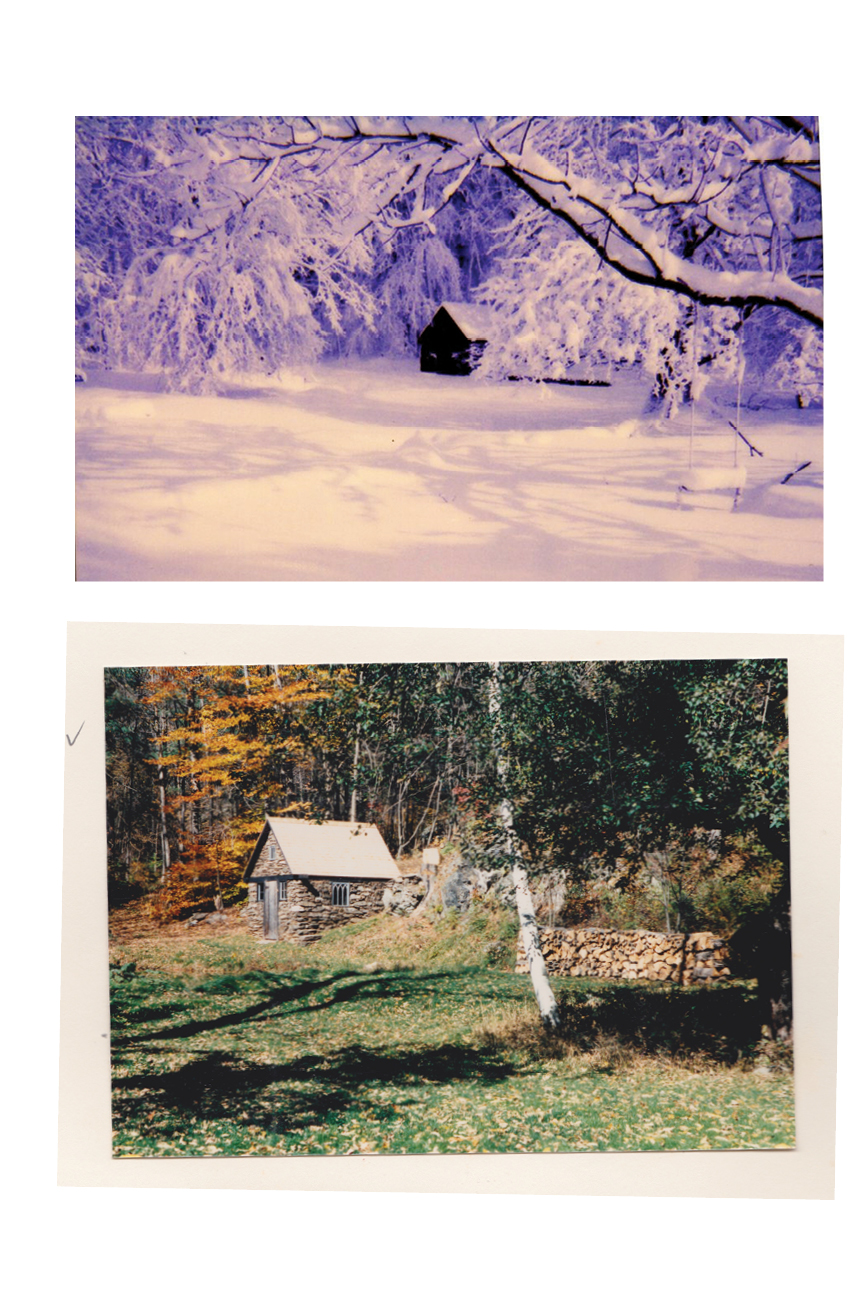
| Bob's toolbox and in the background the Stone Hut and Faraway Cottage — one built for Carson, the other built with Carson |
16
Carson was now a week old and the 6" x 6" hemlock beams were delivered to the hut site. With the help of David Emmons, a carpenter friend, we lifted the sixteen feet of beam over our heads and where it was notched to fit over the doorframe posts, we placed it down. It balanced nicely, with two feet extended on either end of the hut width to be trimmed off later. For the time being a 2" x 4" brace was nailed under each end of the beam showing the exact width of the hut — I would use the brace as a guide when laying up stone for the corner walls. When the walls were six feet high and the window frames boxed within stone, the other two beams were notched together. They would be the top plate for both side walls and carry the rafters for the hut. The trick now was how to attach to the ledge since the rear of both beams would die into the ledge. My friend David had ideas and being builders together we talked, and I like David because he isn’t pushy and he admits his knowledge is limited working wood with stone. He is New England stock, born in Danville, Vermont, where water-witching is big. He can perform it. He also likes to see stone worked. We met in the middle 1970s when he moved to this river valley and rented a small cabin on a knoll where he kept himself, a dog, and lamplight in the window. We used to scheme things together — how we would knock out a few bridges on the road to keep this valley wild and the river would be the roadway — goodwill ideas like that. Since then David has married twice, had a son born, done a lot of different woodworking: some menial, some of proud joy, and moved around from Tucson to New Hampshire. I stayed here and watched his cabin go lonesome, saw the snow pile on the roof, paint peel. Then the cabin and land was bought by someone who didn’t know what to do with a cabin, so it was torn down. I still feel it up there when passing by. Its lumber was salvaged for a high school bonfire rally. Up in smoke. When I told David about it he became quiet and then slyly whispered “shit” with a grin. It was a 12' x 20' cabin and under it was a full cellar of dry stone. One time when I was visiting, David lifted the trap door in the floor to take me down in the cellar to show me the stone, because he knew I would like to see it. We ended up building a few houses together. No matter what was going on, if I gave David a call for a helping hand he would be there. Itinerant. Poor. Continues to rent because banks don’t trust guys like him that move from job to job — so David dreams about the land he wants to build his house on. While jokers that own 100 acres don’t know where half of it is. When I needed an extra hand to lift that 6" x 6" beam David was out here. I watched him lift the beam into place with all the care as if the place was his own.
 |
| My 1957 Willys stone-hauler |
17
I found the Willys jeep a few years before the hut was built balanced on a pallet of hardwood lumber down at Russell’s sawmill. It was in the back of the mill, around the woods edge, where they stick green planks to dry. I had been looking years for this exact jeep and there it was all the time right under my nose. The 4WD spider gears were stripped (joyriding by teenagers in the winter) but I didn’t care, it was a jeep, rugged, animal looking. One of the workers raised it off the pallet with a forklift and after playing with the battery I drove it home. I wanted it that bad. I paid Russell for it, who was away at the time, a few nights later. Now it has to be understood I know little about mechanics, and have brief use for most machines but do have a companionship with a pair of Swedish chain saws and this jeep. I once owned a 1950 Dodge pickup (same age as Susan) but traded the truck to Mike Aldrich, who is a Willys man, for the repair work he could do on the jeep. Susan and I had good times with the Dodge, a backroad dusty pickup, but it wasn’t a woods-buggy or stone-hauler like the Willys. A tag scribbled 1957 was tied to the hood brace on the jeep — that’s its birth. I can’t remember the true name for the model, Mike tells me and I forget, but it has been chopped down in the rear for a flatbed with side panels; all oak, a six-foot bed. Carries cordwood like a dream. I watch the rear springs when loading stone — after twelve years loading stone into a wheelbarrow I was moving to the Willys but loaded it like a wheelbarrow. The wheelbarrow technique would never leave, and neither would the wheelbarrow — it still performs short hops. But on our land all the available stone had been hauled with the wheelbarrow into rambling roadside walls, garden walls, retaining walls, and terraces. I had to now scout the woodlot for stone. Mike repaired the 4WD gears and beefed the rear springs. I did body work on the cab. Larry Crosier — another Willys man and our postal carrier — sold me a non-spitting carburetor for five dollars. Five dollars! — that is unheard of — and so is a guy like Larry. After a few years using the jeep I was teaching myself the rudiments of its mechanics; I could hum or growl with it, but if it flat broke down, I would return to the wheelbarrow for stonework while waiting for the right hand to turn the correct valve. The Willys is a luxury. Without it the hut would have taken two years to build, instead of a part-time labor of six months. So I treated it good, didn’t abuse it, talked to it, took Susan and Carson on rides with me up into the woods to find stone. And we brought back plenty.
 |
| Books to die-for |
18
Books. I’ve never met a stonemason that learned his trade from reading a book. There are a handful on the market that are interesting to page through, but most are written as a “How-to” method. Working with stone is a sensibility and handcraft, you don’t sit and read a book about it and then do it, you are doing it. A book on the work might inspire someone to take it up, and it certainly will guide the ignorant not to hurt themselves, but the one who wants to work with stone finds the stone and lets the stone teach. In a day you should know if you are cut out for the work. I’ve seen curious displays of stonework — for instance, stone piled on stone for a corner footing on a porch; juggled looking, but somehow lasting 100 years. Someone came around and laid that. Showed that balance. Look for the stonework foundations beneath the old covered bridges — high square banks of stone beautiful in their strength and most likely hauled to the job by horses and oxen and unloaded by man. Books will provide the photographs of stonework but it is another thing to perform the work. The hands must get dirty. The book is left behind. It gets too confusing and becomes an interruption having the worker attempt his job while referring to the book. Make mistakes with the stone and repair those mistakes and the mistake won’t happen again. You have to arrive at a feeling where from the hands to the stone become one. A gathering of experience, attention, and pride in the work helps. One book that will inspire — I think it’s the bible to stonework — is Werner Blaser’s The Rock Is My Home. The title alone is definite. His premise is the stone we build with — be it a hut or a castle — compacted together makes the structure a rock. That’s what you have. And the book outlines European communities that have preserved a domestic stone architecture. The photographs in the book are numerous, detailed, and gorgeous. It doesn’t set out to teach, since it can’t, but to enlighten. The layman will look through this book viewing the bulk of the architecture, whereas the stone builder will zero in on detail, the balance of heft, immense concentration of work, the elegant rudiments. I’ve only seen this book in two bookstores and both owners had a keen interest in primitive architecture. Susan surprised me with the book as a gift one year. She bought it from Charlie Miller’s Worldeye Bookshop in Greenfield, Massachusetts which was a haven twenty years ago (Charlie has since sold the shop) for books on architecture, and not the pretty books only, but the nuts-and-bolts books. He would have them wedged in his small shop with Thoreau, Melville, and poetry. I usually reread The Rock Is My Home every winter when the stone is buried under snow. It keeps the appetite whet.
 |
| Bob in the roughed-in door frame of the stone hut and strings are drawn ~ here you get a good look at what will be the back wall of ledge 1985 |
19
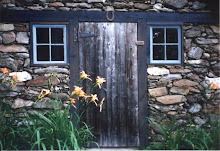
Carson was a month old when the stone walls of the hut were three feet high. I spent a few days away from laying stone nailing together boxed frames for the windows. Plywood 5/8" thick was used since the thickness of the walls was two feet and the frames would be set within the stone. Stone laid next to each panel of the window frame. The header for the windows was the top plate 6" x 6" beam. The window frames were treated to protect them from the moisture of stone and each window was painted light blue. I set all the frames by nailing the top of each frame into the 6" x 6" beam. There is one large window for each side wall and two barn sashes for the front wall. Another pair of sashes would be divided between both gable ends, but I would wait until stonework reached that height before deciding how to set them. Every step of the construction was an event, some of it I had never done before. Most of the time I let common sense and instinct take over and what naturally looked right to my eye. With the window frames nailed in place stone could now be laid under and around each frame. A week earlier I had notched the two side wall top plate 6" x 6" beams and our neighbor Mike came over to lend a hand fitting them. The question still remained how to attach the beams to the ledge. Of course the ledge was rock and rough and creviced enough to balance the two beams temporarily. I decided to build up the beams level with stone shims where it met the ledge, and by the time the side walls of stone were two feet wide underneath, that would be plenty strong for the downward support. The outward push of the beams was solved by drilling two holes in the rear of each beam, then dropping re-bar down three feet into the stonework and curling the stone around the bar as I laid it and thus holding each beam solid. The front butt ends of the side wall beams were notched by the strength and balance of the front wall sixteen-foot beam, and the thick stone corners of the hut were slowly making their way up to sit underneath the beams where they met with a notch. The top plates were in. Window frames hung. Stone was building up. All the beams were stained a smoke color to blend best with the stone. The higher the stonework, the slower it went. I was working off a step ladder in places, conscious all the time how the stone was chosen: clean strong edges to the corner stone, picking both for looks and strength. When in the woods with the Willys hunting for stone I was always keeping in mind what was needed back at the hut site — a special stone for the corner, a slab stone for under the windows, thin flat stone to cap the top of the walls when the top plate beams were reached. In the woods I was taking from walls other men built.

all photographs by Susan Arnold

Stone Hut
a builder's notebook
Bob Arnold
1988, 2013
a builder's notebook
Bob Arnold
1988, 2013