Tuesday, December 21, 2010
Monday, December 20, 2010
Our ever thanks to all who have!
In less than two weeks Longhouse will be 40 years old !
A day hasn't gone by where we haven't worked at it.
To help celebrate the 40th anniversary
(and to get to the 50th)
we are offering a treasure chest to draw from
=
Send $50 and we will send to you 8 publications
of our choosing from the Longhouse treasure chest...
One-of-a-kind
Booklets, cards, broadsides for framing, books !
And on top of that we'll pay for shipping, too!

International orders the only exception so please inquire.
With this, you can gift yourself, or better:
have the bundle shipped to someone else.
Just tell us where to send the gift and we will.
Don't even ask what publications will be sent, that's half the fun.
We're capable of fitting in some real surprises and sizes.
You may pay by credit card, personal check, money order,
or use the easy Paypal account below.
Got a great friend you want to make even greater —
here's your chance.
Mom, Dad, brother, sister, kids, neighbor : "hate poetry"
— try this gift on them.
While supplies last!
Send info, pay us, we'll take care of the rest.
Friday, December 17, 2010
Don Van Vliet, Check Bif, 1986
The artist Don Van Vliet has passed away today in a hospital in northern California.
As well known to the music world as Captain Beefheart, who with his Magic Band, merrily terrorized the world from 1965-1982. There were twelve studio albums released, the last being Ice Cream for Crow.
Trout Mask Replica (1969) should be listened to to be believed. All the albums are required listening for entrance to either heaven or hell.
If you saw the group, you probably haven't forgotten, no matter the drugs or time delay.
Susan still smiles and shakes her head "no thanks" when asked what it was like seeing the master and his band in concert in its heyday (early). She has a little bit of say here being second cousin to Don Van Vliet's wife Janet. Janet "Jan" Van Vliet was older sister to Jim Jenkins, skilled mountaineer, who wrote two detailed guide books mapping out much of the southern Sierra, including the Pacific Crest Trail. Jim died young, in 1979, on a California highway stopping to assist a motorist in need. His mother Ruby would continue the good work revising the guide books until her own passing in 2007.

This deep deep California history.
One day the town of Lancaster, California will be remembered as the town that survived having both Frank Zappa and Don Van Vliet in the same high school (Antelope Valley High School), already teaming up with their combined hothead interest in rhythm & blues.

The Captain would retire from music in 1982 and devote the rest of his life, far from the maddening crowd, to his expressionist paintings. Here and there he was known to show up as a contributor to a few recordings. Years enduring multiple sclerosis would eventually take him.
beefheart & zappa: last.fm
Thursday, December 16, 2010
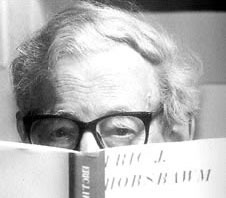
Antonio Polito: This has been the century of the common people. Who now represents these "common people"?
Eric Hobsbawm: At the beginning of the 20th century, the peasant was a typical human being who lived off the land. But at the end of the 20th century, this is no longer the case. We could have chosen a worker, a member of the working class that grew enormously during the century, and probably reached its peak in the third quarter of the century. But today, its size and influence are shrinking fast. What about an office worker, someone who works at a desk in front of a computer? He or she wouldn't do either. An office worker would be fine for western Europe or the United States, but there are still vast areas of the world where this image would not mean very much.
If you insist on looking for a symbol for the 20th century, I would suggest a mother with her children. The people who have most in common are mothers, wherever they live on the face of the earth, and in spite of their different cultures, civilizations, and languages. In some ways, a mother's experience reflects what has happened to a large part of humanity in the 20th century. What is no longer typical in our era is the traditional family structure that develops around the mother. Of course, there wasn't only one type, but almost everywhere there was some family structure. This is no longer true today.
But in spite of the fact that humanity's variety and the rapidity with which it has changed during the 20th century make it very difficult to choose a symbol for the "common people", if there has to be one, I would choose a mother with her children.
from ~ On the Edge of a New Century, Conversations with Eric Hobsbawm by Antonio Polito; New Press, 2000.
Eric Hobsbawm is a fellow of The British Academy and The American Academy of Arts and Sciences. His many books include Industry and Empire; Uncommon People; and On History.
Wednesday, December 15, 2010

"The day after his mother's death in October 1977, Roland Barthes began a diary of mourning."
(October 26, 1977-September 15, 1979)
October 27
Who knows? Maybe something valuable in these notes?
November 5th
Sad afternoon. Shopping. Purchase (frivolity) of a tea cake at the bakery. Taking care of the customer ahead of me, the girl behind the counter says Voilà. The expression I used when I brought maman something, when I was taking care of her. Once, toward the end, half-conscious, she repeated, faintly, Voilà (I'm here, a word we used with each other all our lives).
Not directly in solitude, empirically, etc.; I seem to have a kind of ease, of control that makes people think I'm suffering less than they would have imagined. But it comes over me when our love for each other is torn apart once again. The most painful point at the most abstract moment...
Not to manifest mourning (or at least to be indifferent to it) but to impose the public right to the loving relation it implies.
November 19
A trip from Paris to Tunis. A series of airplane breakdowns. Endless sojourns in airports among crowds of Tunisians coming come for Aid Kebir. Why does the ominous effect of this day of breakdowns suit mourning so well?
November 26
What I find utterly terrifying is mourning's discontinuous character.
November 28
To whom could I put this question (with any hope of an answer)?
Does being able to live without someone you loved mean you loved her less than you thought. . .?
February 16, 1978
This morning, more snow, and lieder broadcast on the radio. How sad! — I think of the mornings when I was sick and didn't go to school, and when I had the joy of staying with her.
April 18, 1978 Marrakesh
Now that maman is no more, I no longer have that impression of freedom I had on my trips (when I would leave her for short periods of time).
May 18, 1978
Maman's death: perhaps it is the one thing in my life that I have not responded to neurotically. My grief has not been hysterical, scarcely visible to others (perhaps because the notion of "theatralizing" my mother's death would have been intolerable); and doubtless, more hysterically parading my depression, driving everyone away, ceasing to live socially, I would have been less unhappy. And I see that the non-neurotic is not good, not the right thing at all.
June 13, 1978
Not to suppress mourning (suffering) (the stupid notion that time will do away with such a thing) but to change it, transform it, to shift it from a static stage (statis, obstruction, recurrences of the same thing) to a fluid state.
June 24, 1978
Virtually no sign of an internalized mourning.
This is the fulfillment of absolute internalization. All judicious societies, however, have prescribed and codified the externalization of mourning.
Uneasiness of ours insofar as it denies mourning.

July 18, 1978
Each of us has his own rhythm of suffering.
July 29, 1978
(Saw a Hitchcock film, Under Capricorn)
Ingrid Bergman (around 1946): I don't know why, nor how to express it: this actress, this actress's body moves me, touches something in me which reminds me of maman: her complexion, her lovely, simple hands, an impression of freshness, a non-narcissistic femininity...
Paris, July 31, 1978
I live in my suffering and that makes me happy.
Anything that keeps me from living in my suffering is unbearable to me.
August 18, 1978
The locality of the room where she was sick, where she died, and where I now live, the wall against which the head of her bed rested where I have placed an icon — not out of faith — and still put flowers on a table next to it. I have reached the point of no longer wanting to travel in order to be here, so that the flowers here will always be fresh.
January 20, 1979
Maman's photo as a little girl, in the distance — in front of me on my desk. It was enough for me to look at it, to apprehend the suchness of her being (which I struggle to describe) in order to be reinvented by, immersed in, invaded, inundated by her goodness.
January 30, 1979
We don't forget,
but something vacant settles in us.
March 18, 1979
Each time I dream about her (and I dream only of her), it is in order to see her, believe her to be alive, but other, separate.
May 1, 1979
I was not like her, since I did not die with (at the same time as) her.
~
Mourning Diary by Roland Barthes
translated and with an afterword by Richard Howard
(Hill and Wang)
Tuesday, December 14, 2010
John Clare had his doubts about John Keats, a poet he had never met.
"In spite of all this his descriptions of scenery are often very fine but as it is the case with other inhabitants of great cities he often described nature as she appeared to his fancies & not as he would have described her had he witnessed the things he described."
An age old tale between the bumpkin and the flatlander.

john keats (1795-1821)
I live in the eye
Here is Keats at Ambleside water fall (England's Lake District); the first water fall he had ever seen:
"We afterwards moved away a space, and saw nearly the whole more mild, streaming silverly through the trees. What astonishes me more than any thing is the tone, the coloring, the slate, the stone, the moss, the rock-weed; or, if I may so say, the intellect, the countenance of such places.The space, the magnitude of mountains and waterfalls are well imagined before one sees them; but this countenance or intellectual tone must surpass every imagination and defy any remembrance. I shall learn poetry here."
You want to hug him with that last line.

robert frost & wallace stevens, key west 1940
Yet I am the necessary angel of earth
"I have seen cowboys; I have seen prairie dogs; hundreds of wild ducks, Indians in camp with smoke coming through their discolored tent-tops; I have seen mountains swimming in clouds and basking in snow; and cascades, and gulches."
...says Wallace Stevens the future executive from Hartford, Connecticut, freshly peeled off from a Harvard graduation and New York Law School and piercing through Canada's wild landscape aboard the Canadian Pacific Railroad in 1903, exhorting to the "character of mountains above timber-line."
It was part of a six-week hunting trip, and the images and bounty of it stayed with the poet through all of his poetry and to his deathbed.
"Downward to darkness, on extended wings."

photo: frost/stevens c/o alfred knopf
Monday, December 13, 2010
RAILROAD EARTH ~
Finn has lived with his family in the Port Townsend region for the last three decades. Recently he gave a great reading which you can link to below. Be sure you use "see all" to watch the whole show. This is Mike O'Connor, poet and translator of Chinese masters, introducing Finn.
Saturday, December 11, 2010
Friday, December 10, 2010
In less than a month Longhouse will be 40 years old !
A day hasn't gone by where we haven't worked at it.
To help celebrate the 40th anniversary
(and to get to the 50th)
we are offering a treasure chest to draw from
=
Send $50 and we will send to you 8 publications
of our choosing from the Longhouse treasure chest...
One-of-a-kind
Booklets, cards, broadsides for framing, books !
And on top of that we'll pay for shipping, too!

International orders the only exception so please inquire.
With this, you can gift yourself, or better:
have the bundle shipped to someone else.
Just tell us where to send the gift and we will.
Don't even ask what publications will be sent, that's half the fun.
We're capable of fitting in some real surprises and sizes.
You may pay by credit card, personal check, money order,
or use the easy Paypal account below.
Got a great friend you want to make even greater —
here's your chance.
Mom, Dad, brother, sister, kids, neighbor : "hate poetry"
— try this gift on them.
While supplies last!
Send info, pay us, we'll take care of the rest.
Thursday, December 9, 2010

I came up from a nap in the evening, 5 degrees and Orion clear as bell over the woods river, and began to read this piece in the Dec 13, 2010 The New Yorker by Joyce Carol Oates. The last book I read by her was many years ago, the thin one on boxing. A pretty good one. The New Yorker for too many years now has engulfed itself with frantic, scare issue pieces on dying, modern medicine, doctoring or not, one misery after another.
This one is a love story and its loss. It's also a woman's piece, beautifully done.
I would read it.
"A Widow's Story", the New Yorker, page 70. Dec. 13, 2010

photo: Joyce Carol Oates and Raymond Smith by Bernard Gotfryd
You know what it's like when your friendly stubble-finger mechanic turns out to be a crackerjack banjo picker in the off hours (are there still "off hours"?) ...well that's what Milan Kundera is to me. A wonder. A grounded novelist, activist, man of letters, and supreme gliding essayist. As much as his writing, there are the subjects he chooses, or which choose him to speak. He's up to job.
In the 1960s Vera Linhartova was one of the most admired writers in Czechoslovakia, the poetess of a prose that was meditative, hermetic, beyond category. Having left the country for Paris after 1968, she began to write and publish in French. Known for her solitary nature, she astonished all her friends when, in the early 1990s, she accepted the invitation of the French Institute of Prague and, on the occasion of a colloquium on the issue of exile, she delivered a paper. I have never read anything on the subject more nonconformist and more clearsighted.
The second half of the past century has made everyone extremely sensitive to the fate of people forced out of their own homelands. This compassionate sensitivity has befogged the problem of exile with a tear-stained moralism, and obscured the actual nature of life for the exile, who according to Linhartova has often managed to transform his banishment into a liberating launch "toward another place, an elsewhere, by definition unknown and open to all sorts of possibilities." Of course she is right a thousand times over! Otherwise how are we to understand the fact that after the end of Communism, almost none of the great emigre artists hurried back to their home countries? Why was that? Did the end of Communism not spur them to celebrate the "Great Return" in their native lands? And even if, despite the disappointment of their audience, that return was not what they wanted, wasn't it their moral obligation? Said Linhartova: "The writer is above all a free person, and the obligation to preserve his independence against all constraints comes before any other consideration. And I mean not only the insane constraints imposed by an abusive political power, but the restrictions—all the harder to evade because they are well-intentioned—that cite a sense of duty to one's country." In fact people chew over cliches about human rights, and at the same time persist in considering the individual to be the property of his nation.
She goes further still: "So I chose the place where I wanted to live, but I have also chosen the language I wanted to speak." People will protest: sure, a writer is a free person, but is he not the custodian of his language? Isn't that the very meaning of a writer's mission? Linhartova: "It is often asserted that a writer has less freedom of movement than anyone else, for he remains bound to his language by an indissoluble tie. I believe this is another of those myths that serve as excuse for timid folks." For: "The writer is not a prisoner of any one language." A great liberating sentence. Only the brevity of life keeps a writer from drawing all the conclusions from this invitation to freedom.
Linhartova: "My sympathies lie with the nomads, I haven't the soul of a sedentary myself. So I am now entitled to say that my own exile has fulfilled what was always my dearest wish: to live elsewhere." When Linhartova writes in French, is she still a Czech writer? No. Does she become a French writer? No, not that either. She is elsewhere. Elsewhere as Chopin was in his time, elsewhere as, later, each in his own fashion, were Nabokov, Beckett, Stravinsky, Gombrowicz. Of course each of them lived his exile in his own inimitable way, and Linhartova's experience is an extreme case. Yet after her radical, luminous declaration, we can no longer speak of exile as we have done up till now.
Milan Kundera

Wednesday, December 8, 2010

LEARNING TO SPEAK
As a child running loose,
I said it this way: Bird.
Bird, a startled sound at field's edge.
The sound my mouth makes, pushing away the cold.
So, at the end of this quiet afternoon,
wanting to write the love poems I've never written,
I turn from the shadow in the cottonwood
and say blackbird, as if to you.
There is the blackbird. Black bird, until its darkness
is the darkness of a woman's hair falling
across my upturned face.
And I go on speaking into the night.
The oriole, the flicker,
the gold finch. . . .
It's our job to pull things back.
Peter Everwine was born in Detroit, raised in western Pennslyvania, educated in the midwest, and settled down for decades in California. When not writing his own poems he is translating from Hebrew and interpretations from Nahuatl.
~
BACK FROM THE FIELDS
Until nightfall my son ran in the fields,
looking for God knows what.
Flowers, perhaps. Odd birds on the wing.
Something to fill an empty spot.
Maybe a luminous angel
or country girl with a secret dark.
He came back empty-handed,
or so I thought.
Now I find them:
thistles, goatheads
the barbed weeds
all those with hooks or horns
the snaggle-toothed, the grinning ones
those wearing lantern jaws
old ones in beards
leapers in silk leggins
the multiple pocked moons
and spiny satellites, all those
with juices and saps
like the fingers of thieves
nation after nation of grasses
that dig in, that burrow, that hug winds
and grab handholds
in whatever lean place.
It's been a good day.
JUST BEFORE SLEEP
In the poem that comes just before sleep,
I am walking out into
the darkness of summer fields,
drawing it close about me.
What I wanted to say
was the silence of olive groves,
the longing of a road white with dust.
I speak an old language, love —
the fields rising and falling,
the small beards of light
nodding over the earth.
I am entering your hair,
coming home.
LOOKING INTO THINGS CLEARLY
The doctor smiles and comes toward me.
In a room so pure I can hardly breathe,
he opens my robe and touches the fragile
bones of my wings. "I'm glad you've come," he says
and I know I'm sick.
Something is wrong with me upstairs.
A neighbor's mouth tears like a wound, so dark
I think of a spring cupped in black roots.
The phone rings and another village is burning.
My head dreams of escaping into white stone.
"It's almost painless," he says, hiding
his hand behind his blue coat.
Only I can't see him clearly.
When I squint he seems to be
my father sidling through the halls of banks,
he is a bruised face, he is the President,
the drifting blue haze of factories,
of my own breath hovering over me.
I reach to touch him, but my fingers
enter and pass through —
he blossoms around them in a red flower of light,
petal after petal of light opens out:
I'm a window looking into a backyard.
Some men are digging what looks like a grave,
about the size of a child's.
NIGHT
In the lamplight falling
on the white tablecloth
my plate,
my shining loaf of quietness.
I sit down.
Through the open door
all the absent I love enter
and we eat.
(from the meadow: selected and new poems)
TWO POEMS BY AYOCUAN CUETZPALTZIN
I
Let the earth last
And the forests stand a long time
Ayocuan Cuetzpaltzin said this, traveling
The road to Tlaxcala
The road to Huexotzinco
Let field after field
Unfold with brown corn
Flowers of cacao
Let the earth last
II
We live in the country where things go away
Is it like this
In that country the dead wander?
Are some happy there
Among old friends?
Or is it here only that passing a face
We look into it
And speak its name?
( translated by PE from "The Aztec Poems" )

from Collecting the Animals
Peter Everwine
Atheneum, 1972
Tuesday, December 7, 2010
Poppa Neutrino (William David Pearlman), spent his early years in San Francisco. At that time he saw a documentary on nomadic aborigines, and made up his mind: "That's the way I want to live; I never want anything more." Throughout his seven decades PN has been a young soldier, outsider/rascal/highway-department-official, circus performer, father, church founder, nomad, band and street performer, designer, raft builder, and nautical record breaker.
In the late 1990s Poppa Neutrino became the second man in history to cross the Atlantic Ocean on a raft, but his vessel was made of trash, and that's a first.
In 2008 Poppa Neutrino moved to Burlington, Vermont to set-up life and shop. This time he built a raft on Lake Champlain.
When his vessel was ready, the plan was to circumnavigation the globe, sailing away from Burlington heading south to Florida with three sailors and three dogs. They would be aboard a new craft — a 37 foot trimaran rigged with two outboards, a supplied pilot house and four cabins.
On November 9th their raft was washed onto rocks at Thompson's Point, Vermont on Lake Champlain. Everyone was rescued.
Stay tuned. And while waiting, perhaps read Alec Wilkinson's book The Happiest Man in the World. It's all about the great Poppa.