Saturday, September 24, 2011

EARTH ~


Charles Bukowski


the mockingbird


the mockingbird had been following the cat
all summer
mocking mocking mocking
teasing and cocksure;
the cat crawled under rockers on porches
tail flashing
and said something angry to the mockingbird
which I didn't understand


yesterday the cat walked calmly up the driveway
with the mockingbird alive in its mouth,
wings fanned, beautiful wings fanned and flopping,
feathers parted like a woman's legs
and the bird was no longer mocking,
it was asking, it was praying
but the cat
striding down through centuries
would not listen.


I saw it crawl under a yellow car
with the bird
to bargain it to another place


summer was over.


silly damned thing anyhow


we tried to hide it in the house so that the
neighbors wouldn't see.
it was difficult, sometimes we both had to
be gone at once and when we returned
there would be excreta and urine all
about.
it wouldn't toilet train
but it had the bluest eyes you ever
saw
and it ate everything we did
and we often watched tv together.


one evening we came home and it was
gone.
there was blood on the floor,
there was a trail of blood.
I followed it outside and into the garden
and there in the brush it was,
mutilated.
there was a sign hung around its severed
throat:
"we don't want things like this in our
neighborhood."


I walked to the garage for the shovel.
I told my wife, "don't come out here."
then I walked back with the shovel and
began digging.
I sensed
the faces watching me from behind
drawn blinds.
they had their neighborhood back,
a nice quiet neighborhood with green
lawns, palm trees, circular driveways, children,
churches, a supermarket, etc.


I dug into the earth.


millionaires


you
no faces
no faces
at all
laughing at nothing —
let me tell you
I have drunk in skid row rooms with
imbecile winos
whose cause was better
whose eyes still held some light
whose voices retained some sensibility
and when the morning came
we were sick but not ill,
poor but not deluded,
and we stretched in our beds and rose
in the late afternoons
like millionaires.


putrefaction


of late
I've had this thought
that this country
has gone backwards
4 or 5 decades
and that all the
social advancement
the good feeling of
person toward
person
has been washed
away
and replaced by the same
old bigotries.


we have
more than ever
the selfish wants of power
the disregard for the
weak
the old
the impoverished
the
helpless.


we are replacing want with
war
salvation with
slavery.
we have wasted the
gains


we have become
rapidly
less.


we have our Bomb
it is our fear
our damnation
and our
shame.


now
something so sad
has hold of us
that
the breath
leaves
and we can't even
cry.


crucifix in a deathhand


yes, they begin out in a willow, I think
the starch mountains begin out in the willow
and keep right on going without regard for
pumas and nectarines
somehow these mountains are like
an old woman with a bad memory and
a shopping basket.
we are in a basin. that is the
idea. down in the sand and the alleys,
this land punched-in, cuffed-out, divided,
held like a crucifix in a deathhand,
this land bought, resold, bought again and
sold again, the wars long over,
the Spaniards all the way back in Spain
down in the thimble again, and now
real estaters, subdividers, landlords, freeway
engineers arguing. this is their land and
I walk on it, live on it a little while
near Hollywood here I see young men in rooms
listening to glazed recordings
and I think too of old men sick of music
sick of everything, and death like suicide
I think is sometimes voluntary, and to get your
hold on the land here it is best to return to the
Grand Central Market, see the old Mexican women,
the poor. . .I am sure you have seen these same women
many years before
arguing
with the same young Japanese clerks
witty, knowledgeable and golden
among their soaring store of oranges, apples
avocados, tomatoes, cucumbers —
and you know how these look, they do look good
as if you could eat them all
light a cigar and smoke away the bad world.
then it's best to go back to the bars, the same bars
wooden, stale, merciless, green
with the young policeman walking through
scared and looking for trouble,
and the beer is still bad
it has an edge that already mixes with vomit and
decay, and you've got to be strong in the shadows
to ignore it, to ignore the poor and to ignore yourself
and the shopping bag between your legs
down there feeling good with its avocados and
oranges and fresh fish and wine bottles, who needs
a Fort Lauderdale winter?
25 years ago there used to be a whore there
with a film over one eye, who was too fat
and made little silver bells out of cigarette
tinfoil. the sun seemed warmer then
although this was probably not
true, and you take your shopping bag
outside and walk along the street
and the green beer hangs there
just above your stomach like
a short and shameful shawl, and
you look around and no longer
see any
old men.


barfly


Jane, who has been dead for 31 years,
never could have
imagined that I would write a screenplay of our drinking
days together
and
that it would be made into a movie
and
that a beautiful movie star would play her
part.


I can hear Jane now: "A beautiful movie star? oh,
for Christ's sake!"


Jane, that's show biz, so go back to sleep, dear, because
no matter how hard they tried they
just couldn't find anybody exactly like
you.


and neither can
I.


about the PEN conference


take a writer away from his typewriter
and all you have left
is
the sickness
which started him
typing
in the
beginning.


Crucifix in a deathhand — this may be Bukowski's finest poem, amongst a cast of thousands. It may in fact be one of the best poems ever written by an American in the past century. It does rival Howl and The Waste Land parts, both poems written in madness. Bukowski would never submit to madness. He looked at and lived with the mad, worked with the mad, presupposed a Spanish North America fluent with landscape, vegetables, color, neglect, duende, death and redemption. He laughed at the Beats having no time to be Beat: he had mail to deliver, a warehouse to get to and then quit and move on, neighborhood bars and racetracks to tend to and rehustle the hustlers. Poems to write by the bucketload so his cartons of original books could dominate bookstore shelves to this day — more than anyone, if we are to be fair, even Mary Oliver. His overall text admits he could be cruel, he could be lovable. His range sweeps with Whitman, Dickinson, Villon, Poe, DH Lawrence, Joe Hill, Nietzche, Walt Disney, Sherwood Anderson, George Grosz, Woody Guthrie, all beer, Joe Blow, classical music by radio, juvenile delinquency. He was preposterous. He saw God, and kept on walking, tail swishing.


Friday, September 23, 2011

GOODBYE SUMMER ~


photos © bob arnold


Thursday, September 22, 2011

EARTH ~


Henry Darger


please read:

http://www.nytimes.com/2011/09/20/arts/design/preserving-the-american-folk-art-museums-place-in-new-york.html


Adolf Wölfli


Martín Ramírez


Henry Darger


paintings/images scanned from our personal library


Wednesday, September 21, 2011

EARTH ~


Nicanor Parra


PIANO SOLO


Since man's life is nothing but a bit of action at a distance,
A bit of foam shining inside a glass;
Since trees are nothing but moving trees:
Nothing but chairs and tables in perpetual motion;
Since we ourselves are nothing but beings
(As the godhead itself is nothing but God);
Now that we do not speak solely to be heard
But so that others may speak
And the echo precede the voice that produces it;
Since we do not even have the consolation of a chaos
In the garden that yawns and fills with air,
A puzzle that we must solve before our death
So that we may nonchalantly resuscitate later on
When we have led woman to excess;
Since there is also a heaven in hell,
Permit me to propose a few things:


I wish to make a noise with my feet
I want my soul to find its proper body.


SOLO DE PIANO


Ya que la vida del hombre no es sino una acción a distancia,
Un poco de espuma que brilla en el interior de un vaso;
Ya que los árboles no son sino muebles que se agitan:
No son sino sillas y mesas en movimiento perpetuo;
Ya que nosotros mismos no somos más que seres
(Como el dios mismo no es otra cosa que dios)
Ya que no hablamos para ser escuchados
Sino para que los demás hablen
Y el eco es anterior a las voces que lo producen;
Ya que ni siquiera tenemos el consuelo de un caos
En el jardín que bosteza y que se llena de airs,
Un rompecabexas que es preciso resolver antes de morir
Para poder resucitar después tran quilamente
Cuando se ha usado en exceso de la mujer;
Ya que también existe un cielo en el infierno,
Dejad que yo también haga algunas cosas:


Yo quiero hacer un ruido con los pies
Y quiero que mi alma encunentre su cuerpo.

translated by William Carlos Williams


My father spoke Spanish quite as easily as he spoke English. . .Spanish was the language spolken in the household. . .So that as children my brother and I heard Spanish constantly spoken about us. A steady flow of West Indians, South Americans, and other speakers of the Spanish language came to visit us.

from ~ Yes, Mrs. Williams, (1959)


compiled & edited by Jonathan Cohen
(New Directions, 2011)


Nicanor Parra is the great Chilean poet and mathematician magnificently still with us at age 97 (birthday was September 5, 1914). Many will say there is no greater poet alive in the Spanish language. And even greater still, Parra is the brother to the legendary folk singer Violeta Parra.


Tuesday, September 20, 2011

EARTH ~


ADDED JOY


I took a

large living

room rug

out into the

sun to

clean —


soon

there were

two butter-

flies on the

rug on the

grass and


that

was

that

for

now

period


end of summer

photo © bob arnold


Monday, September 19, 2011

EARTH ~


“The path of least resistance is what makes rivers run crooked.”
—Elbert Hubbard


Sunday 18 Sept 2011
It's been three weeks now since Hurricane Irene, and a week since we biked/hiked down from Vermont into Massachusetts along the Green River, and the river road on the Vermont side is a mere few inches from being passable. Maybe a day or two more of work from our town road crew. That will make travel passable. Then the road will have to be top coated with gravel (if we're lucky) and smoothed over and await for a helluva mud season next spring. First things first. Returning from our hike Sunday morning before breakfast we could make out the yellow frame outline of a John Deere bulldozer hired by the town waiting to get after some more road and river. Dump truck loads have been going down and back all week, drawing out of the next town of Halifax, and we know the fuel truck deliveries to houses are using that same route. Somehow coming up over Stark Road from a main road in Massachusetts. A road usually avoided except by ones that know their best short cuts — to Colrain, to Jacksonville, to Whitingham, to Wilmington, to Readsboro, even to Bennington. Many of these towns, and others, still in rough, rough shape.

The road into Massachusetts down along the river from Vermont hasn't changed an iota since the flood. It's creamed. There are three houses stuck, stranded, kaput of any access short of ATV and on-foot. This time we left our bicycles tucked away in the woods on the Vermont border and hiked down and had a closer look in. One house built of prefab logs looks abandoned for now. The second log house, a bit newer, is up for sale and was up for sale before the flood. It's kept a small door light on for at least the past two weeks which now looks weakened. I helped peel the logs for this house when it was being built in 1973. The third house going south is owned by a friend and while there is no vehicle there we want to believe Meryl got out before the flood. She has a full clothesline of laundry hanging out in the sun. It looks promising.

One can't even begin to describe what destruction has hit many regions of Vermont and pockets of Massachusetts. Houses by the many dozens demolished. Other houses swum off their foundations and setting 100 yards from where they are supposed to be. Now what? Whole towns leached with spent fuel and toxins. Bridges in some towns bombed by flood water and it may as well be war.

When we got our phone service back my mother called from Florida and just wanted to make sure we were all right, the house was all right, and our cat was all right. I said yes to all three. She said, "Oh, good, so everything's all right." That's a mother for you. One who has felt hurricane winds in Florida, but not floods.

Vermont — except for up around the Champlain region, is one big gorge, crevice, valley, spillway of thousands of creeks, streams, rivers, ponds, waterways, springs — when it was time to let go, it let go like a hemorrhaging bleed. Think of a hospital in full emergency and not nearly enough bandages, stitches, manpower, or imagination. Mother nature works in one direction: force, even when it is quiet and subtle. To watch a flower blossom in slow motion is like watching and sensing the earth splitting open.

Irene changed river directions. Beautiful meandering peaceful and lazy wood-brained rivers that once flowed with the posture of earthworms, are in many cases now straightened, gallant, militant water streams. The rivers have said outright they are taking no-shit from anybody, so be careful and thoughtful how and where you rebuild.

I look closely at a friend who travels down from further north where his town was bewitched by the flood, stranded all of it for awhile, the National Guard and helicopters flew in. He's lost some weight even if he tells me, and I didn't ask, that he hasn't. His house is country smart built on a high plateau so all is fine but he can't move more than wiggle room in his truck. His wife was for awhile living in another town so she could still get to work. He's been backpacking dozens and dozens of miles over hill & dale to help out as a long time volunteer. He's tired. He's lost some meat on his bones. Depression comes to all of us post-hurricane. Everything you once knew and felt and sensed and heard from your homestead is a little altered, or completely gone. You're known as the hearty state with stalwart folks in small towns and villages who make their own way, but that doesn't hold water when a goodly portion of the new population is made up of microchip hardware buffs and they are fast-wired for needing quick results. Patience is going to occur in different ways.

Sweetheart takes a rest on the new river stone where we are cutting up flood trees and hauling them out on our backs and in our arms, and swears she hears trucks, heavy equipment, planes in the river. The small rapids are different. The new stone that flowed in with the flood is naturally rebuilt and fantastic, allowing a much fuller and cleansed sound. We fall asleep to it every night, wake to it. Constant. After awhile Sweetheart has to leave the job site and get away from it — there's something mad and even too male about all the post flood reorganization is how she explains it to me.

I'm cutting trees, full grown, plowed over and flattened to the ground by the flood. There's nothing like seeing ironwood, yellow birch, maple, ash, oak trees taken from the sky and pressed down at your feet. We've raised a red flag on a wisp surviving sycamore tree on this small island where we cut because everything that is standing and alive deserves a celebratory hug, including everything that once was and has washed away.

Returning from our hike this morning we were met by an out-of-state vehicle whose occupants flagged us down and wondered how the road was south of where we all stood. They had a second home a mile up river and had just made it here to have a look. Usually they took this road going back home to Connecticut. We told them there was no road. There wasn't even an Indian trail. They couldn't believe it, so they asked more questions and we talked some more until their faces changed and we got to know one another a little better and they turned around, like the handmade sign said to do, just up from where they passed.


photo © bob arnold

Sunday, September 18, 2011

BYE BYE BLUES ~


Les Paul storming the stage in NYC at age 93


Saturday, September 17, 2011

EARTH ~


ON BUILDING A STONE STAIRCASE AFTER A HURRICANE
(with added commentary by Cralan Kelder & Kent Johnson)


Cralan (in Amsterdam): I'm not sure i understand, how did you build a stone staircase?

new river rock? how did you shape it, or shape the stones? are they stones that were formed from human activity in the past, like cut.


Bob: Good questions!

I've never shaped a stone in all my working life with stone.

I take what I receive, make it work.

You remember our road in relation to the river — it's down over a high river bank (thank goodness).

Many trees came down full length with Irene and the flood, they lodged on an island we have in the middle of the river. Ravaged half the island in the process (took it away, gave us a new stone bed).

I began cutting the trees for firewood the past two weeks, but have to lug it to the bank and somehow get it up to the road. For some years now always cutting driftwood down there I have cut trees and split all the wood right on site. . .then between us, we carry the wood to the bank and I throw it up to Susan on the road. 15 feet or so.

That process is getting old with so much wood, and we're no younger. So I hand dug out a passage-way up the bank (think channel) and scalloped out sections for building in stone stairs, until I reached the road. Hook or crook. It's a dandy little piece of natural furniture, and right you are: all the stones (best flat) came down with Irene. I had used up all the flat stones available before Irene for other jobs.

Now it's cutting the trees to four foot length and shouldering that up the stairs to the road and the pickup truck. When the trees become larger (they will) I'll shorten the log length to 2 feet or less and split it right there and lug those splits up the stairs.

I had one worker pass by and it seemed like he was laughing at my stone tomfoolery. There's always a cynic.

Poetry best, Bob (liked your new one out of Africa)


Kent (also involved in separate cover, unrelated, same subject though):

Amazing.

I love the notion of cutting the stone stairway into the hill to bring the wood up. Something about form as an extension of content, there... Or is that the other way around? Or is it both, always?


Bob (subject matter on the email "Creelyish"):

I was down on the river today finishing up on building this stone staircase and had your crystal clear re-action to this job: "Something about form as an extension of content, there..."

I have to say, only from you this would arrive!

And I lugged more logs up the stone steps.


bob


cralan


kent


Kent Johnson & Cralan Kelder are both poets, memoirists, inventors, wiseguys, and everything they've published is important

some photos © bob & susan arnold


Thursday, September 15, 2011

EARTH TO EARTH ~


Carl Oglesby
1935-2011


http://www.miamiherald.com/2011/09/13/2405003/60s-activist-carl-oglesby-dead.html


Carl Oglesby
w/Richard Davis,
Norman Grossman
Bob Fritz
Elmer Jared Gordon
George Edwards
Peter Psarianos
Tim Hauser
Seymour Barab
Mark Puleo
Vinnie Bell
Joe Mack
Bill LaVorgna

Vanguard Records

1969


Wednesday, September 14, 2011

MEMORIAL ~
(another angle)


Amiri Baraka


Tuesday, September 13, 2011

SHELTER ~


Shelter, edited by Lloyd Khan (Shelter Publications, 1973).

I first read this massive masterpiece on hand-built housing, building crafts, and networking tribes and people the year it was published. It looks as grand and attractive in any bookstore now as it did at its first appearance. Done right, the book is displayed front facing and on a mantel all its own. Yesterday, I was holding the 10th printing in both paws and easily remembering every page. It's thrilling to see how many photographs are in the book detailing earth homes and earth lovers from around the world. It's a compendium of both nuts 'n' bolts and dream-like splendor which can't be knocked.

Here's an address for you landlubbers: Shelter Publications, PO Box 279, Bolinas, CA. 94924.

Website for others: http://www.shelterpub.com/_shelter/shelter_book.html


Monday, September 12, 2011

ROUGH ROAD ~


Sunday 9/11
We're just home from ten miles of rough road travel on bicycles along the river from our home in Vermont down into Massachusetts.

Our town road crew has stepped it up nicely at getting at least part of the Vermont road passable all this week. Every house down along the river now has access. A pretty darn good accomplishment since dear Irene was two weeks ago today. Everyone seems to have their vehicles now parked at their own homes, instead of a mile or half mile away, sidelined.

There's still one mile of road on the Vermont side hugging the river that is wiped out. We carried our bicycles over that part. Culverts shot, stones slabs thrown like styrofoam, culverts beached. It's primeval in there, relatively wild, it's always been one of my favorite locations on the river. The ledge is ledgier, the woods are soaked and thicker, the road just sidewinds and asks forgiveness to get a little further if you please, especially in the depth of winter. There are no houses in these parts.

If you think our Vermont part of the river is bad, take a look down in Massachusetts. We had to carry our bicycles for a good half of two miles before we hit the main road, which is still a back road spur as far as any road commission is concerned. For me it's where Dennison Lumber used to be, where I used to go for sawed hemlock and poplar and v-joint pine and spruce flooring and bags of mortar and 25 pounds of nails once upon a time in my work. The sawmill is over with long ago but I could see when we finally got down there that the river had kept away from making any serious damage.

Where we're headed to is the Ten Mile Bridge that is the go-between for the towns of Colrain and Leyden, Massachusetts. We heard the legendary Octagon House was about all gone with the flood and it's almost too sad for words to express anything more for what this must mean for that family. I had my camera and was taking films and photographs all the way down on this travel but I couldn't bring myself to take a photograph of where that house had once stood. It seemed cruel. We stood on the bridge awhile and just imagined what the river looked like cutting out a treacherous path. The scars are all fresh.

Up from the bridge and back on the Colrain side we figured now was as good a time as any to go visit my old friend Chuck Lynde way up high on the mountain of Avery Road. If I knew he was as high as he was, stuck fast on a dead end of a mountain, I might have come another day. But I've been saying we would visit one of these days and I've been saying it for almost 40 years, so we picked post-Irene to come and say hello. It's a hike-the-bike about a mile straight up hill to get to Chuck's fort, with houses along the way mainly lived in by his extended family of many brothers and an elder mother's homestead where Chuck harbors his two logging trucks, various pickups and dumpers, wood-splitters, conveyor belt, and I noticed when passing an old Coca-Cola icebox chest on the front porch. Exactly like the one we would pull our cold glass bottles of Coke out of as kids, once upon a time, anywhere in America. 10 cents. It's a tidy two storey house in need of painting is mom's place. A glory view from that perch straight ahead into Vermont.

Up at Chuck's we found him in Sunday morning attire — hefty blue gym shorts and nothing else. Brawn body tan from logging all summer. He lifted his grandson into his arms and welcomed us inside like all good country people always do and we took a tour of the fort he's been telling me about all these years. An old woodstove about in every room, except maybe the bathroom, some hooked up, some not. Of the three wild cats we met "Tom", the oldest. Chucky's woodshed is almost empty because he's been delivering wood for months on end to everyone else except himself. The typical backcountry m.o. for most workers. Afterwards, coming down off the mountain and seeing the backside of his mother's place, I spotted the open pole barn spilling full of good blond firewood. Take care of mom.

The road repair in Massachusetts along the river is going to be a mammoth project. There's a giant Volvo backhoe parked on safe land with a monolith storage of all size stone and large rock which has been hauled out this way for probably the past two weeks by the looks of things. It looks like great methodical plans are in the works.

When returning up river we met a jogger on a better part of the road during our three hour outing. As I glided past her, and she was running hard, our eyes met and I said what I believe was the same feeling for both of us at that moment, "Nothing like a beautiful day." She returned a beautiful smile.


photos © bob arnold

we've now bicycled or hiked on-foot from the Hinesburg section of Guilford, down through Green River, including around Pulpit Mountain, further into Colrain and Leyden, Massachusetts following the river and Irene's path all along the way — in some ways this has allowed being a witness and cleansed the spectacle of post hurricane.


Sunday, September 11, 2011

FETCHING ~


with Hurricane Irene


Twelve days, post-Irene, we received back our phone service and returned to our home life of fetching mail and bookshop orders the old-fashioned way — wait & see.

This ended twelve days of road travel and finding curious ways of getting out of this river valley clobbered about by the Irene flood. The road is looking better — we now have two miles down river from the covered bridge that is part normal and part one-lane and be courteous to your neighbor also on the road. But UPS still won't come down.

I can remember this vivid portrait the day after the storm when we came back from searching on bicycles what had happened to this region, only to find half the valley neighbors caught on a river bed ragged left road, all-a-tangle and gossip, cars, trucks, ATVs, those on-foot and now we join on bicycles, trying to get through a bottle neck.

Service trucks to repair things couldn't even begin to get down, so first the neighbors had to rebuild parts of this road and pack it down with their determination at either having a town habit of getting-to-town, or simply needing supplies or some relief right after the flood. But the road got remade in pieces and lumps.

Next came the power company to restore broken lines in at least a temporary relief kit (piggybacking electric lines), then the town road crew made a long bumpy ride inspection, some dumptrucks of gravel followed, and after that we saw a pole setter crew out in the hard rain standing up new poles for the telephone repair to get underway. It took awhile. It had to take awhile.

We visited town and college libraries everywhere and everyone on the staff was accommodating and friendly. Stay positive cynics!

One day we found ourselves in the deep bowels of a basement reference library pretty with two or three brand new wide screen Apple Macs at our whimsy. After struggling and learning the ropes with Dells and whatnot's, on the final days of searching we got behind the controls of old and familiar friends. This only inspired us to climb throughout the library multilevel floors, dark and catacomb-like, monkish immediately in feeling, and tremendous thousands upon thousands upon many more thousands of books in all languages and subjects at our fingertips. Too overwhelming to even begin to want to concentrate. We were enthralled by the spectacle of so much tenderness to books. Our climbing brought us to a tower that was closed. Students have this paradise at their daily disposal.

Back to earth we were making mailing labels, by hand, going from small town Texas to big place Australia and elsewhere. From a country that Gallup now estimates is in a "disengagement crisis" costing America in the order of $300 billion in lost productivity annually. I don't see this happening in the library we are playing somewhat mischief in, nor the town. It seems to be on a progressive cycle with an in-grain network of wealth. This wealth has been usurped, stolen, taken, misplaced, earned, manipulated, inherited, maintained with a fluency from a vast resource much too complicated to point any one finger at, but I'm getting closer and closer to pointing. I only see terrific losses in the majority of other small town New England and forgotten hamlets. Places easily washed away. Places that once were the charm and mother lode.

What is haunting is the massive library of books — all lit by the big windows with the lights shut off — that appear in unison,
untouched. Clean, upright, deliriously rich title after title and not one book pushed or jiggled out of place; with a lone student burrowed into a study carol in one corner, ears plugged in, face eating a computer screen. Oblivious to our book phantom frolic. Does this matter where it is? It's in America.

During all these travel days I've had just the companion with us — Roberto Bolaño's
Between Parentheses (New Directions). Great title for all of us! A volume collecting most of the brash and stellar newspaper columns and articles published between 1998 and 2003. The more I read of Bolaño, and I've read everything translated into English, the more I miss him. He's the Gombrowicz of our time and every time needs a Gombrowicz. There's nastiness and tenderness to the Bolaño touch, just as there is in the best of the natural world. He's so fine at celebrating and dismissing. He can't help but be everlasting with these qualities. He happens to think humor and curiosity are the two most important components of intelligence.

I've also had
Anne Grimes Collection of American Folk Music, book and CD, and this has provided a wood nutty taste to the travels.

Last night our son Carson gave us a lift in from town where we had gathered up from a day of travel four satchels of books and things. Precious notebooks stashed away with precious notes in jacket pockets and inner sleeves. We'd all talk nonstop on the ten mile drive catching up on where we've all been and how things are.


Roberto Bolaño


top photo © bob arnold

Saturday, September 10, 2011

EARTH ~


weather revision


A.R. AMMONS ~


OLD GEEZER


The quickest
way
to change


the
world is
to


like it
the
way it


is.


Archie Randolph Ammons grew up on a tobacco farm in North Carolina. Before he turned 40, he was on the English department faculty (this biology major) at Cornell University where he would later hold down the fort with fellow North Carolinian Robert Morgan. Years before Cornell, Ammons served in WW2, and later taught and was the principal of Hattaras Elementary School. It's been said that he had a school in Miami named after him. If this true, he is one of the few contemporary American poets, I believe, who holds such a distinction. Ammons was born in February 1926 and died the same month in 2001. His many books of poetry show a verve between the very long and very short poem. Emerson would have probably enjoyed his company.

Thursday, September 8, 2011

CRIK ~


I can't remember what day it was when I last saw someone on our back road. Somehow it is already the 8th of September and my body clock is still at around August 28th, wanting one more swim in the river, time to cut more basil and make pesto and think about canning all the garden tomatoes. The woodchuck got the broccoli and one garden cabbage plot, but so far hasn't found the more hidden front yard cabbage plot.


Then Irene came and turned the calendar and the body inside out. Swamped the garden. Just because I've learned the hard way over too many years is why all the firewood is stacked high & dry.


It's been raining the last five days. I mean raining.


The covered bridge in the village is safe. I knew it would be. Look at the way the stone slabs are cribbed and how high the bridge is. I have a feeling the work boss on that job a few generations ago said: "Yeah, it all looks good, but let's put the timber sills just a foot higher. One more foot, boys!" The crew thought he was nuts or a crank or a hardass, but that's just how much the river torrent of Ms. Irene missed the bridge by. I've an old friend up in the village, the oldest resident of the village in fact (been there since WW2) and her eyes still widen when we talk about Irene and how close things got for the village and the covered bridge.


At night, with all the rain, the river roars. If you love darkness and night powers and mother nature being in control, you need to be with me late at night when I stand beneath our front yard hemlock trees and just listen. The mud aroma from the river absorbs all parts. This river sidewinds down from South Pond in Marlboro, Vermont and picks up these days every stream, brook, weep, snot, sniffle and trickle off the messy woodlands along the way. This river has hurt people, wrecked homes, removed property (including our own) and right now it's teaching a lesson to many who took it for granted. Called it nothing but a "crik". It's the maker of this valley, always was.


It's a proud sight to see up river how our neighbor Lyle Howe kept his foot bridge intact. I remember years ago how he lost the first one he built, because a lot of it landed down river on our land, worthless. I didn't ask but watched how Lyle and some helpers planned carefully for the next bridge, and maybe this second one has been compromised a bit at the cribbing and staircase, but from the road it looks like a bonafide survivor. Three cheers for a well-planned second effort.


A few more miles up river someone who owns a fishing pole enterprise kept his building on its feet. We all thought that one would be a goner. The river had to go right under and possibly right through it. We bicycled up the hobbled region right after Irene wasted through and there was the building pinned to its piers, looking good. I'm sure soaked inside and washed out all around it, but another survivor.


Our road's still closed. Dumptrucks are working late. The road's gone to mud, more than three miles of it. We are hiking out at 5AM and picking up our ride and looking for where we can do our work through the day on drier ground. With no visual focus before dawn and in all that dark water roar of the river as our only bearing (the road used to be a bearing, a star) we wait to climb back down onto the river shore where we can work cutting trees, gathering good flat stone, sit by the river as it subsides and wait for someone to come by and call it "a crik".


the friendly sign at the top just tells it like it is for now

the bottom photograph is how our road looks coming from Massachusetts


photos:


Wednesday, September 7, 2011

"ADVENTURE - NOT PREDICAMENT" ~
( James Broughton )


kerouac  pronunciation


Dilley (Texas):

In the final passage of On the Road, Jack Kerouac writes about finding himself standing alone on the hot summer road under a street light in Dilley, Texas. He heard footsteps in the dark and a tall white-haired old man clomped past him with a backpack. He uttered the phrase, " Go moan for man." Its exact meaning was a mystery to Jack, but he thought about it philosophically and used the phrase in the book as if it were a command from another world.


the above quote is the epitaph on James Broughton's tombstone in Port Townsend, WA

this all taken from Bill Morgan's primo road galaxy of Beat travel

Beat Atlas (City Lights), with excellent by-line state by state

character by character, terrific photographs throughout

and dirt under the fingernails when done reading.


ONWARD! ~


What a surprise, it's raining again.

Vermont Governor Shumlin is asking second home owners in the state to give over their homes for many folks lost with nothing after Hurricane Irene. I can hear a pin drop.

Where we are today, just over the border in New Hampshire (crossing the new big muddy Connecticut River) you can hear the flood talk flowing constantly from passersby.

Back home, in Guilford, our road is now the only road officially closed in town. Many have worked on the road over the past week to get it into a one lane path hobbled over river bed stones, but there is nothing "through" about the road. You come and you arrive. It once traveled down along the river to Massachusetts but that once scenic drive took a Dr Jekyll and Mr Hyde turn for the hairy beast during Irene. You can get there by bicycle if you like to carry your bicycle. By vehicle is out. On-foot is blessed as ever. I haven't heard when the two towns plan to put their work crews together to meet at the new promontory point (the border) to rebuild the road, but it may not be before winter.

Selfishly, I adore the quiet. But that's just me.

Yesterday, a flotilla of dumptrucks were working the road north of us, up river, and beefing up the neighborhood-made one lane. A hard rain has been falling ever since. It was mudpie and bare rocks showing when we juggled out this morning in the dark at 5AM. The river roaring is making for bad dreams for man and animal alike.

Like everyone else, we might just scream with delight when the sun returns and stays out for maybe a pair of days. Wouldn't that be nice.

Still no phone. I can point to you in the river where our phone line is a half mile up river from our house. If I pick up a stone and throw it, then pick it up and throw it again, same direction, and heading toward that downed phone line, the house where that stone has landed closest to has phone service. Meaning between our house and the phone line in the river, that house has phone service. We don't. Don't try to figure it out. It's quite typical Vermont-we'll-get-it-to-you-service. That house is being fed from another backhill direction, ours is coming along the river. I remember when the phone line, such such as it was (I didn't have a phone), was stapled to trees. We've come a long way, we now have poles. Until Irene took them.

Try to laugh. It beats feeling sick.

During all of this rabble, Matthew Fluharty was kind enough to send to me a link to his wonderful site on all things rural & curious. Here it is:
http://theruralsite.blogspot.com/2011/08/rural-poetry-series-bob-arnold-and.html
He has fashioned a piece on Longhouse et al., and I just heard there is a second piece about my Back Road Chalkies. Thank you, Matthew, and I hope all enjoy.

There is a poet in Chicago, I forget her name right now out here on the lam, but she has a poem about hummingbirds where she writes (a very short poem) that those with the smallest hearts, like a hummingbird (like flood victims, I say), beat with the mightiest of wings.


a great map for back road news:
http://www.windhamregional.org/roadstatus


Tuesday, September 6, 2011

MORE HIGH WATER ~


There is no one center of the universe


NICOLAUS COPERNICUS


By Labor Day evening we had three inches of rain, five inches by midnight. This is approximately a week after Hurricane Irene, earth soaked, so the five inches is pretty much running freely through cornfields and jumping all streams and rivers quickly. Our river is fed in a watershed of only more and more other rivers and woods streams which fly off down the rocky hillslopes like nobody's business. I can hear them working, flashing, while standing out in the rain right now in the pitch dark. This could get bad all over again. But I'm typing this on a typewriter and who knows when I'll be near a town to re-type and post it onto the Birdhouse. We may be in for another flood. I know we're in for a road already ruined going more ruined. What's after ruined?


Lights flickering. Phone out all week, so far.


This morning in a college town where we went to access a computer before everyone woke up and we were successful, we later walked a posh neighborhood of each and every elegant home. The lawns unmowed because of all the wet weather and the long grass moved in the breeze like a small green sea. The hardwoods were top-of-the-line vintage maples and oaks, and the spruce trees were scalloped as if personally manicured, which I wouldn't put past the neighborhood. The last time I walked in a neighborhood so well-looked after, and not a gated community (yet), was Beverly Hills. Maybe you wouldn't believe, right along with me, how this very street ended up at a Shangri-la of its own private golf course. It was lightly drizzling rain now and out on the rolling manicure and deep forest backdrop we found some stoic players not about to give up. This whole place wasn't built by slouches. It's maybe come to that in these times, but at one time the refinement and class and crafted detail of the immaculate homes' woodwork was measured and etched into place by craftsmen. Mainly men, who way back when, arrived on the job in station wagons with toolboxes in the back. I worked as a boy with these guys -- Germans and Irish and Scandinavians. They worked in clean overalls and their hair was cut short. Every single job started, was a job finished.


I miss these workers now when it's come time to rebuild towns, roads, and think about old bridges. And covered bridges -- and we have one in our village (see photos below). Floods are part of mother nature and these craftsmen came from the same nature. They flowed with the same fluency. It's why their carpentry practice moves so well to this day to the moving eye.


When I moved into this river valley as a boy there were only two families on the road, and one was tucked up on a side road from this road where the river hugs. I became used to two families and to this day it's about all I recognize on this same road. Any two given families. From the old days, only one of the families is gone, and parts of the other one is still around, and some parts of that family has been responsible at helping rebuild our ragged road. They aren't part of any paid town work crew; they're just doing it. Good Samaritans.


Yesterday when I cut cord-length logs on the river from flood damaged trees and got them across and out of the bowl before this next potential flood, I waved to one ATV going by carrying two (man & woman). Then a pair of joggers, bare to the waist, went by and I could hear them moan when they saw what tree work was ahead of me and one gave a sympathy wave. A couple I've never seen walked by and probably returned when I was ducked away at work in the trees. Then a white pickup truck rode by slowly and slowly returned, followed sometime later by a car with Massachusetts plates that I knew would be returning because there was no longer road access to any Massachusetts. Where I was piling my logs on the other side of a shallow section of the river is now five feet in rushing water and all my logs could be long gone. Finish what you start.


I just picked up the phone, 10PM, dead as doornails. I hear the same sound in the receiver that I used to hear holding a large seashell to my ear. It was my mother's brought from her homeland in Ireland; she said the sound I heard in there was the sea. I was seven years old and fully impressed. A mile up river driving home today through mudholes we saw FairPoint workers and a pole-setter crew in dayglo t-shirts head down, getting another new pole in from where another old pole vanished in the flood. It's muck and mud and a backhoe groaning away at it.


One day I'll lift the receiver and it won't be the sea. You think?


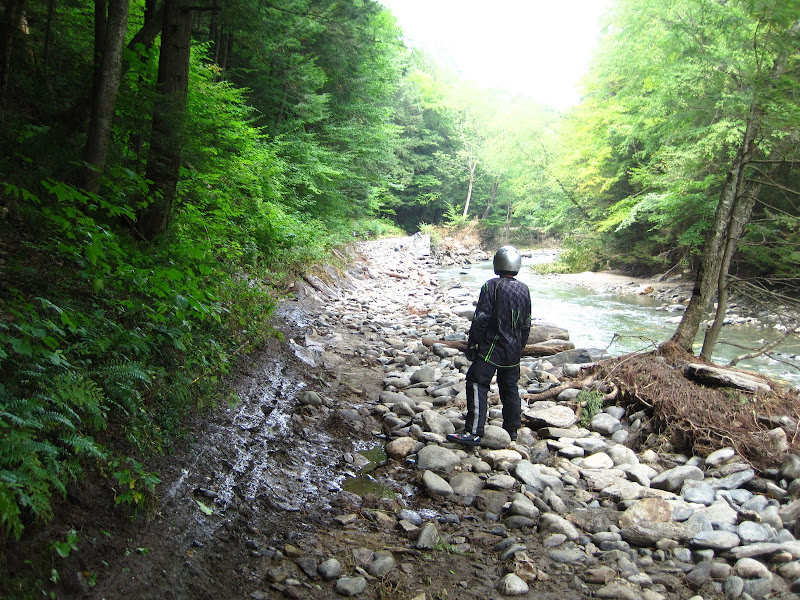
{ Many of the photographs below are of the road I write about along the Green River. That's not dry river bed you're looking at -- that's the road. I have films and still photographs I took the hour when the flood was at its zenith and made this damage, but I still have no way to post these without a phone line to the house. Soon enough. }


writ in VT.

posted in MA.
photos: CNN