Saturday, March 17, 2012

SONIC ~


Davyd Betchkal, sound catcher, in Denali National Park and Preserve in Alaska.

~

IS SILENCE GOING EXTINCT?

http://www.nytimes.com/2012/03/18/magazine/is-silence-going-extinct.html?hp


photo:

Peter van Agtmael/Magnum, for The New York Times


ny times


LONGHOUSE! ~


Malcolm Ritchie


when the poem's out a sense in the body
like the energy left in a twig
after a bird has flown


Some Small Lines on the Great Earth. Longhouse, 2012. First edition. Three color unfolding accordion booklet with thirty new poems. Poet, Buddhist and Japanese scholar, from his steward on the Arran Island of Scotland. New and limited. A signed edition is available upon request.
$10 unsigned


Buy now (U.S. addresses with $2 s/h) with Paypal:


Inquiries, please write the Bookshop with thanks


please click on image


Friday, March 16, 2012

EARTH ~


small town —

the span

of the radio dial


small town

my big words

are gone


small town

the smell-of

everyone's wood


small town

the print shop owner closes

for a walk


even

in the small town

the questions find me


love

in the small town

almost too big


preface ~
these are my small observations of
a small town in a brief time in a
brief life. a town i've come to
cherish because of the fact that it
always is exactly what it is. a
lesson for us all.

vincent tripi
winter 2003


EARTH ~


please click on images


John Martone
skeleton key
copyright 2012
samuddo / ocean
isbn 978-1-105-53007-4


Thursday, March 15, 2012

EARTH ~


Ian Hamilton Finlay


There's Ian trying to row his way out of the photograph, by leaf cover, a man in motion.

This is a superb collection which is a must for everyone's library. Or kitchen table. The poems are all tools, food, bits of fruit, colored leaves, messages. Thoroughly human.

The book is edited by someone who knew him better than anyone possibly could ~ his son Alec, and the long and luxurious introduction by Alec Finlay is a true gift of revelation and respect. Highlighted with photographs and stitches, as Alec calls it, from Ian Hamilton Finlay's letters.

The complete works will one day be twenty volumes, since Ian was poet, artist, builder, sailor and warrior, but this volume of over 300 pages is a wondrous start.


HOW TO BE HAPPY


They take all their rubbish

Down to the sea-shore

And the sea comes and

It takes it away

Twice every day.


IAN HAMILTON FINLAY
SELECTIONS
Edited and with an introduction by Alec Finlay
University of California Press


Wednesday, March 14, 2012

EARTH ~


George Ault, January Full Moon (1941)


The Cleveland, Ohio born painter George Ault (October 11, 1891-December 30, 1948) seemed to have a most excruciating life — born into wealth, with education in London — things began to unravel for the artist after the death of his mother in a mental institution, then each of his three brothers took their lives, two due to personal losses in the stock market crash of 1929. His father gone to cancer, George Ault was without family, penniless, brushes in hand.

By now Ault would be back from Europe living between New Jersey or New York (Woodstock) where he would spend the rest of a reclusive life painting (beautifully), struggling and drinking. His alcoholism became most severe as he almost blinded himself drinking poisonous bathtub gin. His erratic and strange behavior began to keep artist and dealer friends away.

In Woodstock he would turn out many of the paintings that made his reputation, none better than "January Full Moon" with its breath taking face of isolation. To view a clear representation of this painting will send a shiver up your spine, the snow shadows of the moonlight are that clear.

The painter's hardworking second wife Louise Jonas, and her income, kept the couple's heads temporarily above water while living a spartan existence in a tiny Woodstock rental without electricity or indoor plumbing. They would live there ten years, the artist soaked in his obsessive behavior of requiring order in all facets of life. His widow writes,
Both studio and house needed to be perfectly clean before he could sit down at his easel. Ault would do the chores himself, Louise recalled, shining the small house each morning to its permanent brilliance before starting to paint. Outside, Ault knelt with grass-shears and trimmed on either side of the path, close and neatly, cutting back the wildness to leave a park-like strip.

Perhaps his finest paintings show his great eye for lighting — night time landscapes and buildings and its light of darkness — Bright Lights at Russell's Corners is a painting to look for.

Whether he took his own life or not, he was known for his night life drinking binges. Some days after Christmas in 1948, broke, no one calling for his paintings, George Ault was found drowned in a Woodstock creek.


George Ault
France 1924


Tuesday, March 13, 2012

LONGHOUSE! ~


Eero Ruuttila

Today Poems. Longhouse, 2012. First edition. Three color unfolding concertina format with photographs and poems. Noted poet, activist and vegetable farmer shares his outdoor eye to many landscapes with poems and his photographs. New and limited. A signed edition is available upon request. $8, unsigned

Buy now (U.S. addresses with $2 s/h) with Paypal:


Inquiries, please write the Bookshop with thanks


please click on image


Monday, March 12, 2012

EARTH ~


Where the stream overflowed
the long grass
is combed close to the earth


You sing to the bird in me
I sing to the bird in you —
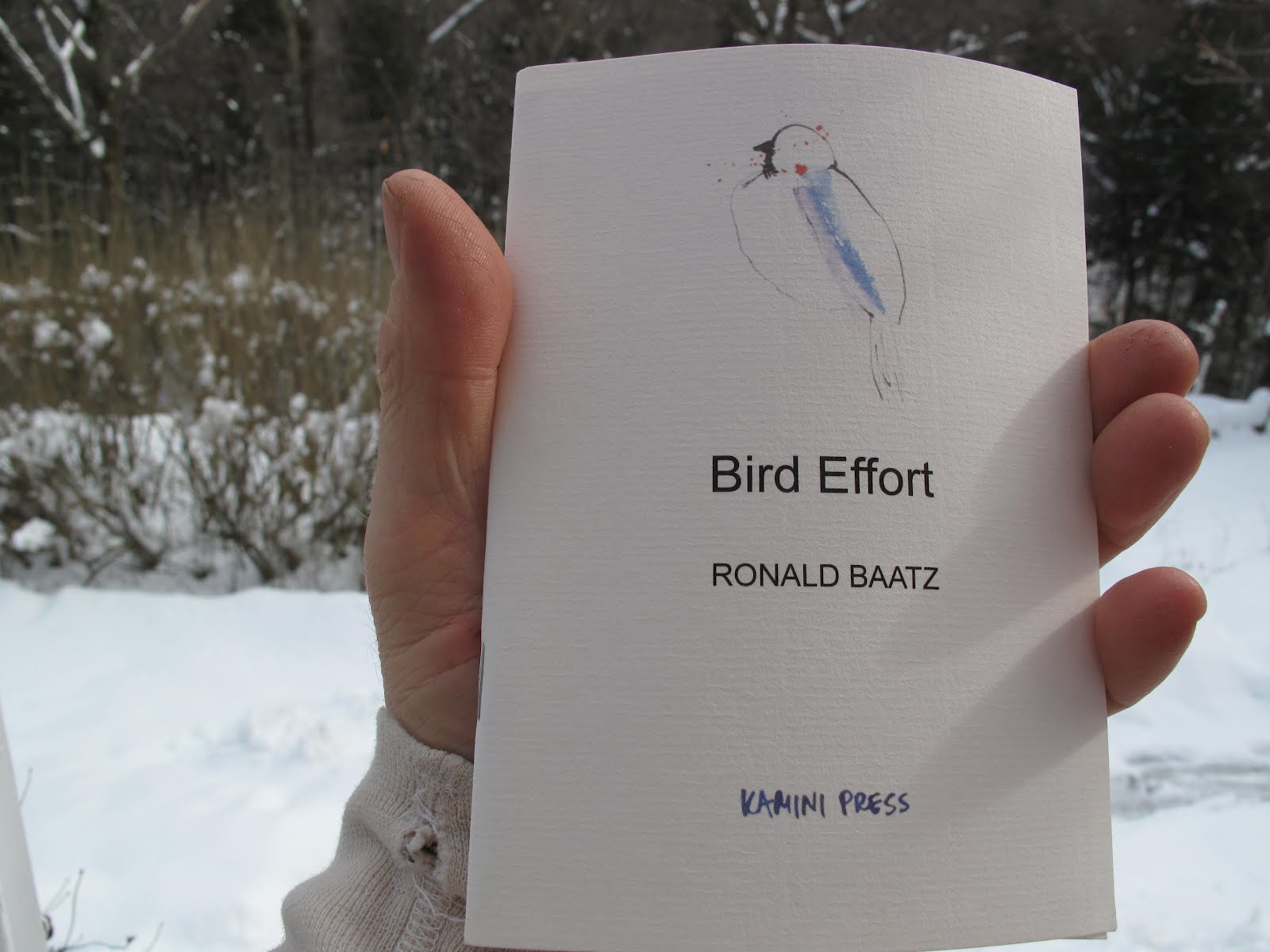
an effort
we love to face
each dawn


Leave me the bread
at least a few slices
leave me your voice
at least a few words
to go with the bread

Snow this morning
when I part the curtains
after getting out of bed
one rib
at a time


Finally
winter is losing its grip —
in my sleep
I hear the pond's spine
cracking

Receiver
hanging off the hook
in a phone booth
hanging off
the earth


Being an insomniac
has made me an expert
in psychological time
the sound of rain
old proverbs

I cry
we all cry
we all cry
because we all die
much like the summer fly


Orange peels —
the shadows of them
as I remember
the shadows of them
curling in childhood

I thought with age
I'd develop a hard shell —
instead I've grown feathers
that are soft and yellow and
prone to falling out


Hammered all night
by the rain —
in the morning
the bicycle is
a shiny stranger

Dogs chase pigs
pigs chase dogs —
the pussy willows
going nowhere
in ecstasy


The stars over the lake
so old and brittle looking —
I stop rowing, rest my back
and think of how soft
my ashes will be

The dog —
i wish i could be that happy
just being let in


Ronald Baatz lives and works
in New York, in the foothills of
the Catskills

Kamini Press
Sweden / Greece
www.kaminipress.com


Sunday, March 11, 2012

HERS ~


film © bob arnold


Saturday, March 10, 2012

FLOWER SHOW ~


We got out of mud roads, drove south, saw the snow line end 5 miles from home ~ in an hour we were within a day of 69 degrees, no snow, no mud, passersby in summer clothes, a rescued turtle, flowers in a greenhouse waiting


photos © bob arnold
"turtle"
© susan arnold


Friday, March 9, 2012

EARTH ~


Such a beautiful guy, Tom Morello, guitar~hero.

No better example than to hear him play with Bruce Springsteen "The Ghost of Tom Joad" (Morello first heard the song on Springsteen's album "Nebraska")
in stadium rock, over the heads of thousands, a political tour de force.


Springsteen is used to playing his own song, but he's never heard it like this, nor has his band, with a vituoso on guitar grinding it low & high like a bulldozer and violin. This is when Morello first put his electric guitar and singing together. And when he personally salutes Tom Joad in words, it's like the book falls open on The Grapes of Wrath.


Tom Morello is family with former President of Kenya Jomo Kenyatta, a Harvard graduate, graduate of Rage Against the Machine, and founder and axis of at least three bands and surmounting. He's one of a rare young breed who can be found playing in stadiums packed to the rafters, coffeehouses, garage setting, small studio, on the streets (Occupy). There's no stopping a lover of music & human rights.


BEAT HOTEL ~


cover photograph:
The poet Abas Amini, 33 year old refugee from Iran has sewn up his eyes, ears
and mouth, and is refusing to eat in protest at the UK's treatment of asylum seekers.
The Home Office refused Abas asylum.
Mr. Amini spent more than six years behind bars, including a year of solitary
confinement, between the ages of 13 and 31. When in jail, he was beaten, sometimes on the
soles of his feet, and suspended off the ground for up to two days. Sometimes he was
subjected to mock executions.
His offences including writing of anti-government poetry, which he would sometimes
read in public, or circulate among his friends, and membership of an underground
communist group.
He was imprisoned for two years for allegedly killing a member of the Iranian
security services, but later cleared by an Iranian judge.

~ from the publisher
photo: Pete Jenkins (28 V 2003)


LAST WORDS


Let me utter my last words
in a taxi cruising slowly through
the beautiful posies of neon signs.
Let someone else die in my room
on the turned mattress
so it doesn't show stains.
Let him savor the smell of it.
The smell of old lemons and let his last
moments be guillotined by badly
played guitars in other rooms.
In readiness I have a shirt with the black
ring scrubbed off the collar and a suit
which was shiny before I sandpapered it.
And now I must find my last words.


Oscar Wilde looked at the wallpaper
and said; "I knew I had to go first."
Goethe screamed, "Let there be light!"
Chekhov said, "How stupid it is for me to die."


What can I say to the taxi driver which is
memorable enough. I cannot think.
I am too overcome by the outrages
perpetrated against me.
Perhaps I should get the taxi driver to cruise
even more slowly so I can pick up
a whore and die in her room
with a beautiful zizzard of neon flashing
through the window.
Let her invent my last words
with all her experience.


please click on image to read


"Sinclair Beiles was born in Kampala Uganda in 1930, the only child of Jewish South African parents, who moved back to Johannesburg when their son was six years old. He studied at Wits and left the country in the mid-fifties. After time in New Zealand, Spain and Morocco, he moved to Paris, which was the center of international bohemia. He stayed in the notoriously anarchic Beat Hotel on 9 Rue Git-le-Coeur, a stone's throw from the river Seine, where at various times, Allen Ginsberg, William Burroughs, Brion Gysin, and Gregory Corso had also stayed. Here he worked as chief editor for Olympia Press, brain-child of maverick publisher Maurice Girodias, who not only gave us 'forbidden' erotic pockets but also seminal literary work by trhe likes of Samuel Beckett, Vladimir Nabokov and William Burroughs. Sinclair saw The Naked Lunch through the press, going through the galleys with Burroughs on their arrival from the printers, and later he would persuade Jean Fanchette of Two Cities Press to publish the first anthology of cut-ups containing the work of its four principal technicians: Sinclair Beiles, Burroughs, Gregory Corso, & Brion Gysin. The book was called 'Minutes To Go'. The cut-up was a method later adopted as a helpful adjunct to his song-writing by David Bowie, and Sinclair would also claim that it had spawned Edward de Bono's Lateral Thinking, following Sinclair having given the Professor a tour of the hotel, during which Sinclair had pointed out some trays of snipped-up newsprint awaiting assembly and had described to de Bono how thought processes might be changed and paradigms shifted, just by means of a pair of scissors and some transparent tape —
thanks to 'cut-up'."

www.gerardbellaart.com


a little peek into the invaluable Sinclair Beiles
The Idiot's Voice is limited to
36 copies


Thursday, March 8, 2012

BACK ROAD CHALKIE ~


Back Road Chalkie


Mud Season


Enough


photos © bob arnold


Wednesday, March 7, 2012

EARTH ~


cheetah cub

Cheetahs have developed abnormal coils in their sperm as a result of warmer temperatures, affecting the big cat’s ability to reproduce.
Photograph: Yuri Cortez/AFP/Getty Images


The world's fastest animal, the African cheetah, is losing its ability to reproduce because of climate change, according to Kenyan researchers.

Scientists with the National Museums of Kenya (NMK) and the Kenya Wildlife Service have discovered that the animal, Acinonyx jubatus, has developed abnormal coils in its sperm as a result of warmer temperatures, affecting the big cat's ability to reproduce. The warmer temperatures are also affecting its feeding habits, they say.

Risky Agwanda, head of mammology section at NMK, said: "Climate change has contributed to defects of the cheetah sperm. Many have abnormal coils, low sperm counts, as well as extremely low testosterone levels. Change in climate has made the survival of the gazelle difficult to survive and as a result, the cheetah has had to switch to other diets, also affecting its ability to reproduce effectively.".

He added that the animal, that can accelerate from 0-100kph in three seconds, has a sperm count 10 times lower than the domestic cat.

"Cheetahs love to prey on Thomson's gazelles, they have a very high protein content compared to other herbivores and the population of the gazelle has been on a rapid decline due to poor climate conditions and human activities.

"We have studied a large number of the cheetahs. As a result, it preys on other herbivores such as the zebra which do not have a high nutritional content. We discovered that the gazelle diet can actually help maintain the good health of the cheetah sperm if the animal has not yet been negatively affected by poor climate," explained Agwanda.

There are currently only 1,000 cheetahs in Kenya according to figures from the Kenya Wildlife Service. In the early 1980s, there were more than 5,000 cheetahs in Kenya.

As gazelle numbers continue to decrease due to drought, conservation efforts of the cheetah could be badly affected. The gazelles are also crossbreeding with other herbivores, reducing their protein content further, Agwanda said.

Scientists have never discovered any reproductive health deficiencies in other big cats, which they say can adapt more to climate change compared to the cheetah.

"The genetic make-up of the animal is more sensitive as compared to the other big cats. The cheetahs have weak genes," said Agwanda.

Mordecai Ogada, a fellow cheetah researcher at the National Museums, says that also another problem threatening the survival of the animal is conflict between humans and wildlife, resulting in damage to to the cheetha's habitat. Ogada added that cheetah numbers have also declined because of poaching for their skin, which fetches a high price on the black market.


Gitonga Njeru guardian.co.uk,
EARTH ~


TSERING WANGMO DHOMPA


Tsering from Longhouse:


please click on image


~ Books of poems by Tsering Wangmo Dhompa ~


My Rice Tastes Like the Lake
, Apogee Press, Berkeley 2011
In the Absent Everyday
, Apogee Press, Berkeley 2005
Rules of the House
, Apogee Press, Berkeley 2002
Recurring Gestures
, Tangram Press
In Writing the Names
, A.bacus, 2000


Tuesday, March 6, 2012

EARTH ~


It's time to look back at a photograph from last summer's garden ~

In Vermont, we won't see bare feet again for a month or two

It's 5 below this morning


photo © bob arnold