Thursday, August 13, 2015

Wednesday, August 12, 2015
LUMBERMAN ~

( 1910 )
LUMBERMAN
My father —
An old lumberman now
Tells me a little yarn about one
Of our descendants who were all
Sawmill owners and loggers and
How Grandfather Henry when he was
Cutting off Mt Greylock for his mill and
For the state of Massachusetts carving a
Road out to the mountain’s summit also
Worked over one landowner for most of
One night about a particular oak tree he
Wanted and left quite pleased from his
Visit with the man because he was given
Permission to cut the tree he had already
Earlier in the day cut down
__________________________
© Bob Arnold
it's one of those things

Tuesday, August 11, 2015
EDDIE CLARK, STONEMASON ~

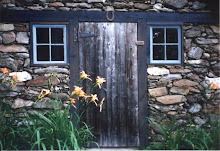
Native Vermonter Edward Clark passed away 2 August 2015 in Guilford, Vermont. His local obituary was filled with a deep personal family history — many kids, many grandkids, wife, long time residency in the town. What it didn't mention was Eddie was a stonemason, a very good one. I bicycled today to one of his many stonewalls to nab a detail photograph of the wall for the Birdhouse as I remember this fellow who I sometimes worked with on other job locations dealing with treework, laying in firewood, plus Eddie's expertise with a bulldozer shaping at least two large farm ponds I once tended to around those ponds for the owner with my scythe.

Eddie Clark
1938 - 2015
1938 - 2015
1938 - 2015
1938 - 2015
1938 - 2015
1938 - 2015
1938 - 2015
1938 - 2015
Monday, August 10, 2015

ZBIGNIEW HERBERT ~

Zbigniew Herbert
BEARS
Bears are divided into brown and white, also paws, head and
trunk. They have nice snouts, and small eyes. They like greedi-
ness very much. They don't want to go to school, but sleeping in
the forest — that, yes, very much. When they don't have any
honey, they clutch their heads in their hands and are so sad, so
sad, that I don't know. Children who love Winnie-the-Pooh
would give them anything, but a hunter walks in the forest and
aims with his rifle between that pair of small eyes.
CAT
He is all black, but has an electric tail. When he sleeps in the
sun he is the blackest thing one can imagine. Even in his sleep
he catches frightened mice. One can see this in the little claws
that are growing from his paws. He is terribly nice and naughty.
He picks birds off the trees before they are ripe.
COUNTRY
At the very corner of this old map is a country I long for. It is
the country of apples, hills, lazy rivers, sour wine, and love. Un-
fortunately a huge spider has spun its web over it, and with
sticky saliva has closed the toll gates of dreams.
It is always like that: an angel with a fiery sword, a spider,
and conscience.
THE WOLF AND THE SHEEP
— I've got you, said the wolf, and yawned. The sheep turned
its teary eyes toward him. — Do you have to eat me? It is really
necessary?
— Unfortunately I must. This is how it happens in all the
fables: Once upon a time a naughty sheep left its mother. In the
forest it met a bad wolf who. . .
— Excuse me, this is not a forest, but my owner's farm. I did
not leave my mother. I am an orphan. My mother was also eaten
by a wolf.
— It doesn't matter. After your death the authors of edifying
tales will look after you. They will add a background, motives,
and a oral. Don't hold it against me. You have no idea how silly
it is to be a bad wolf. Were it not for Aesop, we would sit on our
hind legs and gaze at the sunset. I like to do this very much.
Yes, yes dear children. The wolf ate the sheep, and then
licked his lips. Don't follow the wolf, dear children. Don't sac-
rifice yourselves for the moral.
FOREST
A path runs barefoot to the forest. Inside are many trees, a
cuckoo, Hansel and Gretel, and other small animals. But there
are no dwarfs, because they have left. When it gets dark and owl
closes the forest with a big key, for if a car sneaked in it would
really do a lot of harm.
WASP
When the honey, fruit and flowery tablecloth were whisked
from the table in one sweep, it flew off with a start. Entangled in
the suffocating smoke of the curtains, it buzzed for a long time.
At last it reached the window. It beat its weakening body repeat-
edly against the cold, solid air of the pane. In the last flutter of its
wings drowsed the faith that the body's unrest can awaken a
wind carrying us to longed-for worlds.
You who stood under the window of your beloved, who saw
your happiness in a shop window — do you know how to take
away the sting of this death?
THE POET'S HOUSE
Once there was breath on these window panes, the fragrance
of a roast, the same face in the mirror. Now it is a museum. The
flora of the floors has been exterminated, the chests emptied,
rooms flooded with wax. For entire days and nights they kept
the windows open. Mice avoid this infected house.
The bed is neatly made. But no one wants to spend even a
single night here.
Between his wardrobe, his bed and his table — the white
frontier of absence, precise as the cast of a hand.
_________________
Zbigniew Herbert
Elegy for the Departure
translated from the Polish by
John and Bogdana Carpenter
Ecco Press 1999
Sunday, August 9, 2015
Saturday, August 8, 2015

Friday, August 7, 2015
RAYMOND CARVER ~

Tess Gallagher with Raymond Carver
Soda Crackers
You soda crackers! I remember
when I arrived here in the rain,
whipped out and alone.
How we shared the aloneness
and quiet of this house.
And the doubt that held me
from fingers to toes
as I took you out
of your cellophane wrapping
and ate you, meditatively,
at the kitchen table
that first night with cheese,
and mushroom soup. Now,
a month later to the day,
an important part of us
is still here. I'm fine.
And you — I'm proud of you, too.
You're even getting remarked
on in print! Every soda cracker
should be so lucky.
We've done all right for
ourselves. Listen to me.
I never thought
I could go on like this
about soda crackers.
But I tell you
the clear sunshiny
days are here, at last.
_______________________
Raymond Carver
from ~ Jane Hirshfield's
Ten Windows:
How Great Poems Transform
the World (Knopf 2015)
Thursday, August 6, 2015
Wednesday, August 5, 2015
THE SORT OF WORLD I LIKE ~

The Sort of World I like
I’m on the roof today cleaning the chimney —
Without a sound a bicyclist floats by on the
Dirt road along the river and spots me and
Shouts, “Your house looks great!”
I’ve never seen her before
I look twice to make sure I haven’t
Nope
Don’t know her
But she’s happy
______________________
© photograph Susan Arnold

Tuesday, August 4, 2015

Monday, August 3, 2015
ABDELWAHAB MEDDEB ~

Abdelwahab Meddeb
Tombeau of Ibn Arabi
XXXII
She has an arched back, she walks on shadows, which
dance, idle, she de-louses herself, recluse in the fog,
she watches a gaggle of migrating birds pass, on the
river's bank, on the side of the mountains, there is a
destroyed village, surrounded by grottos, rooms for
the dijinn, my body is a protruding stone, I visit fever,
on the day of rest, she has left, without my knowing,
I see a bed in the lake, in which her face is mirrored,
I sink into her image, in search of her people, scat-
tered to the winds, my body is cut, from the downstream
upstream, I let myself be guided, by the jujube tree
at the end, I met some idols, at the break in the
wormwood, where I embalm my diseases, the saints
walk on their wounds, pain is a hole, it blackens my
reflections, I suffocate, I find her again, in the reality,
of her embroidered lace, I open her blouse, I drink
from her navel, I enter her absence, I bear allegiance to
her, I sign her wrist, with a metal of nocturnal glim-
mers, it burns flowers, save the narcissus and the
tulip, she offers me a cowl, it has the emblem of the
scorpion, the rough wood electrifies my body, dense
in the night, crumbly like coal, her hair is a hive,
which hums around a captive queen, Arab and white,
she speaks frankly, with a Latin flavor, she hides her
body, and uncovers it, she lets down her hair, and
gathers it up, the things of the day take shape, in the
unfinished clay, with sculptor's hands, I touch the
black stone, the mark opens, like a window, the night
sparkles, the moon is a plate, which I break, and
bury, under the circle of fire.
_________________________
Abdelwahab Meddeb
Tombeau of Ibn Arabi
and
White Traverses
translated by Charlotte Mandell
Fordham University Press 2010
http://translate.google.com/translate?hl=en&sl=fr&u=http://www.lemonde.fr/disparitions/article/2014/11/06/mort-de-l-essayiste-et-romancier-abdelwahab-meddeb-1946-2014_4519799_3382.html&prev=search
Sunday, August 2, 2015
JOHN PHILLIPS ~ HOLD EVERYTHING DEAR" ~

HOLD EVERYTHING DEAR
by John Phillips
Three letters to the publisher of Kent Johnson’s I ONCE MET (Longhouse)
1st Letter
18th June, 2015
Dear Bob,
Which goes for the cover: A fine twentieth century Chinese painting of a man fishing in a
river, encouraged, almost, by the presence of a tree, as if protecting his back. The immediate
response has to be one of dialogue: a dialogue with all poets, from all times, back all the way
to ancient Tu Fu and Li Po. It is a discreet nod to the tranquility and transcendence those
great Chinese poets brought gloriously into the world, silently enfolding the contents of the
book into the care of centuries of poetic conversation. Add that to what you say is Kent
Johnson’s interest in fishing, and yes, his infamous involvement with the so-called Yasusada
Affair, and everything fits. Even the Yasusada Affair itself could be seen as yet another
example of this continued dialogue, these encounters with poets, real or imagined. As could
his stunning translations (along with Forrest Gander) of the great Bolivian poet, Jaime Saenz.
(How did Cid Corman put it? ‘Poetry becomes / that conversation we could / not otherwise
have.’) This book confirms and continues the conversation of what it means to make poetry
– to write and to be read, to respond to what is written and to the writers who create it. Some,
naturally, seem to be fine people, good company, thoughtful and considerate; others, perhaps,
leave something more to be desired. And more, the words in the book sing beautifully to the
spirit of Chinese poetry – with its many instances of poets meeting other poets for a cup of
wine and a deep night’s conversation, gazing up at the moon, discussing absence and
presence: the quarrel and the company, the agony and joys of parting and meeting. Often enough, as with this book, with wars and conflict as the interminable background.
As for the writing, I do not think I have read a more charming, intelligent and entertaining
book. Or not since the one Johnson wrote a couple of years ago around and about Frank
O'Hara that Richard Owens published, A Question Mark Above the Sun. Richard did a
beautiful job of making that book. Equally, to my eyes, your production of I ONCE MET is
as faultless. Kent Johnson – at least in the incarnation which he presents as himself in these
pages – comes across as such an honest and open character (even if he does tend to court and
simultaneously shy away from controversy,) whether he’s confessing, after a long train
journey home with Vanessa Place from a conference on Conceptual Poetry at Princeton, to
being surprised – since they hold such differing views on poetry – in finding he likes her as
an individual ‘quite a good bit’, even though he remained ‘ no less skeptical at all’ about
Conceptual Poetry; or, insisting on ‘reciting rhyming, satirical doggerel that poked fun at the
leading lights of the post-avant’ in the supposed bastion of conceptual and experimental fare
which is Buffalo. Equally, when he is in Cambridge, England, saying, somewhat the worse
for wear with drink, to the Austrian poet Franz Josef Czernin: ‘I would in ecstasy wash your
feet in my hair’, only to be told by Tony Fraser that the High German Franz says in response
means, “he really likes you, but that he’s glad you aren’t doing the driving.” Perhaps one of
the shortest poems reveals much of how the others work: ‘I’ve never met the famed poet Ron
Padgett, but I almost did. I raised my fist before his door and paused. There were cicadas
screaming to death in the rich summer trees. Why ruin it, I said, and walked away.’
Only just having finished the book, I feel like jumping right back into it. I don't see how it won't become a classic, much in the way of Joe Brainard's I Remember. Yet it is absolutely itself. A book which should be in the hands of anyone interested in poetry. However, it is not to be mistaken as simply writing about poets and poetry, rather it is poetry. Powerful, moving and, at times, hilarious poetry. Often saying beautiful things: The two poems to his sons, for instance. Of his youngest son, Aaron, he writes: ‘And the more worthy man than I that he is destined to become is as certain as the mountains he so loves are perilous and real.’ When I returned home, I immediately read them to Jasna in the garden over Turkish coffee. Both poems took her breath away. Susan and you deserve the highest praise for bringing out such a wonderful and important book in such a fine fashion.
Please, do pass on my thoughts to Kent. I'd like him to know there's someone over in Cornwall who now has a smile on his face that he put there. It might well be a permanent smile.
Only just having finished the book, I feel like jumping right back into it. I don't see how it won't become a classic, much in the way of Joe Brainard's I Remember. Yet it is absolutely itself. A book which should be in the hands of anyone interested in poetry. However, it is not to be mistaken as simply writing about poets and poetry, rather it is poetry. Powerful, moving and, at times, hilarious poetry. Often saying beautiful things: The two poems to his sons, for instance. Of his youngest son, Aaron, he writes: ‘And the more worthy man than I that he is destined to become is as certain as the mountains he so loves are perilous and real.’ When I returned home, I immediately read them to Jasna in the garden over Turkish coffee. Both poems took her breath away. Susan and you deserve the highest praise for bringing out such a wonderful and important book in such a fine fashion.
Please, do pass on my thoughts to Kent. I'd like him to know there's someone over in Cornwall who now has a smile on his face that he put there. It might well be a permanent smile.
Love, John
~
2nd Letter
Dear Bob,
~
2nd Letter
21st June, 2015
Dear Bob,
I checked online and found a very positive review on Jacket by Cralan Kelder of the original
limited edition Longhouse publication of I ONCE MET from 2007. Appended to the end of
that review is a note by Clayton Eshleman, defending himself against the comments that Kent
Johnson made about meeting him when he was a young poet, putting his own interpretation
of their meeting. (Funnily enough, anyone reading the entry on Eshleman would not think it
warranted any such response or self-defense. Proving, perhaps, one of the impressions the
reader gains of poets: that they are a remarkably sensitive bunch!) What I don't quite
understand is how anybody who is mentioned in the book could take what is written there as
if it were actually written about them. Or why such narcissism? I see each encounter as poem:
I have no interest whatsoever if it is true or not, nor even if Kent Johnson ever met these
particular people. They are playing the characters of poets or writers in a poem, whether they
exist or not, whether what happens in the poem happened or not. Of course, they all do exist,
from what I can tell: painted quite wonderfully and clearly, usually with a few precise
brushstrokes. But I – as reader – never once considered that everything said was the actual
truth (whatever that vast and unyielding animal is). What I was reading were poems! As
poems, they can do and say what they like. Or where's the freedom? How does he put it in the
Author’s Comment at the start of the book? ‘I have tried my best to be true to the experiences
represented here. In a few instances, where my memory flagged, or where poetic license
seemed to proffer – in spirit of Picasso’s famous maxim about art, lies and truth – a
deepening of the genuine, I have, in the venerable traditions of that non-existing genre called
“non-fiction”, not-so-secretly embellished.” I love that phrase ‘a deepening of the genuine’ –
masterful; as is how he ends the paragraph, after saying that anyone can amend or deny
anything written in the book as they see fit, with the declarative: “I stand by every word.”
What could be clearer? So who could take the book as anything other than containing that truth which is the poetic imagination? The words sing because they are song and they are
song because they tell simple facts about all meetings and all partings, not simply those that
pass as having taken place with whoever’s name is uttered within each section. Strangely,
perhaps, I am reminded of Leonard Cohen’s response when he was awarded the Governor
General's Award, I believe for his Selected Poems: 'Much in me strives for this honour but
the poems themselves forbid it absolutely.' The poems in this book refuse absolutely to be
nailed down to any trivial day-to-day truth telling – they are speaking of far more permanent
things: the grace and gravity and beauty of any meeting happening, of there even being
meetings to happen and people to meet, of there being anything at all instead of nothing.
Change the names, make up the poets: the poems would be as true. Create legends. Create
myths. Poems tell the truth beyond what historians consider it to be. Otherwise these poems
would be mere gossip. There is an act, however small, of myth making taking place within
these pages.
Of course, Kent Johnson has been in this territory before; indeed, he should be proud of the memory of the Yasusada Affair which is several times mentioned within its pages. He should be proud of having a part – however small he claims it to be – in the creation of such a myth. How many do that? In fifty years most of the poets in the book will be dead and their work, currently judged valuable or not, will be long forgotten. Will it make the book any less song or less true? No. Not at all. The book – the very stillness at its heart – is pure. There is no stain upon it. Let those who wish to see it in such a light walk away declaring themselves half-blind. It is a wonderful creation and – this might seem crazy, I know – I do not see it having much at all to do with anybody mentioned in it! They are not important enough – in the history of poetry – to become these poems. Not until they themselves have become myths – as has your own Emily Dickinson. Do you think she is upset over being mentioned in the book? No, she is happy as a jaybird, doing a little jig for celebration in her grave. Would she be upset if she happened to be alive and living in Amherst today? Unlikely. I imagine she wouldn’t have the vanity to consider that she is the Emily Dickinson mentioned in these pages, even if Kent and her did hang out by a swimming pool (Dickinson wearing a bikini and sunglasses!), sipping mojitos, ‘casually sharing...the fathomless mysteries of her impossible mind.’
Of course, Kent Johnson has been in this territory before; indeed, he should be proud of the memory of the Yasusada Affair which is several times mentioned within its pages. He should be proud of having a part – however small he claims it to be – in the creation of such a myth. How many do that? In fifty years most of the poets in the book will be dead and their work, currently judged valuable or not, will be long forgotten. Will it make the book any less song or less true? No. Not at all. The book – the very stillness at its heart – is pure. There is no stain upon it. Let those who wish to see it in such a light walk away declaring themselves half-blind. It is a wonderful creation and – this might seem crazy, I know – I do not see it having much at all to do with anybody mentioned in it! They are not important enough – in the history of poetry – to become these poems. Not until they themselves have become myths – as has your own Emily Dickinson. Do you think she is upset over being mentioned in the book? No, she is happy as a jaybird, doing a little jig for celebration in her grave. Would she be upset if she happened to be alive and living in Amherst today? Unlikely. I imagine she wouldn’t have the vanity to consider that she is the Emily Dickinson mentioned in these pages, even if Kent and her did hang out by a swimming pool (Dickinson wearing a bikini and sunglasses!), sipping mojitos, ‘casually sharing...the fathomless mysteries of her impossible mind.’
The thought just came to me that maybe it wasn’t Eshleman’s response that Cralan Kelder
noted at the bottom of his review, but something Cralan made up for the fun of it. Now, that
would be grand. Enough. What I have said is what I have said. It is my truth for this moment in time. It won't
change, either, not as far as my response to Kent Johnson’s book is concerned. But if
someone wrote down a version of what I have said here in a poem (however unlikely and
foolish an act that would be!), subsequently publishing it in their own book and on reading it
sometime later I took offence because it was different to what I remembered happening or
saying, then wouldn't I be the fool? Especially if the work they happened to make was both
beautiful and true.
Love, John
~
3rd Letter
Dear Bob,
~
3rd Letter
28th June, 2015
Dear Bob,
I have one ear on an old radio interview with John Berger, mostly about his book HOLD
EVERYTHING DEAR. The conversation is typical Berger: intense, emotional, each word
weighed before it is spoken, almost as if an oracle is in the process of speaking. It is a voice I
have always enjoyed, but a voice very different to Kent Johnson’s, whose I ONCE MET I
have just finished reading through for the second time. Actually, I enjoyed the book even
more this time round. On first look Kent Johnson and John Berger might appear to have little
in common, but I am not so sure: Both are passionately engaged with the world as they find it,
both are declared socialists, both have lived abroad for portions of their lives, both translate
from foreign languages, both seem to possess a wonderful sense of the company of writers
(living and dead), and both are very much outsiders to any declared literary scene.
Now, I’m not at all sure this is a path worth going too far down, but listening to John Berger, having just read Kent Johnson, seems, in a sense, a continuation; a continuation, at least, of sense making. Both writers actively relish the world and the activity of being in the world. Perhaps the major difference, obvious to any, would be Johnson’s finely tuned sense of comedy and self-deprecation. After all, I ONCE MET is an intensely funny book, not that the humour refuses the tragic, or excludes mention of many of the concerns both writers share: the horrors of war, their belief in socialism, the disease of imperialism. Worth noting here the places Kent Johnson visits in I ONCE MET – among others: Bosnia-Herzegovina, Leningrad, Nicaragua: all places that have held/hold John Berger’s interest. Much as I admire and respect John Berger’s work, Kent Johnson comes across as a much different writer, one who relishes celebrating his own failures and frailties, one who comes over as exemplifying the Dharmic beliefs of the illusionary nature and the impermanence of the self, and who does so – ironically enough – in a book of his own meetings with a vast array of poets from across the world. Is there another writer who could have composed such a comedy of manners? A book that indeed holds everything – and therefore every meeting – to be dear, in the same moment as it recognizes nothing and no-one is there to be held dear, or not for long.
Now, I’m not at all sure this is a path worth going too far down, but listening to John Berger, having just read Kent Johnson, seems, in a sense, a continuation; a continuation, at least, of sense making. Both writers actively relish the world and the activity of being in the world. Perhaps the major difference, obvious to any, would be Johnson’s finely tuned sense of comedy and self-deprecation. After all, I ONCE MET is an intensely funny book, not that the humour refuses the tragic, or excludes mention of many of the concerns both writers share: the horrors of war, their belief in socialism, the disease of imperialism. Worth noting here the places Kent Johnson visits in I ONCE MET – among others: Bosnia-Herzegovina, Leningrad, Nicaragua: all places that have held/hold John Berger’s interest. Much as I admire and respect John Berger’s work, Kent Johnson comes across as a much different writer, one who relishes celebrating his own failures and frailties, one who comes over as exemplifying the Dharmic beliefs of the illusionary nature and the impermanence of the self, and who does so – ironically enough – in a book of his own meetings with a vast array of poets from across the world. Is there another writer who could have composed such a comedy of manners? A book that indeed holds everything – and therefore every meeting – to be dear, in the same moment as it recognizes nothing and no-one is there to be held dear, or not for long.
Love, John
John Phillips is a fine poet and teacher native to the Cornwall district of the U.K.
He has many publications from Longhouse and elsewhere. Look him up!
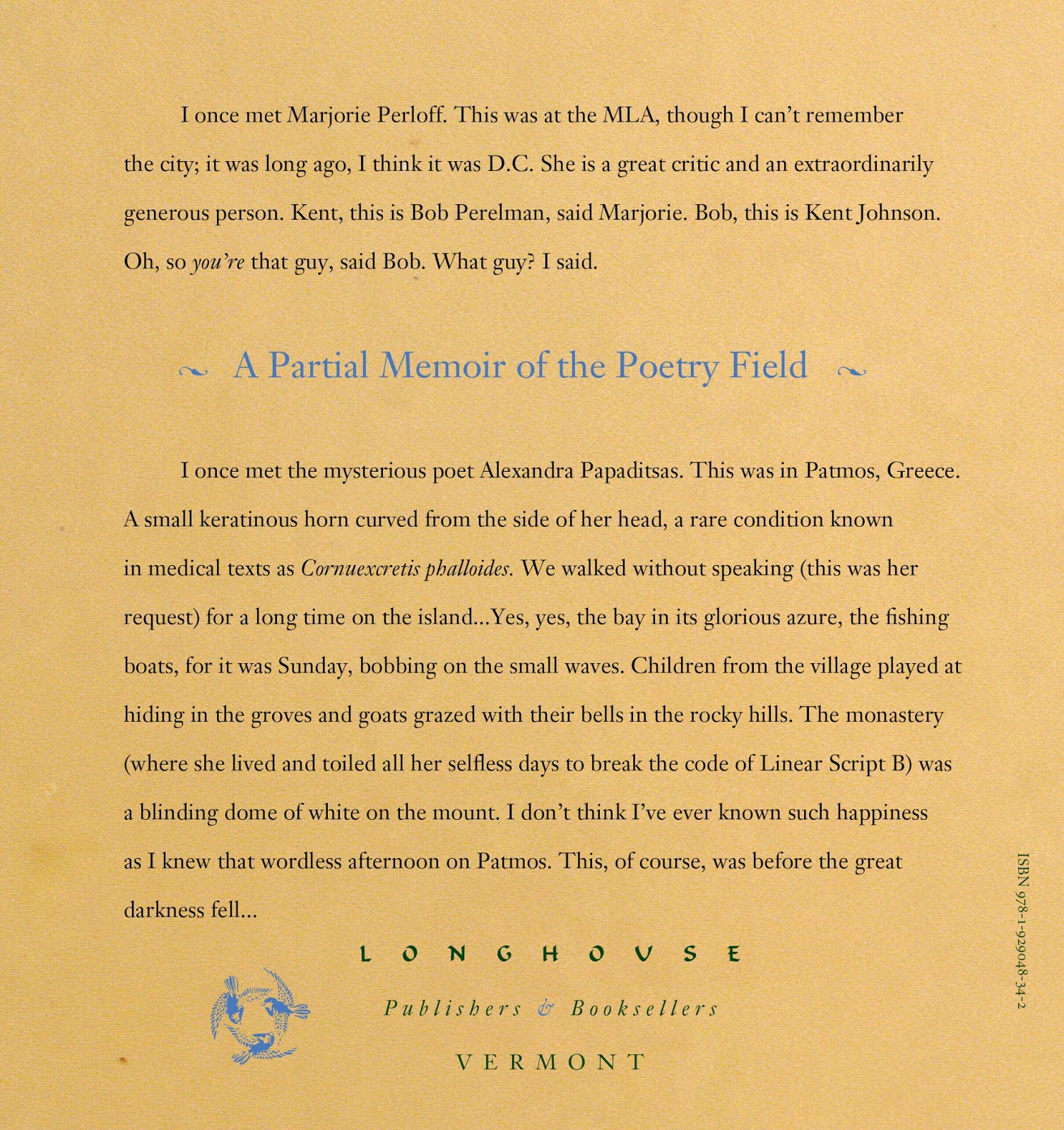
KENT JOHNSON
I Once Met
A Partial Memoir of the Poetry Field
New and available now from Longhouse ~
Prose
176 pages
Perfect bound softcover
Illustrated
____________________________________
176 pages
Perfect bound softcover
Illustrated
____________________________________
$35
Shipping $5 ~ U.S. orders with Paypal
Shipping $5 ~ U.S. orders with Paypal
please use our email address of
longhousepoetry@gmail.com
all orders may be made by Paypal or check
mail order here:
LONGHOUSE
PO Box 2454
West Brattleboro, Vermont 05303
LONGHOUSE
PO Box 2454
West Brattleboro, Vermont 05303
Saturday, August 1, 2015
FREDERICK SEIDEL ~

The attitude of green to blue is love.
And so the day just floats itself away.
The stench of green, the drench of green, above
The ripples of sweet swimming in a bay
Of just-mowed green, intoxicates the house.
The meadow goddess squeaking like a mouse
Is stoned, inhales the grass, adores the sky.
The nostrils feed the gods until the eye
Can almost see the perfume pour the blue.
A Botticelli ladled from a well,
Your life is anything you want it to —
And loves you more than it can show or tell.
_________________
Frederick Seidel
Going Fast
Farrar, 1998
Friday, July 31, 2015
LESSON ~
L E S S O N
You’ve lived
long enough
to see official
human beings
shoot civilians
on the nightly
news
this means it’s
permitted
this means
yr dead
______________
© Bob Arnold
for
Sandra Bland
Tamir Rice
Renisha McBride
Natasha McKenna
Tanisha Anderson
Rekia Boyd
Subscribe to:
Posts (Atom)