Monday, February 4, 2013

Sterling Allen Brown ~
(1901-1989)


Mose


Mose is black and evil
And damns his luck
Driving Mister Schwartz's
Big coal truck.

He's got no gal,
He's got no jack,
No fancy silk shirts
For his back.

But summer evenings,
Hard luck Mose
Goes in for all
The fun he knows.

On the corner kerb
With a sad quartette
His tenor peals
Like a clarinet.

O hit it Moses
Sing att thing
But Mose's mind
Goes wandering; —

And to the stars
Over the town
Floats, from a good man
Way, way down —

A soft song, filled
With a misery
Older than Mose
Will ever be.


Crossing


This is not Jordan River
There lies not Canaan
There is still
One more wide river to cross.

This is the Mississippi
And the stars tell us only
That this is not the road.

We do not know
If any have reached that Canaan
We have received no word.

Behind us the belling pack
Beyond them the hunters
Before us the dismal swamp

We do not know. . .

We have exchanged Louisiana for Mississippi
Merely
Georgia for Florida
Carolina for Tennessee.

We have passed, repassed
So many rivers
Okmulgee, Chattahoochee,
St Mary's, Mississippi,
Alabama, Tennessee,
Mississippi.

We have leapt
From swamp land
Into marshes
We have won through
To blooded clay
To gravel and rock
To the baked lands
To the scorched barrens.

And we grow footsore
And muscle weary
Our faces grow sullen
And our hearts numb

We do not know. . .

We know only
That there lies not Canaan
That this is no River Jordan.

Still are we motherless children
Still are we dragging travelers
Alone, and a long ways from home.

Still with the hard earth for our folding bed
Still with our head pillowed upon a rock

And still
With one more river,
Oh, one wide river to cross.


Sharecroppers


When they rode up at first dark and called his name,
He came out like a man from his little shack.
He saw his landlord, and he saw the sheriff,
And some well-armed riff-raff in the pack.
When they fired questions about the meeting,
He stood like a man gone deaf and dumb,
But when the leaders left their saddles,
He knew then that his time had come.
In the light of the lanterns the long cuts fell,
And his wife's weak moans and the children's wails
Mixed with the sobs he could not hold
But he wouldn't tell, he would not tell.
The Union was his friend, and he was Union,
And there was nothing a man could say.
So they trussed him up with stout ploughlines,
Hitched up a mule, dragged him far away
Into the dark woods that tell no tales,
Where he kept his secrets as well as they.

He would not give away the place,
Nor who they were, neither white nor black,
Nor tell what his brothers were about.
They lashed him, and they clubbed his head;
One time he parted his bloody lips
Out of great pain and greater pride,
One time, to laugh in his landlord's face;
Then his landlord shot him in the side.
He toppled, and the blood gushed out.
But he didn't mumble ever a word,
And cursing, they left him there for dead.
He lay waiting quiet, until he heard
The growls and the mutters dwindle away;
"Didn't tell a single thing," he said,
Then to the dark woods and the moon
He gave up one secret before he died:
"We gonna clean out dis brushwood round here soon,
Plant de white-oak and de black-oak side by side."


Foreclosure


Father Missouri takes his own.
These are the fields he loaned them,
Out of heart's failure, gratuitously;
Here are the banks he built up for his children,
Here are the fields, rich fertile silt.

Father Missouri, in his dotage
Whimsical and  drunkenly turbulent,
Cuts away the banks, steals away the loam,
Washes the ground from under wire fences,
Leaves fenceposts grotesquely dangling in the air;
And with doddering steps approaches the shanties. 

Father Missouri, far too old to be so evil.

Uncle Dan, seeing his gardens lopped away,
Seeing his manured earth topple slowly in the stream,
Seeing his cows knee deep in yellow water,
His pigsties flooded, his flowerbeds drowned,
Seeing his prize leghorns swept down the stream,
Curses Father Missouri, impotently shakes
His fist at the forecloser, the treacherous skinflint;
Who takes what was loaned so very long ago,
And leaves puddles in his parlor, and useless lakes
In his fine pasture land.
See years of laboring turned into nothing.
Curses and shouts in his hoarse old voice
"Ain't got no right to act dat way at all!
No right at all!"
And the old river rolls on. sleepily to the gulf.   


Harlem Street Walkers


Why do they walk so tragical
Oh, never mind, when they are in
The grateful grave, each whitened skull
Will grin. . . .                   


_______________________________________

from The Collected Poems of Sterling A. Brown
edited by Michael Harper
(Triquarterly Books, 1980)


photo : roy lewis 


Sunday, February 3, 2013

SUPER BO(WL) ~


Bo Diddley


Here we have one of the biggest day's of the year (for some) — quite American, quite over the top — so we may as well have the soundtrack of a super American for the day. Like the Sleepy LaBeef song from the day before "Boogie at the Wayside Lounge", it's all poetry with Bo Diddley.


The Story of Bo Diddley

______________________


I was born one night about twelve o'clock
(Ha-ha-ha)
I come in this world playin' a gold guitar
My father was around stickin' out his chest
(Hee-hee)
A-now, mama this boy he gon fee' you a mess
(Ha-ha-ha-ha-ha)
Yeah! Yea-ha, Ooh, uh-huh

Now, people came from miles around
Yeah, just to hear my little guitar sound
Now, some of 'em said I had what it takes
If I keep on practice I'd be famous one day
(Ha-ha)
Woo, I'm a mess!
I'm a killer-diller
Uh-huh, yea-hey, a-uh, uh-huh

Early in the middle of the night
A car drove up with four headlights
(Ha-ha-ha-ha-ha)
Now, a man stepped out wit' a long cigar
He said, 'Sign this line and I can make you a star'
(Ha-ha-ha-ha-ha)
I said, 'Now, what's in it man, what's in it for me?'
He says, 'I'd, play yo' guitar son and wait an see'
Here I am! (heh-heh-heh, heeee)
The girls liked me, they say, 'It's crazy, it sound nice
Uuh-uuh

My first engagement was in Chicago
I'm playin' with my band and they're playin' tonight
I played fo' some people I'd never seen before
I'm playin for the fans, what the fans all like
It was good too (ha-ha-ha-ha)

Who wants our band
But like the parents can't handle it
They like it
What the fans, what the fans all like
Sound nice
If my fans can't handle it
(Ha-ha-ha-ha-ha-ha)
Now, we're playin' and we're singin' our song
Yeah, ah-ha-ha-ha
Ev'rything is goin' our way
What the fans, what the fans all like
Yeah, man
What the fans, what the fans all like FADES-
I'm killer-diller
What the fans, what the fans all like
I'm 'on killa diller.


SIMON PETTET ~


There is a cruel, messianic, dim, tribal intransigence


That gains you nothing


There's a bull-headed childish baby-tantrum


That can unleash untold consequences


I am appalled by the darkening of the sky


I watch my love


It is always my love I watch


The first time that we stayed
In the city we stayed indoors
But I looked out a lot
On an empty lot (and)
Was quiet and kept to myself


We first moved in the dead of winter
I was like an animal
Needing some place warm
(which of course I never got)


But I do recall golden shafts of light
Upon me
One particular winter's afternoon


the robin and the butterfly


and the leaf and the flame


and the extinction


It is when the extreme point of restlessness


is reached


that grace comes


at a terrific speed


BEAU REGARD


Her skinny body is white as a harvest moon,
Clear as a crystal goblet, radiating light
She has one face, two hands with slender fingers,
bright eyes, she looks at me,
she's not afraid to look at me
nor I to look back


SHE


She
is the very picture of fortitude
and on her head wears one of several
floppy hats,
drapes her form in glorious scarlet
and is at ease,
when bending down and calmly placing
either one of both her hands
upon the stormy animal's mouth


__________________________________

Simon Pettet
from More Winnowed Fragments
(Talisman House, 2005)


photo : john sarsgard


GET ON THE BUS? ~


Diary

Rebecca Solnit


The buses roll up to San Francisco’s bus stops in the morning and evening, but they are unmarked, or nearly so, and not for the public. They have no signs or have discreet acronyms on the front windshield, and because they also have no rear doors they ingest and disgorge their passengers slowly, while the brightly lit funky orange public buses wait behind them. The luxury coach passengers ride for free and many take out their laptops and begin their work day on board; there is of course wifi. Most of them are gleaming white, with dark-tinted windows, like limousines, and some days I think of them as the spaceships on which our alien overlords have landed to rule over us.

Other days I think of them as the company buses by which the coal miners get deposited at the minehead, and the work schedule involved would make a pit owner feel at home. Silicon Valley has long been famous for its endless work hours, for sucking in the young for decades of sixty or seventy-hour weeks, and the much celebrated perks on many jobsites – nap rooms, chefs, gyms, laundry – are meant to make spending most of your life at work less hideous. The biotech industry is following the same game plan. There are hundreds of luxury buses serving mega-corporations down the peninsula, but we refer to them in the singular, as the Google Bus, and we – by which I mean people I know, people who’ve lived here a while, and mostly people who don’t work in the industry – talk about them a lot. Parisians probably talked about the Prussian army a lot too, in the day.

My brother says that the first time he saw one unload its riders he thought they were German tourists – neatly dressed, uncool, a little out of place, blinking in the light as they emerged from their pod. The tech workers, many of them new to the region, are mostly white or Asian male nerds in their twenties and thirties; you often hear that to be over fifty in that world is to be a fossil, and the two founders of Google (currently tied for 13th richest person on earth) are not yet forty.

Another friend of mine told me a story about the Apple bus from when he worked for Apple Inc. Once a driver went rogue, dropping off the majority of his passengers as intended at the main Apple campus, and then rolling on towards San Jose instead of stopping at the satellite location, but the passengers were tech people, so withdrawn from direct, abrupt, interventionary communications that they just sat there as he drove many miles past their worksite and eventually dumped them on the street in a slum south of the new power centre of the world. At that point, I think, they called headquarters: another, more obedient bus driver was dispatched. I told the story to another friend and we joked about whether they then texted headquarters to get the email addresses of the people sitting next to them: this is a culture that has created many new ways for us to contact one another and atrophied most of the old ones, notably speaking to the people around you. All these youngish people are on the Google Bus because they want to live in San Francisco, city of promenading and mingling, but they seem as likely to rub these things out as to participate in them.

The Google Bus means so many things. It means that the minions of the non-petroleum company most bent on world domination can live in San Francisco but work in Silicon Valley without going through a hair-raising commute by car – I overheard someone note recently that the buses shortened her daily commute to 3.5 hours from 4.5. It means that unlike gigantic employers in other times and places, the corporations of Silicon Valley aren’t much interested in improving public transport, and in fact the many corporations providing private transport are undermining the financial basis for the commuter train. It means that San Francisco, capital of the west from the Gold Rush to some point in the 20th century when Los Angeles overshadowed it, is now a bedroom community for the tech capital of the world at the other end of the peninsula.

There are advantages to being an edge, as California long was, but Silicon Valley has made us the centre. Five of the six most-visited websites in the world are here, in ranked order: Facebook, Google, YouTube (which Google owns), Yahoo! and Wikipedia. (Number five is a Chinese-language site.) If corporations founded by Stanford alumni were to form an independent nation, it would be the tenth largest economy in the world, with an annual revenue of $2.7 trillion, as some professors at that university recently calculated. Another new report says: ‘If the internet was a country, its gross domestic product would eclipse all others but four within four years.’

That country has a capital that doesn’t look like a capital. It looks like beautiful oak-studded hills and flatlands overrun by sprawl: suburban homes (the megamansions are more secluded) and malls and freeways often jammed with traffic and dotted with clunky campuses, as corporate headquarters of tech firms are always called. Fifty years ago, this was the ‘valley of heart’s delight’, one of the biggest orchard-growing regions in the world. It wasn’t to everyone’s delight: Cesar Chavez and the United Farmworkers movement started in San Jose, because the people who actually picked all those plums and apricots worked long hours for abysmal wages, but the sight and smell of the 125,000 acres of orchard in bloom was supposed to be spectacular.

Where orchards grew Apple stands. The work hours are still extreme but now the wages are colossal – you hear tech workers complaining about not having time to spend their money. They eat out often, though, because their work schedules don’t include a lot of time for shopping and cooking, and San Francisco’s restaurants are booming. Cafés, which proliferated in the 1980s as places to mingle and idle, are now workstations for freelancers, and many of the sleeker locales are routinely populated by silent ranks staring at their Apple-product screens, as though an office had suddenly been stripped of its cubicles. The more than 1700 tech firms in San Francisco officially employ 44,000 people, and a lot more are independent contractors doing piecework: not everyone rides the bus down south. Young people routinely make six-figure salaries, not necessarily beginning with a 1, and they have enormous clout in the housing market (the drivers of the Google Bus, on the other hand, make between $17 and $30 an hour).

I weathered the dot-com boom of the late 1990s as an observer, but I sold my apartment to a Google engineer last year and ventured out into both the rental market (for the short term) and home buying market (for the long term) with confidence that my long standing in this city and respectable finances would open a path. That confidence got crushed fast. It turned out that the competition for any apartment in San Francisco was so intense that you had to respond to the listings – all on San Francisco-based Craigslist of course, the classifieds website that whittled away newspaper ad revenue nationally – within a few hours of their posting to receive a reply from the landlord or agency. The listings for both rentals and homes for sale often mentioned their proximity to the Google or Apple bus stops.

At the actual open houses, dozens of people who looked like students would show up with chequebooks and sheaves of resumés and other documents and pack the house, literally: it was like a cross between being at a rock concert without a band and the Hotel Rwanda. There were rumours that these young people were starting bidding wars, offering a year’s rent in advance, offering far more than was being asked. These rumours were confirmed. Evictions went back up the way they did during the dot-com bubble. Most renters have considerable protection from both rent hikes and evictions in San Francisco, but there are ways around the latter, ways that often lead to pitched legal battles, and sometimes illegal ones. Owners have the right to evict a tenant to occupy the apartment itself (a right often abused; an evicted friend of mine found a new home next door to his former landlord and is watching with an eagle eye to see if the guy really dwells there for the requisite three years). Statewide, the Ellis Act allows landlords to evict all tenants and remove the property from the rental market, a manoeuvre often deployed to convert a property to flats for sale. As for rent control, it makes many landlords restless with stable tenants, since you can charge anything you like on a vacant apartment – and they do.

A Latino who has been an important cultural figure for forty years is being evicted while his wife undergoes chemotherapy. One of San Francisco’s most distinguished poets, a recent candidate for the city’s poet laureate, is being evicted after 35 years in his apartment and his whole adult life here: whether he will claw his way onto a much humbler perch or be exiled to another town remains to be seen, as does the fate of a city that poets can’t afford. His building, full of renters for most or all of the past century, including a notable documentary filmmaker, will be turned into flats for sale. A few miles away, friends of friends were evicted after twenty years in their home by two Google attorneys, a gay couple who moved into two separate units in order to maximise their owner-move-in rights.

Rental prices rose between 10 and 135 per cent over the past year in San Francisco’s various neighbourhoods, though thanks to rent control a lot of San Franciscans were paying far below market rates even before the boom – which makes adjusting to the new market rate even harder. Two much-loved used bookstores are also being evicted by landlords looking for more money; 16 restaurants opened last year in their vicinity. On the waterfront, Larry Ellison, the owner of Oracle and the world’s sixth richest man, has been allowed to take control of three city piers for 75 years in return for fixing them up in time for the 2013 America’s Cup; he will evict dozens of small waterfront businesses as part of the deal.

All this is changing the character of what was once a great city of refuge for dissidents, queers, pacifists and experimentalists. Like so many cities that flourished in the post-industrial era, it has become increasingly unaffordable over the past quarter-century, but still has a host of writers, artists, activists, environmentalists, eccentrics and others who don’t work sixty-hour weeks for corporations– though we may be a relic population. Boomtowns also drive out people who perform essential services for relatively modest salaries, the teachers, firefighters, mechanics and carpenters, along with people who might have time for civic engagement. I look in wonder at the store clerks and dishwashers, wondering how they hang on or how long their commute is. Sometimes the tech workers on their buses seem like bees who belong to a great hive, but the hive isn’t civil society or a city; it’s a corporation.

Last summer, I went to look at a house for sale whose listing hadn’t mentioned that the house was inhabited. I looked in dismay at the pretty old house where a family’s possessions had settled like silt over the decades: drum set, Bibles, faded framed portraits, furniture grimed with the years, cookware, toys. It was a display of what was about to be lost. The estate agent was on the front steps telling potential clients that they wouldn’t even have to evict: just raise the rent far beyond what the residents can afford. Ye who seek homes, come destroy the homes of others more frail.

I saw the same thing happen in the building next door to the rental I eventually found through word of mouth after failing to compete in the open market. These families are not going to live like that again, in pleasant homes in the city centre. Other buildings I visited had been emptied of all residents, and every unit was for sale, each furnished with brushed steel appliances, smooth surfaces and sleek neutral tones to appeal to the tastes of young technocrats.

In the poorer outskirts of the city, foreclosures and short sales (an alternative to foreclosure where the house is sold even though the sale won’t cover the debts) go on as they have across much of the country since the crash in 2008, and a group called Occupy Bernal Heights (a neighbourhood spin-off of Occupy San Francisco, co-founded by the sex activist Annie Sprinkle) has shown up at the banks and at the houses to defend many owners, one home at a time. Poverty is cruel and destructive. Wealth is cruel and destructive too, or at least booms are. The whole of the US sometimes seems to be a checkerboard of these low-pressure zones with lots of time and space but no money, and the boomtowns with lots of money, a frenzied pace and chronic housing scarcity. Neither version is very liveable.

San Francisco’s tech boom has often been compared to the Gold Rush, but without much discussion about what the Gold Rush meant beyond the cute images of bearded men in plaid shirts with pickaxes looking a lot like gay men in the Castro in the 1970s. When gold was discovered in 1848, employees left their posts, sailors abandoned their ships, and San Francisco – then a tiny port town called Yerba Buena – was deserted. In the Mother Lode, some got rich; many died of contagious diseases, the lousy diet, rough life and violence; some went broke and crawled back to the US, as the settled eastern half of the country was called when the gold country was an outpost of newcomers mostly arriving by ship and the American West still largely belonged to the indigenous people.

Supplying the miners and giving them places to spend their money became as lucrative as mining and much more secure. Quite a lot of the early fortunes were made by shopkeepers: Levi Strauss got his start that way, and so did Leland Stanford, who founded the university that founded Silicon Valley. The Mexicans who had led a fairly gracious life on vast ranches before the Gold Rush were largely dispossessed and the Native Californians were massacred, driven out of their homes; they watched their lands be destroyed by mining, starved or died of disease: the Native population declined by about four-fifths during this jolly spree.

San Francisco exploded in the rush, growing by leaps and bounds, a freewheeling town made up almost exclusively of people from elsewhere, mostly male, often young. In 1850, California had a population of 120,000 according to one survey, 110,000 of them male. By 1852 women made up ten per cent of the population, by 1870 more than a quarter. During this era prostitution thrived, from the elegant courtesans who played a role in the city’s political and cultural life to the Chinese children who were worked to death in cribs, as the cubicles in which they laboured were called. Prices for everything skyrocketed: eggs were a dollar apiece in 1849, and a war broke out later over control of the stony Farallones islands rookery thirty miles west of San Francisco, where seabirds’ eggs were gathered to augment what the chickens could produce. A good pair of boots was a hundred dollars. Land downtown was so valuable that people bought water lots – plots of land in the bay – and filled them in.

Wages were high too, until 1869, when the Central Pacific Railroad (built by Stanford and his three cronies) connected the Bay Area to the East Coast, and the newly unemployed railroad workers and the poor of the east poured in. The Annals of San Francisco describe the city twenty years earlier, in 1849:
As we have said, there were no homes at this period in San Francisco, and time was too precious for anyone to stay within doors to cook victuals. Consequently an immense majority of the people took their meals at restaurants, boarding-houses and hotels – the number of which was naturally therefore very great; while many lodged as well as boarded at such places. Many of these were indeed miserable hovels, which showed only bad fare and worse attendance, dirt, discomfort and high prices. A few others again were of a superior class; but, of course, still higher charges had to be made for the better accommodation.
The oil and gas boomtowns of the present, in Wyoming, North Dakota and Alberta, among other places, follow this model. Lots of money sloshes around boomtowns, but everyday life is shaped by scarcity, not abundance. The boom workers are newcomers. They work long hours, earn high wages, drive up the cost of housing for the locals, drive out some locals, eat out, drink a lot, brawl, overload local services, often get addicted or injured. In Wyoming last year I met a disability counsellor who told me about the young men who go into the coal and gas mining business, make more money than they’ve ever seen, go into debt on a trailer home, a fancy truck, extravagant pleasures, and then get permanently disabled on the job and watch their lives fall apart. A journalist who’d been reporting on the boom in North Dakota told me about ranches ruined by toxins and a trailer park full of Native Americans who’d lived there for many decades evicted to make room for higher-paying miners with brand-new trailers. Like a virus, mining destroys its host and then moves on. There are ghost towns across the west full of dying businesses with the landscape around them ground into heaps leaching toxic residue.

There are ways in which Silicon Valley is nothing like this: it’s clean, quiet work, and here to stay in one form or another. But there are ways in which technology is just another boom and the Bay Area is once again a boomtown, with transient populations, escalating housing costs, mass displacements and the casual erasure of what was here before. I think of it as frontierism, with all the frontier’s attitude and operational style, where people without a lot of attachments come and do things without a lot of concern for their impact, where money moves around pretty casually, and people are ground underfoot equally casually. Sometimes the Google Bus just seems like one face of Janus-headed capitalism; it contains the people too valuable even to use public transport or drive themselves. In the same spaces wander homeless people undeserving of private space, or the minimum comfort and security; right by the Google bus stop on Cesar Chavez Street immigrant men from Latin America stand waiting for employers in the building trade to scoop them up, or to be arrested and deported by the government. Both sides of the divide are bleak, and the middle way is hard to find.


Saturday, February 2, 2013

SLEEPY ~


Sleepy LaBeef
 Photo by Jim McGuire


Born Thomas Paulsley LaBeff in Smackover, AR., the 6'7" singer "Sleepy LaBeef" is the ultimate rockabilly survivor


Boogie At The Wayside Lounge by Sleepy LaBeef on Grooveshark


Don't look now — but you're listening to a poet recite


EARTH ~


( 1994 )


Tantoo Cardinal


http://www.kingdomcounty.org/our_films/where_the_rivers_flow_north.php 

http://www.howardfrankmosher.com/movies/wheretheriversflownorth.html

http://articles.latimes.com/1994-12-07/entertainment/ca-5805_1_rivers-flow-north

and what's come of Hollywood:

http://www.guardian.co.uk/film/2013/jan/30/steven-soderbergh-retires-from-film


Rip Torn as "Noel Lord"


A terrific film that seems to have gone lost like many wonders now do — or maybe they always have. Made in Vermont by some Vermonters and those that understand the grounding of life and meaning. It's tough to find an available copy of the film to share even as a snippet, so I made my own illegal ware and I expect I'll hear something from somebody some day because everything now is owned and a possession, and how-dare-me, but it's worth it to share something this fine. Particularly the roles played by Rip Torn and Tantoo Cardinal as homesteaders. It's rarely this touching and beautifully physical as it's captured here. A few films from rural Japan and deepest Russia do come to mind. Here's one of ours.


Friday, February 1, 2013

EARTHEN ~


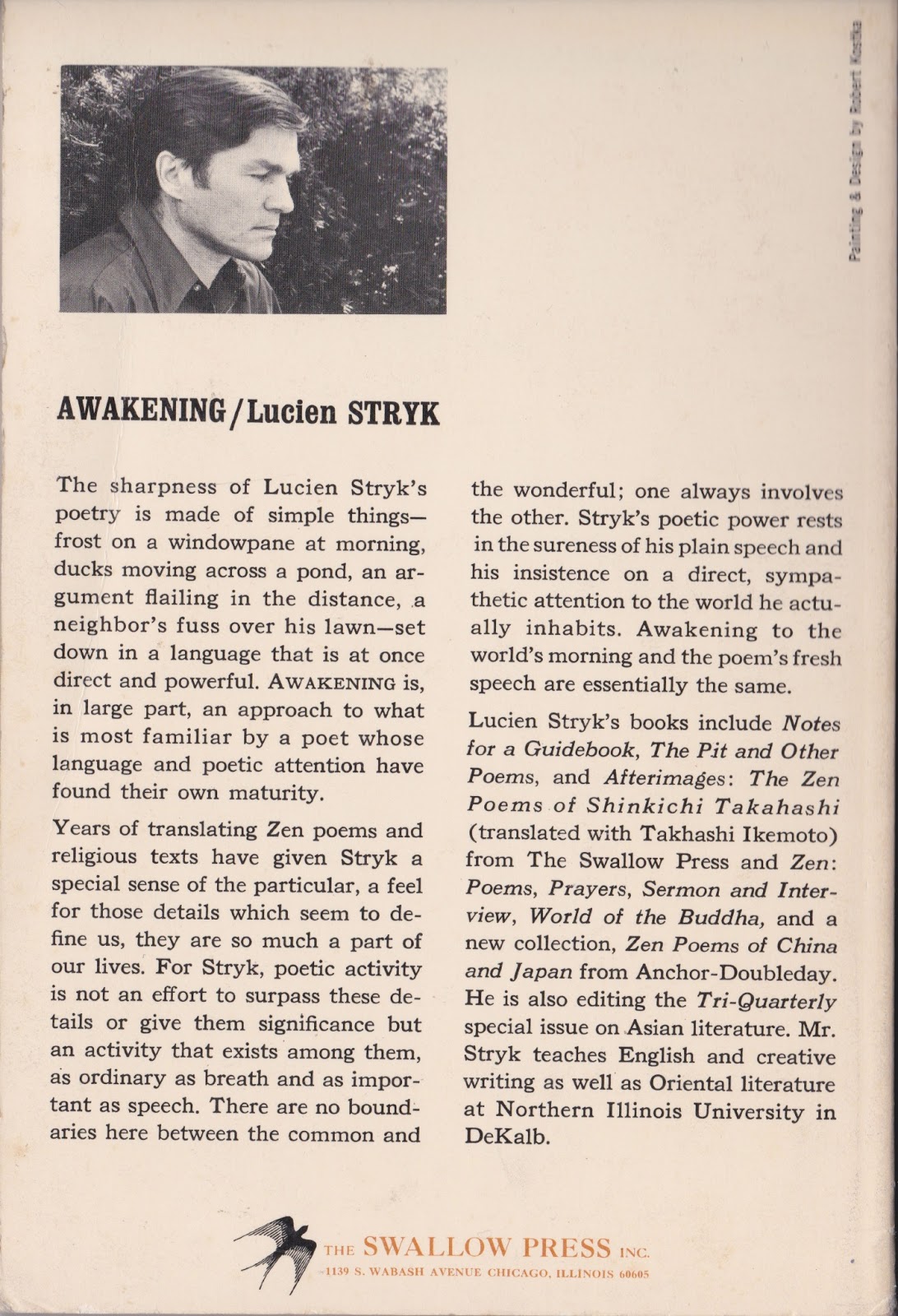
I'm sorry to say I knew Lucien Stryk had died  because after years on end of no one coming for his books of poems or wonderful anthologies, and lessons of zen, someone ordered one of his books of poems from our bookshop. A sure sign something was up in poetry heaven. The same thing happened today for Anselm Hollo. Yes, poets will take what they can get. But something more must also come, a little bit more of us.


Here are some of Lucien Stryk's poems from that book many poets still have in their libraries, Awakenings (Swallow Press 1973)


____________________________________


The Edge


Living that year at the edge
of the ravine,
sloped down to the woods, we listened

to the animals before the town
awoke, blurring
the limits of our days,

forcing its round, the needs
of others.
Near sleep, after loving, we felt

part of a stillness with the dark
and all its creatures,
holding to the edge of where we lived.


Awakening

Homage To Hakuin, Zen Master, 1685-1768


I

Shoichi brushed the black
on thick.
His circle held a poem
like buds
above a flowering bowl.

Since the moment of my
pointing
this bowl, an "earth device,"
holds
nothing but the dawn.


II

A freeze last night, the window's
laced ice flowers, a meadow drifting
from the glacier's side. I think of Hakuin:

"Freezing in an icefield, stretched
thousands of miles in all directions,
I was alone, transparent, and could not move."

Legs cramped, mind pointing
like a torch, I cannot see beyond
the frost, out nor in. And do not move.


III

I balance the round stone
      in my palm,
turn it full circle,

slowly, in the late sun,
      spring to now.
Severe compression,

like a troubled head,
      stings my hand.
It falls. A small dust rises.


IV

Beyond the sycamore
dark air moves
westward —

smoke, cloud, something
wanting a name.
Across the window,

my gathered breath,
I trace
a simple word.


V

My daughter gathers shells
where thirty years before
I'd turned them over, marveling.

I take them from her,
make, at her command,
the universe. Hands clasped,

marking the limits of
a world, we watch till sundown
planets whirling in the sand.


VI

Softness everywhere,
snow a smear,
air a gray sack.

Time, Place. Thing.
Felt between
skin and bone, flesh.


VII

I write in the dark again,
rather by dusk-light,
and what I love about

this hour is the way the trees
are taken, one by one,
into the great wash of darkness.

At this hour I am always happy,
ready to be taken myself,
fully aware.


__________________

1924-2013
Lucien Stryk died on January 24 at St. John's Hospice on London. He is buried in Highgate Cemetery.


Thursday, January 31, 2013

Wednesday, January 30, 2013

ODE ~


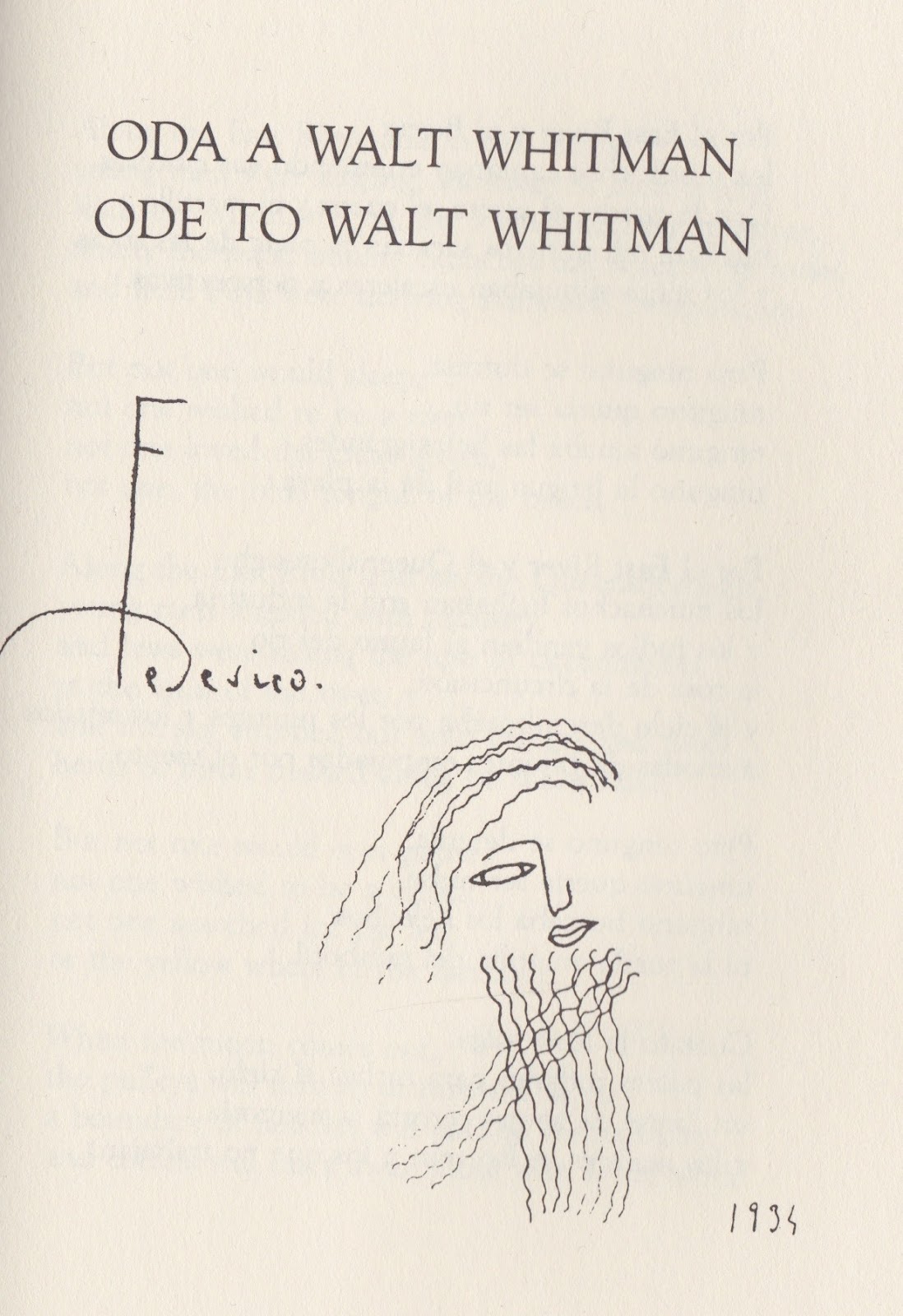
Ode to Walt Whitman


by Federico Garcia Lorca


Along the East River and in the Bronx
young men were singing, showing off their waists.
With the wheel, the oil, the leather and the hammer,
ninety thousand miners extracted the silver from rocks,
and little boys were drawing stairs and perspectives.

But not one would sleep,
not one wished to be a river,
not one loved the great leaves,
not one, the blue tongue of the beach.

Along the East River and on the Queensborough
young men wrestled with industry,
and Jews were selling the rose of circumcision
to the faun of the river,
and the sky emptied out onto bridges and roofs
herds of bison pushed along by the winds.

But no one would ever pause,
not one wished to be a cloud,
not one searched for the fern
or the yellow wheel of the tambour.

When the moon comes out,
the pulleys will turn to disturb the skies;
a boundary of needles will enclose the memory,
and coffins will carry away those who never work.

New York of muck,
New York of wire and of death:
What angel is carried hidden in your cheek?
What perfect voice will speak the truths of the wheat?
Who, that terrible dream of your stained windflowers?

Not for one single moment, beautiful old Walt Whitman,
have I ever ceased seeing your beard full of butterflies,
or your corduroy shoulders worn thin by the moonlight,
or your thighs of a virginal Apollo,
or your voice just like a column of ash;
aged one, as beautiful as the mists,
who wailed the same as a bird
with its sex pierced by a needle.
Enemy of the satyr.
Enemy of the vine,
and lover of bodies beneath coarse cloth.

Not for one single moment, my virile beauty,
for on mountains of coal, on signs and on railroads,
you dreamed of being a river and sleeping like a river
next to that comrade who placed in your breast
the tiny hurts of nescient leopards.

Not for one single moment, Adam-blooded one, All-Male,
man alone upon the seas, beautiful old Walt Whitman,
because on rooftop terraces,
huddled together in bars,
running out of the sewers in bunches,
trembling between the legs of chauffeurs
or flitting about on the platforms of absinthe,
the faggots, Walt Whitman, are pointing at you.

That one, too! Him, too! And hurling themselves
down upon your luminous and chaste beard
are blonds of the north. Negroes of the sands;
a multitude of shrieks and gestures,
just like cats and just like snakes,
are the faggots, Walt Whitman, the faggots,
blurry-eyed with tears, flesh for the whip,
or the boot or the bite of animal trainers.

That one, too! Him, too! Tinted fingers
are leveled at the shores of your dream
when that friend eats from your apple
with its slight taste of gasoline,
and sunlight sings upon the navels
of the boys playing beneath the bridges.

But you never sought out scratched eyes
or the darkest swamps where they submerge little boys,
or that frozen saliva,
or those wounded curves like toads' bellies
that faggots lug about in cars and on terraces
while the moonlight lashes them on the street corners of terror.

You only sought a nude who would be like a river.
A bull and a dream that would join wheel and seaweed,
a sire of your mortal agony, a camillia of your death,
and he would wail in the flames of your hidden Equator.

Because it's not right for a man to seek his delight
in those blood jungles of the morning after.
The skies have shores where one can avoid life,
and some bodies should never be repeated in the Dawn.

Agony, mortal agony, dream, ferment and dream.
That's the world, friend: agony, mortal agony.
The dead are decomposing beneath the clocks of the cities.
The war passes by us, weeping, with a million grey rats,
rich men give to their mistresses
tiny, illuminated half-corpses,
and Life is neither noble, nor good, nor sacred.

A man can, if he wishes, guide his desire
over a vein of coral or a celestial nude;
tomorrow loves will become rocks, and Time,
a breeze coming through the branches fast asleep.

That's why I never raise my voice, old Walt Whitman,
against the little boy who inscribes
a little girl's name deep into his pillow,
nor against the young man who dresses up as a bride
in the darkness of his clothes closet,
nor against those lonesome men of the casinos,
who drink with disgust from the waters of prostitution,
nor against those men with lecherous gazes,
who love men, but whose lips burn in silence.
But decidedly against you, faggots of the cities,
with your tumescent flesh and vile thoughts.
Mothers of filth. Harpies. Unsleeping enemies
of the Love that bestows crowns of joy.


_________________________________


 from Ode to Walt Whitman & Other Poems
Federico Garcia Lorca
translated by Carlos Bauer
(New Directions 1988)


Tuesday, January 29, 2013

SHARED ~


To the Naropa Community

I am very sorry to announce that Professor Anselm Hollo passed away this morning following a long illness. Anselm was one of the pillars of the Jack Kerouac School and a great friend to Naropa and beloved mentor to hundreds of students and inspiring poet to countless readers around the world.

Anselm’s  wife Jane Dalrymple-Hollo and children Kaarina and Tamsin were with him during what Jane described as a peaceful death. Naropa has lost another of our treasures, who will be greatly missed. Please join me in sending good wishes to Anselm as he embarks on his next journey and to the family during this poignant time.

Anselm will be at the Crist Mortuary and his family would welcome you to visit tomorrow, Wednesday, between 4 pm and 7 pm at 3395 Penrose Place, near 34th St and the Diagonal. Professor Reed Bye is working with my office in planning a memorial for Anselm for some time next week. Details will follow.


Charles G Lief
President
Naropa University
2130 Arapahoe Ave
Boulder, CO 80302
(303) 546-3517
www.naropa.edu<http://www.naropa.edu>

---
For general rules of using Naropa's staff and faculty mailing lists, visit:
http://eropa.naropa.edu/staff/it/GeneralRulesofusingNaropasStaffandFacultyMailingLlists.asp


 Anselm Hollo
1934~2013


Paavo Anselm Aleksis Hollo was born in Helsinki, Finland. His father, Juho Aukusti Hollo(1885–1967) — who liked to be known as "J. A." Hollo — was Professor of Philosophy at the University of Helsinki, an essayist, and a major translator of literature into Finnish. His mother was Iris Antonina Anna Walden, a music teacher and daughter of organic chemist Paul Walden. He lived for eight years in the United Kingdom producing three children: Hannes, Kaarina, and Tamsin, with his first wife, poet Josephine Clare. He was a permanent resident in the United States from the late 1960s until his death. At the time of his death and he resided in Boulder, Colorado with his second wife, artist Jane Dalrymple-Hollo.

Hollo published more than forty titles of poetry in the UK and in the US, in a style strongly influenced by the American beat poets.

In 1965, Hollo performed at the "underground" International Poetry Incarnation, London. In 2001, poets and critics associated with the SUNY Buffalo POETICS list elected Hollo to the honorary position of "anti-laureate", in protest at the appointment of Billy Collins to the position of Poet Laureate Consultant in Poetry to the Library of Congress.

Hollo translated poetry and belles-lettres from Finnish, German, Swedish and French into English. He was one of the early translators of Allen Ginsberg into German and Finnish.

Hollo taught creative writing in eighteen different institutions of higher learning, including SUNY Buffalo, the Iowa Writers' Workshop, and the University of Colorado at Boulder. Since 1985, he has taught in the Jack Kerouac School of Disembodied Poetics at Naropa University, where he held holds the rank of Full Professor.

Hollo became ill, and during the summer of 2012, had brain surgery.

Several of his poems have been set into music by pianist and composer Frank Carlberg.

Poets Ted Berrigan and Alice Notley named their son Anselm Berrigan after Hollo.

Hollo died from post operative pneumonia on January 29, 2013 at the age of 78.

wikipedia


EARTH ~


Amos Oz


Two final thoughts from Oz worth the consideration of Israeli politicians: On the nature of tragedy and the nature of time.

“The Israeli-Palestinian conflict is a clash of right and right. Tragedies are resolved in one of two ways: The Shakespearian way or the Anton Chekhov way. In a tragedy by Shakespeare, the stage at the end is littered with dead bodies. In a tragedy by Chekhov everyone is unhappy, bitter, disillusioned and melancholy but they are alive. My colleagues in the peace movement and I are working for a Chekhovian not a Shakespearian conclusion.” 

And this: “I live in the desert at Arad. Every morning at 5 a.m. I start my day by taking a walk before sunrise. I inhale the silence. I take in the breeze, the silhouettes of the hills. I walk for about 40 minutes. When I come back home I turn on the radio and sometimes I hear a politicians using words like ‘never’ or ‘forever’ or ‘for eternity’ — and I know that the stones out in the desert are laughing at him.” 

Sit down with Oz. That is my advice to the next Israeli government — and to all the deluded absolutists, Arab and Jew, of this unnecessary conflict whose unhappy but peaceful ending is not beyond the scope of open-ended human imagination.

Roger Cohen, The New York Times


photo : Stelios Charalampopoulos


[ from the moleskine ] ~


If I Am Lost & The Shadow Grows Long


Inhabit the house

like a bird


Build a nest


of twigs,


bits of cloth

paper


To be abandoned

in time —


dwelling

for a time


_________________


KIM DORMAN
from gleanings / fragments / february 2013
Houston, Texas


photo © bob arnold