Wednesday, September 17, 2014

START WITH THE TREE PART IV ~


The old saw is true ~ measure twice, cut once.


I'll move quickly putting this side of the roof on with Susan up on the second floor steadying, and me working off both ladders. I figure, correctly, by the time I build staging, I'd have this side of the roof on.


“Voilà!”


Up in the pines


The back roof moves a wee bit easier using the lean-to roof as staging to work from.


Susan paints two coats on the two windows that will show out from the stone gable on the east side (river side). I'll store them away until I have the stone laid up, then work the windows in.


The paint bucket, the wood truck, the catch-all, the all-American Japanese pickup truck. No better.


Now with the main roof stitched down tight, get the lean-to roof on.


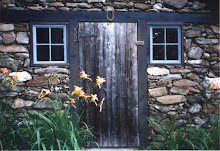
Susan says this photograph reminds her of our first cabin, circa 1974, which is right up the river but long gone in renovations and remodeling over the years. You won't find it. And Susan is right about the cabin similarity.


Twin gable end window rough openings framed up, all trim painted, roof on and ready to tackle the stone work for the front wall.


 I also applied a tough vinyl band of flashing that I decided to paint away from its dull black to the same color as the trim.


This gives some mapping of the new structure in relation to our house. A good, wide, snow shoveled path length for sure. It looks easy in the summer.


Susan walking from the house with my tool belt and the jug of fresh water.


A beat-up and scuffed loft pine floor after the workout with the rafters.
Leave it alone and let it recover.


Spacing for roof purlins for the steel sheets. A full 1 x 4 spruce boards.


Another view of the lean-to roof layout.


Side view of the main roof rafters and purlins.


Looking out from the twin windows to the road and over the brow is the river.
That will be my stone to work with into the building front wall piled up to the left of the photograph. I tore down an old stonewall I built decades ago to get this stone material. You can see the 'tan line' from that stone wall on the lower portion of one of the two oak trees. Wood chips level out the dooryard for now. Screen gravel will soon be delivered and raked over the chips. The wood chips arrived one morning from a work-site down the road where trees were being removed and the crew wanted to save hauling the chips away; I said, thankfully, "Haul them here."


One day we went searching all over the Berkshires and then a drive across southern Vermont for used windows. No one had any, until one guy in Wilmington, Vermont, 15 minutes before he closed, we pull up when I can see four or five old storm window sashes leaning in his dooryard for sale. All the same fair price. I choose the best one and then with two bicycles stuffed in the back bed had to figure out how we'll transport the window home without breaking some of the panes. Two minutes left the guy rushes out from his used granny's attic domicile with a large ribbon of bubble wrap to save the day. Then he stood by the side of the road and waited for the bus to pick him up to take him home. I asked him if he "needed a lift?" Nah, he said, he does this every day. The next day I framed up the window, sideways, not its proper vertical design, but it's a window.


  Ridge cap


photos 2014  © bob & susan arnold


Tuesday, September 16, 2014

TALKIN' CID CORMAN ~


Cid Corman in his Kyoto, Japan study
( avalanche )


Kelly Writers House pays host to two events celebrating the work of Cid Corman:


Yesterday U Penn showed a panel discussion and reading of Cid Corman. Many asked why I wasn't invited. They don't get that academics don't invite non-academics, unless, of course, they are famous and have a drawing card. In that situation even Cid wouldn't have been invited, and often he wasn't. One more irony in the road show of poetry in America. I made a link on the Birdhouse for this duo-event in case anyone wanted to watch the program. It had some fine moments.


KAMA SUTRA ~


A Lesson from Kama Sutra


With the drinking glass studded with lapis
wait for her,
by the pool around the evening and the rose perfume
wait for her,
with the patience of the horse prepared for mountain descent
wait for her,
with the manners of the refined and marvelous prince
wait for her,
with seven pillows stuffed with light clouds
wait for her,
with burning womanly incense filling up the place
wait for her,
with the sandalwood male scent around the backs of horses
wait for her,
and don't hurry, so if she arrives late
wait for her,
and if she arrives early
wait for her,
and don't startle the birds in her braids
and wait for her,
so that she sits comfortably in her beauty's summit in the garden
and wait for her,
so she may breathe this strange air upon her heart
and wait for her,
so she may breathe this strange air upon her heart
and wait for her,
so that she lifts her dress off her calf cloud by cloud
and wait for her,
take her to a balcony to see a moon drowning in milk
and wait for her,
offer her water, before wine, and don't
look at twin partridges sleeping on her chest
and wait for her,
slowly touch her hand
where she places the glass on the marble
as if you were carrying dew for her
and wait for her,
talk to her as a flute talks
to a frightened violin string
as if you two were witnesses to what tomorrow prepares for you
and wait for her
brighten her night ring by ring
and wait for her
until the night say to you:
You are the only two left in the universe
so take her, gently, to your desired death
and wait for her! . . .


 ____________________


Mahmoud Darwish
The Butterfly's Burden
(Copper Canyon 2007)
translated from the Arabic by Fady Joudah


Monday, September 15, 2014

Seán Pádraig Ó Ríordáin ~


 Sean Riordain
Selected Poems
Yale
translated from the Gaelic by Frank Sewell

_____________________________________


"In the mid-twentieth century, a new generation of poets writing in Irish emerged, led by the young Seán Ó Ríordáin, among others. Ó Ríordáin’s work has stood the test of time well, and he continues to engage today’s Irish readers and writers. This well-rounded selection of poems brings most of Ó Ríordáin’s works to English-language readers for the first time. The poems appear in their original Irish alongside English translations by some of Ireland's leading poets. Also included for the first time in English is Ó Ríordáin’s essay What Is Poetry?, considered an extraordinary touchstone of critical insight for poets and literary commentators. The volume reflects Ó Ríordáin’s seven main concerns: poetry and its place in the artist’s life; the plural self; the relationship between the individual and society; gender relations; the nature of animals; Ireland, its language and culture; and mortality."


Sunday, September 14, 2014

RURAL LIFE AND THE NEIGHBORHOOD ( A ROCK & A SOFT PLACE ) ~


Okay you, if it makes you feel more at ease, you aren't my Guilford muse. I meant it, sincerely, as a compliment. You are, then, our friend. A valued good neighbor. We should be both aware that we don't have to react or even act the way we have been — by sharing and telling and wanting to work together — but we are, and for a very important reason, really the only reason: saving a loving place, that won't be loved if we don't love it. People have learned, often the hard way, that's the way love works. You have to work it. Or it goes away. And Green River and its covered bridge and the river that runs underneath it has no voice unless we give it one.


So that's what we're doing.


I've linked the last Selectboard meeting below c/o of BCTV. The media format is quite a valued contribution for those not able, or even wishing to be at such meetings. It shouldn't be lost on anyone how revealing this format becomes as people attempt to format plans and dive into discussions. We should allow it room and not take advantage of it.


That said, please take the time to watch the entire presentation here, it showcases quite a contrast of wishes, lies and dreams.


On the one hand we have a gentleman and then a woman presenting a very simple plan of a picnic area for families and children. You can watch the man literally rise to the occasion of his plan, really his dream. Notebooks in his arms and drawn up maps all sketched out and real. This picnic region will be near the old brick schoolhouse in Guilford Center. It's a natural — there's a grassy part, a gentle slope and it all abides with a brook that runs through it all. A natural act. The man has witnessed that he doesn't even have to tell children what to do and not what to do when they visit the location, they showed him what the region can do by simply doing it themselves. They frolicked. Went to the brook. Made Japanese style boats out of the knotweed that for some reason has had Guilford adults run around with their hair on fire for years now. Watch the children Mr & Mrs. Adult, they'll show you one of the many things you can do with knotweed. Since the plant is here and will always be here. We in Vermont used to have this ability to work with what we have. Now it's down to the children to show us.


Now watch the reaction of the Selectboard members in the video. They have the obvious challenges of today's rigid society, protocol, liability, and the giant mess of things we've made for ourselves. I get it. There are irons to straighten out; always have been and always will be. But instead of rising to the occasion with this very viable dream (one Selectboard member did), things are deferred, tabled, told to go play in the road. We can watch the man and woman who are presenting showing such patience and willingness to work through a plan, but also offering that winters are long and this winter would be an opportune time get this good dream onto its feet. 


Tabled. Not shutdown, it will probably work out, eventually, while a six year old ages to become a nine year old, but if these presenters just had an old bridge with them in the bargain, something that would awaken the other two Selectboard members up, a bridge that they could use down on the Green River and slide it in just about anywhere in the vicinity of the covered bridge, which is doing just fine if we would let it, then we might have something to talk about. The irony and theater and despair is palpable.


And becoming cruel.


Next up come three gentleman sitting in the back row of the Select board meeting. Have a look. They each have a lot to say and are ready to share it. Some of what is spoken will be very bright, insightful, even warped, some times courageous. Each live along the Green River in some capacity and they are trying to show living comes with responsibilities.


One of the gentleman describes himself as someone who works best in a "process." He correctly doesn't like the way his good name has been used in his own attempt at devising a plan for a Bailey bridge to be used temporarily over the Green River. Right here you're watching irons in the fire being straightened. I admire anyone who stands up and asks for a fair playing field. The only problem with this is a few years ago, my wife caught this same man on our land with others cutting trees and obviously confused at what they thought was doing-good. My wife is also a "process" person and fortunately stopped this little spindrift crew in their act before things got worse and wanted to know what was up, what in the world we're they doing? This man of "process" said he had no time to talk to her and left her standing there. You can't be in a rush and also respectfully understand the act of "process." You can't have it both ways.


I've taken a great deal of time, and put myself into jeopardy, writing within the thread of many essays, about the dynamics of the rural neighborhood. Good folk who can also work with unabashed prejudice, disregard, and assault. It should be understood this isn't a good thing. In the simplest of terms, it doesn't build bridges.


Which brings me to the second gentleman in the group of three. In the most generalized terms, cutting to the chase, because I've watched this man ask important questions and offer pertinent ideas at previous meetings. At this meeting he claims, perhaps, the covered bridge in Green River may be "bigger" than the town. A multifaceted way at saying many things at once: the bridge has become obsolete in these times; Guilford as a populace can't get around the idea they even have a covered bridge and they must protect it; Guilford continues to purchase expensive equipment that can't even ride over a covered bridge; Guilford is fed up with the covered bridge and so have many of its Green River citizens and the people just want to get to town; these detours have to stop! the Selectboard is at a loss, etc etc. Poker-faced, the gentleman offers the blitzkrieg of all plans: maybe the covered bridge has to be torn down and a new bridge set in its place? He would like the engineers at Hoyle Tanner to put this into their planning scheme and let the town know what this adventure would entail and finally cost. 


Why not? It's throwing a beautiful baby out with the bath water, but why not. It's a wonderful challenge to the town — do you know how to love your covered bridge, river, chapel on the knoll, hamlet of homes, the slow and wandering yellow corners of the school bus on these winding roads? Or should we just straighten this all out, put in a fast bridge and get ourselves quicker to Brattleboro and Brattleboro quicker to us? Lose, of course, everything that brought most of us here — "god's country" as one farmer with a detectable twinkle to his hardwood eye and not a hint of despair once described this river valley to me as we were haying the big meadow now owned by Michael Knapp / Laura Metsch and the Vermont Land Trust. Time will tell, but we may be lucky we have them. I was lucky at one time to be working with this farmer.


The third gentleman in the trio of back row audience members at this Selectboard meeting was greeted with a honeydew compliment, deserved, by one of the Selectboard members as to his "citizen of the year" for Vermont, if such an award was given, at his allowing so many vehicles onto his land and meadow while we are in this trying period of no covered bridge and people needing not only a footbridge, but maybe a Bailey bridge, and now a makeshift parking lot to park all their vehicles so they can get to town or their jobs just like they always have. With people now it's all about what they always have had and what is their habit — not about learning new ones.


For an outsider reading this essay, let it be understood, our covered bridge is out for only two months, maybe three. There are two viable detours to get everyone everywhere they need to go. If we were in another "god's country", say Big Sur, California, when Route 1 washes away, and I mean washes away, in a landslide, the road is often out for up to a year. 365 days. 12 months. Four seasons. A long time. The people have these options before them: the vast Pacific ocean to the west of them, a mountain range to the east, and north-to-south their main thoroughfare has disappeared. They make-do. Make-do is what makes god's country. If I may: I came to Green River 42 years ago on-foot, no vehicle. I got to town and my two jobs on-foot for two years. I either hiked in (12 miles) which I did countless times, or I hitched a ride, and by hitching a ride I met my neighbors: Alden Bell, Judy Bell, Don Squires, Bub Visser, Oscar & Lottie Weatherhead, Harvey Cutting, Mary Blair, Bill Blair, Jerry Freeman, Shaun Murphy, Martin Brown, Anne-Marie Brown, Peter Wilde, Steve and Linda Lembke, Maury Lynde and Fred Koch. A versatile group. You see how it works?


Back to the gentleman in the audience and his big meadow and a compliment from the Selectboard which will politely but surely be slapped back across their faces in what I believe is a telling moment in the drive to put in a new bridge or keep the very covered bridge many of us love. Please listen to the appeal of this man speaking, from his heart, as a land owner and wanting to be a good neighbor, at what it takes to know where you live and what you may embrace and must protect. You are listening to a plea here. Please listen, maybe learn.


The consulting engineers of Hoyle Tanner are about to present their findings to the town from out in the field. It will be a survey of at least five options, four including new bridges, one a by-pass road involving no bridge (my choice), and if we entertain the wild challenge of tearing down the covered bridge because Guilford can't be the proper stewards (my interpretation) then that makes six options. Hoyle Tanner are professional engineers, geared to show the town what-is-what. No opinions, bare facts, nuts and bolts, costs and maintenance. It's the ultimate ultimatum, plus a grand demand on the town and citizens to put-up or shut-up as to what they can afford, wish to maintain, and hold dear. 


 [ BA ]


photo 2014  ©  susan arnold


Saturday, September 13, 2014

AUTUMNAL ROOTS & BLUES #1 ~


Flowers & Xylophone


compiled by Bob Arnold September 2014


Friday, September 12, 2014

WITNESS : ART & CIVIL RIGHTS IN THE SIXTIES ~


Jack Levine
Birmingham '63
(1963)


Philip Guston
City Limits
(1969)


 May Stevens
Big Daddy Paper Doll
(1968)


 Ben Shahn
Human Relations Portfolio
Michael Schwerner, Andrew Goodman, James Chaney
(1965)


This is a terrific show — to see so many of the paintings and photographs in the flesh (of a sort)
in a New England college town, is an achievement to witness; plus the settings of each art piece are masterfully thought through and placed. Get yourself to The Hood in Hanover, run up the stairs (second floor) and quietly absorb and sink into the burning.


Thursday, September 11, 2014

RUKEYSER'S ELEGIES ~


THE BEATLES (EVERYTHING) ~


Every album and every song ever released by the Beatles—from "Please Please Me" (U.S. 1963) to "The Long and Winding Road" (U.S. 1970)—is turned inside out and upside down by a crew of music historians in this lively and fully illustrated work. 
Patti Smith writes a personal preface.


The Beatles
All the Songs

672 pages
Black Dog & Leventhal Publishers, 2013


_______________


I Am The Walrus by nADA on Grooveshark


Wednesday, September 10, 2014

RURAL LIFE AND THE NEIGHBORHOOD ( PRESERVE ) ~


`


summer and winter weave


Dear —


You are a powerhouse for Guilford, and never mind Guilford, for the world. Heck, all of Ireland!


My mother came over at age 17 from Ireland with my American WW2 soldier dad (he found his girl friend while stationed after D-Day, 1944). He was then a boy just graduated from Williston Academy in Easthampton, wet behind the ears, and my mother (still alive at 86) was the middle daughter of many from Belfast. Her father was a baker with a horse & cart, and then he became a policeman on a bicycle, as did his youngest son Brian when he grew up and moved to Hartford, Connecticut. Home of the great poetry 'policeman' Wallace Stevens. Brian was one of my guideposts as a boy. His older brother, David, a skilled carpenter at slate roofing already at age 15 in Belfast, became the other one. They all came over pretty much with my mother and father after WW2 and plunked themselves down in the northern Berkshire hills where my family had the sawmill and lumber industry (right down the road from our Green River house, really) and I had the good fortune of growing up with them all. Soda and potato bread the staple, laughter and safe hard drinking, which made me a teetotaler. Sometimes it works that way.


We have not only noticed all the clarity and goodness by the hand of Friends of Algiers Village, we marvel at its presentations each time we pass through. One doesn't tire at seeing restoration work done correctly. Elegantly. And it's no accident a skilled mechanic with a generosity and intelligence by hand via one Doug Richmond is already set up in the same locale. The corner is humming, thanks to you all.


Have you walked out into the wash of the moonlight tonight? my my. Sweetheart and I are up at 3AM just to have this and all day yesterday all I did was build one barn door, and here I am at 7 this morning off to build barn door #2. Part of the Bell family just drove by at 3:30 in their open-to-the-weather ATV to get someone up to the footbridge crossing and I guess to one of their vehicles and off to their job. Another one in the family will follow up again at 5 o'clock. This is one way it works when you have to work . . . with a covered bridge out, and that wash of moonlight right in and up the river. Let it be your guide.


After we watch the select board meeting c/o Brattleboro-TV we'll put our heads together and have another letter to you. 


"Use it up, wear it out, make it do, or do without."
~ old New England adage


"Cronies" are wonderful but not when they are sticks in the mud and hurting true progress — which is about doing a job right. Right means beneficial to both man and environment. A lesson this entire country is still learning the hard way about, after many who passed through Ellis Island showed them the right way. The "cronies" think they have a better way but it's most often next generation half-baked impatience; they didn't sit long enough on their grandparents' knees.


I think back at Bill Nebelski's presentation at the previous select board/feasibility meeting and these guys are the type of guys I worked with once upon a time. Good-natured and seeing things from "1965" when they're working on a covered bridge from 1872. It's 1872 we're trying to preserve and the entire community should get their heads around, or it will be gone. For good. Facsimiles and fake villages are the "vanilla box" you speak of. A dorky plan of a "footbridge" for a covered bridge already pronounced as "in good shape" by Hoyle Tanner and after all the effort Peter Welch and his crew are mustering out is an insult to their disciplined, yeoman work. We went up and happened to meet Peter last week, nice guy. When Nebelski spoke about roofing the covered bridge, that height! it brought back memories when I steel roofed the bed & breakfast garage right next to the covered bridge —same height, same river, same rocks below — and I did this long before the bed & breakfast was there. When a vehicle went through the covered bridge while I worked on the roof of the garage, I felt the earth rumble all the way up to where I was perched. Same ledge it all sits on.


In Vermont we all sit on the same ledge. So build it right.


 [ BA ]


photos 2014  ©  susan arnold


http://brattleborotv.org/green-river-feasibility-study-public-info-mtg-82514


Tuesday, September 9, 2014

JONTHAN WILLIAMS (PHOTOGRAPHS) ~


Jonathan Williams, Photographer


Black Mountain College
Museum & Arts Center
56 Broadway
Asheville, NC 28801


Monday, September 8, 2014

INGEBORG BACHMANN ~


Anxieties


What then will remain?
I sigh, suffer, search,
and my wanderings
will never end.
The dark shadow
which I have followed from the start
leads me into the deep loneliness of winter.
There I stand still.
The frost coats my hair
and the cold burns through my limbs.
Melodies of dead silence play a dance,
endlessly turning round each other.
Blue spirits leap into the room —
the departed who wandered off before me
desiring, like lords, an ancient right.
Now they will be paid with blossoms
which many summers saw
and which break and fall this winter.
The trees exude the cold from within,
and tears, which the moonlight draws out,
hangs as thin cones coated in ice.
Over there, above the glacier,
the long departed pour out their blood,
and so I follow their example and do the same to them.
I listen close to the centuries,
though I don't want to be swallowed up by them.
Into the shadow which wants to stretch this far
I try to press a vestige of myself,
despite the idle fear of wasting my leaf.


Libraries


The shelves sag.
The volumes are weighted down with the past.
Their sweat is dust.
Their impulse is rigidity.
They no longer struggle.
They have saved themselves
upon the island of knowledge.
Sometimes they've lost their conscience.
Here and there, protruding
from them, human fingers
point directly towards life
or towards heaven.


[ I'm still afraid]


I'm still afraid to snare you with my breath,
drape you with blue banners of the dream,
or outside the misty door of my darkened castle,
burn torches, such that you'd find me . . .

I'm still afraid to free you from shimmering days,
from the golden river bed of time's own river of sun,
fearing my heart would burst silvery above the moon's
own terrible countenance.

Look up and don't look at me!
The banners are sinking, the torches have been extinguished,
the moon follows the course it traces.
It's time you came to seize me, holy madness!


I Know of No Better World


Who knows of a better world should step forward.
Alone, no longer out of bravery, not wiping away this saliva,
this saliva worn upon the cheek
as if to a coronation, as if redeemed, whether at communion
or among comrades. The weak rabbit,
the rat, and those fallen there, all of them,
no longer alone, but as one, though still afraid,
the dream of returning home
in the dream of armament, in the dream
of returning home.


The Radical Means


Wasteland, but only to the eye

that serves life,

feather-light rubble.


__________________


Darkness Spoken, with a foreword by Charles Simic, gathers together Ingeborg Bachmann’s two celebrated books of poetry Borrowed Time and Invocation of the Great Bear, as well as early and late poems not collected in book form, over 100 of them appearing in English for the first time, as well as 25 poems never before published in German. Bachmann is considered one of the most important poets to emerge in postwar German letters, and this volume represents the largest collection available in English translation. Influencing numerous writers from Thomas Bernhard to Christa Wolf to Elfriede Jelinek (winner of the 2004 Nobel Prize in Literature), Bachmann’s poetic investigation into the nature and limits of language in the face of historical violence remains unmatched in its ability to combine philosophical insight with haunting lyricism.

Bachmann was born, the eldest of three children, in 1926 in Klagenfurt, Austria. She studied philosophy at the universities of Innsbruck, Graz, and Vienna. In 1953 she received the poetry prize from Gruppe 47 for her first volume, Borrowed Time (Die gestundete Zeit). Her second collection, Invocation of the Great Bear (Anrufung des großen Bären), appeared in 1956. Her various awards include the Georg Büchner Prize, the Berlin Critics Prize, the Bremen Award, and the Austrian State Prize for Literature. Writing and publishing essays, opera libretti, short stories, and novels as well, she divided her time between Munich, Zurich, Berlin, and Rome, where she died in 1973 from a fire in her apartment caused by her falling asleep in bed while smoking a cigarette  — she awoke to find herself surrounded in flames. Horribly burned at age forty seven the poet was gone to us three weeks later.


The translator, Peter Filkins has published two volumes of poetry, What She Knew (1998) and After Homer (2002), and has translated Bachmann’s The Book of Franza and Requiem for Fanny Goldmann. He is the recipient of an Outstanding Translation Award from the American Literary Translators Association and the Berlin Prize from the American Academy in Berlin. He teaches at Simon’s Rock College of Bard in Great Barrington, Massachusetts.


Sunday, September 7, 2014

PROSPECTORS ~


Sam Shepard, Johnny Dark
2 Prospectors
University of Texas Press,  2013


DON HUNSTEIN ~


Don Hunstein, photographs
Jon Pareles, text
Keeping Time
Insight Editions, 2013