EARTH ~
Wednesday, April 21, 2010
Tuesday, April 20, 2010
EARTH ~
David Shapiro is still a young fellow and has lived many life times. His first collection of poems January was published long before he was twenty years of age, by Holt, and with an endorsement from Jack Kerouac. For decades he has taught many poets and art lovers from around the world. His craftsmanship as a musician is yet another of his whole worlds. When young guys, David with his close friend Ron Padgett, compiled one of the finest anthologies of the legendary New York School of Poets. Just about everyone who should have been in there was, with a photograph. Cloud bursts of poems, too. One day in early spring David sent to me this gift poem, tucked in a letter because he knew I might like it, and he knew I might print it up into a tiny broadside to frame. He was correct. Anyone can write us for a copy, and a few are signed.
EARTH ~
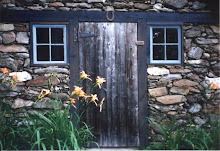
Here's one of my photographs from the polaroid series going back some dozen years. I'll include a few more as time goes along. I use a Canon digital camera now — plus make one to two minute films with it. We can't seem to find the film for my old polaroid, clunky and beautiful in its time at making finished photos roll out. My father used his for years. He kept his film in the refrigerator. All this human province of moves and even errors of taking pictures, storing film, having the miracle of the developed photograph in your hands, after a little bit of precious waiting (which is like listening which is like talking which is like thinking) is becoming lost.
photo © bob arnold
Monday, April 19, 2010
EARTH ~
It was one of those early Saturday morning drives straight up the countryside of the open highway, barely any traffic, clear weather sailing, and I read all of Samuel Menashe's New and Selected Poems (The Library of America). Many to myself, some aloud to Sweetheart at the wheel. Sunshine in the fields and pastures. Just a hint of the dark Connecticut River coming into view between the hills. Music also on low. Menashe doesn't at all seem to mind. You can almost read any one of his poems aloud between the songs. That short. Often that memorable. I'll share all the ones I read to Sweetheart. It's easy enough to do.
Pity us
By the sea
On the sands
So briefly
Always
When I was a boy
I lost things —
I am still
Forgetful —
Yet I daresay
All will be found
One day
The hill I see
Every day
Is holy
SURVIVAL
I stand on this stump
To knock on wood
For the good I once
Misunderstood
Cut down, yes
But rooted still
What stumps compress
No axe can kill
SLEEP
gives wood its grain
Dreams knot the wood
APOTHEOSIS
Taut with longing
You must become
The god you sought —
The only one
FASTNESS
I shoulder the slope
that holds me
up to the sun
with my heels
dug into dust
older than hills
I left my seed in a grove so deep
The sun does not reach through the trees
Now I am wed to the wood and lord of all leaves
And I can give the green blessing to whom I please
In the Fall 2010 Samuel Menashe will be 85 years old. A New Yorker by birth and by right, except for some occasions in Europe, including as an infantryman at The Battle of the Bulge in 1944, Menashe has been at home in New York City. At the 1944 Battle he could just as easily have been beside my father, also an infantryman in that battle and one year older. A mere 20 years old. Like other American poets Menashe received his first taste of recognition in England, and it stands that way to this day. In 1961 Kathleen Raine rose to his short and often spiritual poems, as did Donald Davie. He's been honored by The Poetry Foundation with their "Neglected Masters Award", and if he's lucky, he'll remain happily that way. It's always been just the nest to thread poems.
SAMUEL MENASHE
It was one of those early Saturday morning drives straight up the countryside of the open highway, barely any traffic, clear weather sailing, and I read all of Samuel Menashe's New and Selected Poems (The Library of America). Many to myself, some aloud to Sweetheart at the wheel. Sunshine in the fields and pastures. Just a hint of the dark Connecticut River coming into view between the hills. Music also on low. Menashe doesn't at all seem to mind. You can almost read any one of his poems aloud between the songs. That short. Often that memorable. I'll share all the ones I read to Sweetheart. It's easy enough to do.
Pity us
By the sea
On the sands
So briefly
Always
When I was a boy
I lost things —
I am still
Forgetful —
Yet I daresay
All will be found
One day
The hill I see
Every day
Is holy
SURVIVAL
I stand on this stump
To knock on wood
For the good I once
Misunderstood
Cut down, yes
But rooted still
What stumps compress
No axe can kill
SLEEP
gives wood its grain
Dreams knot the wood
APOTHEOSIS
Taut with longing
You must become
The god you sought —
The only one
FASTNESS
I shoulder the slope
that holds me
up to the sun
with my heels
dug into dust
older than hills
I left my seed in a grove so deep
The sun does not reach through the trees
Now I am wed to the wood and lord of all leaves
And I can give the green blessing to whom I please
In the Fall 2010 Samuel Menashe will be 85 years old. A New Yorker by birth and by right, except for some occasions in Europe, including as an infantryman at The Battle of the Bulge in 1944, Menashe has been at home in New York City. At the 1944 Battle he could just as easily have been beside my father, also an infantryman in that battle and one year older. A mere 20 years old. Like other American poets Menashe received his first taste of recognition in England, and it stands that way to this day. In 1961 Kathleen Raine rose to his short and often spiritual poems, as did Donald Davie. He's been honored by The Poetry Foundation with their "Neglected Masters Award", and if he's lucky, he'll remain happily that way. It's always been just the nest to thread poems.
photo of Samuel Menashe on the beach by Martin Duffy
Sunday, April 18, 2010
ARCHIVE
Here is Once Upon a Time on the campus of Bowdoin College in Maine where James Koller invited poet friends like Ted Enslin, Gary Lawless, Bern Porter, myself and others to wear sandwich board signs with our poems nicely hand-printed and mix in the crowd at a Maine Arts Festival busy with boat builders, weavers and knitters, musicians, jugglers, farmers and their animals, and we poets wandering around with our sandwich poems, and in our hands we carried copies of the poems printed on postcards. If you liked the poem, we'd hand you a postcard of the same poem to keep.
Ain't life grand?
Ain't life grand?
bob arnold, photo © susan arnold
Saturday, April 17, 2010

DEAR LOUISE, WHO IS READING PATTI SMITH'S
JUST KIDS
ALONG WITH OTHER DREAMERS I KNOW
JUST KIDS
ALONG WITH OTHER DREAMERS I KNOW
I don't believe any human is any more a phenomenon than another
Norbu included
Dylan included
Gandhi and Max Factor
It's a journey
You would land right into Patti Smith's hands
and vice-versa
I always believed she was caring
mostso after the epiphany of a sorts she
went through after her husband's death
having children
restocking her mind and life after
Mapplethorpe and others bowed out
She's one who lives by her ghosts, lives by her lover
Personally, my favorite kind
I believe she does work from an honesty
This is what raises her stakes much
higher than the mere hippie or beat
Ginsberg might be surprised an heir is not a guy nor a Cody
or a Dharma but a Chicago born gal, raised in Jersey
She may not be, but she appears quite
at-home with her looks, frame and being
She's hanging out laughing and serious
I also believe her relationship with
her parents is strong and vital to her
Not a runaway
even if she looks like the poster child for one
She carries her good contradictions
photo Patti Smith: www.rockrgrl.com/
photo Louise Landes Levi: :flickr.com/photos/
Friday, April 16, 2010

STEVEN FAMA
Here's a link to his fine blog
And below is Steven's review of Longhouse publication Mock Orange by Joseph Massey
the glade of theoric ornithic hermetica
Quick (really!) and really (really!) good
Joseph Massey
Mock Orange
(Longhouse Publishing, 2010)
Mock Orange
(Longhouse Publishing, 2010)
Late last month as spring began Joseph Massey sat down in Humboldt County, California, where he lives and works, and wrote a sequence of nine poems.
Around March 27th, Massey e-mailed his poems to Bob and Susan Arnold in Green River, Vermont, asking if they’d be interested in publishing them. As you probably know, the Arnolds are the long-time proprietors of Longhouse, a small scale / big vision publishing and bookshop operation.
The Arnolds said, “Let’s do it” and then did, justlikethat. Over the next few days, they designed, printed, neatly glued, and otherwise did what was needed to get Massey’s poems out to the world. On April 7th, the resulting three color fold-out booklet (4.5" x 3") with wrap-around band was listed for sale on the Longhouse web-site. That same day, I ordered up two copies, using Paypal to transfer the cash.
Longhouse must have filled and sent my order quickly (no surprise there!) because yesterday (Monday, April 12th) the mail carrier delivered their business-sized envelope to me at work in Berkeley. Massey’s Mock Orange – that’s the title of the work – was in hand.
How’s that for blending a bit of the timeless (the diligence of poet and publisher), the new (the internet), and the old (snail mail) to bring about something quick (really!) and really (really!) good? I mean, it’s less than three weeks since Massey sat down and wrote Mock Orange. And yet here are his poems, in a beautiful little booklet, having traveled from California’s North Coast to Southeastern Vermont then back across the country to the Bay Area. Wow! Belatedness be damned!
+(+)+
I’m nuts for Massey’s writing. Last April I wrote about his Areas of Fog (click here, if you please), and later included it on my list of the year’s top five poetry books (click here). I also called his The Lack Of, published in December, the chapbook of the year (click here and scroll down a touch).
So when Mock Orange arrived, I read it right away. It didn’t take long: its nine untitled poems range from four to ten lines. I read it again on the train coming home, and a few times more last night. Getting up this morning, I decided to do this post tonight, fast as I could, to honor the spirit of this (really!) quick and really (really!) good book (well, at least I’m quick).
+(+)+
satellite view -- Arcata (in fog), the bay, the ocean
Massey’s poems, and those in Mock Orange are no exception, mostly come from the particular place he’s at, the actual geographic/physical location. He lives in what might rightly be called an adequate enough shack (I visited Massey there last fall, for a couple hours), situated on a rise or hillock just a mile or two from Humboldt/Arcata Bay, and a bit further from the Pacific. He can walk to the center of Arcata, and via bus or other ride get to Eureka, the county seat a few miles south. Many perceived particulars, from right at or near home or the more general area, get into and maybe sometimes give rise to his poems.
But Massey’s poems also come from the particular place he’s at with regard to – among other things – modes of perception, ways of thinking, maybe how he feels, and approaches to making poems. This mix of what’s within (the head, the emotions, the words) and without (things perceived) is of course what it’s all about. As Rae Armantrout has said, “The best poetry is looking outward and inward at the same time. A poet, like any artist, just doesn’t feel satisfied with the world; a poet has to answer the world, not just be a passive receiver.”
+(+)+
The results of this outward/inward mix, in Massey’s work, are usually intense. Because the poems are short, there’s no wandering or fluff. They are hot. The poems are also intense because – follow me here – Massey has a particular attraction for particulars that convey some particular moment. His poems, including those here in Mock Orange, seem mostly to convey a moment, one of (to list some that I sense in these poems) definition, recognition, loss, doubt, and wonder.
Ultimately, all the possibilities of the mind and the world might make a poem for Massey, if there’s something that gives rise to it. He gives special attention, I think it fair to say, to moments of thought, of perception. It’s like each poem, no matter how small, is a double-shot of some intense instant, realized in words. It’s very invigorating, a rush of specificity and alertness. This is all the more special here because it all comes from just about right now -- this spring -- just a few weeks ago.
+(+)+
I’m going to share and discuss a bit just one poem from Mock Orange. I don’t want to give away Massey’s (or his publisher’s) goods, and I want to keep this post quick, in the spirit of the poem-writing and booklet-making. Here’s the fifth poem in the sequence, one of the shortest of the nine. The poem has two primary images, with a kind of pause in between, and so it works in a way that is similar to haiku:
docks swallowed
--------------------in fog—
a transient talks
--------------------into a pine cone—
Now that has one heck of a (call it killer) final image: who can’t picture the street person there? This poem works mostly in the frisson and maybe friction between that image and the one that precedes it. I’m not going to parse it out fully (and probably couldn’t even I wanted to) but somehow the two images seem to go together. Part of it is Massey doing a bit of sleight of hand (and eye), putting the same extended hyphen at the end of each line, resulting in an unusual visual rhyme -- the punctuation -- that links the two couplets (those hyphens also permit the respective images to remain open, forever). There’s also a connection given the rhyme of “docks” and “talks,” and perhaps also in the anatomically close pharyngeal / laryngeal locus of “swallowed” and “talks.” There’s also in both images, and maybe this is the most significant link, disappearance: the docks into a mist, the words into the cone. What sub-surface elegance there, in that uncommon juxtaposition!
And maybe that’s what this poem is about, a moment of connection between the two seemingly disparate observations. But there also seems to be a tension between the two images. The second image is unexpected after the more traditional poetic image that comes first. The disjunction’s fairly severe, actually. Reading it several times the last two days, I sometimes laugh at the weirdness of it, of the idea of somebody talking to a pine cone popping into the poem there. Yet talking to a pine cone might not be so funny, in that it may be a snapshot of (let’s say) schizophrenia. As such, it disturbs too. Does Massey suggest, or at least ask us to consider the possibility, that “docks swallowed / in fog—” is as much a delusion as talking to a cone? Is this a poem about doubt, with the second image undercutting the poeticizing of landscape embodied in its first image? Hmm. So it goes in these poems, seemingly simple but with possibilities coming through once the reading gets close and the ideas start spinning.
+(+)+
There are eight other poems in Mock Orange, and each is a – forgive me, I’ve used the following term before about Massey’s poems, but it works here too – a gem. There’s one – # viii – that can be read as one short (eight line) poem or almost as three separate smaller poems, given how it’s arranged and spaced; the shape neatly matches the perception presented. Another (# iv) convincingly turns the afternoon haze into a kind of ocean surf. Two others (# vi and the final poem, # ix) show how an observation, something seen, can animate the most unassuming of places, at least (especially) if the poet’s words can get it down right. And these are just a part of this really (really!) good and (really!) quick booklet.
+(+)+
Endnotes
The description regarding the writing and publication of Mock Orange is based on information found in Joseph Massey’s April 7, 2010 blog post (click here and scroll down), and Bob Arnold’s April 11, 2010 blog post (click then scroll here, if you please).
Mock Orange is available at the Longhouse website (click here, it’s the sixth book down from the top). The price is $8.95 plus $2.00 for shipping/handling in the US. It’s also available via ABE (click here), although with a higher shipping charge.
+(+)+
++(+)++
+(+)+
++(+)++
+(+)+
April 13, 2010
Thursday, April 15, 2010
Vassilis Zambaras
IN CREDIBLE EVIDENCE
If you would like to purchase the new booklet, please link here
For the complete Longhouse titles we offer, please link here
IN CREDIBLE EVIDENCE
If you would like to purchase the new booklet, please link here
For the complete Longhouse titles we offer, please link here

With a close friend, I sort of worked behind Vassilis's back — which isn't hard, since he is tucked away in Greece — and chose some favorite poems we liked by this fine poet. We wheeled through his blog Vazambam, a daily bread of poetry and goodness and found plenty. . .then I asked Vassilis to just empty out the cupboards and send what other poems he had. Nothing like a poet who jumps with the joy of making, so we made.
THE ORIGIN OF SPECIES
On top of poems are written
Other poems, thus
The destruction of the world's
Perfected.
Wednesday, April 14, 2010
Tuesday, April 13, 2010
Monday, April 12, 2010
FEDERICO GARCIA LORCA

Federico Garcia Lorca (1898-1936)
In Search of Duende
photo: http://thestainofpoetry.wordpress.com/2008/03/24/absent-soul-alma-ausente/

NIGHT
Candle, lamp,
lantern, and firefly.
The constellation
of the dart.
Little windows of gold
trembling,
and cross upon cross
rocking in the dawn.
Candle, lamp,
lantern, and firefly.
translated Jaime de Angulo
Every art and in fact every country is capable of duende, angel, and muse. And just as Germany has, with few exceptions, muse, and Italy shall always have angel, so in all ages Spain has moved by the duende, for it is a country of ancient music and dance where the duende squeezes the lemons of death — a country of death, open to death.
Everywhere else, death is an end. Death comes, and they draw the curtains. Not in Spain. In Spain they open them. Many Spaniards live indoors until the day they die and are taken out into the sunlight. A dead man in Spain is more alive as a dead man than any place else in the world. His profile wounds like a barber's razor. The joke about death and its silent contemplation are familiar to every Spaniard. From Quevedo's Dream of the Skulls to Valdes Leal's Putrescent Archbishop, from seventeenth-century Marbella who says, while dying of childhood in the middle of the road,
La sangre de mis entrans
cubriendo el caballo esta.
Las patas de tu caballo
echan fuego de aquiltran...
The blood of my womb
is covering the horse.
Your horse's hoofs
throw off black fire...
to the more recent youth of Salamanca who is killed by a bull and moans:
Amigos, que yo me muero.
Amigos, yo estoy muy malo.
Tres panuelos tengo dentro,
y este que meto son cuatro...
Friends, I'm dying.
Friends, it's pretty bad.
Three handkerchiefs in me,
and this one makes a fourth...
In Search of Duende
(New Directions 2010)
photo: http://thestainofpoetry.wordpress.com/2008/03/24/absent-soul-alma-ausente/
Sunday, April 11, 2010
WALTER FRANCESCHI
A GOOD IDEA
~
A dozen more poems by this quietly alive Italian poet working to this day in the Florence region, where Dante showed us his soul. This is the second Longhouse booklet for Walter. Also see ~ Little Satori
If you would like to purchase the new booklet, please link here
For the complete Longhouse titles we offer, please link here
A GOOD IDEA
~
A dozen more poems by this quietly alive Italian poet working to this day in the Florence region, where Dante showed us his soul. This is the second Longhouse booklet for Walter. Also see ~ Little Satori
If you would like to purchase the new booklet, please link here
For the complete Longhouse titles we offer, please link here
STAR
That little point
— is bigger than me.
BECK
Often, but not always, grasping a 'vintage silvertone' guitar when on stage ~ Beck Hanson was born in 1970. His maternal grandfather was visual collage maestro Al Hansen. Already famous, what influences Beck ~which casts a wide net, from Hip-Hop to Latin music, to theater, puppets, jugband, full throttle rock 'n' roll and a family enriched Scientology ~ seems to influence those who listen. There's no stopping the guy.Saturday, April 10, 2010
JOSEPH MASSEY
Mock Orange
If you would like to purchase the new booklet, please link here
For more Joseph Massey and the complete Longhouse titles we offer, please link here
Mock Orange
If you would like to purchase the new booklet, please link here
For more Joseph Massey and the complete Longhouse titles we offer, please link here

Joe's out there on the edge of northern California. I came through the town where he is fifteen years ago after driving and hiking through redwoods the day before. With a little boy you drive a little, you hike a little. Two weeks ago Joe sent this sheaf of new poems by electric mail. I read and wrote back with a "Let's do it." We designed and printed and folded and wrapped all the next few days of rain. Good old rain.

docks swallowed
-------------------------------in fog —
a transient talks
-------------------------------------------into a pine cone —
-------------------------------in fog —
a transient talks
-------------------------------------------into a pine cone —
Friday, April 9, 2010
AMIRI BARAKA


"Imperialist society removes every thing from humans except Appetites. It feeds those appetites' self-destructive confusion about the nature of the world, and if not stopped will eventually destroy, at least, human life on this planet. For instance, imperialism removes arts from humanity, making "art" a mysterious marketable commodity that must reflect the pathology and philosophy of imperialism to be valued. But art is the ideological reflection of life. Art is Creation. Art versus Aren't. Imperialism pushes Aren't. It wants to turn the world into Aren't. Make all us Wases."
from Digging, The Afr0-American soul of American Classical Music (U Cal.)
JIMMY SCOTT
"To listen to Jimmy Scott is to enter a ghostly corridor of unlikely romance" Amiri Baraka
Thursday, April 8, 2010
ROLF DIETER BRINKMANN
Under Glass
Translated by Mark Terrill
We are showing half the booklet for your reading enjoyment.
If you would like to purchase the booklet, please link here
(b. 1940 Vechta, Germany / d. 1975, London)
from Under Glass
please click onto poems to enlarge

Even though he has been gone for 25 years, we believe Rolf Dieter Brinkmann is one of the forefront poets in Europe. Someone or other likes to compound his influences from Gottfried Benn to Ted Berrigan — a saucy range — but he may be all by himself. No need for the comparisons. For years Mark Terrill has been working with dedication and care on his Brinkmann translations. We first published a handful when editing together the Origin sixth series, and Mark continues to turn up each year with another riotous bunch. Three-cheers to those who keep good things ongoing.
Mark Terrill

photo: loqasto.wordpress.com/.../
photo: poetrydispatch.wordpress.com/
Wednesday, April 7, 2010
Tuesday, April 6, 2010
BARBARA MORAFF
~
--------Vermont farm richly green
-----& rolls & spreads to every growing hand
trees there lift uplift embrace
----------as we do air in wind sun earth & water
-----the secret blazing within
Love Thy Poet card #58
first published by Longhouse 2007 available here, plus Barbara's foldout booklet of poems "Footprint",
Monday, April 5, 2010
PEGLEG
we saw the fox at a distance
hopping on three legs
we later went to find his snow
tracks crossing the pond
sure enough — three paws down
one paw up
this morning we found his
tracks closer, climbing
stairs to the porch and stopping
to look into our bedroom door

photo © bob arnold
THIS MAY BE THE LAST SNOW REPORT OF THE SEASON, BUT ONCE I STICK FIRM TO THIS, IT WILL SNOW. SURE ENOUGH. ALL THE SNOW IN THIS PHOTOGRAPH HAS VANISHED. TWENTY YARDS BEHIND THE SQUATTER'S HEAD, PEEPERS ARE DAILY SINGING.
MY BET IS THE FOX IS SNOOZING IN THE WARMING SUN.
~
MY BET IS THE FOX IS SNOOZING IN THE WARMING SUN.
~
Subscribe to:
Posts (Atom)