Saturday, July 13, 2013

Friday, July 12, 2013

Layla Rosemary Arnold ~


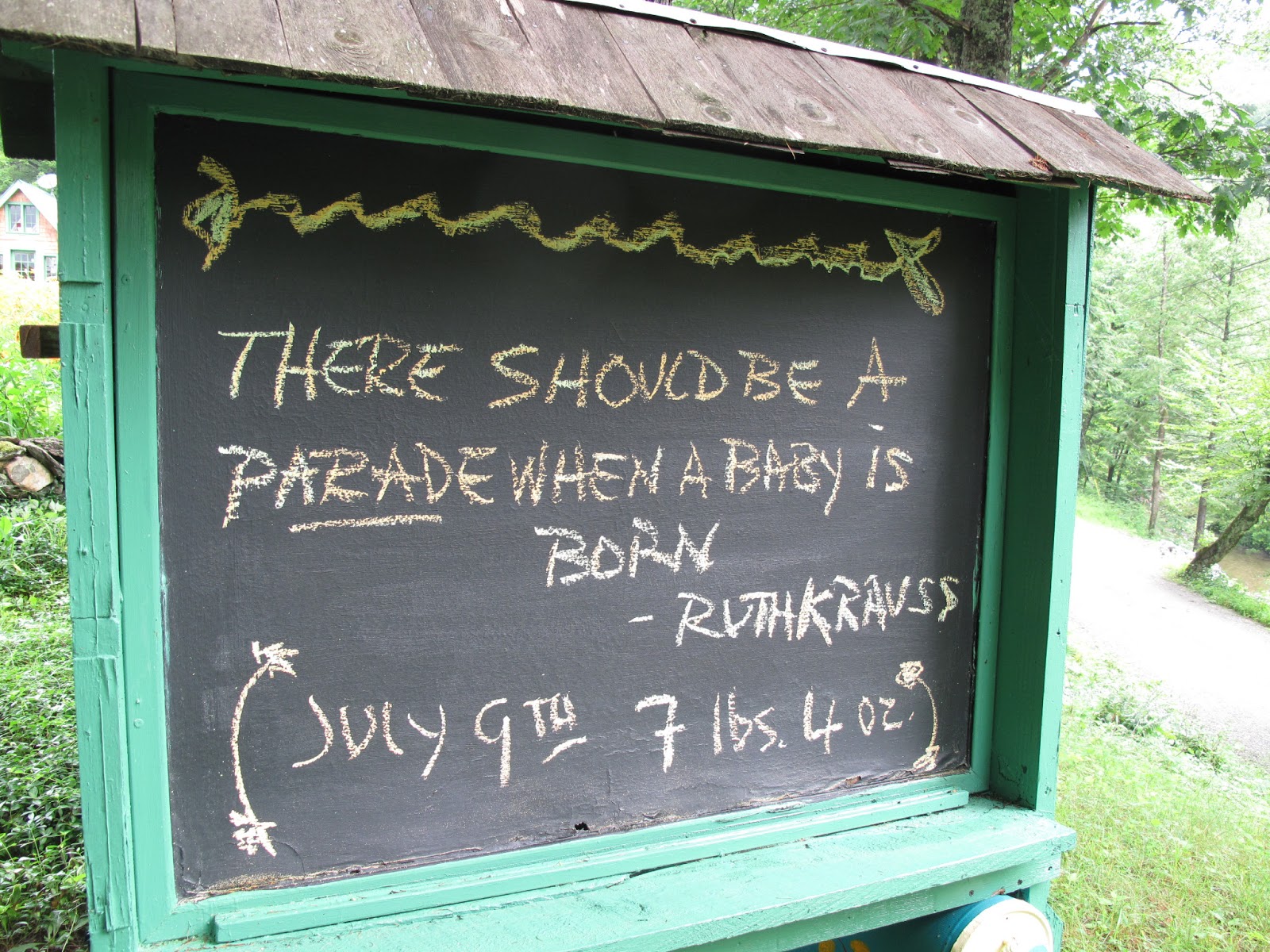
Ruth Krauss Back Road Chalkie


At around 7AM came the short but sweet email from our son Carson —


______________________________


"Hi Mom and Dad,

Layla Rosemary Arnold, born July 9th at 11pm, 7 pounds, 4 ounces. She's really beautiful and has a full head of dark hair. Jocelyn was a warrior and pushed for over 6 hours. No drugs or hospital involved. Pretty astonishing. We're exhausted and incredibly excited she's with us finally.
You're officially Grandparents.
Thinking of you and hope to see you.

much love,
Carson"


_____________________________


So I said to Sweetheart, "Let's find some stuff and be one of the first to hold this little baby." She was game, naturally. Eyes bright. Around the house I found a painted egg I was always fond of, plus a beaded bracelet, and Sweetheart took down one of Carson's favored stuffed animals (giraffe) and passing a delicious pie shop on the way to their house (less than an hour away), we chose the blueberry pie with heavenly crust, which went into a white box and the only touch missing was a string wrapped around the box. They still could have, but they didn't; it's one more of those little missing qualities of life. We arrived at weary Carson's house at 10AM and hugged him outside the front door on the tiny porch.


Upstairs Jocelyn after those six hours hard labor was tuckered out and Layla Rosemary Arnold had the vibrant red coloring of a newborn exactly 11 hours old. We were the first on the scene. After she passed the disturbance of oxygen, air bubbles? her natural color returned, with her lovely lips and quite large feet and resting snugged against Jocelyn's heart with a half-filled mason jar of water at her bedside, we all visited. Carson likewise tuckered out in a red Sun Ra T-shirt, shorts, two days beard, barefoot, tiny room, floor fan blowing, upstairs old New England shotgun house by a river and a roadway going way too fast, council was made.


Downstairs, letting Jocelyn and Layla rest deeper, we broke into the pie with Carson and joked like the three former band members we once were together, not quite parents, and not quite our child, but buddies from all the years we train-traveled, cross-country-rode, bussed, hardwork at home in the woods, footloose family. . . and laughed over all the recent rocky times. I love, adore, protect, swoon, abide and pleasure sink into anyone I can have a relationship with like this. Carson was all smiles and that old trust he once had with us was in full evidence of ribbing and quickly galvanizing over deep waters that anyone knows must never be taken all that seriously. It's love that must be taken seriously. So we loved the pie, and we loved our son; saving over half the pie for the next visitors.


We stayed about three hours. Could hear the baby cry.


Then we headed to three towns and did a bunch of ruined-for-the-day-in-a-bliss errands new grandparents do — like groceries, bookshop sale hunting, saw a very elder Vermont friend in a parking lot and tugged on her sweater sleeve (humidity at 89%!) and shared with her the news, and she beamed like a sea lion! we then went off and ate some good junk food (salad, fries and a large Coke, all shared between us), climbed to the summit of Sugarloaf and no one was up there post thunderstorm humid and jungle licked and explosively green, with that forever breeze on its stone faced eastern side, where the peregrines and buzzards sail, then somewhere on the road home shared a caramel sundae. What in the world!? All in celebration of a granddaughter. Now we have to climb the mountain again! And one day with that little girl.


It suddenly dawned on us, hours & hours later, talking aloud, rain on the windshield — why in the world did this fine birthing center in New Hampshire where Layla was born at 11PM, allow this young couple to drive an hour long home the murky dark countryside at 2AM, exhausted and exhilarated at once. . .couldn't they have bedded them down there until daylight, then proceeded home? It's a question new grandparents fuss over.


And furthermore, just think — a year ago this summer we had a witch-hunt taking up against us on our road by a select some — and this year a new baby is born into the life. People, hang onto your hats! Life can flip and change and wiggle through your fingers. Let it.


Rode home along the river. No one on it except a lonesome traveler with Texas plates and a passenger with thin arm tattoos and a haunting southwest long glare stare. Driving and curious that I was looking into western-eyed, I stared back. My sort of kinda hombre. That doesn't always work.


Now home in the thick of rain forest and mud mist river evening shaking down.


[ BA ]


Back Road Chalkie "Ruth Krauss"
some photos © Bob Arnold


Thursday, July 11, 2013

New from Longhouse Summer 2013 ~ Austin Smith & Michael Theune


Austin Smith & Michael Theune
Midwestern Death Poems


"Over the past decade, we have collected a vast
array of haiku, a portion of which is presented here. 
Gathered from sources as antique shops,
estate sales, and used bookstores,
we believe we have discovered the existence 
of a tradition not unlike the Japanese tradition of the
jisei, or as defined in Yoel Hoffman's
Japanese Death Poems, the "farewell poem to life."


$10 postpaid, US addresses
Please inquire as to international orders
poetry@sover.net


Available from
 Longhouse
 PO Box 2454
West Brattleboro, Vermont
 05303 

 credit card or check ~

Buy now through Paypal with this link for domestic addresses.


Wednesday, July 10, 2013

Tuesday, July 9, 2013

THE LOVE OF SIMON VINKENOOG ~


AS TOLD BY HEATHCOTE WILLIAMS
NARRATION & MONTAGE BY ALAN COX
 (AND A CAST OF THOUSANDS)


Simon Vinkenoog at Longhouse

Heathcote Williams at Longhouse


Peter Whitehead's film
Wholly Communion (1965)
Royal Albert Hall, London ~


New from Longhouse Summer 2013 ~ Jeff Todd Titon


Jeff Todd Titon
Davey


"Davey had heard this nonsense about the old trees thirty
years ago when he bought the orchard. It was planted
out for production, mostly in Macintosh and Red and
Golden Delicious, but it came with a small section
that had been planted to ancient varities. The former
owner had a hobby; he tracked down old trees all over
New England, and he took cuttings that he grafted
to rootstock and planted them in what he called his
experimental orchard."


$10 postpaid, US addresses
Please inquire as to international orders
poetry@sover.net


Available from
 Longhouse
 PO Box 2454
West Brattleboro, Vermont
 05303 

 credit card or check ~

Buy now through Paypal with this link for domestic addresses.


Saturday, July 6, 2013

HAJJ PAINTINGS ~


"Since the seventh century, the Hajj, or Great Pilgrimage to Mecca,
has been a lifelong goal of devout Muslims throughout the world.
Entire households may save for years to send a respected family member to Mecca.
Egyptian journey by commissioning a local artist to depict their religious
odyssey on the walls of their homes. Hajj paintings is the first visual record
of the richness and variety of this naive art form, considered Egypt's most 
significant contribution to the contemporary international folk art scene."


"Photographer Ann Parker and writer Avon Neal spend a decade
exploring towns, villages, and isolated farm communities along
the Nile, across the Delta, down the Red Sea coast, and into the
Sinai. On the walls of buildings ranging from alabaster factories
to mud brick farmhouses they found brilliant murals illuminated
and scenes from the Koran. Their nearly one hundred and fifty
color photographs and accompanying descriptions record the
radiant palette of mostly self-taught artists."


"On exterior walls, images of transportation — ranging from
camels to airplanes — provide a spirited contrast with calligraphic
inscriptions and pastoral renderings of Islamic workshop.
Occasionally, images of pure fantasy, business and commercial references,
scenes from everyday life, and traditional representations
from Pharaonic times, as well as a variety of plants and animals, adorn
the houses. Parker and Neal also reveal the cool, shaded interior
walls of pilgrims' homes where murals unmarred by the elements  often
depict more personal themes. They examine the meanings of recurring motifs,
 compare regional styles, and identify contemporary masters of Hajj paintings."


 Hajj Paintings

Folk Art of the Great Pilgrimage
by Ann Parker and Avon Neal
Smithsonian 1995


Friday, July 5, 2013

HURDY-GURDY MAN ~


Just sent from Scotland
 (and thank you, Malcolm)
 and quite a treat — 
Donovan!
 busking on the street in Glasgow
 with a young and artful street singer


one
more
humble
moment
in
time


PORTISHEAD AT GLASTONBURY 2013 ~

(BETH GIBBONS)


It's almost impossible, at least for me, not to love a band that has only recorded three albums in 19 years in this day and age of hard sell, and true to form each album is a tour de force. Never mind when Portishead played Glastonbury last week — a band that can go on hiatus and do solo work elsewhere for 5 years (for Gibbons = Rustin Man etc) — it was the band's lead singer Beth Gibbons who stole all the shows, when on their closing number she ran off the stage to spend some time hugging and touching the crowd all along the barricaded front row. Nice touch — reach over the barricade. No one losing a beat from that electrified and screen pulsing stage. And was it me, or did you also feel the surging crowd, in pitch outdoor darkness, come all that much closer to the band? Before leaving the stage Gibbons said, with sincerity, to the soothing sea of trip-hop devotees, "Thank you so much ... I hope it was all right."


Thursday, July 4, 2013

CHOOSING TO LOVE THE WORLD ~


Thomas Merton
photo : Edward Rice


One thing I know — that it is my destiny to be a contemplative, a Christian, and an American. I can satisfy my vocation with nothing that is partial or provincial. I cannot be a "North American" who knows only the rivers, the plains, the mountains, and the cities of the north, the north where there are a few Indians, where the land was colonized and cultivated by the Puritans . . . .This north is grand, powerful, rich, intelligent; it has a warmth all its own, a surprising humility, a charity, an inner purity that the stranger does not know. But it is incomplete. It is neither the better or the richer part of the hemisphere . . . . It lacks the roots of the old America, the America of Mexico and the Andes, where silent and contemplative Asians came millenniums ago to construct their hieratic (highly stylized and priestly) cities. It lacks the intense fervor and fecundity of Brazil, which is also African, which smiles with the grin of the Congo and laughs with the childlike innocence of Portugal. The northern half of this New World lacks the force, the refinement, the prodigality of Argentina with all the lyricism of its tormented and generous heart.


photo : Jonathan Williams


He who attempts to act and do things for others or for the world eithout deepening his own self-understanding, freedom, integrity and capacity to love, will not have anything to give others. He will communicate to them nothing but the contagion of his own obsessions, his aggressiveness, his ego-centered ambitions, his delusions about ends and means, his doctrinaire prejudices and ideas. There is nothing more tragic in the modern world than the misuse of power and action to which we are driven by our Faustian misunderstandings and misapprehensions. We have more power at our disposal today than we have ever had, and yet we are more alienated and estranged from the inner ground of meaning and of love than we have ever been. The result of this is evident. We are living through the greatest crisis in the history of man; and this crisis is centered precisely in the country that has made a fetish out of action and has lost ( or perhaps never had ) the sense of contemplation. Far from being irrelevant, prayer, meditation and contemplation are of utmost importance in America today.


Thomas Merton's hermitage in Kentucky
photo : Thomas Merton


We have an instinctive need for harmony and peace, for tranquility, order and meaning. None of these seem to be the most salient characteristics of modern society . . . . We must face the fact that the mere thought of contemplation is one which deeply troubles the person who takes it seriously. It is so contrary to the modern way of life, so apparently alien, so seemingly impossible, that the modern man who even considers it finds, at first, that his whole being rebels against it. If the ideal of inner peace remains attractive, the demands of the way to peace seem to be so exacting and extreme that they can no longer be met. We would like to be quiet, but our restlessness will not allow it. Hence we believe that for us there can be no peace except in a life filled with movement and activity, with speech, news, communication, recreation, distraction. We seek the meaning of our life in activity for its own sake, activity without objective, efficacy without fruit, scientism, the cult of unlimited power, the service of the machine as an end in itself.


Thomas Merton passed away at the age of 53 in Bangkok Thailand in 1968. Trappist monk, mystic and author of more than 70 books, he was born in France on the last day of January 1915. He lived the greatest part of his life at the Abbey of Gethsemani in Kentucky. He was ordained to the priesthood in 1949 and given the name Father Louis.


Merton passages from
Choosing to Love the World
by Thomas Merton
(Sounds True, 2008)


Wednesday, July 3, 2013

TO LIVE OUTSIDE THE LAW. . .

YOU MUST BE HONEST ~
(HAVE A WIFE AND KID)


"U.S. Postal Service Logging All Mail for Law Enforcement"

FRANK STANFORD ~


Frank Stanford on the left in shades with Allen Ginsberg, Peter Orlovsky and friends


 Stanford was a native son, in this land of Independence.


Circle of Light


When you take the lost road
You come to the snow
And when you find the snow
You get down on your hands and knees
Like a sick dog
That’s been eating the grasses of graveyards
For twenty centuries.

When you take the lost road
You find woman
Who has no fear of light
Who can kill two cocks at once
Light which has no fear of cocks
And cocks who can’t call in the snow.

You find lovers who’ve been listening
For the same roosters to sing
For twenty centuries
Roosters that have swallowed stones
Out of each other’s tracks
But have never met
Anywhere on the road.

When you take the lost road
You find the bright feathers of morning
Laid out in proportion to snow and light
And when the snow gets lost on the road
Then the hot wind might blow from the south   
And there is sadness in bed for twenty centuries
And everyone is chewing the grass on the graves again.

When you get lost
You come to the moon in the field
The light all lovers soil
The sheet no one leaves clean
The light cocks are afraid to cross
The same moon woman danced under
For twenty centuries
With blood on her face.

When you get lost on the road
You run into the dead
Who have broken down stones
In their throats for twenty centuries
I saw two little crazy boys crying
Because it was morning
And when morning comes it comes
In the morning and never at night.

I saw two security police taking out a man’s balls
And I saw two little crazy boys
Crying by the road who wouldn’t go away
But two has never been a number
Because it’s only legal to pass one at a time
It’s only a drum you can carry but you can’t beat
It’s the evidence they need to make you disappear.


In Another Room I Am Drinking Eggs from a Boot


Hans Richter


What if the moon was essence of quinine
And high heels were a time of day
When certain birds bled
The chauffeur is telling the cook
The antler would pry into ice floes
Swim with a lamp
And we’d be shivering in a ditch
Biting through a black wing
There would be boats
There would be a dream country
The great quiet humming of the soul at night
The only sound is a shovel
Clearing a place for a mailbox


Friend of the Enemy


The yolk went down my leg
Like a beautiful snail without a shell,
Went down the hill
To the skillet of water, to the nymphflies,
Into the lips of pond minnows,
Down the long belly of the gar – the hellbenders
Having dived and lost, then into
The paw of the lame panther
Who loped back to her lair with it.
As for the white, it stayed with me,
Mark of the beast, birth, and trade.


Living


I had my quiet time early in the morning
Eating Almond Joys with Mother.
We’d sit on the back porch and talk to God.
We really had a good time.

Later on,
I’d sort baseball cards
Or look for bottles.
In the afternoon I’d shoot blackbirds.

Jimmy would go by the house for ice water
And make the truck backfire.
Oh, I really liked that.
That was the reason he did it.

In the evening the cottontails ran across the groves.
I shot one and put him in the backseat.
He went to the bathroom.
Jimmy said I knocked the shit out of him.

At night we would listen to the ballgame.
Then to the Hoss Man.
Jimmy liked “Take Out Some Insurance On Me Baby”   
    by Jimmy Reed.


The Arkansas Prison System


Is like a lyric poem
with seven basic themes
first the cottonpicker
dragging behind it a wagon of testicles
a pair of pliers which can fill in
for a cross in a pinch
then there is the warm pond
between the maiden’s thighs
next we have some friends
of yours and mine
who shall be with us always
Pablo the artist
the pubis of the moon
Pablo the cellist
panther of silence
Pablo the poet
the point of no return
and in case of emergency
the seventh and final theme
of this systematic poem
is the systematic way
death undresses in front of you


Weariness of Men


My grandmother said when she was young
The grass was so wild and high
You couldn’t see a man on horseback.

In the fields she made out
Three barns,
Dark and blown down from the weather
Like her husbands.

She remembers them in the dark,
Cursing the beasts,
And how they would leave the bed
In the morning,
The dead grass of their eyes
Stacked against her.


The Light the Dead See


There are many people who come back
After the doctor has smoothed the sheet
Around their body
And left the room to make his call.

They die but they live.

They are called the dead who lived through their deaths,
And among my people
They are considered wise and honest.

They float out of their bodies
And light on the ceiling like a moth,
Watching the efforts of everyone around them.

The voices and the images of the living
Fade away.

A roar sucks them under
The wheels of a darkness without pain.
Off in the distance
There is someone
Like a signalman swinging a lantern.

The light grows, a white flower.
It becomes very intense, like music.

They see the faces of those they loved,
The truly dead who speak kindly.

They see their father sitting in a field.
The harvest is over and his cane chair is mended.
There is a towel around his neck,
The odor of bay rum.
Then they see their mother
Standing behind him with a pair of shears.
The wind is blowing.
She is cutting his hair.

The dead have told these stories
To the living.


Crest


I   Or Your Woman

The night was a bad one.
I only saw one other person out:
A big black man on muleback
Riding along the levee, marking the water.

There was a lantern in his hand
And what you could call a grim smile on the lips.
I shifted down gears,
Rolled down the window, turned the radio low.

And said, “Say there, man, how goes it?”
But he couldn’t hear me for the rain
And the song on his transistor radio.
“I don’t know,” he said, “but it’s raining,

Raining to beat hell.”
Said I, “Do you think it’s going to quit?”
“Friend, I couldn’t tell you.”
When big water will, you call everyman friend . . .

We said our goodnights,
Went on, by mule and flatbed truck, wearing black
Rubber, cold to the bone,
Like divers from different ships meeting below.

All you can do is nod, some of the times.
At least, we spoke, knowing that living
Anywhere near the river
You speak when you can; the only thing you try

To hold is your liquor,
And we had none, that bad night on the levee.
Always down the road, I looked up
In the mirror.  And I’m sure he’d a done the same.


II   Midnight

I almost slid off, once
Imagining this cloud was a pall
And the moon was a body.
I don’t know who put coins over her eyes.

When I got to Rampion’s Ferry,
I thought I was the only one there.
I mean it was quiet,
Except for the current, the cables, and the rain.

I got a piece of rope
Out of the back of my truck, and wound it
Around the generator
Engine; it kicked right off the first pull.

The yellow bug lights came on,
And I saw a body move under a purple blanket.
He cussed me out
For waking him up, pulling his old self up.

There was some kind of fish
In the weave of his poncho; other figures
Of snakes and birds, too.
I didn’t mean to wake the awnry fellow up,

I wonder if I did.
A strange odor came from underneath him
When he dragged out his towsack.
It didn’t smell of something burning, but of

Something that was singed.
Like the rain, it didn’t let up.
“Are we going crosst it, or not,”
He told me in a voice, half-blooded song.


III   Some Past Twelve

Someone with a light
Rode up before I could see what all
He was pulling from the burlap:   
Blue calling chalk you find in pool halls, ivory

Tusks, a stringer with rotten heads
The good book and another I couldn’t pronounce—
Just as worn,
And one of those paperweight crystals that snows.

He had strummed the mandolin twice,
A couple of sounds blue as a fox in trouble
In a snowdrift on a ridge, like weeds
Burning underwater, a few licks of silent fire.

When I recognized the lookout
The ferry wasn’t more than a few feet off the bank,
So the mule made it aboard, easy;
Its hooves on the planks like a mad, rough carpenter

Nailing driftwood together.
Oh, we made it across.  We didn’t exactly
Hit the dock on the head,
But we floated on down to Vahalia’s Landing.

We had a good time.
The foreigner played the mandolin, the river
Reached its crest,
And the man on the mule and I drank way into the morning.

They heard us, the ones on land.
“We’re a floating whorehouse, without noun women.”
And in the dead of night,
Rain and all, we motioned them on.


Riverlight


My father and I lie down together.
He is dead.

We look up at the stars, the steady sound
Of the wind turning the night like a ceiling fan.
This is our home.

I remember the work in him
Like bitterness in persimmons before a frost.
And I imagine the way he had fear,
The ground turning dark in a rain.

Now he gets up.

And I dream he looks down in my eyes
And watches me die.


The Intruder


after Jean Follain

In the evenings they listen to the same
tunes nobody could call happy
somebody turns up at the edge of town
the roses bloom
and an old dinner bell rings once more
under the thunder clouds
In front of the porch posts of the store
a man seated on a soda water case
turns around and spits and says
to everybody
in his new set of clothes
holding up his hands
as long as I live nobody
touches my dogs my friends


 [ and for the long distance runner] ~


[“The Last Supper”] from The Battlefield Where the Moon Says I Love You


I am afraid after reading all these so-called initiation books that some
cortege of boot lickers will enter my room while I am sleeping and suck
my eyes out with soda straws they will be older men and women much like
the amanuenses with bad breath in the principal’s office who call
up and tell on you the Unferths of the world better beware
I know Jesus would have kicked your teeth in you couldn’t pull that shit on him
he was telling his buddies one night boys I’m glad y’all decided to come on up
and eat supper with me I hadn’t got much there’s a few things I’d like to say
at this time Matthew says to Simon I sure as hell don’t know what he’s got us
here this time for I’m beginning to wonder you talked to him lately
yea I was shooting the shit with him on the mountain but I want to tell you
this Matthew don’t never come up on him when he’s alone he jumped on me
I thought he was going to kill me he was just walking around just talking
to himself waving his arms like he does he’s worse than John   
Jude put his hand up to his mouth and said down the table I think Jesus is going
off his rocker get Simon to tell you what he asked me
Simon says he didn’t want to talk about politics or dreams or nothing he just said
Jude next time y’all are over in Mesopotamia why don’t you pick me up a few   
bottles of that wine they make over there
sure thing Jesus I says
well now the boss is talking he is saying I asked y’all up here because frankly
I’ve been feeling a little sick lately and I want to make sure y’all know what
to do in case anything happens I know one of you is going to do me in I know
that but goddamnit y’all know those people in town are after my ass
the other night I walked down the streets in a disguise and I seen a couple
of you messing around and drinking with the soldiers what’s going to happen
if one of you gets drunk and lets it slip where I’m hiding out then I’ll
be in a fix you know if they was to find me they going to cut me y’all ever
think about that and Peter ain’t you ever going to get it straight what you’re
supposed to do give me one of those biscuits Judas and go outside and take a   
look-see I got you Jesus Judas says
John leans over he says been catching any fish Peter
oh well I been getting a few of a morning they ain’t biting too good now you know
on account of this blamed weather nobody is even listening to Jesus he’s just
talking to himself like he was crazy Matthew says I believe he’s been hitting
that wine a little too hard don’t you reckon
Jesus says another thing I told all of you it’d be better if you didn’t get
involved with women
now just listen to that little two-faced bastard James the Lesser says
we all know what he’s up to shacking up with all those town girls
the other night he was dressed fit to kill and drunk as six hundred dollars
a rolling around in the mud like a hog kissing that whore’s foot why shit
I wish he’d let us in on what he really does
Thomas spoke up for once he says I know what you mean the other day Andrew
and I asked him about some scripture he said leave me alone I don’t know
nothing about that shit and then we seen him cussing out a priest over at the   
temple he knew more about it than the elder did
another thing Matthew says I wish he’d start writing what he wants done down
and do it so I can read it you know as well as I do that damned Peter can’t
keep it straight he won’t get anything right
Bartholomew says don’t make no difference atoll cause Paul is going to tell
it like he wants to that’s for damned sure
all the time Jesus just mumbling to himself wine spilt all over his robe
the rest of them chattering and cussing trying to figure him out
John the Baptist about the only one Jesus can count on except for crazy John   
is banging his goblet on the table he is saying now ain’t this a sight
spitting in the lord’s face at his own birthday party I’ll swan
Brother John why don’t you tell Jesus what the real problem is
the crazy one says everyone of y’all is chickenshits you are afraid to look
those elders in the eye and tell them what you think ya’ll get up on a rock
to talk and you see a soldier coming and you say anybody seen a stray mule
Jesus is saying to himself I’m going to pull those temples down if I have to
get me a rope and tie it to a pillar and a jackass and do it myself
wake up Jesus Philip says
Paul who hadn’t touched a drop gets up and gets his paper out and says
the nature of the problem Jesus is this the people don’t believe you
those fellows in the temples have got it all organized all they have to do
is send out stooges and hire a couple of rednecks who make out like they’re
crippled they have a big gathering they say the same things you say they   
pull off a fake healing the redneck’s wife stands up she says LIE he ain’t lame
he’s just drunk and so all the people go home saying those christians what a   
bunch of wind see Jesus they are using your material but they ain’t coming
through so that is making you an enemy of the people we just got to get
organized as is proved here today by your followers carrying on as they did
so I’m getting sold down the river by the elders and their hirelings uh
that’s right Jesus ask anybody here why I didn’t think they’d do that he says
I told you a long time ago not to keep talking with them temple people John says
you should a know’d what they was up to ain’t nobody going to understand you
why you ought to know that when we first run on to you we had second thoughts
we thought you was crazy there’s probably still some sitting down here right   
this second that still thinks you are a crazy one but Jesus you should a known
we been through a lot together we go a long way back you should a listened
all they wanted was you they liable to get you yet then they won’t have no
competition they want to keep feeding the hogs the same slop
they the ones that want to get fat man you listening to me Jesus
he says ok if that’s the way they want to do things at the temple
I’m going to change my tactics I going out after these chillun more than I have
been they’ll know I’m telling the truth I still got a few things up my sleeve
left what’s that Paul says
I’m going to do a few things can’t nobody follow
we could always go back to biting the heads off fish and chickens Peter says
why don’t you let us in on it for a change Paul says we follow you around
like we were a bunch of sheep picking up your tab bailing you out of jail
coming up here all the time for supper and what do we get to eat nothing
why can’t you have a little faith in us Jesus
ok this is what we going to do he says hold on who is that walking up the steps
it’s just Judas
how does it go boy Jesus says and the other one answers just fine Jesus just fine
and John the Baptist turns around he says to the one who has just slipped in boy
didn’t I see you talking to some white folks the other day
here endeth with a chord on the guitar that’s how the men did Jesus like he was
old like he was young just like Elvis did to Big Dad Arthur I know
just like another blind singer the men come down to see with their equipment
they get his song they pay him twenty dollars and he don’t hear from them ever
again except sometimes in the mail on Christmas when one of them might send a   
five dollar check there won’t nobody cash oh tell me brother how do the old men
feel who were young as purple flowers from Hawaii once when they listen to their
songs coming in over a borrowed radio tell me don’t they take up a notch in they belt
don't they tie another knot in they headband don't they wring that sweat out
have mercy Jesus deliver me from the lawyers and the teachers and the preachers
and the politicking flies can’t you hear them buzz can’t you hear them bite another
chunk out of me oh brother I am death and you are sleep I am white and you are
black brother tell me I am that which I am I am sleep and you are death we are
one person getting up and going outside naked as a blue jay rolling our bellies
at the moon oh brother tell me you love me and I’ll tell you too I want to know
how do they like it when the ones who sung shake they leg on the Television
I want to know Jesus don’t a blind man count no more some by signs others by
whispers some with a kiss and some with a gun and some with a six bit fountain
pen whoa lord help me and my brother help us get through this tookover land


 Estate of Frank Stanford © C.D. Wright


Frank Stanford was born in 1948 and died just shy of his 30th birthday in1978 at his home in Fayetteville, Arkansas, the victim of three self-inflicted pistol wounds to the heart. A prolific poet known for his originality and ingenuity — dubbed “a swamprat Rimbaud” by Lorenzo Thomas and “one of the great voices of death” by Franz Wright. He was raised in Mississippi, Tennessee, and then Arkansas, where he lived for most of his life and wrote many of his most elegant, eerie, spooky, powerful poems. He attended the University of Arkansas from 1967-9 and studied engineering while continuing to write poetry. He authored over ten books of poetry, including eight volumes in the last seven years of his life: The Singing Knives (1972), Ladies from Hell (1974), Field Talk (1974), Shade (1975), Arkansas Bench Stone (1975), Constant Stranger (1976), The Battlefield Where the Moon Says I Love You (1977), and Crib Death (1978). Some of the poems above are also from an unpublished manuscript.